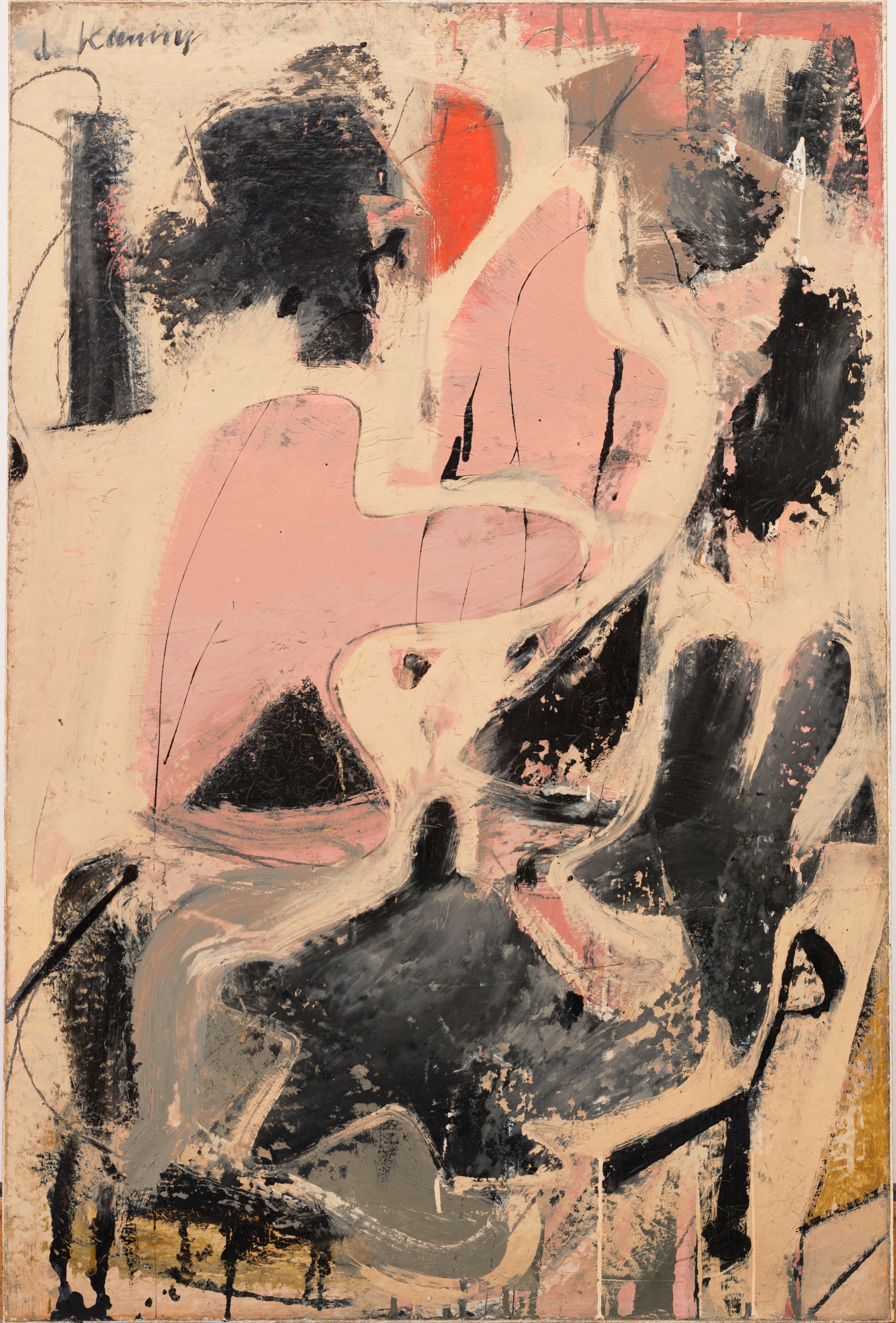
Willem de Kooning, Valentine, 1947. Oil and enamel on paper on board, 36 ¼ × 24 ⅛ inches. © 2026 The Willem de Kooning Foundation / Artists Rights Society (ARS), New York. Courtesy the Museum of Modern Art.
Word count: 811
Paragraphs: 9
The Princeton University Art Museum
March 15–July 26, 2026
Before seeing a single painting in this terrific eighteen-painting show, the museum visitor encounters Harry Bowden’s 1946 photograph of Willem de Kooning (b. 1904; d. 1997) standing in his studio. The photo is in fact an icon. De Kooning has his right hand in his pocket, as if this were a traditional portrait or a version of the figure on the left in his 1938 Two Standing Men, painted in his figurative style. There is some irony in the photograph since de Kooning in no way resembles a squire on his estate or a gentleman in his drawing room. In his left hand, the inevitable cigarette—inevitable not only because of tobacco addiction but because the studio or loft had no heat. He is next to an easel with a canvas mounted on it at about chest height: he can thrust his brushes into the heart of the canvas with ease. The easel is made to accommodate canvases of various sizes, prefiguring the easel de Kooning could raise, lower, or turn upside down in his East Hampton studio. His clothing is paint smeared but clearly thick to keep out Manhattan frigidity. Behind him on the left, a can marked Sapolin, the brand name of the commercial paint de Kooning used. On the easel, an unfinished canvas with some figures reminiscent of those included in the show, but on the floor sheets of paper marked with grotesque faces, the precursors of de Kooning’s famous “Women” paintings, faces that do not appear in any of the works included here.
The photograph is arranged, posed, nothing left to chance. It constitutes an ideal introduction to the work inside the viewing space, all of it carefully composed. De Kooning may have left Rotterdam in 1926, but the lessons of Dutch seventeenth-century painting stayed with him: Jan Steen’s interiors look like pandemonium until we realize that composition dominates frenzy. The same applies to de Kooning. And here is a difference between de Kooning’s sense of order and Joan Miró’s 1928 deconstruction of three Dutch interiors: Miró wants to destroy and create, acknowledge and demolish, while de Kooning wants to use a tradition to impose structure on the images supplied by his imagination.
Three works—an interior, a street scene, and a landscape—enable us to see how de Kooning fuses tradition and innovation.

Willem de Kooning, Untitled (Reclining Figure), ca. 1945. Oil and charcoal on Masonite, 15 × 19 ⅞ inches. © 2026 The Willem de Kooning Foundation / Artists Rights Society (ARS), New York. Courtesy Gene and Sueyun Locks.
Untitled (Reclining Figure) (ca. 1945) perfectly enacts de Kooning’s modus operandi. A 15-by-20-inch oil and charcoal on Masonite (compressed wood fibers used to make kitchen cabinets), the work is a line drawing, a Gestalt exercise, with the merely suggested humanish figure in the foreground, a wall and window to the right, another behind the figure, and a monstrous shape hovering over the figure. The figure’s gender is ambiguous, but the suggested flats look like dancing shoes. The entire piece is about the containment of energy; the outlined walls are restraints that keep the structure from flying into pieces.
Gansevoort Street (ca. 1949) is a cityscape, taking its name from a cobblestone street in Manhattan’s Meatpacking District, a zone inhabited by artists during the forties. De Kooning’s depiction is predominantly pale red, recalling the dried, faded blood of slaughtered animals. Where Reclining Figure is static despite its flowing lines, Gansevoort Street is dynamic, a compendium of images recalled from walks along the eponymous block. A combination of Cubism and Futurism in the sense that the various building shapes seem on the one hand to whizz by while on the other they are fixed on the cardboard surface. A kaleidoscopic vision of the city in all its simultaneity, the work is amazingly complex because of the interaction of so many layers of paint.

Willem de Kooning, Gansevoort Street, ca. 1949. Oil on cardboard, 30 × 40 inches. © 2026 The Willem de Kooning Foundation / Artists Rights Society (ARS), New York. Courtesy Anderson Collection at Stanford University.
Landscape, Abstract (ca. 1949) is de Kooning’s reinterpretation of landscape painting, not in the Dutch tradition of a Jacob van Ruisdael, but more in the Romantic tradition of a Caspar David Friedrich. This enamel-on-paper has the mountain of the sublime at its center, while on either side the blots of black paint capture the ecstatic mood sought by Romantic painters and poets when contemplating nature in all its glory. But even here composition is the dominating factor. The mountain is framed by the repoussoirs of traditional landscape painting, so once again de Kooning acknowledges tradition even as he moves it in a new direction.
The Breakthrough Years is a splendid example of a trend that must be applauded: the show, limited in scope, captures a moment in a long career. Not the grand-scale retrospective where individual pieces are apt to get lost in the crowd. Just enough for the viewer to be able to comprehend what a master like de Kooning was doing at a specific time. This important show invites slow contemplation in an ideal setting—a room of its own.
Alfred Mac Adam is Professor of Latin American literature at Barnard College-Columbia University. He is a translator, most recently of Juan Villoro’s Horizontal Vertigo (2021), about Mexico City.