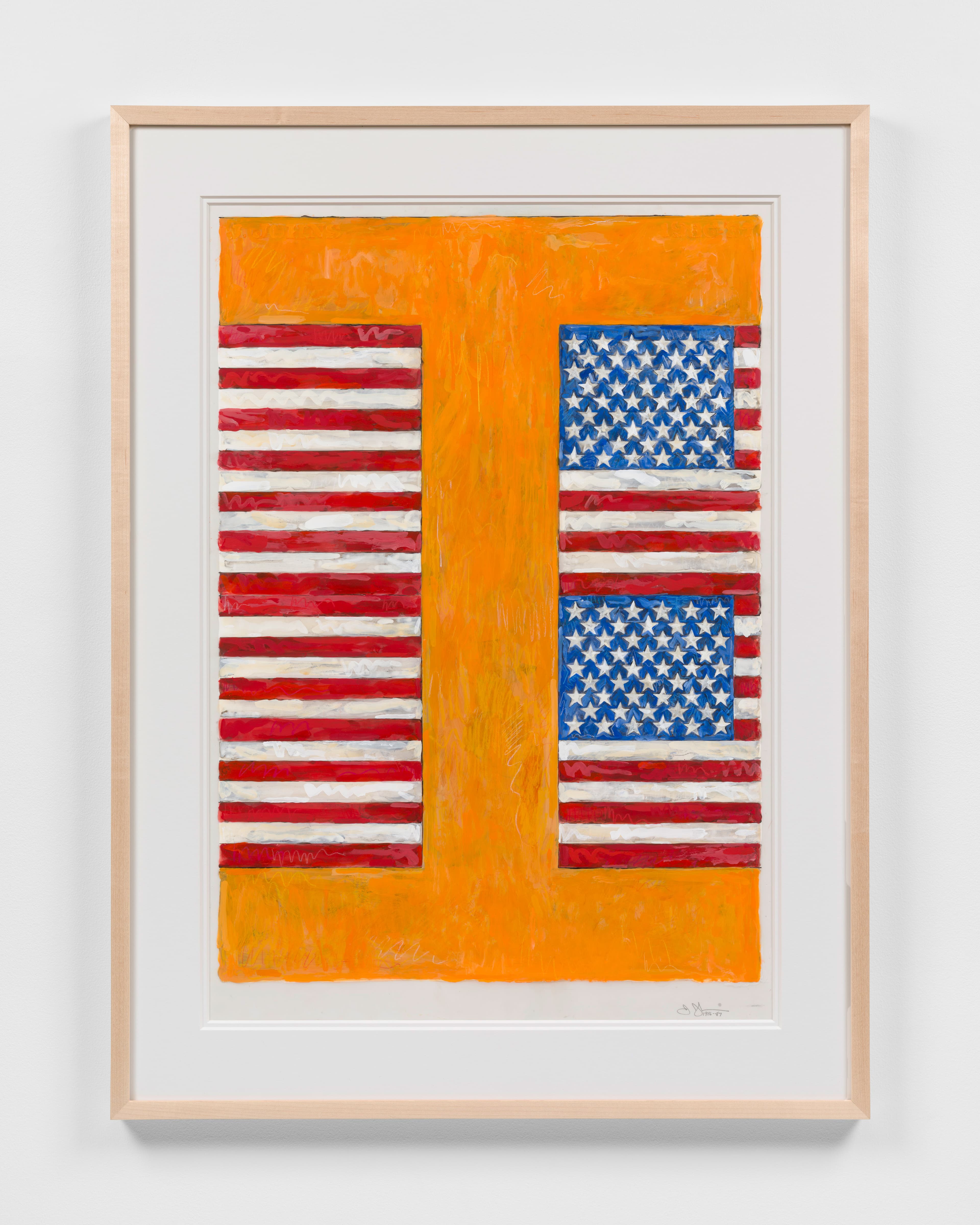
Jasper Johns, Two Flags on Orange, 1986–87. Acrylic, ink, and crayon on plastic, 34 ⅛ × 24 inches. Courtesy Craig Starr Gallery.
Word count: 1295
Paragraphs: 9
Craig Starr Gallery
April 2–June 27, 2026
New York
Few symbols are more fraught than the American flag. Emblematic of both unity and divisiveness, it has been hoisted to signal pride in this country’s foundational principles of freedom and democratic representation but has also become a metonym for jingoistic nationalism. In 1953, when Jasper Johns returned to the United States from army duty in Japan during the Korean War, the Red Scare and the McCarthy-era witch hunts were at full throttle. A year later Johns took up the motif of the American flag, not for its political amplitude but rather for its use value in his growing repertoire of what he called “givens,” things in the world, decontextualized yet notable for their immediate visual resonance. He would go on to subject the flag’s elements—its horizontal stripes and canton populated with stars—to a vast number of material manipulations. His expansive, multifaceted rehearsing of this single motif is stunningly in evidence in Craig Starr’s thoughtfully staged presentation. Spanning five decades, 1955–2000, the exhibition, organized in collaboration with Johns and his studio, comprises loans from both major institutions and private collections, including the artist’s own. Starr has organized the show in memory of the collector and patron Agnes Gund (b. 1938; d. 2025), whose close relationship to both the gallery and Johns informed her curation of Jasper Johns: Crosshatch at Craig Starr in 2019.
To move through this low-lit environment is to experience the richness of Johns’s varied treatments of a single motif, each iteration a unique physical repository of his shifting artistic modalities. His canonical origin story of the motif is simply, “One night I dreamed that I painted a large American flag, and the next morning I got up and went out and bought the materials to begin it.” He would later remark of the American flag, “I knew it was a flag, and had used the word flag; yet I had never consciously seen it.” Paradoxically, he would achieve this conscious seeing by means of tactile processes. His first Flag (1954–55) is not so much a painting of a flag as a construction of one, an object whose “subject” is coextensive with its surface, background and foreground collapsing into a single plane. Constituted as an aggregation of parts—plywood panel, graphite drawing on bedsheet, oil paint, and collage of torn fabric and newspaper dipped in molten encaustic—it was a strategic foil to Abstract Expressionism, whose pigments, as Leo Steinberg wrote, remained “the medium by which something seen, thought, or felt, something other than pigment itself, is made visible” even while the paintings are nonrepresentational. Despite Flag’s voluptuous, relief-like surface, authorial affect is withheld.

Installation view: Jasper Johns: Flags, Craig Starr Gallery, New York, 2026. Courtesy Craig Starr Gallery.
The gallery’s hang, organized neither chronologically nor solely by medium but near anecdotally, offers telling examples of that originating flag’s vast and various lineage. Johns’s spatial and material manipulations of color, texture, doubling, stacking, splitting, and spacing within the frame encourage a lively comparison of his technical explorations of material means. That the motif becomes more and more estranged as Johns extends his mastery over it is surely among the many delights of this presentation.
In the early Flag on Orange Ground (1957), the motif, outlined in graphite pencil, is positioned in the upper register of a fluorescent yellow-orange field, itself also surrounded by a smudged, barely perceptible graphite perimeter. Johns has filled in the canton in a faded aqueous yellow and has executed the alternating stripes in a pale, rheumy red and white, effecting the sense that the entire motif is nearly wiped from view. In another act of near erasure, Flag of 1955, a graphite drawing, is deluged in graphite wash, which Johns applied with both a brush and his fingers. The ruled stripes are filled in with dense alternating groupings of vertical and diagonal striations and areas of cross-hatching that exceed the perimeter of the graphite outline. Johns has admitted to mistakenly stenciling sixty-four stars rather than forty-eight (the number of states at the time). Centered on and almost filling the approximately eight-by-ten-inch paper sheet, the motif seems to recede; the three colors of the original flag are reduced to a monochrome of shifting high- and low-value gray tonalities, and graphite stains create a mistlike wash running across the motif and extending beyond it to the edges of the paper. In Study for Two Flags (1969), Johns drew two graphite images of the flag, each filling its own sheet, then joined the two sheets; these flags reverse the original flag but not each other, creating a strange mirroring/nonmirroring mise en abyme. Squiggles add textural interest, while darker and lighter impressions seem to mime the tactile effects of encaustic relief.
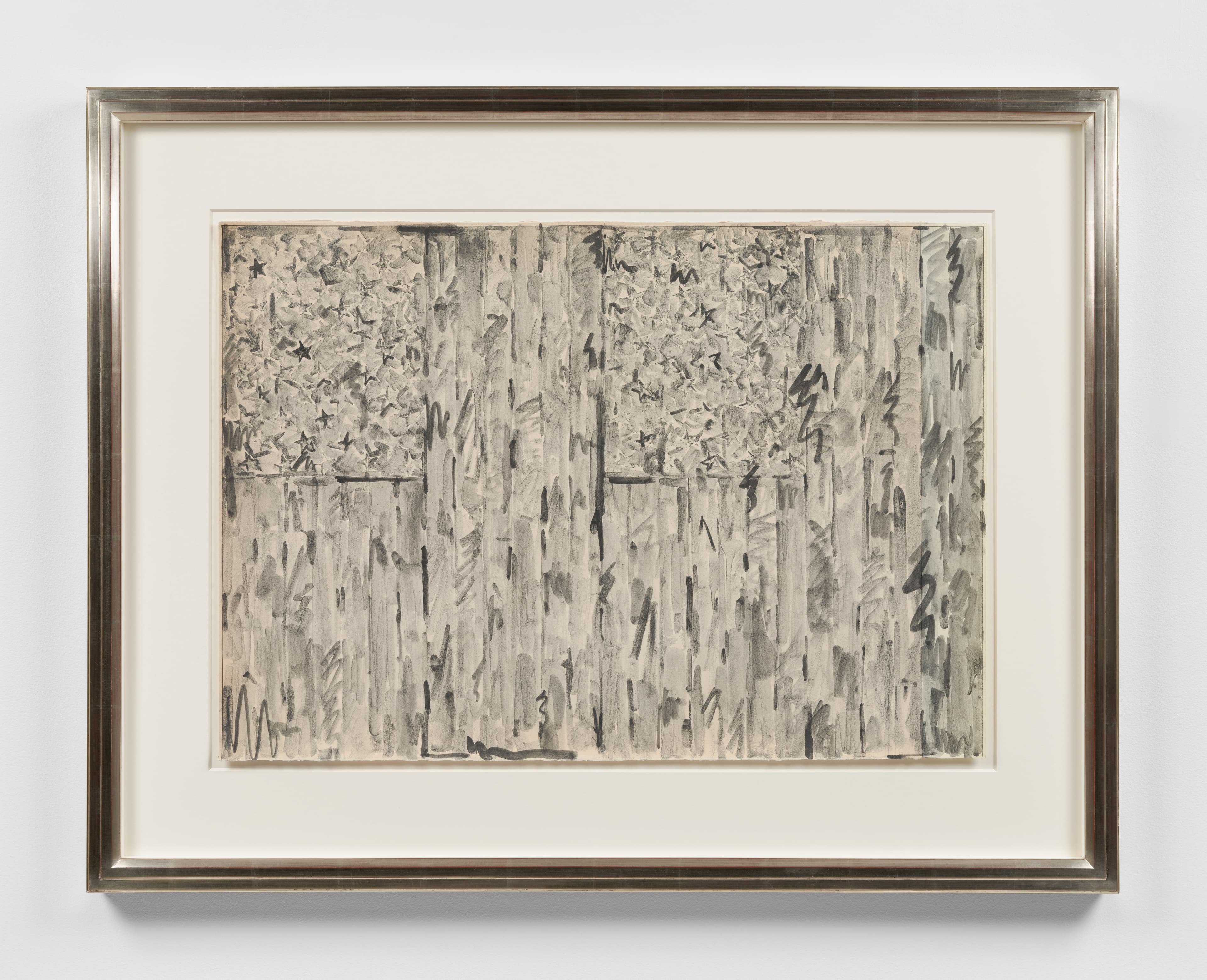
Jasper Johns, Study for Two Flags, 1969. Graphite wash and graphite pencil on two adjoined pieces of paper, 21 ⅛ × 29 ⅞ inches. Courtesy Craig Starr Gallery.
Throughout the group, the flags’ material makeup and their setting within or filling a field seem intuitive choices, part of the artist’s growing arsenal of modifications of the motif over the course of decades. What projects from these treatments is not so much the image of a flag, which to this viewer seems to recede, but rather a performed rendering and manifestation of tactility. For the viewer, as for Johns, each work presents a new situation, a new problem to be solved, a new test of the robustness of the motif. “I like to repeat an image in another medium to observe the play between the two.… In a sense, one does the same thing two ways and observes differences and sameness—the stress the image takes in different media,” the artist has said. His rhetorical question, “What kinds of differences do you tolerate and what kinds do you encourage?” is foundational for his near-obsession with recycling images in different mediums, a practice that Thomas Crow has called his habitual recursivity.
With Two Flags on Orange (1986–87) Johns performed a further act of conscious seeing through a kind of estrangement: having split two flags stacked on top of each other vertically, he set the two lefthand halves on the right and the two right hand halves on the left, with an orange ground dividing and surrounding them. Rather than embedded in their surround, the flags seem wedged into it as in a tongue-and-groove construction, suggesting a further sense of equivalency between motif and ground. That equivalency is enhanced by the effect of the work’s plastic substrate, which tends to reduce viscosity. Here, the eye picks up each sinuous brushstroke overlaid along the red and white horizontal stripes, each repeated short stroke of orange acrylic that ultimately fills the surround, and each nearly orthographic squiggle that Johns overlays with crayon.
Beyond Two Flags on Orange, three further works on plastic in the exhibition suggest Johns’s embrace of chance procedures to defamiliarize the motif in an effort to know it more fully. On plastic, he has said, the ink “has a life of its own, independent of me. I seem to have almost nothing to do with it, to be an observer.” In Flag on Orange Field (1977) and Two Flags (1985), both analogues of previous works, tonal modulations of gray and blotches of black capture the rich textural variations of fluid running over the plastic matrix in randomly shifting values of light and dark. Like the ebb and flow of water rippling and bubbling through sediment, the ink flows in Flag on Orange Field convey the sense of accidental rather than controlled movement through which Johns distills matter into sheer process. In Two Flags, Johns has made a single handprint at lower right. Ghostlike amid churning ink, its near-camouflaged yet insistent presence calls an abrupt halt to the viewer’s allusive and picturesque ideations. A synecdoche for the artist’s presence, the inked impression is both indexical and laconic—an emblem of Johns’s tactile seeing, a hand cut from the artist, as estranged as it is uncanny.
Patricia L Lewy is an independent art writer, curator, and artists’ estate manager living in New York City.