Word count: 873
Paragraphs: 11
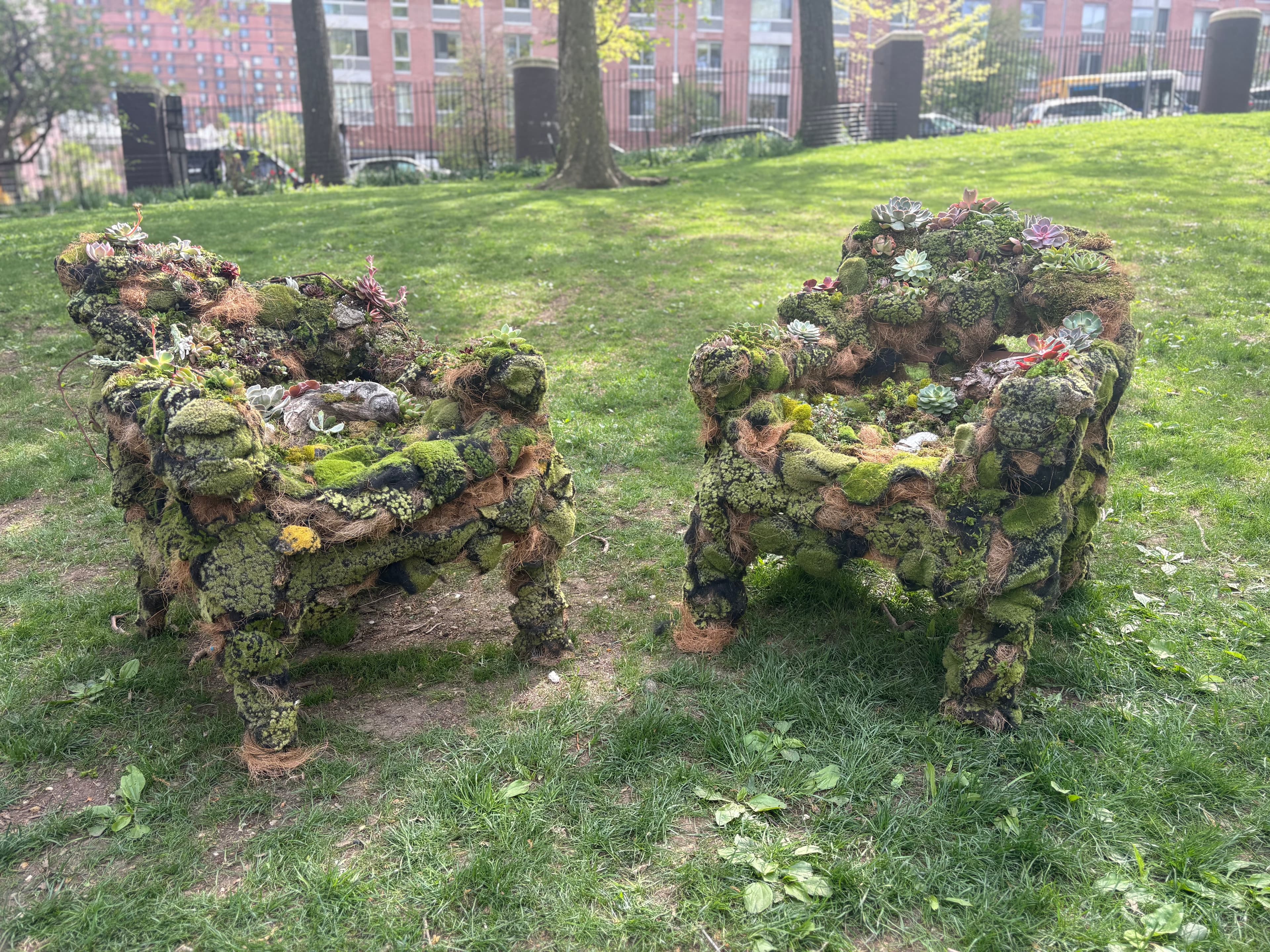
Installation view: Harlem Sculpture Gardens, Jackie Robinson Park, New York, 2026. Courtesy West Harlem Art Fund and New York Artist Equity Association.
Jackie Robinson Park, St. Nicholas Park, Montefiore Park, & Morningside Park
May 2–October 30, 2026
New York
Traveling from Brooklyn, a visit to Harlem to see the third installment of the Harlem Sculpture Gardens means an hour on the train to 155th Street and a walk to the northern tip of Jackie Robinson Park. The Harlem Sculpture Gardens presentation, a project envisioned and curated by the West Harlem Art Fund’s Savona Bailey-McClain in collaboration with New York Artist Equity Association, has grown to include four parks: Jackie Robinson Park, St. Nicholas Park, Morningside Park, and Montefiore Park.
When I’m viewing public sculpture, a big part of the joy is the trek—the discovery of a new landscape and the preparation of supplies for the journey. It helps if you like to walk. Good shoes are essential and sunglasses highly recommended. If the journey is long—more than forty city blocks for me that morning—you may want an umbrella at the ready, and snacks are advisable.
If your enjoyment is in the experience of the moving landscape, the sculpture must be well integrated. No sculpture can overcome it. Each must instead complement it or activate it. In Harlem, of course, the landscape is largely urban, despite the concealing scrim of trees on the narrow strips of land comprising the parks.
From the heights of 155th Street, looking out and down over the asphalt-lined groves below, wide stone stairs carved from the native schist drop down into Jackie Robinson Park. Following their trajectory eventually leads to a wide alley, framing the brightly colored steel of Ted Salmon’s I-beam Offspring (all works 2026) at its southern terminus. From this distance, the sculpture is a noteworthy punctuation mark, favorably situated against the hulking back of the WPA-era Jackie Robinson Pool at the south end of the park. The sculpture’s human and humane scale puts it in conversation with passersby.
On my way out of Jackie Robinson, I am stopped by two moss-covered lawn chairs, clustered together on the large green just south of the pool, a work titled Swallowed by Natalie Colette Wood. They are just a bit of a tease for the weary traveler, since the desire to sit is immediately foiled by the realization that to do so would inevitably crush the tiny flora and fauna with which these chairs are nearly enveloped. Their skin is, in fact, alive. As I stood, people approached, looked carefully, asked questions of me (I was holding a clipboard and looked official) and uttered words of praise. These chairs are not competing with their neighbors, the grass and trees. Their unassuming air makes them welcoming, a come-set-down-and-let’s-chat feel. Wood’s work is not declarative, like so much public sculpture, but rather pointing away from itself toward what matters beyond it—our natural home. This might be why so many people stopped in the brief time I was there. I noticed no such interactions with the sculptures the rest of the day.
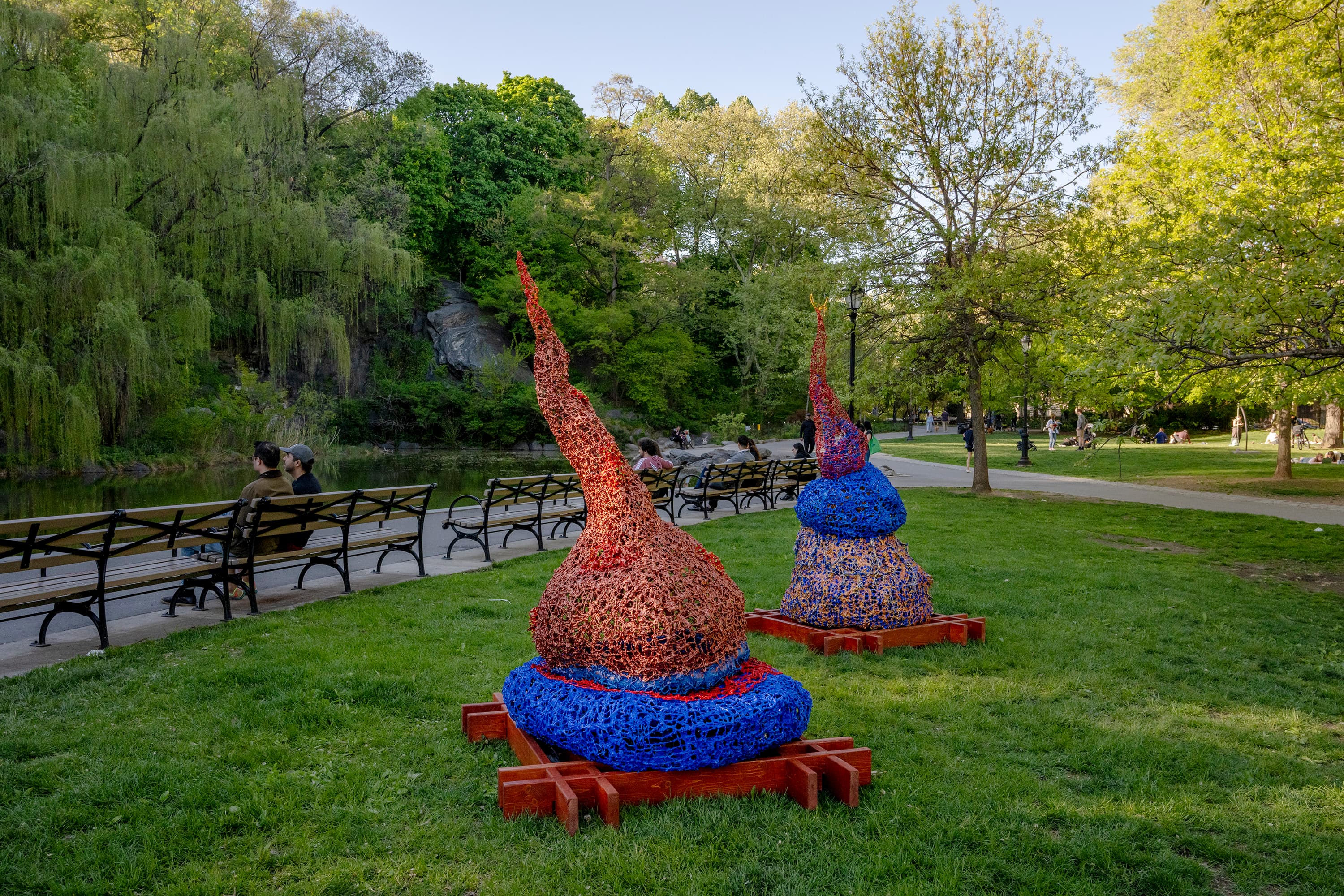
Installation view: Harlem Sculpture Gardens, Morningside Park, New York, 2026. Sculptures by Elizabeth Knowles. Photo: Steven P. Harris for the West Harlem Art Fund and New York Artist Equity Association.
I made my way south to St. Nicholas Park, where any sculpture was going to have to compete with a maze of those same massive, winding schist stairs, bedrock to all these parks. Appropriately, offerings by Phil Beuhler in photographs printed on vinyl and by Moses Ros in painted aluminum take up architectural themes, as do the Beacons On The Lawn by Chris Sancomb, which engage directly with the breeze, conjuring an elemental relationship to Wood’s chairs. I measure their allure by my willingness to walk up the long grassy slope upon which they perch and from which point I climb still further up the six flights of stairs that lead out of St. Nicholas Park to the west toward my next destination: Montefiore.
There I find Michael Poast presiding with four modernist offerings, raw steel constructions, bent and cut with a hand-made feel. To reach them, I must skirt City College’s sprawling campus and local high school athletic fields along 138th Street, all of which feels connected to Poast’s placements, which reveal affinities with commonplace, urban storefront roll gates and signage. Poast’s high modernist creations pay homage to New York City’s rough edges.
On my way down to southernmost Morningside Park, I pass Roosevelt Triangle and a sculpture, Harlem Hybrid (1976) by the late, great Richard Hunt. Its grounded sense of integral permanence mirrors Manhattan’s movement in its serpentine surfaces. This permanent sculpture is not part of the exhibition but serves as a reminder of the relative impermanence of the sculpture I’ve been seeing, and its losing struggle with time and the elements.
The enchanting plane trees that line Morningside’s northernmost walk are home to jumpy squirrels and joggers. They lead me south to Morningside Pond where Canadian geese and a lone white egret look on as I consider Elizabeth Knowles’s Gourds—intricate painted wire sculptures, evoking the processes of growth and decay in their psychedelic coloring and spiraling protuberances. Before I go, I can’t miss Dianne Smith’s satisfyingly scaled Afro Puff, a succinct sculpture, wound and wiry knit of black steely hair topped with an aluminum afro comb like a fork stuck in a bowl of spaghetti. This urban hymn sports an exuberant graffiti-covered pedestal, reminding me of my Brooklyn home.
Ben La Rocco is a contributor to the Brooklyn Rail.