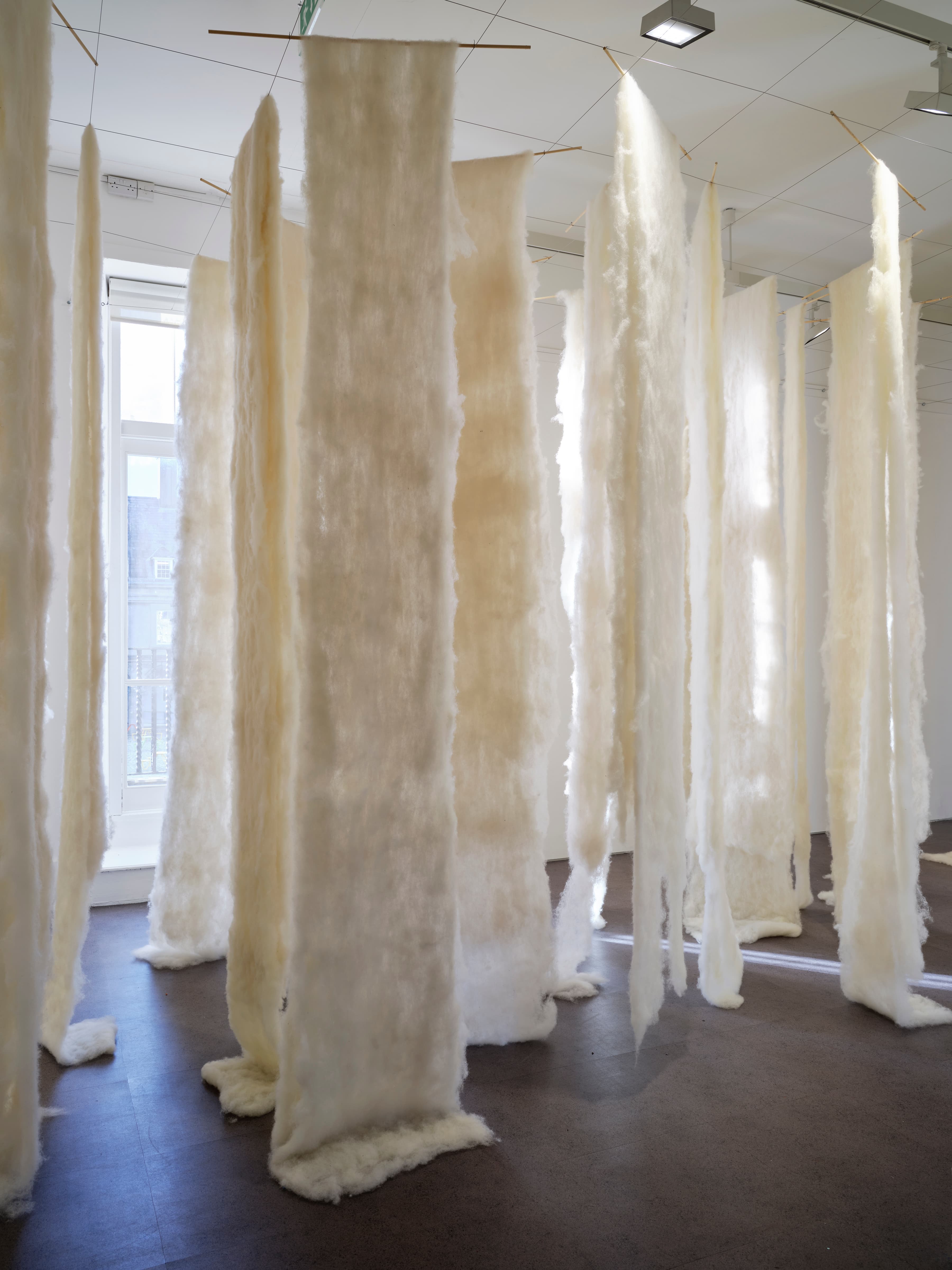
Installation view: Cecilia Vicuña: Reverse Migration, a Poetic Journey, IMMA, Dublin, 2025–26. Courtesy the artist. Photo: Ros Kavanagh.
Word count: 951
Paragraphs: 11
Irish Museum of Modern Art
November 7, 2025–July 5, 2026
Dublin
On a surface level, we associate Ireland and Chile with completely different geographies, cultures, histories, and overall aesthetics. Yet, Cecilia Vicuña’s solo exhibition at the Irish Museum of Modern Art (IMMA), Reverse Migration, a Poetic Journey, argues that reality is more nuanced. The exhibition—Vicuña’s first show in Ireland—was originally conceived as a retrospective. However, after uncovering her own ancestral ties to the Oisín Clan in Northern Ireland, the show evolved into something more: an exploration of interconnectedness across unlikely places and peoples.
For over seven decades, Vicuña has meditated on this notion of interconnectedness through the quipu: an ancient Andean system of communication and record keeping comprised of knotted cords. At the heart of Reverse Migration is one such work: Aran Quipu (2025). Like Vicuña’s other quipus, Aran Quipu is built out of unspun wool, suspended in sporadic clusters from the ceiling. This particular installation, however, reflects on the symbolism of the Aran sweater through rare, heritage wool sourced from the Galway Wool Co-op. The organic tactility of Aran Quipu feels hardly removed from the sheep it came from, emphasized by a raw looseness of its unspun fiber. As Vicuña reflects in a nearby poem, handwritten on the wall, “nothing holds [Aran Quipu] together except the desire of each fiber to hold on to the next.” She concludes: “Perhaps one day we will see this cosmic desire for togetherness as what connects us all.”
The quipu suggests larger histories of imperialism: when the Spanish colonized the Andean region in 1532, they outlawed and destroyed this ancient system of communication. Ireland holds its own history surrounding the erasure of a language. Over centuries of British colonization, efforts—often violent—were made to erase the native Irish language. After the creation of the Irish Free State in 1922, attempts were made to revive the forbidden dialect. Now, Gaeilge appears on every road sign and is a required subject for primary and secondary school students in the Republic of Ireland.

Installation view: Cecilia Vicuña: Reverse Migration, a Poetic Journey, IMMA, Dublin, 2025–26. Courtesy the artist. Photo: Ros Kavanagh.
In an adjacent gallery, Vicuña expands her consideration of shared eradication into the ecological realm through Mourning Dialogue (2025). This immersive sound work amplifies the artist’s mourning chants for disappearing glaciers in conversation with the iconic call of the Curlew, Ireland’s most endangered bird. Here, invisible sound waves serve as Vicuña’s connective fiber. As the sonic vibrations reverberate through museum-goers’ bodies, humanity is bound within a global network of environmental injury. The phantom dialogue spills into nearby galleries, affirming that natural destruction is not limited to a singular place.
Amidst an expansive—if occasionally unwieldy—survey of Vicuña’s career, Reverse Migration continues to uncover cycles of loss and renewal shared between Ireland and the artist’s Chilean roots. In one gallery, through images titled A Poetic Journey in Northern Ireland (2006), we watch Vicuña and her partner, James O’Hern, traverse the Emerald Isle. Under cloudy skies, they open their arms at the sight of rolling green hills and lay upon the edge of jagged cliffs—likened, by Vicuña, to those of Chile. Other photos record the artist’s recognizable acts of ritual—her practice of literally weaving thread across landscapes, stones, and ruins—as she pays tribute to her newly discovered sacred land.
In one image, Vicuña lifts flowers to the exaggerated genitalia of an Irish Sheela-na-gig, or a medieval stone carving of a female form, thought to have served the purpose of warding away evil spirits. In the adjacent gallery, a Sheela-na-gig on loan from Ireland’s National Museum is on display near a series of new paintings. Tracing the Sheela-na-gig’s strong features, Vicuña highlights her similarities to the feminine icons of Indigenous Andean and Chilean traditions: the Andean Pachamama, or Mother Earth, for example, worshipped for sustaining and regenerating life. In the artist book Mapping the Silence, published alongside the exhibition, Vicuña muses that the Sheela-na-gig “is really birthing us in all lands, all territories of this earth.”

Installation view: Cecilia Vicuña: Reverse Migration, a Poetic Journey, IMMA, Dublin, 2025–26. Courtesy the artist. Photo: Ros Kavanagh.
Before visiting Reverse Migration, the artist Sara Dotterer introduced me to ecotones, or borders where two distinct ecosystems overlap: the space where forest meets ocean, woodland meets pasture, mountains meet desert, and so on. Also referred to as “zones of tension,” these areas both buffer and bridge otherwise harsh transitions, and, in doing so, promote incredible biodiversity.
Throughout Reverse Migration, I felt as though I was navigating a dynamic, newly imagined ecotone, identified and nurtured by Vicuña. This imagined border between Ireland and the artist’s South American lineage indeed embraces tension by recognizing the traumas of colonization, environmental destruction, and cultural loss specific to each place. But by stitching and overlaying fragments of these narratives into one shared experience, and in doing so, signaling an ethereal exchange beyond segregated histories, it also fosters unexpected forms of evolution. In the galleries of IMMA, new visual and spiritual traditions bloom and thrive.
This thriving is most palpable in Foraging Quipu (2025). Built out of debris gathered by local Dubliners, largely consisting of native plants, the installation is quite literally a zone of tension: it is a sporadic collection of local materials, knotted together through a foreign ritual and suspended at varying heights. And yet, just as a poem transforms fragmented stanzas into something epic, this quipu, too, creates harmony out of discord. Delicately navigating one’s body through the quipu, there is an implied respect for land and ritual between all of us, affirming Vicuña’s assertion that “we are all indigenous to this earth.” Woven together in our nativeness, the concept of a border transforms into something that enables movement rather than prohibits it. Through this movement—this reverse migration through time and place—we uncover a new, shared language of cosmic interconnection and survival.
Allison Carey is a Brooklyn-based art historian and curator whose work foregrounds marginalized narratives and challenges art historical frameworks. She is the Assistant Curator at the Shirley Fiterman Art Center, Borough of Manhattan Community College (CUNY).