Word count: 1083
Paragraphs: 10
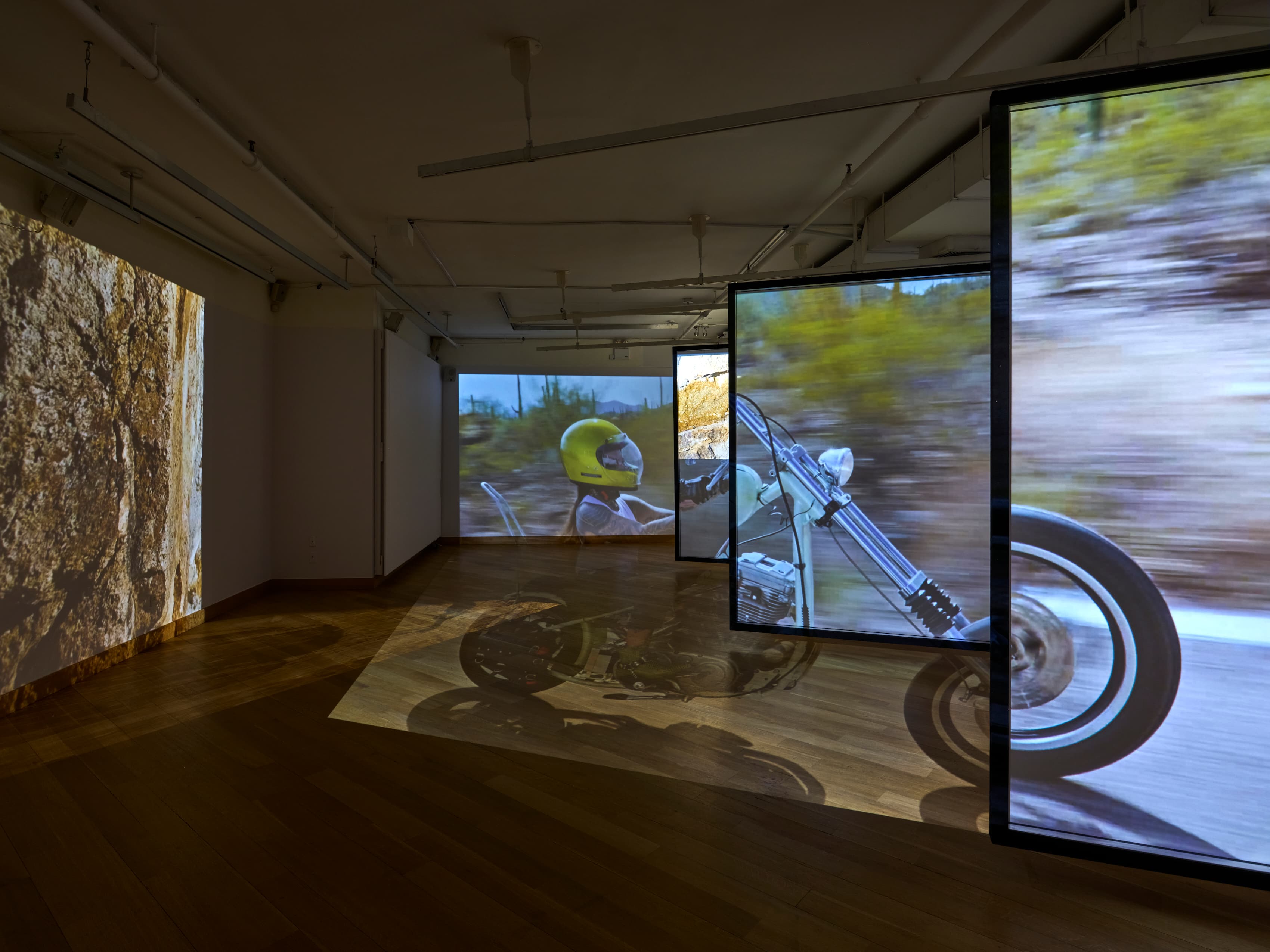
Installation view: Shu Lea Cheang: LOVER LOVE, Leslie-Lohman Museum of Art, New York, 2026–27. Courtesy Leslie-Lohman. Photo: Garrett Carroll.
Leslie-Lohman Museum of Art
April 3, 2026–January 3, 2027
New York
Shifting between a utopian documentary of an alternative community and elegiac shrine for a departed collaborator, Shu Lea Cheang’s LOVER LOVE (2026) is a floor-to-ceiling video environment that focuses on trans identity and world building. Installed at the Leslie-Lohman Museum, it offers a place for gathering, while encouraging visitors to reflect on the increasingly complex relationship between gender and technology.
Cheang’s innovative cinematic experience consists of four ceiling-mounted video projectors streaming images from two facing sides of the gallery. The projectors loop a quartet of 28-minute films, each one with its own soundtrack: dialogue, live music, and environmental sounds that emerge from different groups of speakers sited throughout the space. All four films, which contain many of the same characters and locations, are synced to begin at the same time. The projected images appear on four rectangular screens that subdivide the gallery as well as the walls and floor. Visitors are encouraged to slide the screens along hanging tracks, an intervention that stops all the soundtracks and triggers a snippet of a sad electronic song. This mediation also causes the moving images to fall on different surfaces, thus changing their sizes, framings, and positions in the gallery space.
To make LOVER LOVE, Cheang spent a month filming in Tucson, Arizona, with the support of local queer and film communities. She worked with eight non-gender-conforming individuals who represent themselves, telling their stories and performing in various striking ways. They speak intimately to the camera, sharing both their hopes and their fears, conveying what it is like to live as a gender rebel in a time of rising anti-trans animus. Cheang encountered the Tucson community in 2024 while touring the 4K restoration of her lesbian sci-fi film Fresh Kill (1994). Drawn to their warmth and vitality, she immediately felt a strong affinity with them—a connection that appears to have been mutual, judging from the openness and candor with which they engage the camera.

Shu Lea Cheang, LOVER LOVE, 2026. Four-channel digital color film with sound, movable screens, and interactive speaker system, 28 minutes. Courtesy the artist and Leslie-Lohman. Photo: Garrett Carroll.
The four-channel installation unfolds as a textured, immersive portrait of the Tucson trans community, situating its members within a constellation of lived environments that together form a shared, if fluid, world. Across a sequence of interwoven settings—a motel room, a junkyard filled with old cars, the sunlit exterior of a roadside diner, city streets, a house under construction, and the expansive roads and trails of the desert—the work stages a wide range of performative actions. Individuals sing, drum, clap, dance, play cello, DJ, ride motorcycles, serve food, apply makeup, cut their hair, and engage in ritualized practices that move along a spectrum from the spiritual to the erotic.
In one sequence, a tracking shot passes community members seated in front of altar-like tables, as they chant and recite. In another, an individual cleans their boots in the desert and then meets with a lover to kiss and engage in blood play under the Arizona sky. At other moments, performers address the camera, speaking candidly about themselves, their relationships, and their visions of trans utopias. A person talks about sex work and is later shown stationed by the highway, moving in and out of cars. Elsewhere, the camera tracks different solitary figures whose shifting relation to the lens—by turns inviting and evasive—foregrounds the dynamics of visibility and withdrawal. Layered onto, as well as in between, these scenes, Cheang incorporates a rich visual lexicon of digital animations: a smoking, six-winged seraphim in flight, blooming flowers, a flying saucer, flowing blood, and passages of poetic text that track across the frames. Together, these elements interpret and amplify the spiritualism as well as the specific subjectivities of the Tucson trans community, while also creating a sense of a lived reality shaped by digital interventions.
There is also a ghost in the machine. Triggered by the spectators’ manipulations of the screens, a disembodied phantom appears: the voice of Aérea Negrot, the Venezuelan-born, Berlin-based singer, performer, and DJ to whom the work is dedicated, and whose 2011 song “It’s Lover, Love,” provides its alternative soundtrack. Negrot began reconstructing her artistic and gendered identity in the late 1990s, and collaborated with Cheang from 2016 to 2023 as an actor and a musician. Her death by suicide in 2023 renders her vocal presence in the work even more charged; at once archival, spectral, and insistently alive within the participatory audiovisual environment that reanimates her, she evokes both the power and the precarity of trans identity, a spectral counterpoint to the installation’s various embodied subjects.
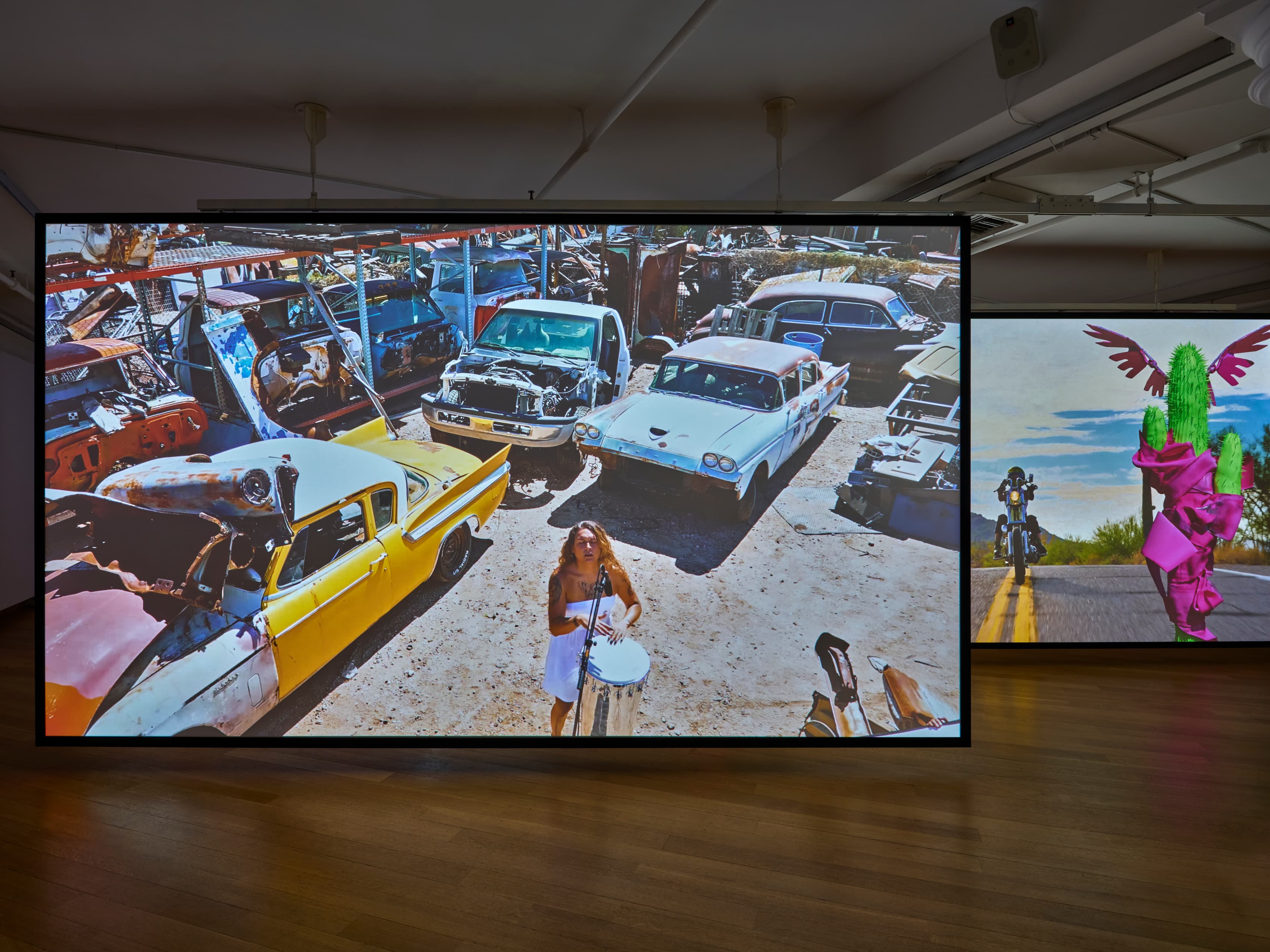
Installation view: Shu Lea Cheang: LOVER LOVE, Leslie-Lohman Museum of Art, New York, 2026–27. Courtesy Leslie-Lohman. Photo: Garrett Carroll.
Cheang’s installation brilliantly links Negrot with the Tucson trans community through an ingenious formal system that uses sound, image, and architecture to place the spectator in an active, co-productive role. Initially conceived as an exploration of “trans-fragility, the lost love and the shallow slits of hope permitted in the controlled societies’ surveillance apparatus,” the work sustains these terms not as fixed themes but as a dynamic system that interrelates individuals—present and absent, living and dead—through technologies of sight and sound.1 As viewers move the screens, images split, double, and re-scale; fragments once unified diverge in size and depth; and previously occluded projections emerge and overlay one another. Simultaneously, the spectators’ own shadows fall across the screens, wall, and floors, inscribing their bodies directly onto the field of projections and allowing them to enter—literally and figuratively—the installation’s world. Within this continuously reconfigured environment, Negrot’s melancholic refrain—“If it’s lover love, it’s over”—cuts across and interrupts the polyphony of the Tucson community, registering as a persistent, affective undercurrent. The installation’s shifting framings, superimpositions, and embodied interventions thus materialize trans identity as a process of ongoing performance, recording, recomposition, and projection: a radical exploration of gender as it is cut, spliced, and redistributed across collaborative and technologically networked environments.
This treatment of form resonates directly with Negrot’s own articulation of trans identity as a condition of perpetual transition. Reflecting on her experience, she noted, “I started transitioning years ago and then de-transitioned and transitioned again. … I guess life remains a constant transition.” In LOVER LOVE, a haunting memorial to her friend, Cheang translates this insight into spatial and audiovisual terms. By inviting viewers to collaborate in the reconfiguration of pre-recorded sounds and images—and to see themselves projected within it—the installation reframes media technologies not only as instruments of surveillance and control, but also as platforms for collective reimagining: spaces in which gender identities are not fixed or imposed, but continually hacked, renegotiated, recombined, and transformed.
Matthew Biro is Professor in the Department of the History of Art at the University of Michigan. He is the author of Anselm Kiefer and the Philosophy of Martin Heidegger (1998), The Dada Cyborg: Visions of the New Human in Weimar Berlin (2009), and Anselm Kiefer (2013). His reviews of contemporary art, film, and photography have appeared in Artforum, Art in America, Contemporary, Art Papers, and The New Art Examiner.