Matthew Biro
Matthew Biro is Professor in the Department of the History of Art at the University of Michigan. He is the author of Anselm Kiefer and the Philosophy of Martin Heidegger (1998), The Dada Cyborg: Visions of the New Human in Weimar Berlin (2009), and Anselm Kiefer (2013). His reviews of contemporary art, film, and photography have appeared in Artforum, Art in America, Contemporary, Art Papers, and The New Art Examiner.
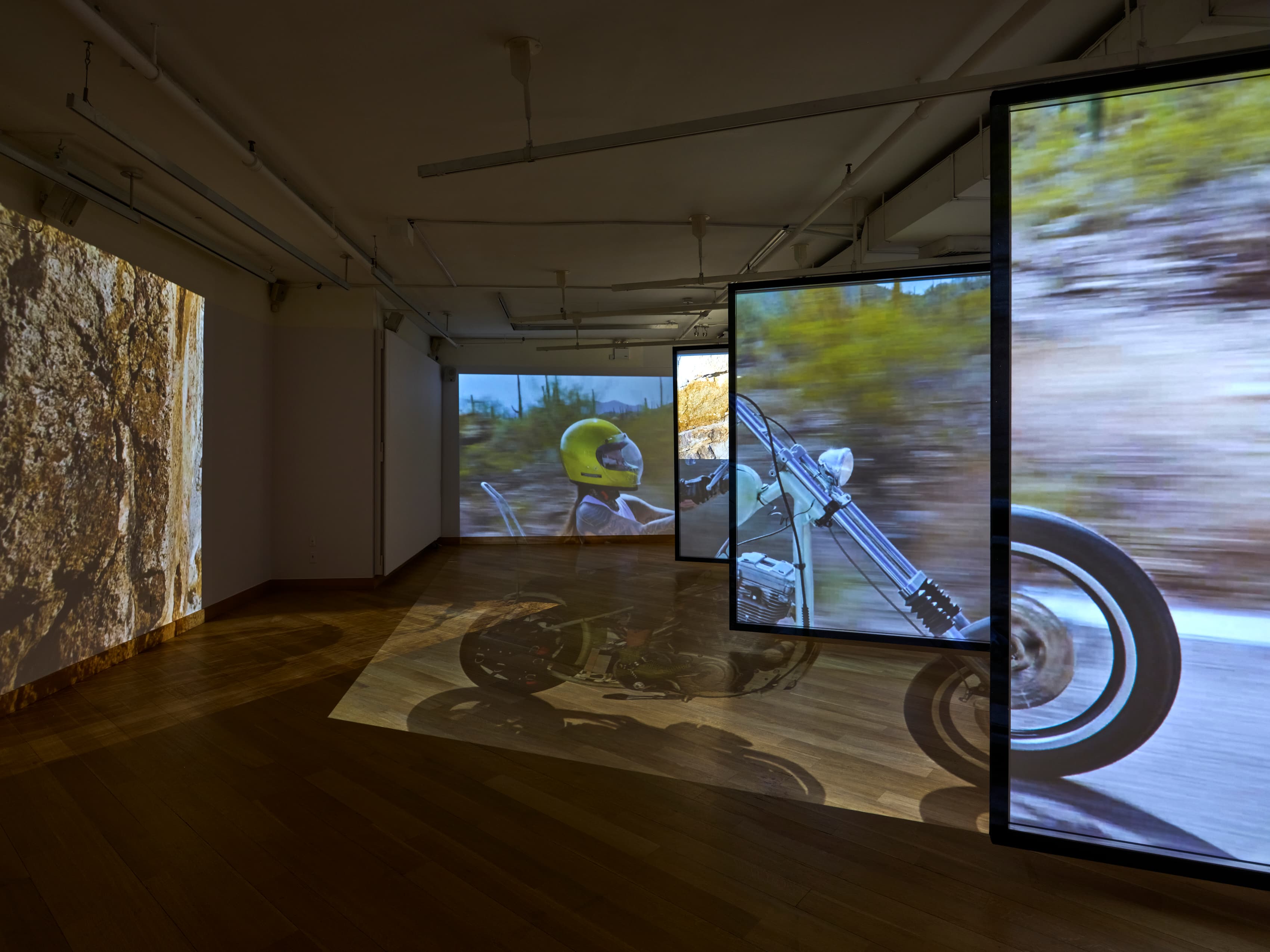
Shifting between a utopian documentary of an alternative community and elegiac shrine for a departed collaborator, Shu Lea Cheang’s LOVER LOVE (2026) is a floor-to-ceiling video environment that focuses on trans identity and world building.
Because it appears as part of a larger environment, Steyerl’s film cannot be understood apart from the multimedia installation of which it is a part. At Esther Schipper, where the show is called Contemporary Cave Art, the video is part of a labyrinthian cave with multiple screens showing animated paleolithic paintings moving slowly on rock walls.

Pieces of a Man, Jammie Holmes’s latest project with Library Street Collective in Detroit, is a compact and powerful exhibition confronting Black trauma and healing. Consisting of seven large-scale acrylic and oil pastel paintings, all from 2021, it confirms Holmes’s promise as a compelling and lyrical new voice in contemporary painting.

For Rosalind Krauss, the pivotal difference between Dada photomontage and Surrealist photography had to do with the relative presence of either the photographer or the world in the image itself. Surrealist “photographs are not interpretations of reality, decoding it, as in Heartfield’s photomontages. They are presentations of that very reality as configured, or coded, or written.”

Since the late 1970s, Carrie Mae Weems has pursued a socially engaged form of creative practice, examining how identity is constructed through concepts of race, gender, and class, while interrogating the processes by which we produce a sense of self in relation to both private memory and public history.

Comprising a total of forty-five medium-sized photographs, La Calle (The Street), presents highlights culled from more than forty trips that Alex Webb took through Mexico between 1975 and 2007.

It’s taken a long time for Bruce Conner (1933 – 2008), the polymath San Francisco artist who was a major force in the development of both found-object sculpture and experimental film in the United States, to be given a major retrospective.

Can art today be a form of protest? And, if so, what subjects, what issues, what transgressions or injustices, does it most vitally and persuasively critique? In many ways, the obvious answer to this question is “yes.”
