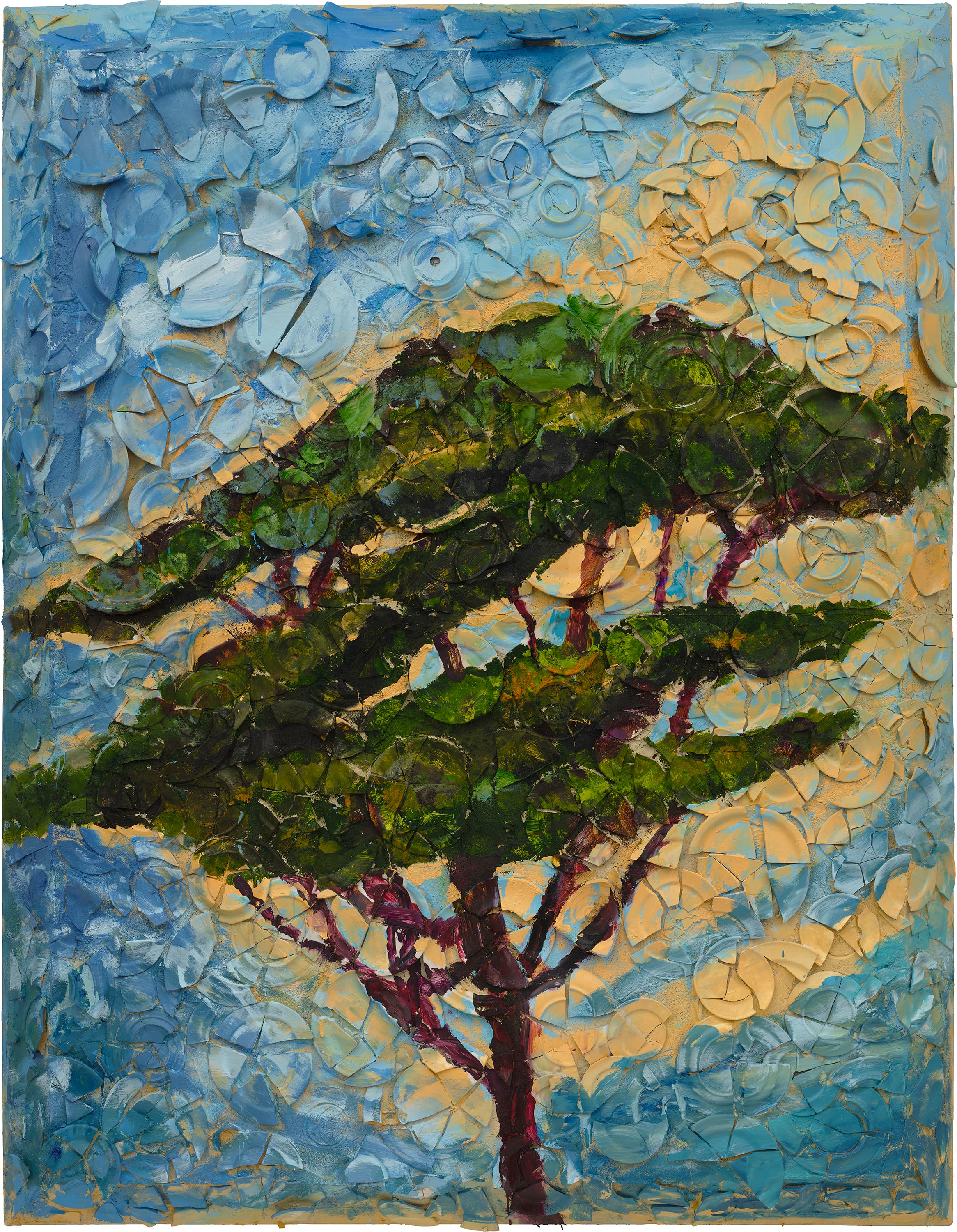
Julian Schnabel, Portrait of Italy Through Its Trees V, 2025. Oil, plates and bondo on aluminum, 108 × 84 inches. © Julian Schnabel / Artists Rights Society (ARS), New York. Courtesy Pace.
Word count: 802
Paragraphs: 9
Pace Gallery
May 15–August 14, 2026
New York
The old saw “you can’t see the forest for the trees” provides a useful way to understand Julian Schnabel’s superb seventeen-piece show now on view at Pace. Schnabel (b. 1951)—apparently suffering no fatigue after completing his fascinating film In the Hand of Dante (based on the novel by Nick Tosches)—has returned to one of his own sources: the plate paintings he began making in 1978 and showed as a retrospective last November at the Mnuchin Gallery. That show included one new work stashed on the gallery’s rarely visited top floor: a landscape which we can now see as a precursor to this exhibition. This new work destroys the traditional oppositions between painting and sculpture, figuration and abstraction. Anyone who assumes Schnabel’s focus on trees means he’s gone “back to nature” should think again.
First, the title of the show. The same tree appears in all the works: pinus pinea, the “Italian stone pine” Schnabel saw every day in Italy while filming In the Hand of Dante. But what does the preposition “through” mean here? Are we looking through the trees at Italy, reduced to maps of the area around Genoa that Schnabel has repurposed as the surfaces of the paintings? Or are we looking at Italy by means of the trees? “Through” means many things: passing from one end to another, a method, a period of measured time. Schnabel conjugates all these meanings in his title, and then, in remarks incorporated into Pace Gallery’s press statement, confuses us by saying that these paintings, “are pictures of something, but not really of trees.”

Julian Schnabel, Portrait of Italy Through Its Trees Painting on Map XXI, 2026. Inkjet print and oil on paper, 62 ½ × 105 inches. © Julian Schnabel / Artists Rights Society (ARS), New York. Courtesy Pace.
When is a tree not a tree? When it is a gesture. In 2001, Schnabel produced his “Big Girl” series, based on a found portrait he recreated with a line drawn across the canvas to cover the eyes of the pictured girl. We can find other examples of this horizontal slash of paint in Schnabel’s abstract paintings; it is one of his essential motifs, a horizon or a sight line.
One possible, albeit improbable, source may explain the value of this slash in Schnabel’s oeuvre: René Descartes’s 1637 treatise on geometry, which establishes the concept of the grid, a vertical y-axis and a horizontal x-axis that converge at a center, the origin. It is the x-axis that matters to Schnabel—a will to power that creates the possibility of mapping any point on a plane. So, when Schnabel says about the show, “It’s the idea of seeing,” he is telling us that his act of seeing is the metaphorical control imposed on nature through maps—or the process of pictorial representation itself. The maps the artist uses as surfaces here are long out of date, but what is at stake here is the flatness of the map, its reduction of the earth to a comprehensible flat surface that enables us to determine distances. The trees are that horizontal X axis, the sight line that creates and dominates pictorial space.

Installation view: Julian Schnabel: Italy Through Its Trees, Pace Gallery, New York, 2026. Courtesy Pace Gallery.
Meanwhile, the smashed plates and crockery function as Schnabel’s confession that the real world is not a flat plane, that reality is chaotic. Portrait of Italy Through Its Trees III (2025)—oil, plates, and bondo on aluminum—is a superb enactment of Schnabel’s phenomenology of geometric seeing. A large, 84 by 132-inch piece, it is dominated by four horizontal treetops gradually diminishing in size until they join at the bottom in branches so thin they look like roots. Everything changes as the viewer either approaches or withdraws from the work. We either see flatness or a rugged surface depending on where we stand. The effect of the repeated treetops is hypnotic—a rhythm, or motionless motion that entrances the viewer.
Portrait of Italy Through Its Trees VII (2025) is an even more brutal version of this interplay between abstract, geometric surfaces and actual reality. A painting in portrait mode—a vertical rectangle that acknowledges the Y axis as another form of control—this too is built from oil, plates, and bondo on aluminum, and measures 108 by 60 inches. Here Schnabel renders the treetops as jagged left and right slashes, a violent cancellation of the chaos beneath—some of the jagged pieces of pottery are really menacing. The point, as in III, is to seize the viewer’s gaze by means of a discordant harmony. The effect is enthralling.
In 1757, Edmund Burke drew a distinction between the sublime and the beautiful, saying the sublime fills us with awe, fear, and agoraphobia while the beautiful soothes us with delight and order. In 2026, Julian Schnabel brings the two together: it is impossible to view these works without simultaneously being struck by trepidation and exulting in the fabulous interplay of blue, green, and Naples yellow. Truly a painterly triumph.
Alfred Mac Adam is Professor of Latin American literature at Barnard College-Columbia University. He is a translator, most recently of Juan Villoro’s Horizontal Vertigo (2021), about Mexico City.