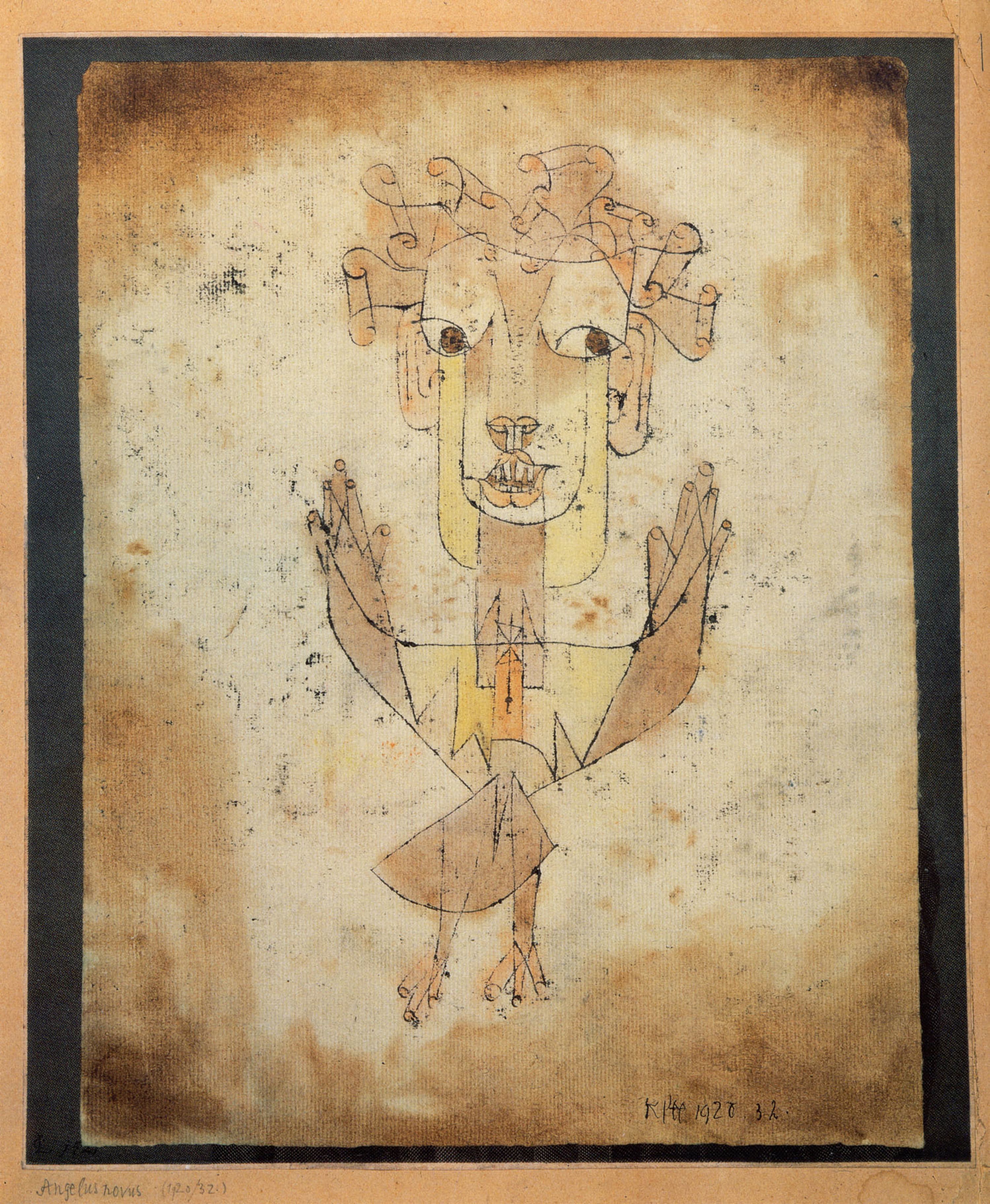
Paul Klee, Angelus Novus, 1920. Oil transfer and watercolor on paper, 12 ½ × 9 ½ inches. © 2026 Artists Rights Society (ARS), New York. Courtesy the Jewish Museum.
Word count: 1327
Paragraphs: 11
Jewish Museum
March 20–July 26, 2026
New York
Having exited a rousing concert in the Jewish Museum’s second-floor event space, a teenage girl burst through the galleries of the Paul Klee: Other Possible Worlds exhibition nearby. It was impossible to miss her sidling up skeptically to one of the artist’s characteristically nonrepresentational works, and querying the security guard on hand—“What is this? Is it Jewish?”—before dashing off as he (justifiably) shrugged his shoulders.
Even leaving aside shortened adolescent attention spans, the Jewish Museum’s remit places upon its exhibitions the further, a priori onus of specific cultural or biographical framing. And even as a non-Jewish artist, Klee more than meets the mark. With the Nazi rise to power in the early 1930s, he was disparaged by Party officials and dismissed from his teaching job on the specious grounds of being a “Galician Jew.” Yet it was Klee’s elliptical and whimsical pictorial innovations, which helped dynamize twentieth-century modernism, that first sparked National Socialist opprobrium. For a Nazi kulturkampf that had staked up Aryan supremacy and pseudoscience, Jewishness had come to stand in for aesthetic and cultural degeneracy writ large. (No less than seventeen of Klee’s works appeared in the infamous Degenerate Art Exhibition of 1937, with more than a hundred pulled from Germany’s public collections.) Klee did not merely appear to exemplify cultural transgressions; he responded to them in his work with mordant nuance and intelligence—responses which this show sets into relief. The full spectrum of the artist’s range of styles, motifs, and approaches proves salient even in the relatively narrow timeframe the exhibition comprises, between Klee’s dismissal from the Düsseldorf Art Academy in 1933 to his death from scleroderma in 1940 in his native Switzerland.

Installation view: Paul Klee: Other Possible Worlds, Jewish Museum, New York, 2026. Courtesy the Jewish Museum. Photo: Graves Projects / Julian Calero.
“Here I am, there’s no place for me in Germany anymore,” Klee told Rolf Bürgi (the son of an early collector of his work) upon moving back to his home town of Bern. After a decade teaching at the Bauhaus, new horizons beckoned in Düsseldorf, where he embarked on an increasingly stippled, pointillistic, labor-intensive style, exemplified here by the 1932 painting Clarification. The Muses fell mute the next year, when the Gestapo summarily raided Klee’s home in Dessau. A telling “X” stamped atop a stylized self-portrait—its mouth downturned and eyes grimly narrowed—memorializes the loss of Klee’s job and livelihood in the wryly titled Struck from the List (1933). Across the room, the charcoal work Mask: Red Jew from the same year evokes the eponymous trope from both German medieval culture (where it alludes to a legendary ruddy Jewish warrior) and Yiddish-language trope (for which it served as a talisman against antisemitism).
Klee’s identification with Jewish suffering transcended personal experience of Nazi harassment, which in his case entailed exile but not physical threat to his person or family. A number of drawings from 1933 (the year of Hitler’s rise to power) such as Fools’ Party, “He” a Dictator Too!, Manhunt, and Barbarian Mercenary by turns ironize, satirize, and deride the preening of politicians and the violence of their henchmen. Less explicit in their denunciation are two abstract works of watercolor on paper from the same year, So to Speak and Imponderable, which the artist himself referred to as “impudent lines” and which address more obliquely the regime’s anti-modernist and repressive rhetoric.
Indirect allusions to both German and wider European malevolence surface even amid shifting formal experiments throughout the decade (some due to Klee’s increasing manual rigidity), from the grinning monster of Your Ancestor ? (1933) to the drawings Half-Animal and Child-Eater, the painting Protected Children, and the striking watercolor Outbreak of Fear III (all 1939). Several of his paintings of fruit and flora, such as Suffering Fruit (1934) or Pathetic Germination (1939), tacitly assail the pseudoscientific fallacy of eugenics. (That the term entartete [degenerate] was originally used in German to designate plants that had evolved beyond the propriety of their species makes these references all the more poignant.) Redolent of non-Western hieroglyphs and pictographs, and including the Star of David and other symbols, Printed Sheet with Picture (1937) likewise defies the imposition of Aryan iconography as the key to aesthetic “health.”
Despite his worsening health and the outbreak of war, Klee barely relented even in his final years. He completed no less than 1,253 works in 1939, and 366 more the following year, before his death in June. One of the exhibition’s strengths lies in interpolating and juxtaposing Klee’s scope; the unease of specific works is exacerbated by the relative play and whimsy of others. Thick black lines, which emerge in the late 1930s, occasionally lend themselves to pictographic playfulness, as in Forest Witches (1938), or else the spare lyricisms of Kettledrummer (1940) and This Star Teaches Bending (1940). The last room allows a number of paintings, arresting simply in their formal and compositional originality and experimentation, to dialogue with other images subtly imbued with a sense of extra-pictorial dread.

Installation view: Paul Klee: Other Possible Worlds, Jewish Museum, New York, 2026. Courtesy the Jewish Museum. Photo: Graves Projects / Julian Calero.
The expository earnestness of several wall texts sometimes strains too hard in underscoring Klee’s ideological allusions. The abstract texture of Stone Desert (1933) is said to give up the ghost of “a posture intimating oppression,” for instance, while the mysterious creature anchoring Departure of the Ghost (1931) is said to figure Klee himself. The same goes for describing the painting Mask of Fear (1932) as necessarily representing “blunt terror.” Such a designation takes the artist too quickly and too literally at his word. Might not the proverbial mask here be seen as an apotropaic one, evinced in the figure’s rotund, jocular appearance and subtle curl of a smile? Pictures often do more or less than their titles, particularly when the politics of resistance (and the resistance of politics) is concerned. That Klee also conjured up memories of his time in Egypt and Tunisia in Arab Song (1932)—painted the year that elections saw the Nazis become Germany’s biggest political party—suggests an ecumenical appeal to ethnic and cultural otherness in countering the myth of Aryan ascendency.
No other work of Klee’s proves more consistently associated with interwar politics and fascism than the artist’s monoprint Angelus Novus (1920), famously sealed by the writing of the German-Jewish philosopher Walter Benjamin, who both purchased the print and found in it an allegory of history. Writing on the work in 1940, the year of his own suicide while hounded by Nazi tormentors, Benjamin consecrated its significance not only for ethics and philosophy, but for Jewish pain. (At the time of my viewing the exhibition, a facsimile stood in for the original work, as it was stuck at the Jerusalem Museum due to “conditions affecting international transport.” It has since been delivered and is now on view.) The late 1930s saw Klee take up the angel motif repeatedly. Forgetful Angel (1939) evinces his professed desire “to be as newborn … to know nothing at all”—an understandable will to oblivion given the times.
If the Angelus Novus lends historical, epistemological, and aesthetic context to the exhibition’s focus on Klee’s last decade, the same cannot be said of its first room. The gallery features stunning early images, including the punctilious etchings Two Men Meet, Each Believing the Other to be of Higher Rank (1903), Virgin in the Tree (1903), and the stunning painting Around the Fish (1926). In the latter’s swirling panoply of signs and symbols we find some intimation of future compositions. But what does this painting, or the other works from the 1910s and ’20s in this gallery, contribute to the exhibition’s otherwise astute narrative? Adding to this slightly confused premise, the catalogue organizes works thematically rather than chronologically (as in the galleries), further dislodging images from either historical trajectory or a unified argument. To be sure, the particular strength of Klee’s oeuvre lies in its refusal of any neat narrative or succession of stylistic moves. This exhibition’s most cogent moments reflect that studied reticence and ambivalence—that constant imagining of still other worlds—as a particular mode of politics in its own right.
Ara H. Merjian, is an art historian and Professor of Italian Studies at New York University.