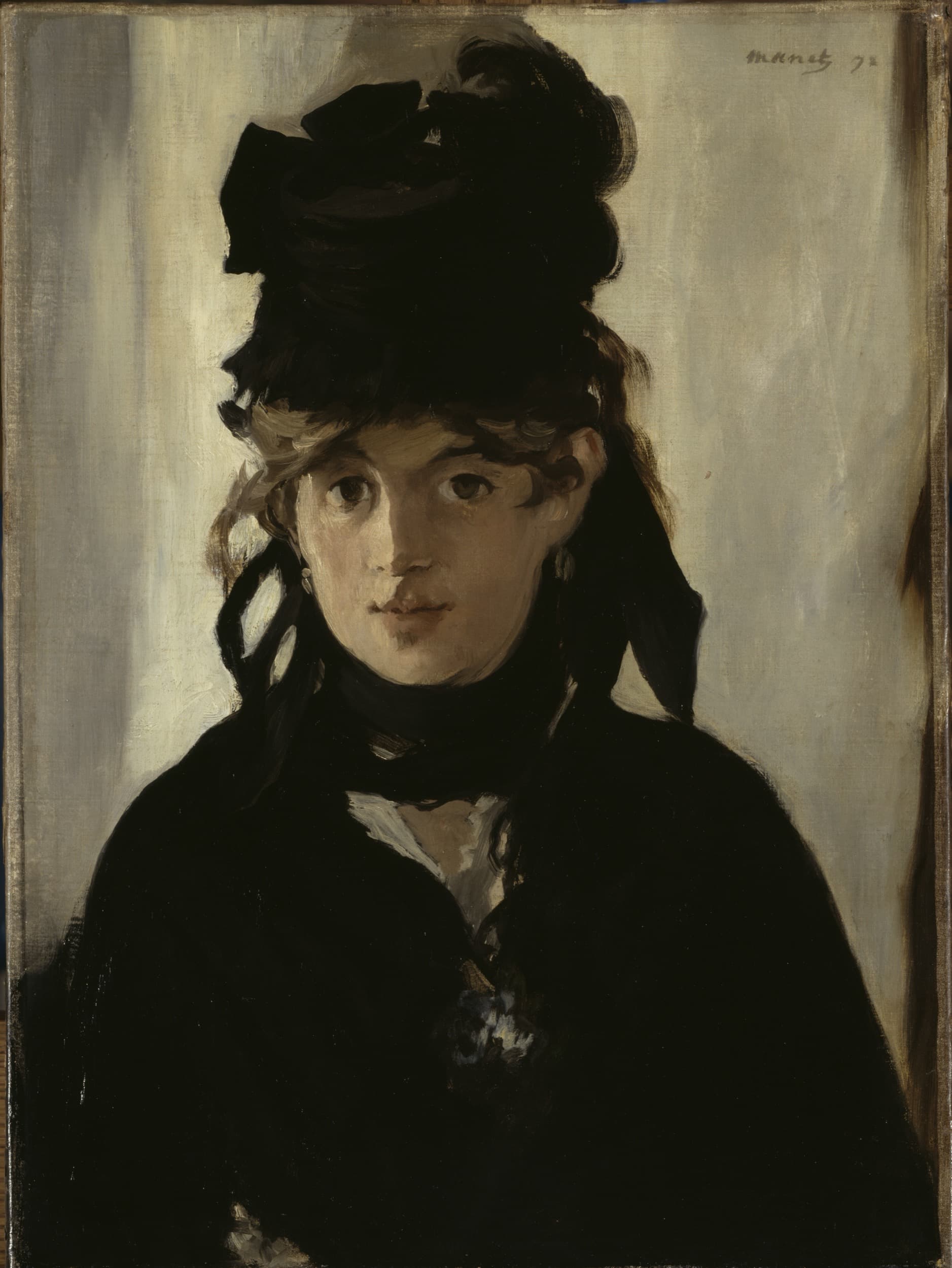
Édouard Manet, Berthe Morisot with a Bouquet of Violets, 1872. Oil on canvas, 28 ⅛ × 22 ⅝ inches. Courtesy Grand Palais/RMN (Musée d’Orsay).
Word count: 1532
Paragraphs: 10
March 29–July 5, 2026
Cleveland, OH
There is a critical scene in Agnès Varda’s film Cleo from 5 to 7 (1962) when the protagonist wanders alone into Le Dôme Café, sits, and orders a cognac. Though Cleo Victoire is on tenterhooks, awaiting medical test results, her apprehension is belied by her casually chic appearance, glowing hair and skin, and enviable, teeming cosmopolitan environs. On the restaurant wall hangs a poster for an Édouard Manet exhibition at the Musée Cantini, Marseille, featuring his portrait of Berthe Morisot from 1872—his friend the artist with a nosegay of violets, wearing a black hat, choker, and dress—glamorous and the eternal Parisian. The scene, at the midpoint of Varda’s temporally-based film, is part of a key transitional sequence, when Cleo has removed her wig and light-colored clothing and put on a sleeveless black dress and a black fur toque. In doing so, she reverts to Florence, her true self, and plunges into a public space. As Varda has noted in correspondence with the film critic and professor Howie Movshovitz:
First forty-five minutes: Cleo is described as seen by the others, defined by THE others. She is a doll. She is a princess. And she sees herself as the main subject. Second part of the film … She starts to see, to observe the others … From a passive person (she is looked at) she becomes an active person, she looks, she is part of a world.

Berthe Morisot, Reading, 1873. Oil on canvas, 18 ⅛ × 28 ¼ inches. Courtesy the Cleveland Museum of Art.
The focused and absorbing Manet & Morisot exhibition at the Cleveland Museum of Art, curated here by Heather Lemonedes Brown, begins with a room of four oils and three prints out of Manet’s existing thirteen portraits of Morisot, including the stunning painting from the Musée d’Orsay noted above. It establishes her as the object of Manet’s non-predatory gaze and appears to play into the trope of Morisot as a model for his experiments in studio realism in the period. But as one moves through the show, Morisot’s own pictures, in tandem with Manet’s, reveal her as the active observer, in fact the more lastingly commanding artist. And this cleverly designed shift, commensurate to Varda’s in Cleo, is brought to a crescendo in the concluding room, titled “Morisot After Manet,” in the form of self-portraits that bear an exciting intensity and a level of assuredness Manet never managed in his own self-imaging. Her penetrating and energetic self-portrait of 1885 at age forty-four anchors this gallery. Morisot—painter, wife, sister-in-law to Manet, and mother—has made herself subject and object. Rather than her being seen through Manet’s eyes, her own self-fashioning and self-definition closes the show, turning the tables on the expectations of these two artists, while highlighting the joint tragedies of the painters’ early deaths: Manet of complications from syphilis at fifty-one in 1883, and Morisot from pneumonia that she caught from her daughter at age fifty-four in 1895. Unlike Cleo, Morisot’s early demise closes the story, a tale more fully told through essays, timelines, and letters in the impressive catalogue.
This show, originating at the Legion of Honor in San Francisco under its lead curator and catalogue editor/author, Emily A. Beeny, has been reduced in size to just over forty works but not intensity. Despite the regrettable absence of masterpieces in the first venue such as Manet’s own Self-Portrait (ca. 1878), The Balcony (1868–69), and View of the Exposition Universelle (1867), the display makes the most of opportunities to juxtapose the two artists to mutual advantage. One stunning wall includes, from left to right, Morisot’s peerless and kinetic Lake in the Bois de Boulogne (Summer’s Day) (ca. 1879); Manet’s Boating (1874–76); Morisot’s aqueous stab at dolce far niente, In a Villa by the Sea (1874); and Manet’s Railway (1873), which is one of his greatest paintings and features the best puppy in the entire history of art. What is also striking is the size of the pictures. Manet’s are each over three feet high; Morisot’s are half the size. Manet’s studio compositions were made for the annual Salons, to advance his mission to upend the art world from within. Morisot was painting her life on cabinet scale. As Linda Nochlin asked in 1988 in her essay on Morisot’s Wet Nurse and Julie (1879, not in this show), “Why should the disintegration of form characteristic of her best work not be considered a vital questioning of Impressionism from within, a ‘making strange’ of its more conventional practices?” The root of Morisot’s more and more compelling modernism becomes admirably clear on this one banger of a wall in Cleveland. Nochlin saw this stylistic shift as possibly indicative of “a complexly mediated inscription of internalized conflict—motherhood versus profession.”

Berthe Morisot, Self-Portrait, 1885. Oil on canvas, 24 x 19 3/5 inches. Musée Marmottan Monet, Paris, Fondation Denis et Annie Rouart. Photo: Shelly Duncan Photography.
At every turn, Morisot ingested the spontaneity of en plein air paintings and challenged its end products. Early works like The Harbor at Lorient (1869), View of Paris from the Trocadero (ca. 1871–73), and On the Beach at Petits-Dalles or Fécamp, (1873) feature dynamic compositions which move from lower left to upper right into space, appropriate for a right-handed artist who delighted in hatching, her brand of tache. Each hangs beside Manet pictures similar in subject that flatten out form through planarity and parallelism. The latter may be more formally daring, and Morisot may initially be using perspective as a kind of compositional crutch, but her paintings have verve. Eventually the thinned-out paints of her early works give way to a delight in brushwork, in crosshatching as substance and building material. The museum’s own arresting slice of life, Reading (1873), signals this new approach. A woman, posed by Morisot’s older sister Edma, sits in the foreground, flipping through a book, its pages fluttering like those of the Virgin’s prayer book in scenes of the Annunciation, buffeted by the air from Gabriel’s wings. But this is no modern religious picture. While the woman has her eyes focused on the pages, the wall text reveals that originally they were locked on the viewer. She has cast aside her parasol and fan—the fashionable aegis of deflection—as a laborer with a haywain moves along a road in the background. This is a woman at ease, unthreatened, immersed in her inner intellectual life. The color is high, the construction is looser than Manet’s, the flickering and slippery brushstrokes flow along summer currents with Edma’s gossamer veil. Morisot has made her into something more radical than the object of the gaze.
Compare that to Manet’s so very posed In the Garden (1870), with its forward-facing female (also Edma), a lounging male behind her posed by the Morisot sisters’ younger brother Tiburce, and Edma’s baby at left in the pram. The surface is pure Manet fire, but the picture seems conventional in comparison. Elsewhere, Manet’s Woman Reading (1880–82) from the Art Institute of Chicago, with its chic subject sitting in a café holding a journal on a wooden newspaper stick while her eyes look beyond its pages to the off-canvas society around her, seems almost too self-aware. Despite their active surfaces and scenes of modern life in Paris, they now read as artificial. It is Morisot’s work that feels more radical, more urgent.

Édouard Manet, The Railway, 1873. Oil on canvas, 36 ⅖ × 44 inches. Courtesy National Gallery of Art, Washington, DC and the Cleveland Museum of Art.
To be clear, Manet is the greatest French artist of the second half of the nineteenth century, with a parade of vital works across all genres that critique, delight, and perplex in equal measure, and whose exposure and impact on modernism was profound and unparalleled. But in comparison with Manet, the radical nature of Morisot’s practice is more fully revealed. The exhibit traces their sustained friendship: first Manet influenced her, then her disintegration of form influenced Manet, but then Manet’s work again pushed her towards ever more brazen pictures. For example, I was mesmerized by At Bougival (1881), in some ways both her most idealized and deconstructed image. Her daughter Julie stands at left, handing white wildflowers to a seated young woman posed by the family nanny and maid, Pasie. It feels like a reworking of, again, an Annunciation, with the en plein air bravura of Morisot’s mature Impressionism replacing gilded heavenly backgrounds of the likes of Simone Martini. Pasie is idealized, beautiful, red cheeked and full lipped in a white dress, dark hat, and with free-flowing hair. Historians have not sussed out her surname yet, but Morisot readily conveys an image of her true self. And the slashing and crosshatched brushwork conveys a lush garden without subsuming the figures. At Bougival trades in unabashed visual splendor, while its activated surface communicates the artist’s considerable labor.
In the concluding “Morisot After Manet” room, Morisot’s 1885 Self-portrait also hangs. Notice the flowers on her left breast, on her gold jacket, like military regalia on a uniform. The barely described palette and brush in her hand at left. The gaze not at us but off to the right, past our shoulder. It is Morisot as an active person, as a part of the world and, thanks to a generation of art historians including Nochlin and Anne Higonnet (who has an essay in the catalogue), and the curators and essayists for this charged and revealing exhibition, her experience of life, like that of Cleo, is the story of her art.
Jason Rosenfeld, Ph.D., is Distinguished Chair and Professor of Art History at Marymount Manhattan College. He was co-curator of the exhibitions John Everett Millais (Tate Britain, Van Gogh Museum), Pre-Raphaelites: Victorian Avant-Garde (Tate Britain and the National Gallery of Art, Washington, D.C.), and River Crossings (Olana and Cedar Grove, Hudson and Catskill, New York). He is a Senior Writer and Editor-at-Large for the Brooklyn Rail.