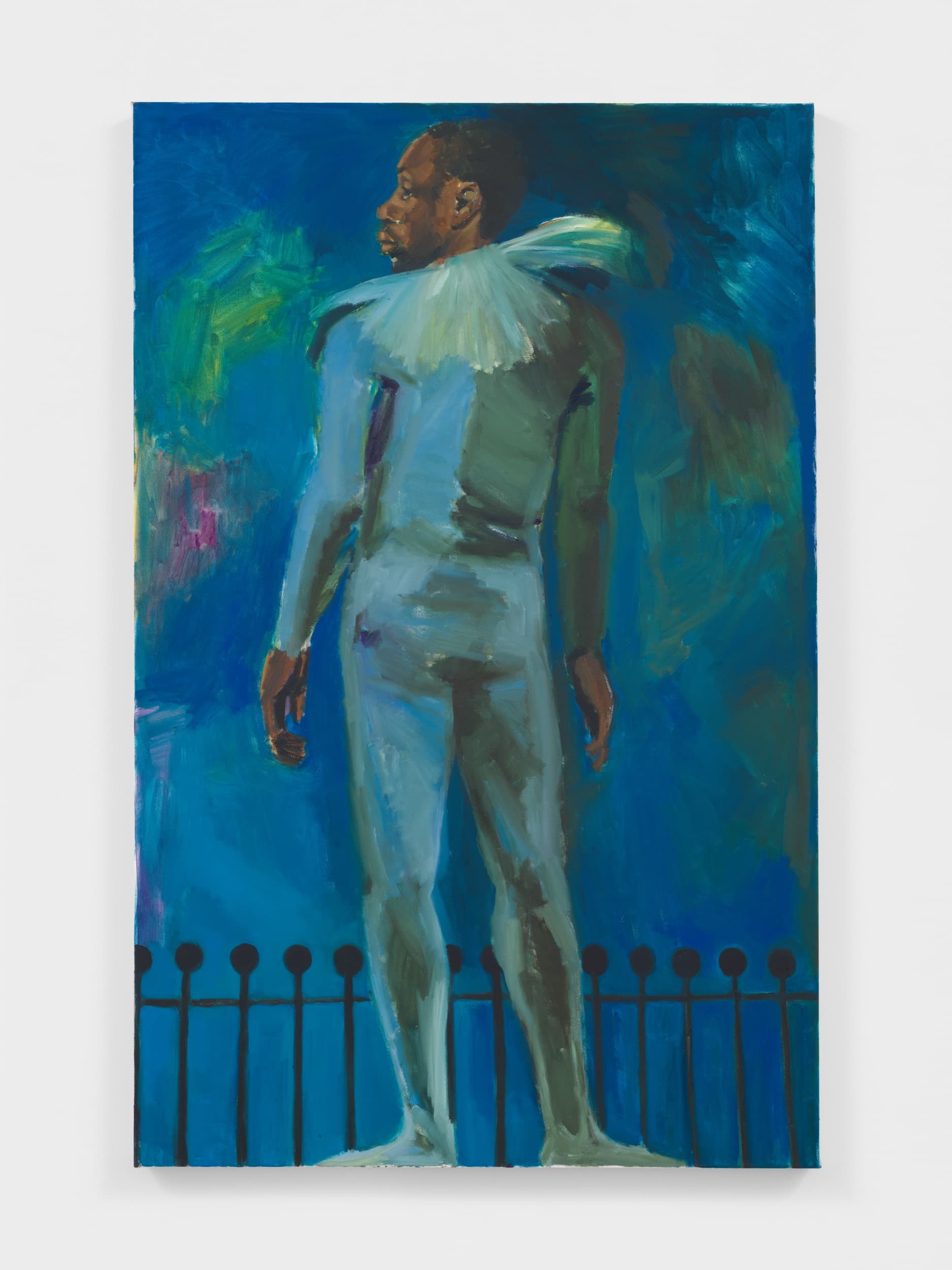
Lynette Yiadom-Boakye, Shining Honeycreeper, 2025. Oil on linen, 55 ⅛ × 35 ½ × 1 ½ inches. © Lynette Yiadom-Boakye. Courtesy the artist and Jack Shainman Gallery, New York. Photo: Dan Bradica Studio.
Word count: 1223
Paragraphs: 12
Jack Shainman Gallery
April 24–July 31, 2026
New York
If the English language, at its most debased and inhumane, is merely a colonial import—puncturing the spirit and cinching it subtly into subjugation—what then is the power in sacred chthonic storytelling? Well, if you’re where the radicals are, you know what they know: it is only through undressing language forced upon you and soaping it clean that one can bathe the mind anew and filch unnamed truths.
Many A Moonlit Caveat, Lynette Yiadom-Boakye’s latest exhibition at Jack Shainman, across both its New York locations, moves through this sinister knowing. It opens with the prose poem Wake-Keeper (2026): an eminent man dressed in a pigeon’s blood robe, his hands clasped, his eyes signaling the kind of wisdom that is not gleaned from book learning. His face is long, slightly wearied, but his skin ageless, his feet pampered and clean. If the journey was long or arduous, he remains physically unscathed. If he is drained, fed up, or simply seconds from going inward to meditate, he wears, most fastidiously, his propriety. Men in repose—especially those with sun-rich hues and clipped cashmere hair—are so rare a sighting these days that one is forced to stand in awe, to move closer to make sure your eyes are not playing tricks on you. The story etched in oil secretes, upon closer inspection, a kind of noble loneliness, a glaze of something bitter in its tender rendering. A black bird hovers just over the man’s shoulder, haunting him, or better yet, helping him, though the tale is not didactic and offers a gothic symbolism that makes the mind whir.

Lynette Yiadom-Boakye, Wake-Keeper, 2026. Oil on linen, 59 ⅛ × 51 ¼ × 1 ½ inches. © Lynette Yiadom-Boakye. Courtesy the artist and Jack Shainman Gallery, New York. Photo: Dan Bradica Studio.
For all its lonely menace and voluptuous sorrow, there is the impression of romantic life blooming across the painting’s linen—of life sustaining itself, evolving stronger, in the same fragile fashion of velvet-tinged tulips growing from the soil of thick, deep slime.
If we know that romanticism moves in cycles, always spiraling back to its primeval origins, we know that the gothic nightworld—defeated, raised, defeated again—is allowed, even for a moment, to be its own heaven. It took me time to fully enjoy that fact, as my own shallowness and love of Apollonian warmth and glamour makes me bristle when beauty terrifies. I was also impeded by an outmoded Black bourgeois sense of propriety I sometimes fall prey to, my own ridiculous snobbery needing a warmer mirror, better lit.
Yiadom-Boakye’s strength as a narrative designer, as a storyteller—for painter is too thin a description—lies in her refusal to script a marked moral content, and in how many transgressive moments she makes a viewer re-read. Her titles reveal a mirth a melancholy mind will miss, and her characters may agitate a viewer malnourished on a diet purely composed of Marvel films and clinical, automated stereotypes. However fictive her worlds are, with their self-dissolving mistiness and Dionysian haze, in this showcase they feel more fleshed than ever, more desirous and ambivalent, more human than most contemporary editorial spreads. If today’s films and photography relax their theatricality for the sake of an algorithm, Yiadom-Boakye relaxes nothing, least of all her rituals and standards.
Take The Honour Between Thieves (2025). A figure in white trousers performs a shoulder stand against a sky divided between streaks of cobalt and warm rose, legs thrust upward, hands gripping their spine, as a magpie rests atop their flexed toes. There is very little happening in the frame, but the simplicity is nearly baroque in its offering of metaphor and theory. So saturated, even on their back, in such refined air—evading surveillance, evading a flattening gaze—there is an impressionistic streak across the dancer’s face that feels as if, in the middle of creation, Yiadom-Boakye considered scrubbing it entirely, as if to preserve the dancer’s self-esteem. This could be an oil poem about the economy of who holds the body up to transcend gravity, and what wild thing alights at the apex of that effort, or it could simply be a still from a day in the dancer’s life, a moment in which they are simply circulating their blood. Neither the magpie nor the swirl of color that surrounds the dancer explains itself. Half classic, half romantic—with that bite—her work holds a mode of eroticism rarely engaged with by scholars.

Installation view: Lynette Yiadom-Boakye: Many A Moonlit Caveat, Jack Shainman Gallery, New York, 2026. Courtesy the artist and Jack Shainman Gallery.
In Black Deference to the Cunning (2025), that sexiness comes fully into the light. A man stands loose-limbed and grinning on a checkered floor, electric with ease, while a fox at his feet gazes upward with an attention that is not quite animal, not quite devotional, but is without question erotic—devastatingly so because he retains a presence that doesn’t allow for any projection. He taunts you as only the best heartbreakers do, smiling like one of those men who lie so well you can only admire their armor. Yiadom-Boakye doesn’t simply evade an easy reading—at her best, she blazes into centuries of appropriated folklores and offers back the most humbling truths.
The sacred charge running through this canvas—through the fox’s upturned face, through the man’s full and unapologetic aliveness—is the “mask-off” moment of being truly seen: its pleasure, its terror, and the grin that has made its peace with any projection. Here the fox does what the critical establishment cannot—it refuses to be polite about what it wants.
Shining Honeycreeper (2025) remains my favorite and the exhibition’s perfect elegy. I remain a gone-with-the-wind dreamer, willfully resistant to all the crudeness of reality, swept up in the air of my own imagination, so I chose to see Yiadom-Boakye’s stories with a patina of high fantasy. I see a long-lost prince, petulant and willful, dropped down to a place not to his liking. In blue-gray leggings and the most ruffled rococo collar, he stands before an iron fence with his back turned and his gaze directed toward something that seemingly displeases. A smattering of birds, whose plumage matches his own garb, enunciate how far he may fly. Yiadom-Boakye places him inside it not as appropriation or critique but as a sovereign claim: He is dressed, based on his posture, for himself. He is not performing for you. His dignity does not display itself, but persists, seriously and without your permission.
Across thirty-eight offerings, Yiadom-Boakye’s tales flip trite questions like “Can the subaltern speak?” on their head. Much has been written about her preference for ambiguity, her willful deflection, and though this is made plain by the quality of the oil painting itself—a quality of wiping clean as much as building up—one wonders if her psyche too is engaged in the radical act of correcting apartheids of knowledge that thread through so much of art history. In Many A Moonlit Caveat, the quality of her oil sharpened into what I can only call black ice: its clarity deceptive, its surface brilliantly lit, its treachery underfoot and in the eye of the beholder. Because if these are not portraits but stories that may offer clues to survival, you need only look into the eyes of Sunbird 6 (2026)—charcoal on paper, a man curled into himself, festooned in feathers, eyebrows raised as if to suggest unimpeachable pride, lips pursed as if to say plainly, “Even if there are ciphers of history which society may not be ready for, they’ll haunt you all the same.”
Killian Wright-Jackson is a contributor to the Brooklyn Rail.