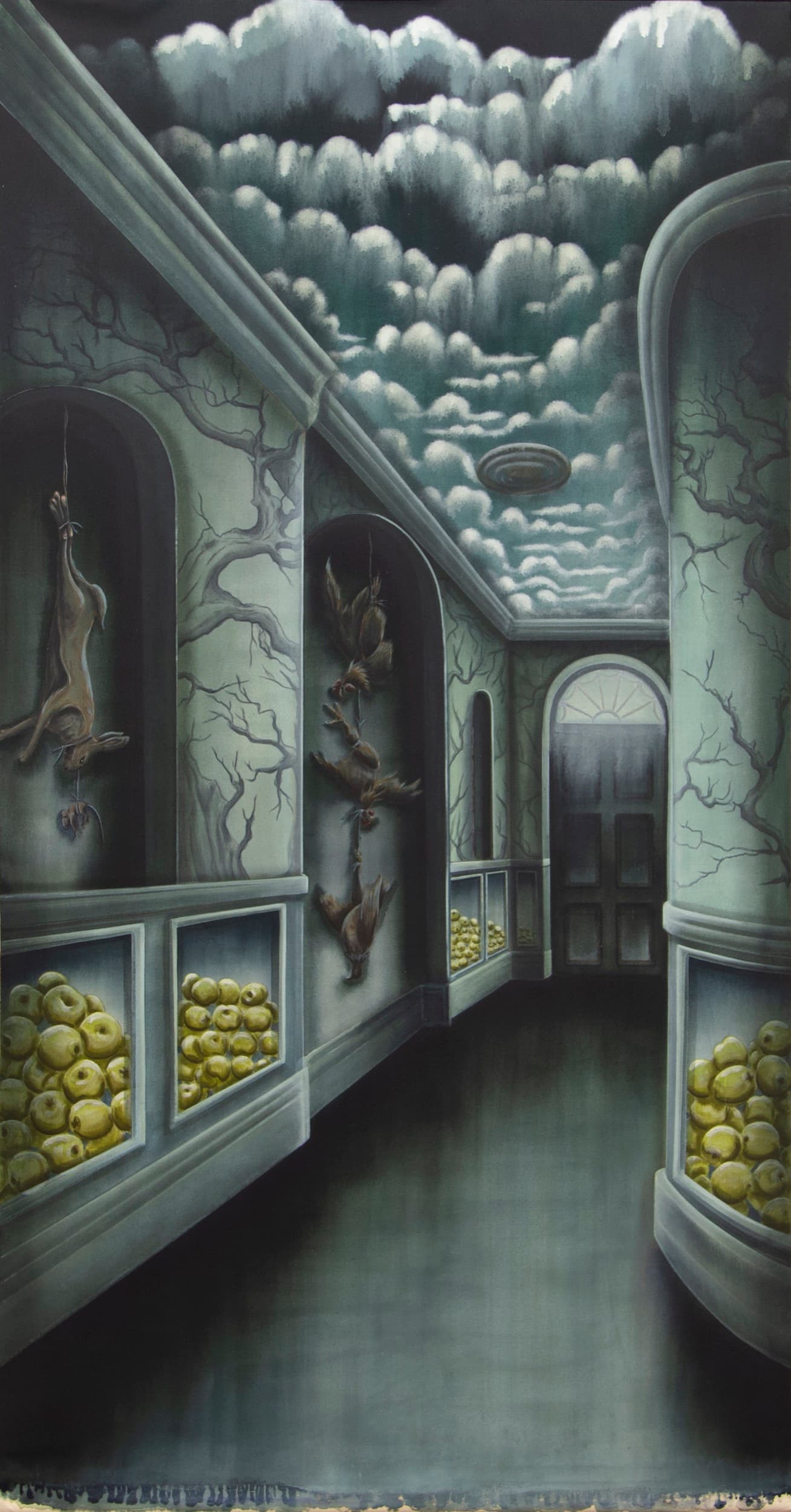
Kati Henning, Tangled Up in Blue, 2026. Acrylic on canvas, 102 ½ × 54 inches. Courtesy the artist and dieFirma.
Word count: 596
Paragraphs: 7
dieFirma
April 30–July 25, 2026
New York
Kati Henning’s rather chilling show is understatedly titled An Unquiet House, setting the tone for an autobiographical roundup. Many stories are being told in these paintings, wrapped in a scruffy web of fathomable and more obscure symbols. Henning does a cinematic take on both realism and fantasy, letting her imagination thrive in the realm of the decidedly real and the charmingly supernatural.
Much to the point, Henning begins by claiming exhibition territory at dieFirma, housed directly next door to the former headquarters of the edgy downtown publication, The Village Voice. The tunnel-like space leads us on a journey that’s something less than modern, yet feels of the moment—scary and unpredictable. Henning draws from many worlds and many pasts in her large acrylic-on-canvas paintings. They range from the fields of the deadpan Grant Wood-style Gothic; through the richly intimate and ornate interior settings of Renaissance and Rococo, embellished with sculptures of mythological animals and statuary; into more conventional images from nineteenth-century Romanticism to mid-twentieth-century American regionalism; and finally to science fictional descriptions of unnatural, dark looming skies. We see a bottomless world with atmospheric dripping, created by washes made with a garden sprayer, preventing us from ascertaining our place in the firmament and most forcefully warning us of what we as humans are losing.

Kati Henning, Purple Kitchen Skies, 2024. Acrylic on canvas 16 × 20 inches. Courtesy the artist and dieFirma.
The artist cites her upbringing in Union County, Ohio, in a strict, conservative religious community, surrounded by Amish and Mennonite societies and noted for their rejection of ornamentation, playfulness, and excess as inspiration for her depictions of spare, dreary landscapes and dwellings built on sensory deprivation. As a teenager she periodically lived in a tent in a cornfield with an outhouse to escape the anguish and turmoil of her home life. It’s perfectly natural that rot itself is the subject of many paintings. She portrays her home as a horror house, with a winding stairway leading to nowhere, grass growing at the foot, and cases of apples filling glass-enclosed cabinets along a hallway and a dead animal hanging from an alcove, in the painting drolly titled Tangled Up in Blue (2026).
Henning succumbed to a life of rebelliousness in which she found she could turn horror into a potentially optimistic, idyllic future—a dreamscape of her own creation. She portrays cornfields in her Coral Skies and Corn Field (2024) as tall stalks outside her windows accompanied by a sky—interior and exterior—filled with stylized, bilious static baroque clouds. She furnishes her settings with abundant details, many of them culled from architectural fittings and discarded objects she dug up from the fields, including Victorian-style ceramics and hardware. An especially poignant touch is a phone dangling on a cord along a flower-papered kitchen wall. It won’t be answered, just as the meal set out presumably for a family on a large dark wood table won’t be eaten. There are also doorways that won’t open and windows framed in otherworldly colors, as in the van Gogh-ish Purple Kitchen Skies (2024).

Kati Henning, Coral Skies and Corn Field, 2024. Acrylic on canvas, 16 × 20 inches. Courtesy the artist and dieFirma.
Henning’s is a narrative of wishing and regretting, jam-packed with nostalgia, anger, fear, and terror in the details. Accompanying it all are a few hopeful, optimistic touches, such as the presence of a rabbit as a recurring symbol appearing at the foot of a bed, perhaps touching on the notions of fecundity and transformation. Henning takes us on a trip through an exciting and perilous Oz-like land, where nature and nurture vie for ascendancy. In the end, it may be simply that there’s no place like home—like it or not.
Barbara A. MacAdam is a New York-based freelance arts writer.