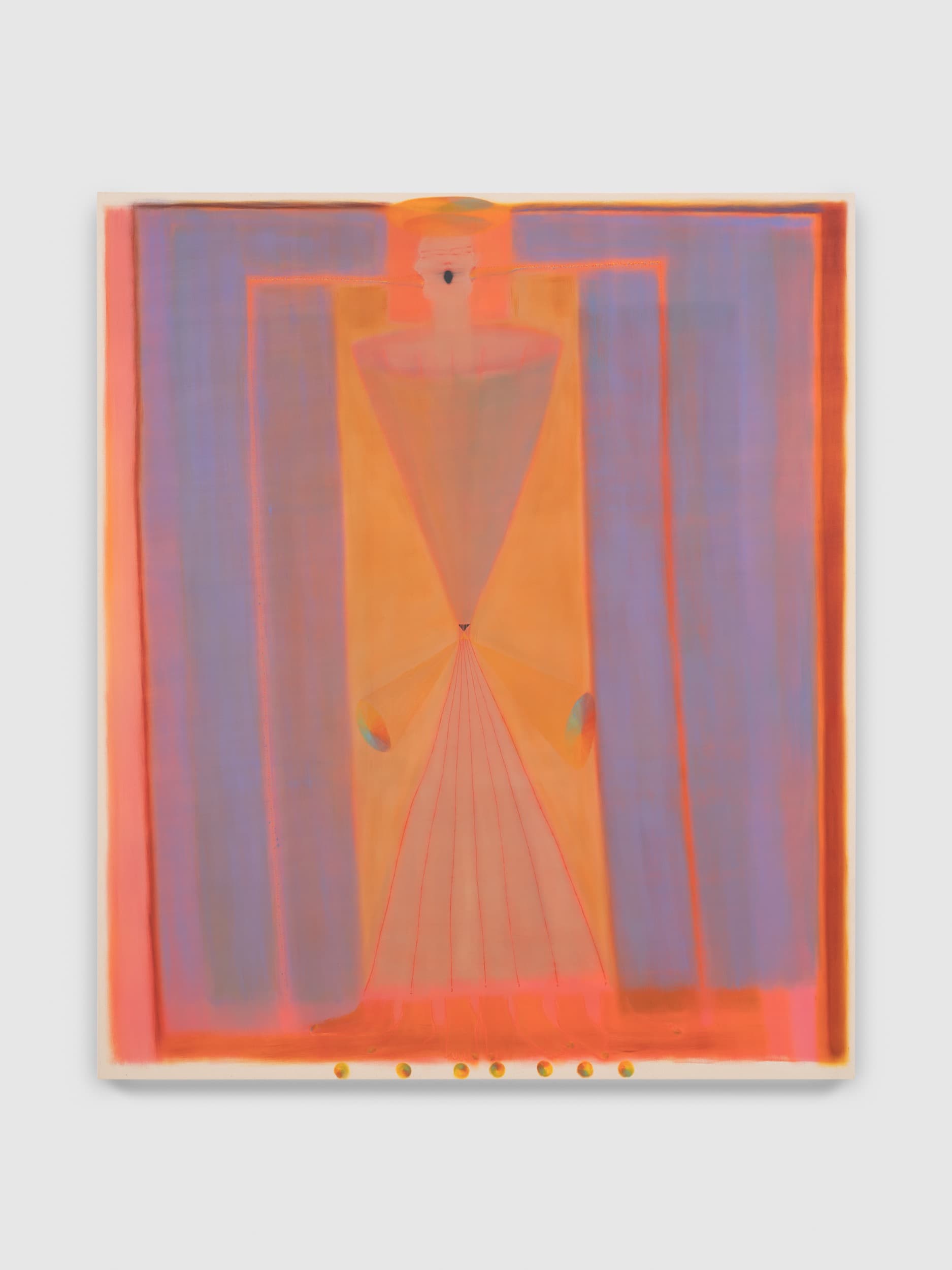
Amorelle Jacox, Movement (mother), 2026. Oil on canvas, 76 × 65 inches. Courtesy the artist and Management.
Word count: 818
Paragraphs: 7
Management
April 29–June 7, 2026
New York
Hannah Arendt’s concept of natality reframes the world through its endless beginnings. Significantly, it is also a rejection of the patricidal drives of replacement and imagery of the canonical avant garde of the last century, framing instead a life cycle that is separate from the death drive. Amorelle Jacox’s paintings rekindle earlier flames from the perimeters of art’s history, finding new approaches to deal with the faded and phantasmagoric nature of our current world. In her exhibition Mothers of Time, currently on view at Management, the figure is more present than in previous works. But still, Jacox’s figure is barely perceptible, kept precisely at the edge of visual registry, and appears more like channels of the deep space of the painting than bodies. Jacox reveals what can be loosened from the soft vibration of subtle differences, and the mystic knowledge that can be learned from weaving in and out of void and losing the body’s outline to its environment. Ultimately, the work suggests that the sensitive knowledge of the painter’s hand is an epistemological countermeasure to the limitations of modern art.

Installation view: Amorelle Jacox: Mothers of Time, Management, New York, 2026. Courtesy the artist and Management.
In Jacox’s work, the artist consigns soft stains to broad areas of canvas, trusting these uninterrupted dispersions to hold the soft lines that subtly break their borders. In Movement (mother) (2026), shimmering curtains of soft lavender, tangerine, and deeper oranges ghost each other. In it, the head of the tilt-a-wheel mother appears tripartite. Emanating from their polyphonic mouth is the stippled cadence of primary colors, permeating outward, directionally, as spectrums, as ecstatic rhythms, and as a careful language of the artist’s delimitation. Along the raw canvas edge, Jacox aligns a series of color wheels, spinning in autonomous directions. Of all of the paintings in the exhibition, Movement (mother) best demonstrates the artist’s use of layered color. The ultramarine blue, layered against orange, creates a fugitive gray that almost escapes our ability to perceive it. Things come and go.
For many of the other paintings included in the exhibition, Jacox limits herself to carefully chosen hues that she lays out scarcely on the canvas. This creates an effect of hiddenness, a palette discovered at fade-out’s edge. In Number (mother) (2026), Jacox paints in maroon to render a scene of warm shadow. The figure stands across the domains and creates a triangle with the zone of light reaching up, as if to swallow a sword or hold a relic in her hand. In Shadow (mother) (2025–26) a figure is encased within another. Their bodies are inter-channeled. A string of light divides the painting and gently forms a circle around the figures’ feet. It is a ceremony opening up a bismuth yellow portal nearby. The triangle and the portal are recurrent motifs within the work. The triangle carries the mystical symbolism of manifestation, but also directly connects to Hilma af Klint’s altarpieces. It also, historically, recalls the pyramidal compositions of the Madonna and Child paintings of the Renaissance. Manifesting permanence of the infinite—how painting can be the place of that and its own natality, the role of the mother’s ability to give life—is a painting’s enduring virtue.

Amorelle Jacox, Light (mother), 2025–26. Oil on canvas, 76 × 65 inches. Courtesy the artist and Management.
It is interesting to note that Paul Klee aimed to derive a theory of painting around the concept of motion. In his notes on painting, he designated form-making as a relation to the primordial feminine. Jacox’s work seems to carry on from the lineage of Paul Klee, specifically his mystical period, and the work of other mystics and Orphists such as Robert and Sonia Delaunay, especially their interest in creating harmonic color systems through the chambering and color-blocking of distinct and adjacent color areas. But it also shares a way of depicting the figure consistent with Hilma af Klint and later, Susan Rothenberg (and her Mary I [1974]), who both kept to simple form and outline as a way of losing the body into the ground. Jacox’s style is a soft mosaic form of painting that balances stable rhythm with emergent form. However, she balances these harmonies on an unstable edge, on borders of raw canvas that wedge, tilt, and careen the soft voids of space into modernist evocations of weight and movement.
In her 1997 book Wet, Mira Schor establishes that the ground of a painting is a feminist space. Staining, spilling, pouring, and rubbing are the words that counteract the individualistic and mystifying language of the patriarchal mark. The mother as an archetype and genre figure reminds us that the knowledge produced by the hand of a painter is a progenitor. She is a self-pronunciation of life and form. And the eye that sees color in the low levels of light, and slowly pulls the figure out from fill, is able to do away with the unnecessary binary of abstraction and representation, to multiply each of their aspects outside of historicizing bounds.
Andrew Paul Woolbright is an artist, gallerist, and Editor-at-Large at the Brooklyn Rail, living and working in Brooklyn, NY. Woolbright is an MFA graduate from the Rhode Island School of Design in painting and is the director of the Lower East Side gallery Below Grand. He currently teaches at Pratt and School of Visual Arts in New York.