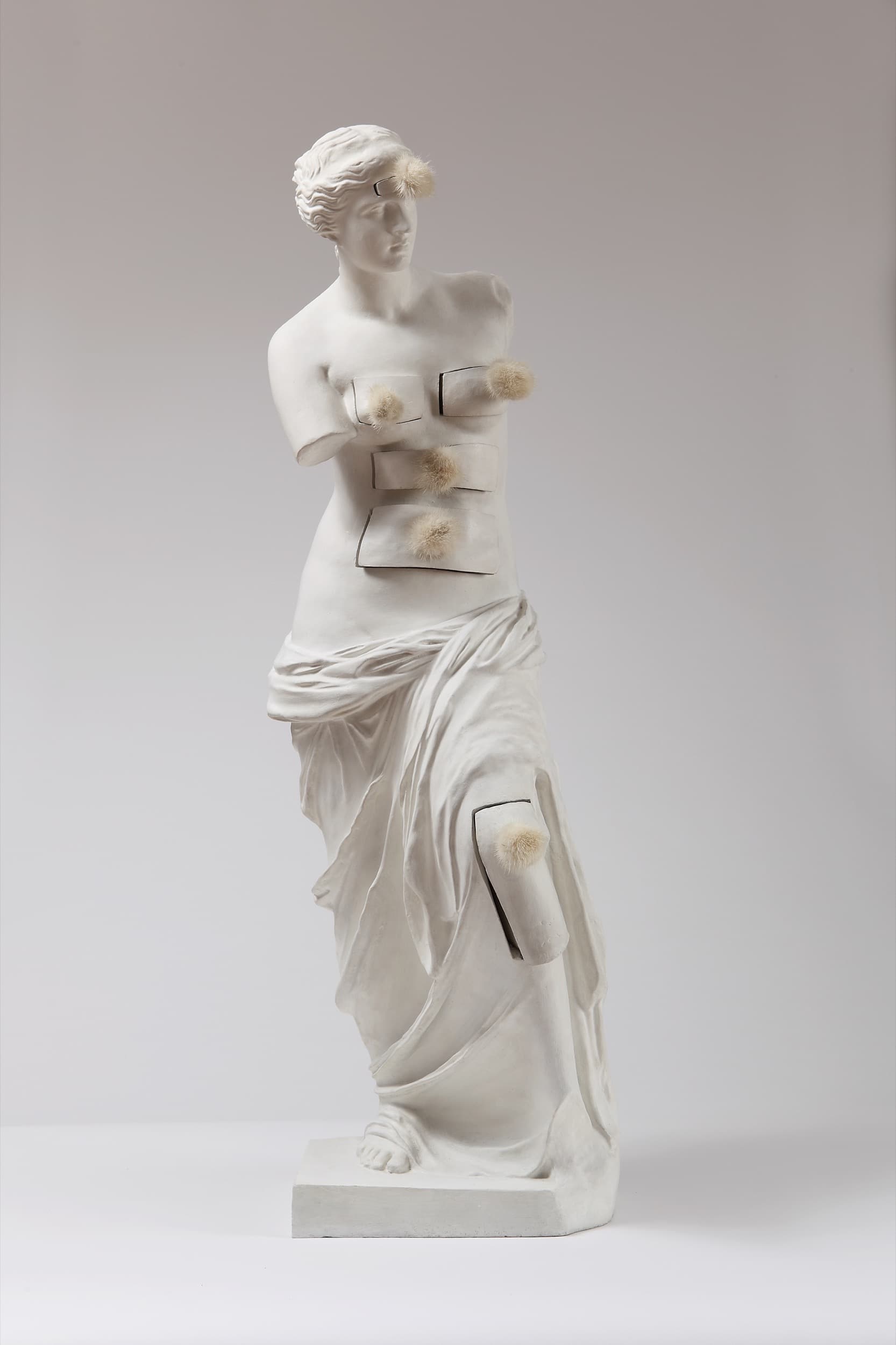
Salvador Dalí, Venus de Milo with Drawers, 1936/64. Painted bronze and mink pompoms, 38 ⅜ inches. © Salvador Dalí, Gala-Salvador Dalí Foundation / Artists Rights Society (ARS), New York.
Word count: 820
Paragraphs: 11
Di Donna Galleries
April 18–June 13, 2026
New York
Is it a mere coincidence that the Di Donna Galleries presents “the most radical and transformative decade of Salvador Dalí's career” at the same time as Marcel Duchamp is celebrated in the city with great ceremony? Duchamp, as usual, takes precedence, on view throughout the extensive sixth floor at MoMA and at Gagosian’s Madison Ave gallery. Let me remind the reader of a few little-known details. Dalí helped make Duchamp’s suitcases during the war. The two also collaborated on installing Étant donnés (1946–66), whose door came from Dalí’s hometown. Dalí contributed to the piece by creating the illusion of the shimmering, flowing waterfall of the background. Dalí and Duchamp were once neighbors in Portlligat and Cadaqués, respectively.
These concurrent exhibitions encourage us to see the major similarities that unite them: the modified readymades, for example, such as Venus de Milo with Drawers (1936/64), the Retrospective Bust of a Woman (a 1930s hairdresser’s mannequin head) (1933/77), and the lobster telephone. Very fine replicas are on display at the Di Donna gallery. The catalogue certainly emphasizes the supposed unconscious significance of all these objects, but they are above all a reflection on the mass production of over-familiar cultural objects that Dalí takes pleasure in discrediting, as well as a subversion of the boundaries between fine art and everyday utilitarian objects such as furniture.

Installation view: Dalí: The Great Years, 1929-1939, Di Donna Galleries, New York, 2026. Courtesy Di Donna Galleries.
The chronologically arranged Dalí exhibition includes wonderful works from the thirties but neglects the enormous change in Dalí’s art at the end of this decade. In fact, a significant rupture occurred: the artist relocated to the United States and began distancing himself from painting, redirecting his creative energy toward ballet, with works such as Bacchanale and Tristan Fou. Was this transition truly as seamless as it appears?
After his collaboration with Luis Buñuel, Dalí intended to continue along this path and, beginning in 1939, turned to Léonide Massine to stage Bacchanale, following in the tradition of painters who before him had collaborated with the Ballets Russes. Many of his costume designs published in American fashion magazines corresponded to stage projects. The exhibition catalogue includes a rare photograph of Coco Chanel standing before a fireplace, on whose mantel rests Dalí’s stage costume canvas for Lola Montez: a double image of a flamenco dancer virtually transformed into a skull, which concluded the ballet Bacchanale.
Another gouache-and-ink study (1939) features an elaborate helmet inspired by Harold Eugene Edgerton’s famous milk-splash photograph. A white swan emerges from this elaborate helmet for Ludwig II. The bird’s sinuous neck becomes the graceful arm of a dancer. A blot of ink serves as the dark backdrop for a ballet scene in which the dancers resemble dandelion seeds. A brochure displayed in a showcase refers to this imagery, though it is difficult for a non-specialist to decipher. The catalogue essay does not explore this perspective, although the world of theater was fundamental to Dalí. His museum in Figueres is a theater-museum. His choice of the loudmouthed Mae West—known for her bold wit—as the model for his Lips Sofa speaks volumes. The show presents an exquisite drawing for the project (1937) realized with the collaboration of designer Jean-Michel Frank.
Not all the works on view carry the same weight. Alongside drawings and preparatory studies for a stage curtain and for choreography are masterpieces. Everyone will appreciate Dalí as a miniaturist and colorist in works as significant as The Profanation of the Host (ca. 1930), The Weaning of Furniture-Nutrition (1934), or Nocturnal Spectre on the beach (1935). His talent as a painter is immeasurable.

Salvador Dalí, The Profanation of the Host, ca. 1930. Oil on canvas, 39 ⅜ × 28 ¾ inches. © Salvador Dalí Museum, Inc., St. Petersburg, FL, 2020. © 2026 Salvador Dalí, Gala-Salvador Dalí Foundation / Artists Rights Society (ARS), New York.
But what predominates—and sets Dalí apart, at a distance from Duchamp—is the emphasis placed on sexuality in its most organic form. In his writings, which were highly forward-looking, Dalí repeatedly ridiculed the concept of the “eternal feminine.” That traditional sexist stereotype takes shape in the breasts of the Venus de Milo, represented as empty drawers. They proliferate in the famous modified appropriation of the statue itself and spread into other works as well. In Anatomies (ca. 1937), executed in the decalcomania technique, six pairs of breasts appear as black reserves, except for one woman whose breasts are represented as two empty drawers.
Long before Judith Butler, Dalí wrote extensively about deconstructing gender in his Surrealist essays. I cannot help but see the drawer-breast isolated within a vast empty space in the 1936 gouache-on-paper presented at the Di Donna Galleries as profoundly symbolic of that approach. This empty drawer, larger than life—rendering the heterosexual couple in the background insignificant—overturns the world of binary sexual identities far more radically than Rrose Sélavy and the other costumed personae of Marcel Duchamp.
The two artists certainly shared a mutual admiration and long friendship. It may therefore be worth reconsidering how each revisits objecthood not as material presence alone, but as a fragmented and eroticized structure of desire.
Frederique Joseph-Lowery is a curator and author. She is a specialist on Salvador Dali.