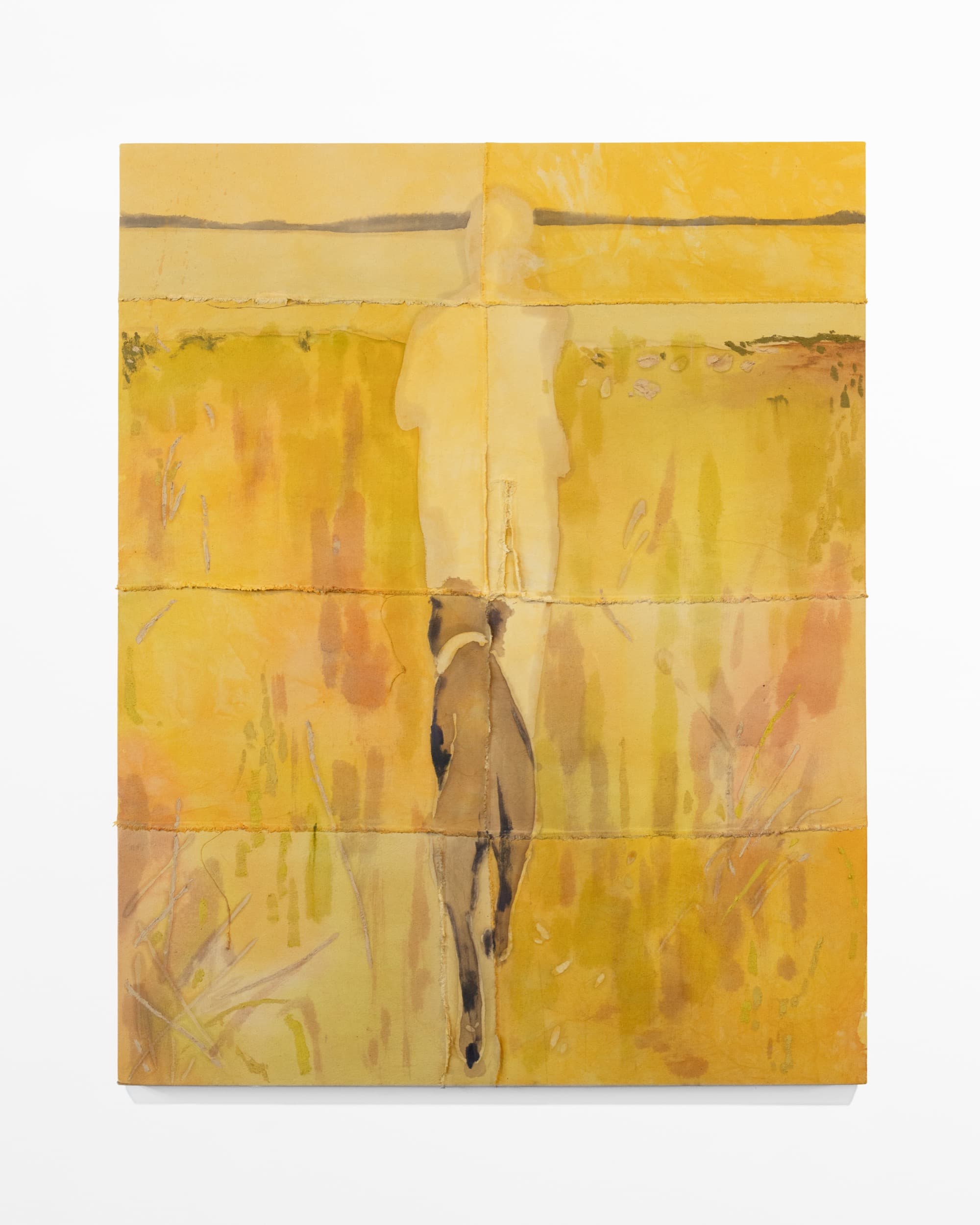
Tessa Greene O’Brien, Izzy in the Field, 2026. Oil, bleach, wax resist on dyed and sewn canvas over panel. 60 × 48 inches. Courtesy the artist and Alexandre.
Word count: 864
Paragraphs: 7
Candice Madey
April 23–May 22, 2026
New York
Alexandre
April 23–June 19, 2026
New York
Poems from Here, the title of Tessa Greene O’Brien’s first solo show in New York, evokes the sensation of viewing her Maine landscapes across the twenty-one works from 2026 that make up her dual-venue exhibition, at Candice Madey and Alexandre. While we are constantly aware of the “there” of the scenes shown, whether moody coastal cliffs or fields drenched in colored light, the artist’s process heightens an awareness of the physicality of the object and keeps us riveted to the immediacy of our experience viewing it. Beginning with pieces of dyed canvas that she stitches together in raised grids, she un-stretches and re-stretches over panel what emphatically begins (and in some ways remains) a textile—bleaching, waxing, and ironing it in a batik-like exercise. Finishing up with brushwork, she elicits images that counterpoint direct and indirect mark-making. She masterfully achieves that play in Cow Parsnip (Gilman Wass Field), in which stained darker blotches are set to churning across the field as if registering the shadows of clouds circulating above. The sunlight of late summer manifests in an all-over golden tonality with flecks of paint picking out wildflowers near and far, moving from color literally within the surface to delicate impasto atop it. One is reminded of Helen Frankenthaler’s abstract landscapes of the early 1980s.

Installation view: Tessa Greene O’Brien: Poems from Here, Candice Madey & Alexandre, New York, 2026. Courtesy the artist and Candice Madey & Alexandre.
Half of the works on view are 36 inches square, some are larger (generally 60 by 48 inches), and the grand winter scape Crescent Beach, Deep Winter, which depicts a vast stretch of melting snow and muddy flats, clocks in at 80 by 72 inches. While she focuses on lonely spots ranging through the seasons, her scenes also frequently include a single human figure, sometimes diminutive and trudging into the distance, and sometimes more prominent, materializing or dematerializing, and registering more like a state of mind than a position in space. In Izzy in the Field, a ghostly, lemon-yellow silhouette figure is joined by a dog that follows behind. Placed directly at the center along a vertical seam, the two are headed through a field toward coastal water, seemingly measured in their progress by several raised horizontal seams. In Jasper Beach, the human figure is transparent, discernible only in an electrified outline as if beamed in from a distant planet; details of the surrounding field comprise its substance, as do small light bursts of what look like stars in its upper portions.
In such works, we feel the experience of a protagonist so immersed in their rambling—and seeing—that they become inextricable from the place. O’Brien uses color to heighten this sense of absorption. She is, in fact, a wonderful colorist, as in her choice to fashion a fully chromatic night in Purpoodock Night Ski, where a lone skier is barely visible in a winter field purple and dun and lit by flashes of orange—perhaps a reference to the northern lights. Sometimes she relinquishes verisimilitude altogether, as in the diminutive Elm Tree, Night Walk, a mainly red painting (composed on fabric from a repurposed life preserver) that splits into pink in the upper portion of the tree. Is it really night? Unexpected daubs of color energize her paintings as in Mill Creek, Night Skate, where specks of vermilion and green sparkle within a screen of white brushstrokes—the conveyance of a heavy wet snowfall. In Northern Bayberry, Cliff Walk, inexplicable touches of blue surface here and there within a patch of goldenrod as the vermilion of bayberries dances upward. Nondescriptive touches of color everywhere animate the painting as such. A painting is, after all, a “site of memory, labor, and material history,” as Annabel Keenan writes in the excellent essay for the show’s publication.

Tessa Greene O’Brien, Purpoodock Night Ski, 2026. Oil, bleach, wax resist on dyed and sewn canvas over panel, 36 x 36 inches. Courtesy the artist and Candice Madey.
Northern Bayberry, Cliff Walk also presents another of O’Brien’s favored subjects: a tree—in this case a leafless white birch—located directly at the center of the composition. Its branches frame a house and mountain above, as if to acknowledge a kinship; higher still is a narrow horizon alive with storm clouds. In the darkening ambience, a mood is set. O’Brien can favor the center of the canvas for such occupancy: a single pine, an aura of gold around its edges (Cow Parsnip); a spider web alight with dewdrops, reminiscent of works by her fellow Mainer, Lois Dodd (Cow Parsnip Spiderweb, Addison); a large plant spreading its fronds like ragged arms (Addison Goldenrod). O’Brien pays open homage to other painters associated with Maine as well: to Katherine Bradford in her diminutive figures immersed in color fields, and to Marsden Hartley in her walls of dark, looming pines dwarfing the human. Her animist spirit harkens back still further, to Romantic landscapes such as those by Caspar David Friedrich, where nature both reflects and dissolves human subjectivity. Still, hers is a gentle relationship with her viewers, never overpowering. The intimacy of her conception allows for an experience little disturbed by intimations of the sublime, let alone the vexing troubles of an endangered nature. In offering up such variety and beauty, she asserts nature’s resilience, and the world’s remaining openness to a companionable viewing.
Faye Hirsch’s forthcoming book, co-written with Ingrid Schaffner, is In The Company of Artists: A History of Skowhegan School of Painting & Sculpture (Hirmer Verlag).