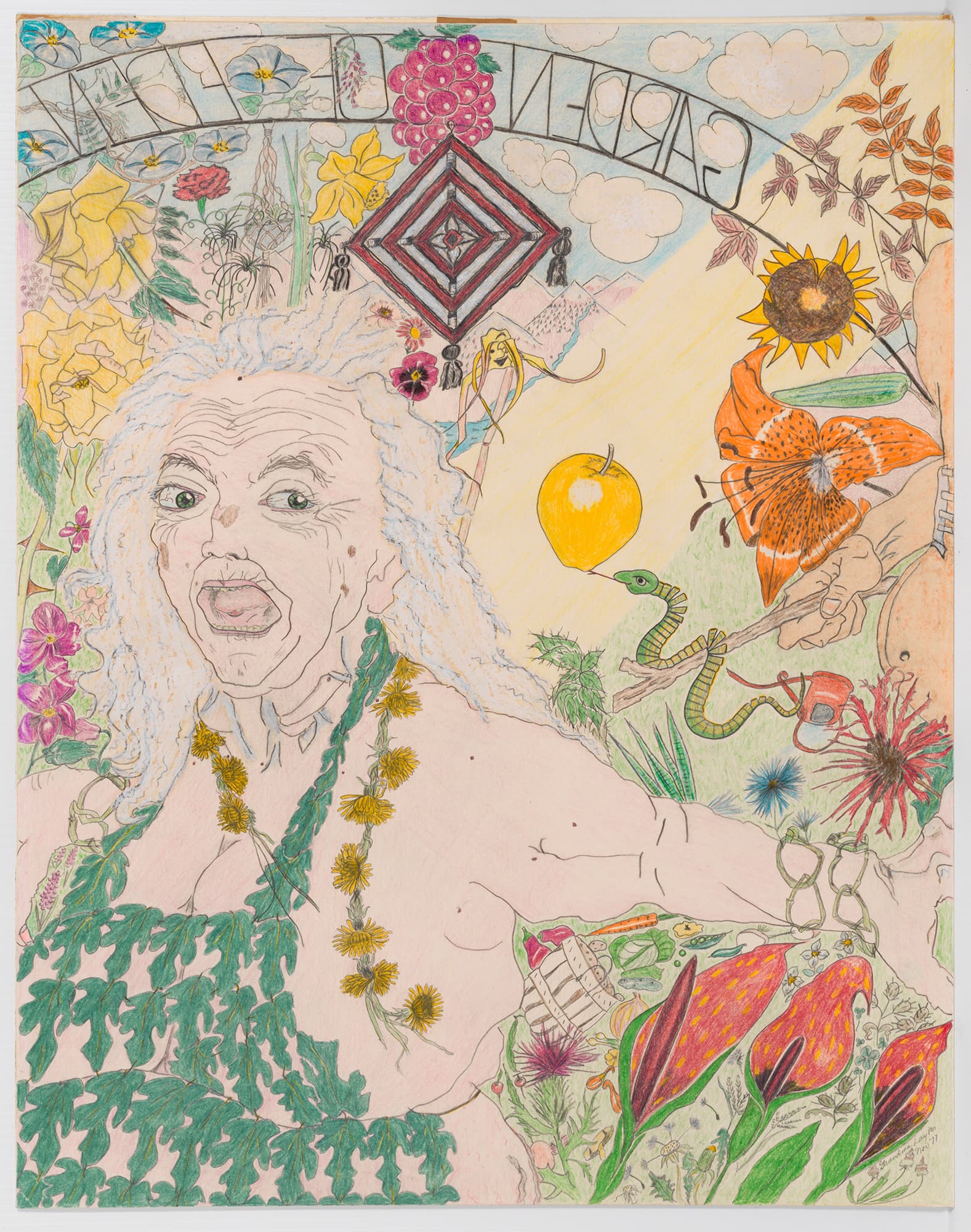
Elizabeth Layton, Garden of Eden, 1977. Colored pencil and graphite on paper, 24 × 18 inches. Courtesy American Folk Art Museum, New York.
Word count: 865
Paragraphs: 5
American Folk Art Museum
April 10–September 13, 2026
New York
Writing as an artist, looking at the exhibition Self-Made: A Century of Inventing Artists at the American Folk Art Museum makes one question the rules of composition, perspective, proportion, color matching, etc. These rules are not specific to art in the West; every society that engages in institutionalized art making—from the court of Louis XV to the Dogon, to the Maya, to Heian Japan—has rules. The argument is usually that self-taught artists were not inculcated into the orthodoxy of image-making, and thus work beyond the confines of aesthetic and societal expectation, for better or worse. Sister Gertrude Morgan’s 1970s painting The Greater New Jerusalem breaks most of the rules I learned in art class: she presents two tiny figures, a bride and groom, in the lower right hand corner of a massive edifice in which the activity in over 240 rooms is obsessively presented. Around this edifice hovers a holy choir of female, possibly angelic heads. Perhaps the firmest rule that Morgan breaks is in her depiction of a white groom and a Black bride, along with an interracial women’s choir. But we will focus on composition here. Attempting to capture this teeming activity on such a small scale is overwhelming, but Morgan has created a hierarchy that divides the figures and spaces, in effect creating a new set of personal rules resulting in a functioning whole, a methodology formulated over a long, alternative career. The same is true in Madge Gill’s tightly drawn, elaborate networks of faces peering out from a flowing and tumultuous cascade of sumptuous Art Deco attire. Gill has chosen to render her world as one of fluctuating patterns which engulf all life, rather than Morgan’s theological hierarchies which compartmentalize. Gill’s palette is much more sedate and indistinct while Morgan’s is bright and clear, but each artist is actually working within a carefully coordinated program of contained variables, calibrated to produce a distinct effect.

Installation view: Self-Made: A Century of Inventing Artists, American Folk Art Museum, New York, 2026. Courtesy American Folk Art Museum, New York. Photo: Jason Mandella.
The artists included in Self-Made seem to regularly address several formal issues that lie outside the concerns of mainstream art-making. The teeming impulse is a frequent occurrence, arising out of the desire to tell an entire story or express a complete idea in one image. Each artist represented—Henry Darger, Minnie Evans, Adolf Wöfli, and Joe Coleman, among them—tackles the problem with modulations of color, or line thickness, or variations in scale, allowing the viewer to more effectively follow the story the artist is telling. Another of the frequent subjects in Self-Made is the psychologically probing self-portrait. Apparently one of the rules of formal art-training, which seems to be conveyed by osmosis more often than directly codified, is an emphasis placed on mellowing the presentation of self. Elizabeth Layton’s self-portrait Garden of Eden (1977) depicts the subject as a mature, unenthusiastic Eve. A bright yellow apple is offered to her by a green wooden wiggle snake, while a similarly over-the-hill and rotund Adam, just out of frame, seems to menace her with a stick. An overflowing and threatening paradise explodes with life behind Layton, clearly demarcated by a gateway, vaguely reminiscent of the notorious entrance to Auschwitz. The words “Garden of Eden” replace “Arbeit Mach Frei” in her rendering of the wrought-iron arch. Such is life. There is a lot of raw ego in these portraits that in more mainstream work is transmuted into socially accepted signifiers, as in the couture and backgrounds of Kehinde Wiley or the smug or bemused expressions of Anna Weyant and Michaël Borremans, for instance. Roy Ferdinand depicts himself as a shaman of sorts in an untitled, mixed-media work on paper from 1992, complete with a priest’s collar, necklace of cowrie shells, and a pentagram pendant around his neck, along with candles, incense, and Akua’ba sculpture on a table in the background. He wants us to know who he is, and he provides an itemized account of his life and personality up front.
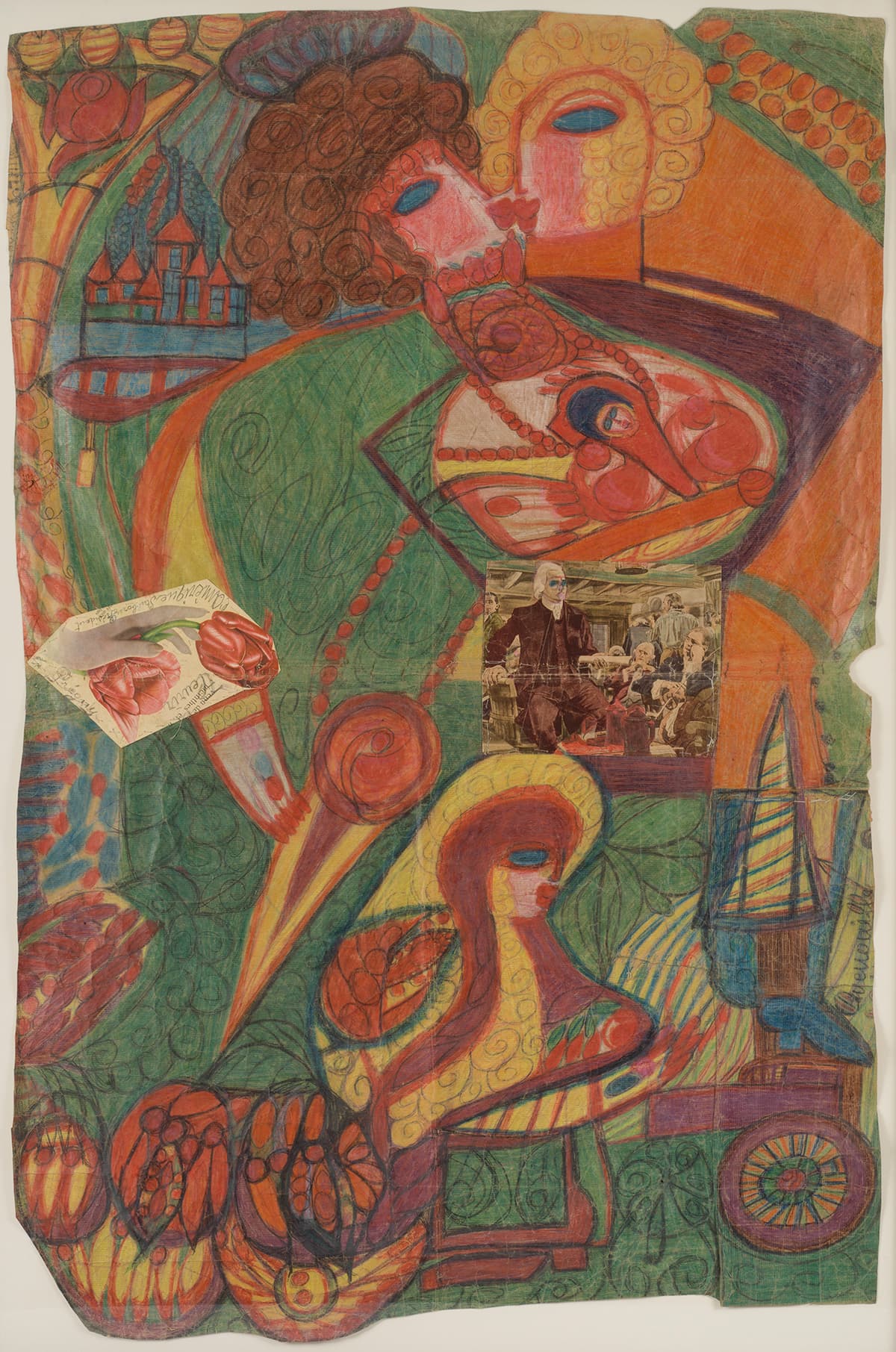
Aloïse Corbaz, Untitled (‘Fleurir [Bloom] / l’Amérique Stubborn Président [the Stubborn American President] / Prégny / Quenouille [Bulrush]’), ca. 1956. Colored pencil, graphite, sewn paper cutouts on wrapping paper 47 ⅝ × 30 ½ inches. Courtesy American Folk Art Museum, New York.
Again, viewing Self-Made as an artist, what seems most pertinent are the intersections between outsider artists’ visual rules contained within their hermetic practices, and more mainstream practices. The exhibition begins with the eternal Bill Traylor, positioned as the pre-eminent self-taught, “self-made” artist. Yet his work is not teeming, busy, or overwhelming, nor is it concerned with self-portraiture or overt autobiography. Perhaps his popularity stems from the fact that his self-invented aesthetic nestles so nicely with tradition, but is just slightly off-kilter. The same holds true for Aloïse Corbaz (featured prominently in the 2024 Venice Biennale Foreigners Everywhere, along with Madge Gill), whose drawings are frequently swirling concoctions of multiple figures in varying scales, occasionally embroidered with a collaged image, but her aesthetic is close to that of Marc Chagall or Maurice de Vlaminck, neither jarring nor alien. The subtext of Self-Made: A Century of Inventing Artists, is that as artists, we are always searching for a state of equilibrium within our practice that answers the questions, visually, that we are asking. The solution I walked away with from the show is the always unsatisfactory answer, “I’ll know it when I see it.”
William Corwin is a sculptor and writer based in New York. He has been writing for the Rail for fifteen years.