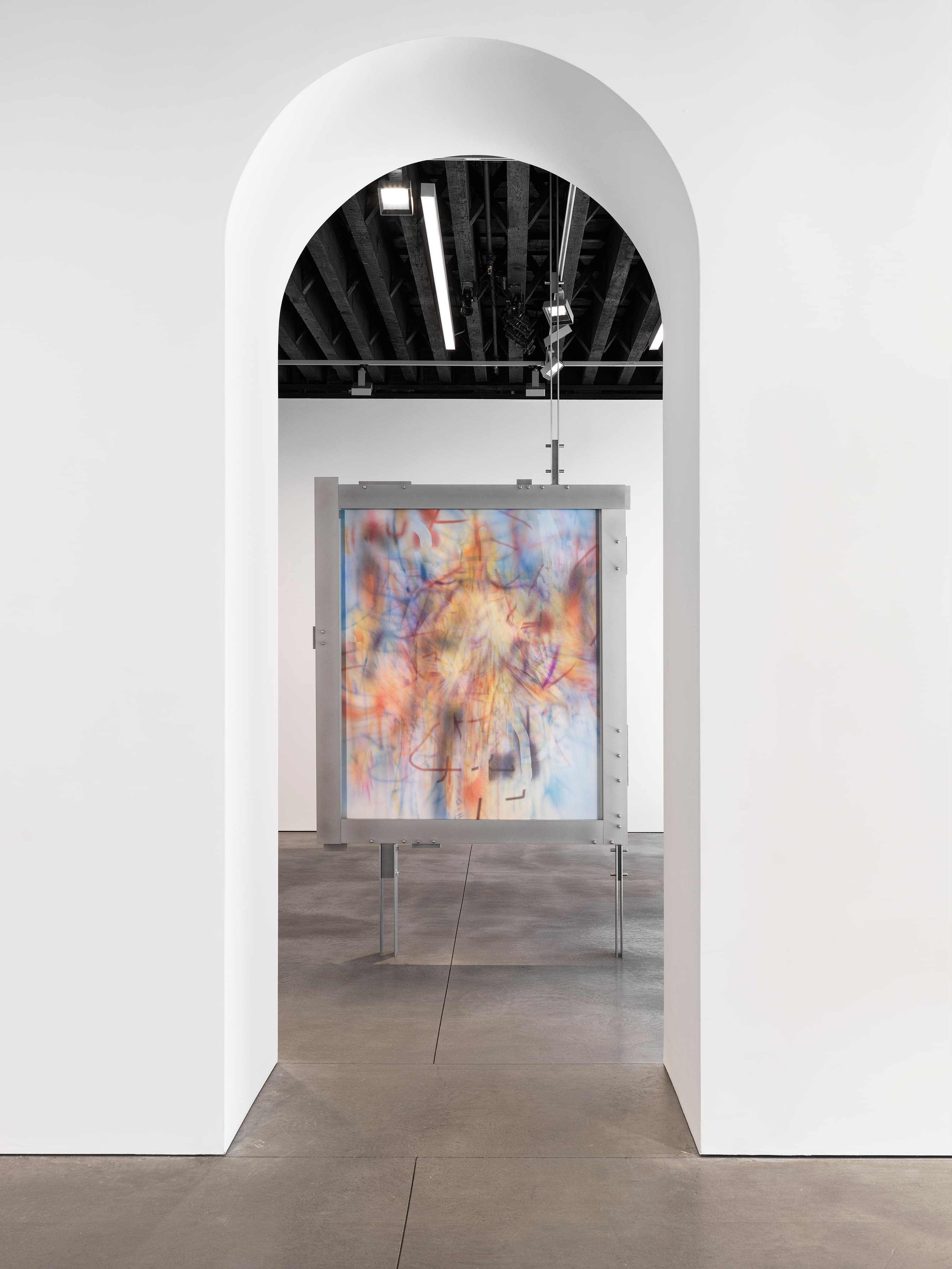
Installation view: Julie Mehretu: Our Days, Like a Shadow (a non-abiding hauntology), Marian Goodman Gallery, New York, 2026. Courtesy the artist and Marian Goodman Gallery. Photo: Alex Yudzon.
Word count: 1335
Paragraphs: 9
Marian Goodman Gallery
April 14–June 6, 2026
New York
Julie Mehretu has filled three floors of the Marian Goodman Gallery with three discrete bodies of work: paintings, drawings, and a series of hybrid paintings/sculptures made in collaboration with the sculptor Nairy Baghramian. Created between 2023 and 2026, these works demonstrate different aspects of Mehretu’s aesthetic reach. Each floor is partitioned to create two halves within which Mehretu’s paintings—some wall-bound, some freestanding—are staggered in proximate relationships, neither mirroring each other nor proceeding in line. The positioning encourages viewers to meander anecdotally, Wandering (2026), as John Jasperse titled a dance in response to these paintings, or engaging in what Mehretu calls slow viewing. Since drawing is foundational for Mehretu’s practice, it was particularly gratifying to see so many examples of her delicate, improvisatory works of this kind are set apart in a dedicated room off the third floor. These roughly 15-by-11-inch pen-and-ink drawings are as intimate, intricate, and delicately rendered as any in the history of the medium.
Mehretu’s nuanced and empathic understanding of the societal disruptions caused by political violence, repression, and natural disasters led her to seek a way to locate these events indexically through schematic renderings such as cartographic maps or architectural plans, which she stacks and overlays with her signature visual vocabulary of lines, curves, dashes, screen-printed Benday dots, erasures, smudges, and other improvisatory kinetic responses. Agitating and disturbing her surfaces, Mehretu’s gestures respond to, resist, disrupt, or yield to the visually apparent geometries of the documents they traverse. Recently, however, Mehretu sensed that the game of intellection through which viewers read these layered grids seemed to reduce her marks to mere decoration. Compelled to mask her ground layer, she began manipulating media photographs of societal upheavals and natural disasters into chromatic blurs and then embedding her markings within the resulting play of light, texture, and color.

Julie Mehretu, Black Monolith (after Atopolis: For Édouard Glissant by Jack Whitten), 2024–26. Ink and acrylic on canvas, 144 × 180 inches. Courtesy the artist and Marian Goodman Gallery. Photo: Tom Powel Imaging.
The title of the current exhibition, Our Days, Like a Shadow (a non-abiding hauntology), suggests that Mehretu’s new works function in a liminal present tense, an in-betweenness on the threshold of visuality. Like a visual circuit threaded through time and space, each painting reifies its past. Black Monolith (2024–26), for example, is an homage to Jack Whitten’s Atopolis: For Édouard Glissant (2014); “atopolis” is a portmanteau word meaning “without place.” Evidently, Whitten haunts Mehretu’s aesthetic present. She describes Black Monolith as a cosmology of diverging energies that undergoes infinite cycles of formation and unraveling. As she has suggested, her nearly figural lines evoke bodies in motion through time, “bodies folding,” limbs conjoining and separating.
Several works from Mehretu’s “Black Paintings” series are arrayed along the walls of the gallery’s third floor. Studies in negation, they substitute black grounds for white. Inspired by red rocks striated with white that Mehretu saw while hiking in Utah, these grounds are shot through with shards of white and streaks of blue and violet, eruptions of reflected and refracted light that burst through the strata of blacks, scored with markings and erasures. Mehretu has coaxed these light effects with interference inks, mica-based pigments whose particles split light into prismatic arrays of color. Amplified by the light-absorbent black surfaces around them, this iridescence creates spontaneous shifts in illumination that seem to rhyme with the viewer’s bodily movements. Nuanced and dynamic, the “Black Paintings” offer stunning examples of Mehretu’s controlled, muscular paint handling. Her titles for these works are negations, repetitions of the phrase “cannot hold;” the verb’s subject progresses from lungs to belly to hands to ground, specters of an emptied-out futurity.

Installation view: Julie Mehretu: Our Days, Like a Shadow (a non-abiding hauntology), Marian Goodman Gallery, New York, 2026. Courtesy the artist and Marian Goodman Gallery. Photo: Alex Yudzon.
A second series in the exhibition, “TRANSpaintings/Upright Brackets”, is a collaboration with the sculptor Nairy Baghramian that forces literal dimensionality from planarity. Layers of translucent monofilament polyester mesh receive inked and acrylic markings that nearly mask “ghost images from recent reportage of geopolitical events,” according to the gallery’s press statement. To retain the paintings’ verticality while ensuring their transparency, Baghramian built aluminum brackets that free Mehretu’s worked substrate from the gallery walls, clasping their indeterminate spatiality in a minimalist geometric embrace. Attached to floor and ceiling by off-center legs and arms, the rigidity of these structures contrasts with the play of lambent light over the paintings’ recto and verso surfaces. Aided by Mehretu’s use of interference inks, these works shift between high and low values, between density and porousness, as light is bent and bounced, amplified and diminished into shadow for viewers circumnavigating them. The phrase “Our days, like a shadow” in the exhibition title derives from a Bible verse, 1 Chronicles 29:15: “For we are strangers before you and sojourners, as all our fathers were. Our days on the earth are like a shadow, and there is no abiding.” For Mehretu, these words recall what she had identified in earlier work as “shadow effects”—the slippage between present and past. In the “TRANSpaintings,” however, such shadows are reimagined in three dimensions, acknowledged and traced as counterpoints to the fluctuating play of light. Metaphorically, these inhering shadows, as spectral presences of the past, also represent the transience and flux of present time.

Installation view: Julie Mehretu: Our Days, Like a Shadow (a non-abiding hauntology), Marian Goodman Gallery, New York, 2026. Courtesy the artist and Marian Goodman Gallery. Photo: Alex Yudzon.
Mehretu insists that her paintings are inherently performative, since their making involves percussive, repetitive motions that activate spaces within and beyond them. The desire to urge her markings beyond their planar confines was in part what led her to the “TRANSpaintings.” She has also spoken of her paintings as “physical, sensorial image[s] that [are] time-based, emergent experience[s].” Jasperse’s Wandering, choreographed to music newly composed by Hahn Rowe and Will Johnson and danced in the exhibition for several days during its run, made the performative elements inherent in Mehretu’s work come to life. As if opening into a fourth dimension, the artist’s markings seemed to be released from their frame, the dancers extending their implied trajectories in propulsive movements across the viewing spaces. The dancers enacted Mehretu’s sinuous arcs, her parallel and crossing linearities, as they progressed from dexterous and beguiling bodily pairings to clinging and writhing over rectangular props—hovel-like rolls of cardboard and displaced mattresses, suggesting discarded objects used by displaced populations—and gallery walls (analogues, perhaps, of Mehretu’s substrates). As they ascended from the first floor to the second and then the third, viewers followed in train. On the first and second floors, Jasperse’s dancers improvised in counterpoint within Rowe’s electronic and acoustic sonic atmospheres, spliced through by erratic percussive cues. Johnson’s driving rhythmic pulses on the third floor urged the dancers into synchronized dynamic movements, turning Mehretu’s markings into a visceral, heart-racing activation of space. Just as Mehretu has described her rapidly accumulating marks as “accelerating to gain that wicked mass of marks,” so the dancers raced to a sudden break in time that marked a conclusion.
Mehretu’s marks are formed from both intention and intuition. They suggest ancient Chinese grass script—abstracted ideographic writing—yet unlike calligraphy, they are not symbols or graphemes. Rather, they are inked impressions on a substrate of architectonic undertracings and impressionistic chromatic grounds that they extend, resist, or obliterate. The artist’s insistent mark-making, which she has called “disruptions in the surface image,” carries the possibility of breaking through to a third space within the painting—a historic space, layered and stratified, that haunts the image but that might lead in turn to a new beginning. Mehretu has called her markings “performance[s] in making and seeing and looking … evolved out of the depth of past paintings. Like Paul Klee’s Angelus Novus (1920), after which she titles the wing-like spreading of colors in one of her “TRANSpaintings,” Mehretu, following Walter Benjamin’s celebrated interpretation of Klee’s work in Theses on the Philosophy of History (1940), turns her face toward the catastrophic wreckage of the past. Yet, in contrast to Benjamin’s reframing, Mehretu looks toward the future and confronts it collaboratively, with empathy and understanding. To my mind, Mehretu is a philosopher/painter of prodigious persuasiveness who demands committed engagement. Here she achieves that authentic fusion of viewer and work, and in doing so attains the immersive experience she seeks.
Patricia L Lewy is an independent art writer, curator, and artists’ estate manager living in New York City.