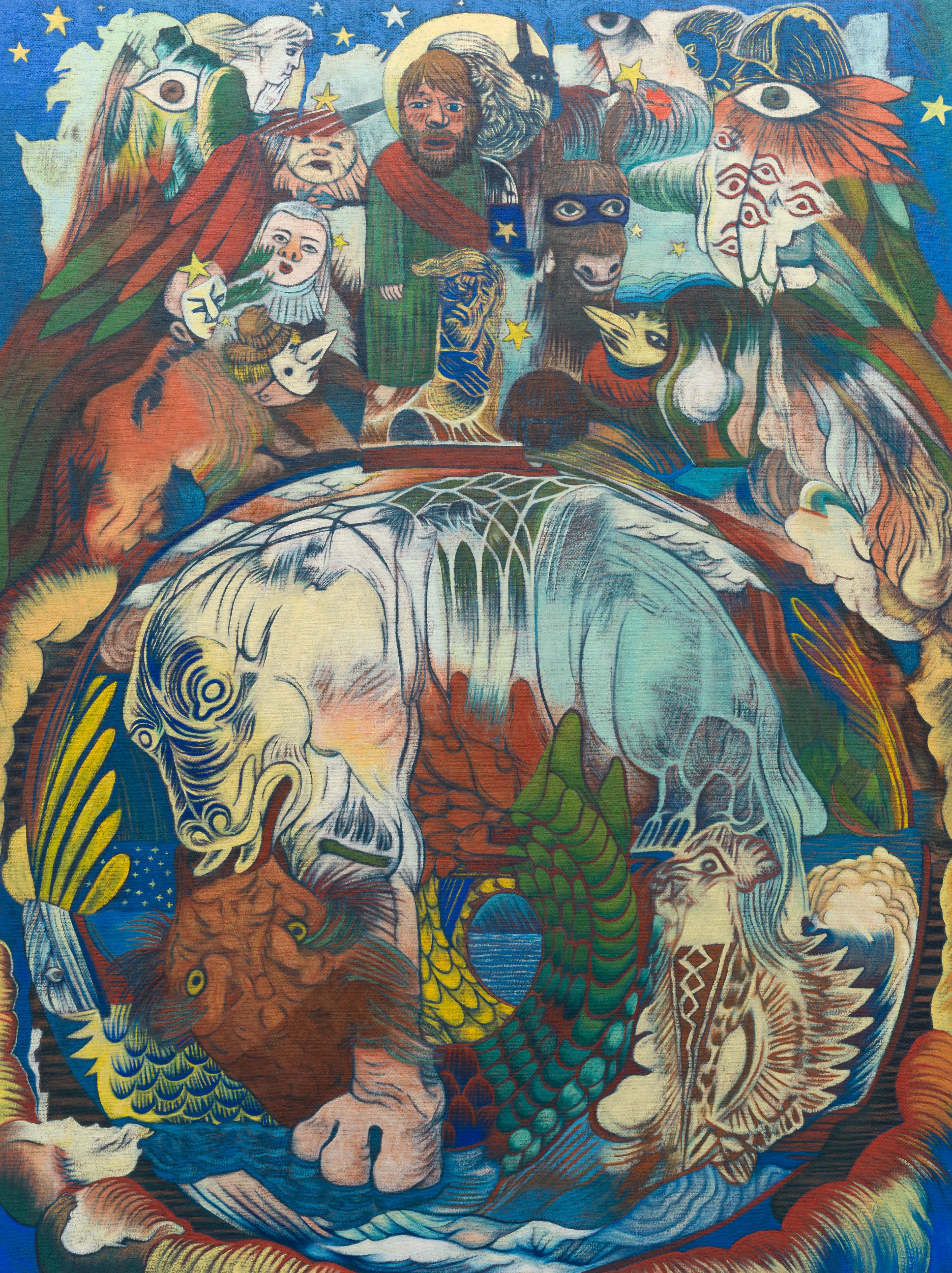
John Hee Taek Chae, Behemoth and Leviathan, 2026. Oil on linen, 48 × 36 inches. Courtesy the artist and D.D.D.D..
Word count: 964
Paragraphs: 9
D.D.D.D.
May 15–June 20, 2026
New York
John Hee Taek Chae’s new body of work at D.D.D.D. can be broadly sorted into three groups: closely cropped, caliginous portraits of masked non-white Immigration and Customs Enforcement (ICE) agents; a row of double-sided banner paintings installed like flags protruding from the wall; and large paintings of Boschian, carnivalesque compositions featuring skeletons, masked figures, and light eschatological iconography. However divergent they appear aesthetically, all of these works have, to varying degrees, been catalyzed by the birth of Chae’s first child.
For the last few years, Chae has been plumbing American mythology in its various permutations: Boy Scouts, cowboys, Western landscapes, homesteaders. Central to his work is how identity functions in relation to ideology and the often-accidental mutations of visual culture. It is a question that has taken on new urgency with the birth of his third-generation Korean American son in a rural, postindustrial town in an area of western New York that largely voted for an anti-immigrant agenda. If most first- and second-generation immigrants feel unmoored in their uneasy, assimilated-but-not-native status, the identity of being a third-generation Korean American offers a rare rootedness, fortified by legacy and more readily absorbed into a broader Americanness. But what will this mean for Chae’s son in the context of his rural New York birthplace where the only mention of Korea tends to appear in public, nostalgic hometown hero banners of Korean War veterans?

Installation view: John Hee Taek Chae: Third, D.D.D.D., New York, 2026. Courtesy D.D.D.D..
The eight banners installed on the wall in Chae’s show comprise the “Hometown Hero” series. The banners vary in subject matter, but the majority depicts the faces of Korean War veterans born within a sixty-mile radius of his son’s birthplace and who lost their lives in the Korean War. Chae heavily stylizes these veteran portraits and grafts onto them words, stars, and mini patch-like tableaux, creating paintings within paintings. Rendered in cyanotype and graphite, the backs of these banners are umbral and ghostly, as if serving as the unconscious of their more saturated and figurative front sides. This obsession with showing the backside of things—both metaphorically and literally through formal decisions—has been a throughline in Chae’s works the past few years.
One of these banners, Hometown Hero: John Steuart Curry’s John Brown (2026), recreates the Midwestern artist Curry’s famous portrait of John Brown, a controversial abolitionist in nineteenth-century America. Compelled by his strong Christian convictions, Brown unequivocally advocated for the use of violence in slave liberation after witnessing what he believed was the futility of abolitionist pacifism. Eventually executed for treason, Brown became a symbol of visionary fervor. Brown, in many ways, scrambles our usual codes of white Antebellum Americanness and serves as a counterpoint to the overtly racist, materialist connotations associated with whiteness while raising uncomfortable questions about his extremity: was he righteous, or delusional? You can’t decant complicated figures of Americana—whether John Brown or hometown hero veterans—into vessels of liberal pluralism and easy consumption. Maybe that’s why Chae has to first subject them to multiple rounds of transformation in an exercise that is as aesthetic as it is anthropological. There is something melancholic about the very concept of hometown heroes, as though it embalms the fates of these local sons and their sacrifices within the provincial parameters of their hometowns. What Chae does is unseal them and bring them back to life, transfiguring them through unnatural color palettes that almost signal his ambivalence for what they stand for.

Installation view: John Hee Taek Chae: Third, D.D.D.D., New York, 2026. Courtesy D.D.D.D..
The prophetic, appropriated nature of paintings like John Steuart Curry’s John Brown finds echoes in Chae’s Behemoth and Leviathan (2026), a Miltonic painting based on an early nineteenth-century print by William Blake. In it, Blake depicts Leviathan and Behemoth, the untamable primeval creatures described in the biblical book of Job to symbolize God’s supreme power of creation. In Chae’s version, which he created by compositing his own drawings with Blake’s, the sparseness of the upper empyrean half of the original composition swells cacophonously with angels and masked figures surrounding a Jesus on a masked donkey. It’s reminiscent of James Ensor’s proto-Expressionist painting Christ’s Entry into Brussels in 1889 (1888), in which a herd of mask-wearers and clowns dwarfs a haloed, isolated Christ in the center.
In Chae’s hands, the famous Blake print about divine power transforms into an Ensorian cosmology that sweats out lonesome, apocalyptic visions and thrums with a messianic libido. Behemoth and Leviathan and John Steuart Curry’s John Brown both employ a kind of figuration that has become somewhat démodé: an ironically salvific, visionary figuration that marries American Regionalist painting and the eschatological valences of our current political moment. Given the current cultural penchant for looser, deliquesced modes of figuration devoid of any overt historical or religious stakes, Chae’s particular flavor of figuration—which dramatizes meta-narratives in a skeptical yet exalted way—has the freshness to unsettle.
If Chae’s Behemoth and Leviathan deploys masks in the Bakhtinian sense of leveling power structures, the artist’s portraits of immigrant ICE agents also foreground masks, albeit in a much more literal way. Instead of cannibalizing older works of art, these portraits of ICE agents are unfalsifiable in their currentness and pressing in the context of Chae’s newborn son who is brokering a legacy of Americanness shaped by these very agents. I’ve been thinking about what these portraits of ICE agents and hometown heroes have to do with the larger, fantastical paintings in the show like Behemoth and Leviathan. They are all, maybe, competing vectors of the same desire for redemption and for unification with something larger than our individual selves, however misguided the attendant course of action may be. They issue radically different visions of duty, birth, and death, denying us any identitarian parti pris but mediated by the tender vulnerability of being a new father all the same.
Emily Chun is a writer and a Ph.D. candidate in art history at Stanford University.