Word count: 903
Paragraphs: 10
James Cohan Gallery
May 15–June 27, 2026
New York
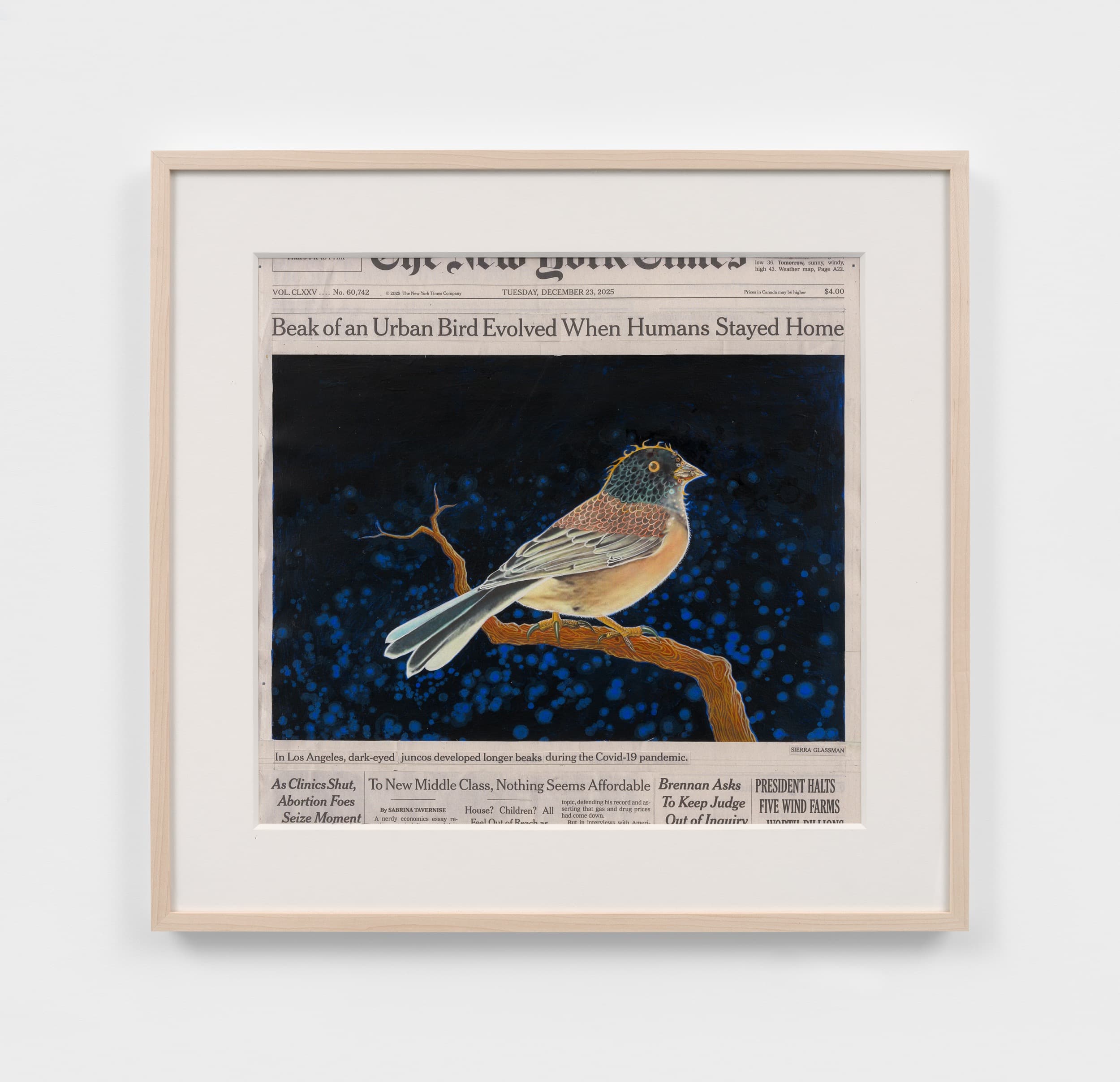
Fred Tomaselli’s current exhibition, Blooms Disrupted, unfolds across two distinct gallery spaces, each anchored by materially divergent bodies of work that nonetheless share a common perceptual inquiry. In the first, Tomaselli extracts headlines, images, and fragments of domestic and global events from front pages of the New York Times, which he then disassembles and reconstitutes through his distinctive systems of arrangement. In the second, larger space, the artist presents intricately composed paintings derived from botanical subjects sourced from his own garden. While these two groups of works differ sharply in appearance and tone, both demand a similar labor from the viewer: a sustained oscillation between recognition and doubt, surface and structure, image and material.
Tomaselli’s practice has long been invested in destabilizing the reliability of vision. What initially appears coherent gradually reveals itself as far more constructed and contingent. This tension between optical immediacy and material complexity has defined his work since the mid-1990s, when he began embedding pharmaceutical imagery, collaged elements, and resin surfaces within densely layered compositions. In Blooms Disrupted, that foundational concern persists, though it is sharpened here by the dual pressures of contemporary media saturation and ecological intimacy, as well as a more painterly mark-making.

Fred Tomaselli, September 29, 2021, 2021. Gouache, photo collage, leaves and archival inkjet print on watercolor paper, 11 × 12 inches. Courtesy the artist and James Cohan Gallery.
The newspaper works, all titled and dated after specific days in a calendar year (e.g., December 23, 2025 (2025); September 29, 2021 (2021); February 27, 2026) (2026), function as acts of both interference and reorientation. Removed from their original context, the authoritative voice of The New York Times fractures into a field of competing visual and textual fragments. Headlines lose their linear coherence; images slip free of their captions; narrative continuity dissolves into a more associative, almost hallucinatory structure. Tomaselli does not simply critique media consumption—he aestheticizes its fragmentation, making visible how information is absorbed, misread, and recombined in the contemporary psyche. The result, at once familiar and alienating, echoes the cognitive overload of scrolling through news feeds while slowing that experience into something more deliberate and reflective.
If the newspaper works externalize a collective condition of informational excess, the botanical paintings seem, at first glance, to offer a retreat into the organic and the personal. Yet this distinction quickly collapses under analysis. At a distance, these images present themselves as lush, almost hyperreal depictions of a cultivated garden. Leaves, petals, and vines interweave in rhythmic, phantasmagoric arrangement. However, as one moves closer, the illusion of naturalism gives way to a more complex material reality. Tomaselli’s surfaces are built through processes of accumulation, collage, and meticulous layering. He incorporates unexpected elements that dislocate the coherence of the depicted forms and source imagery from his own flower garden. In the case of Blue Olana (2025), flowers appear to bloom in the foreground of a clear blue sky. But a closer look reveals an accumulation of printed materials, painted passages, mandala-like motifs, starbursts, and tendrils that blossom into images of flowers and abstract patterns.

Fred Tomaselli, Blue Olana, 2025. Acrylic, photo collage and resin on wood panel, 48 × 48 inches. Courtesy the artist and James Cohan Gallery.
This slippage—between what is seen and what is actually there—places Tomaselli in a historical lineage that includes figures such as Giuseppe Arcimboldo, whose composite portraits transformed recognizable, discrete elements into uncanny assemblages. Like Arcimboldo, Tomaselli delights in the moment when the eye’s desire for coherence is undermined by the image’s structure. Yet his work is less allegorical than phenomenological, concerned not merely with symbolic transformation but with the mechanics of perception itself: how images are constructed, how meaning is assigned, and how both can be destabilized.
Across both bodies of work, Tomaselli’s process emerges as a kind of perceptual testing ground. The viewer is invited to move back and forth—literally and cognitively—between distance and proximity, between the image’s legibility and the opacity of its material construction. At a remove, the works cohere into recognizable forms: a headline, a flower, a tree. Up close, they fragment into a dense network of details that resist easy categorization. This push and pull produces a subtle but persistent disorientation, one that compels the viewer to question not only what they are seeing but how they are seeing it.
In this context, Blooms Disrupted compels by shifting focus from individual subjects to the very conditions through which we perceive them. Tomaselli treats both domains as malleable materials, subject to the same processes of extraction, manipulation, and reconfiguration. The newspaper, often seen as a neutral vessel for objective information, is shown to be as flexible and unstable as the organic forms of the garden. Similarly, he reveals the natural world, frequently idealized as authentic and unmediated, to be equally constructed through deliberate artistic intervention. These bodies of work resist the easy binaries of nature versus culture, truth versus illusion, and surface versus depth. Instead, Tomaselli proposes a more fluid understanding of images as sites of continual negotiation, where meaning is never fixed but always in the process of being made and unmade. Viewers, conditioned to seek meaning, inevitably attempt to reassemble these elements into something legible, succumbing to the compulsion to impose clarity where ambiguity persists.
In an era defined by visual excess and epistemic uncertainty, Tomaselli’s practice resonates by foregrounding the instability of perception. He not only reflects the complexities of contemporary experience but also invites more critical engagement with the images that shape it. Blooms Disrupted ultimately asks us to look more closely—and, in doing so, to recognize that what we see is never quite what it seems.