What Fountain Changes to Art History (It’s Not What You Think)
Word count: 4266
Paragraphs: 34
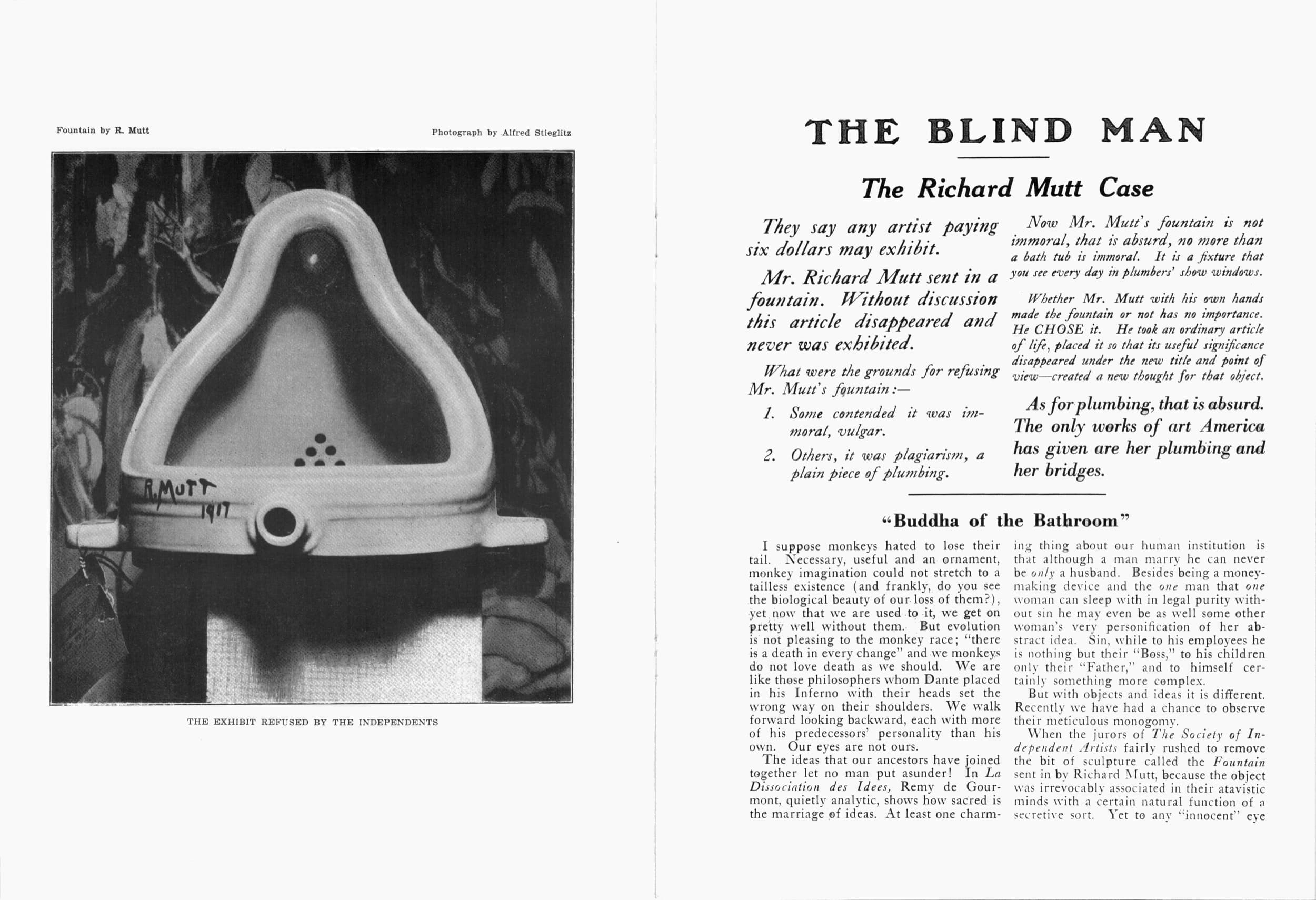
Double-page spread from The Blind Man (No. 2), May 1917. © Association Marcel Duchamp / ADAGP, Paris / Artists Rights Society (ARS), New York 2026.
What I think you think, if you are a well-informed art lover who visits the galleries and reads the Brooklyn Rail, is that Fountain, Marcel Duchamp’s famous and infamous urinal signed R. Mutt and dated 1917, initiated a sea change in the art world: a radical break and not just a new style, as the one set in motion by Les Demoiselles d’Avignon (1907). Under the impulse of Georges Braque and Pablo Picasso, this style, Cubism, evolved to include papiers collés, cardboard guitars, and real sugar spoons sitting on top of bronze absinth glasses—the latter (1914) an assemblage that Duchamp perhaps anticipated when he mounted a bicycle wheel on a kitchen stool and called the result an “assisted readymade.” It is not impossible to see Bicycle Wheel (1913) as having more or less smoothly morphed out of Cubism. But not so the unassisted readymades: the 1914 Bottle Rack, the 1915 snow shovel inscribed In Advance of the Broken Arm, the 1916 typewriter cover titled Pliant de voyage, the hat rack and the comb of the same year, the 1917 coat rack called Trébuchet, were UFOs which the rare people in the know didn’t take seriously. Duchamp himself considered them “little game[s] between ‘I’ and ‘me’,” and if he smuggled two of them into a gallery in 1916, to his great satisfaction they went unnoticed and didn’t raise an eyebrow: they were a dry run for the real test.
New York, 1917
The real test came with Fountain: that’s when the readymades’ public life started. Fountain was submitted (wrong word) for inclusion in the first exhibition of the Society of Independent Artists, in New York, in April 1917, and was rejected (wrong word again) by the founding members of the Society. “Submitted” is the wrong word because anyone who had paid their six dollars membership dues to the Society could proclaim themselves an artist and had the right to exhibit whatever they wanted. “Rejected” is the wrong word for the same reason: “censured” is the right word. It seems that Duchamp tested the limits of the Society’s liberalism with a provocative Dada gesture and that the ensuing scandal belatedly ushered in a new era when, some forty to forty-five years later, Fountain was spectacularly rehabilitated precisely because its anti-art, confrontational stance was recognized as the mark of significant avant-garde art. There is a lot of truth in that account. The untruth lies in its implications. It would be an insult to Duchamp’s intelligence, and to his ethics vis-à-vis his fellow artists, to impute to him the intention of challenging the Independents to accept an object meant as anti-art and destined to raise a scandal. The fact is that he carefully avoided raising a scandal by waiting until the exhibition was over before he published, in a little artists’ magazine with a tiny readership, an editorial accompanied by the photo of a urinal that put the Society’s act of censorship on the record. That’s for his ethics: if a scandal had broken out during the show, the Independents’ legitimacy as an artists’ society would have been instantly ruined. As for his intelligence: he knew from the start that Fountain was art, not because he anticipated the logic that would sooner or later recognize confrontation and negation as the true marks of significant avant-garde art, but because anything a legitimate member of the Society chose to show was automatically art. Duchamp understood that he could have his cake and eat it too: R. Mutt’s entry could easily pass for a Dada gesture even though it did anything but challenge the Society’s liberalism: it acknowledged it. Duchamp’s superior intelligence made him wager that his acknowledgment would not be acknowledged in return, that Fountain would be rejected—proof that anti-art is in the eye of the beholder—and that, sooner or later, posterity would turn the Society’s betrayal of its principles into a successful Dada gesture on his part. By censuring Fountain, the Independents fell into Duchamp’s trap: they unwittingly turned art into anti-art; and Fountain passed the test, validating in advance the avant-garde logic that turns anti-art into art.
Pasadena, 1963
To all appearances, Fountain thus confirms the avant-garde logic, albeit with a dialectical twist. The viewers make the painting, Duchamp used to say. In this case: they will make the Fountain; and posterity will make me the quintessential Dada artist; all I need to do is wait. To what extent Duchamp engineered how long he would wait—as it turns out, more than forty years—is a tough question for his exegetes. To what extent he engineered the sudden fame he acquired late in life is an even tougher question. The fact is that the new generation of artists that emerged in the late fifties to early sixties—helter-skelter: Pop artists, Nouveaux réalistes, members of Zero, Fluxus, Gutai and Mono-ha groups, Op art and Kinetic artists, Neo-Concretists, Minimalists, proto-Conceptual artists, and the list goes on—did not wait for the seventy-six-year-old Duchamp to be given his first museum exhibition at the Pasadena Art Museum in 1963, to be—or so the story goes—under his influence. Except that the wobbly concept of influence seems quite inadequate to account for such sudden efflorescence. The general impression is that the impact of Duchamp’s work on the above-listed art movements is of a different nature. “Influence” perhaps accounts for the rapid international dissemination of Cubism in the wake of Braque and Picasso’s stylistic innovations, but Duchamp’s mark on the recent history of art is not stylistic. It has been called conceptual, but that doesn’t explain much. The general feeling among the people who have haunted the contemporary art scene beginning in the sixties is that the readymades, and Fountain in particular, have changed the institution of art. Some even say they changed the definition of art. The evidence is compelling, starting with the simultaneity of the birth of the above-listed art movements and the skyrocketing rise of Duchamp’s reputation. This cannot be coincidental: Duchamp must have had a hand in a sea change of the art world, a change that began to be felt in the fifties and was completed over a timespan of two decades. From the early seventies on, people started to speak of a post-Duchamp art world. Nobody ever spoke of a post-Picasso art world.

Pablo Picasso, Glass of Absinthe, 1914. Painted bronze with absinthe spoon, 8 ½ × 6 ½ × 3 ⅜ inches, diameter at base 2 ½ inches. © 2026 Estate of Pablo Picasso / Artists Rights Society (ARS), New York.
A Brief Note on Art History
The story of Duchamp singlehandedly inducing a mutation of the art world has such currency that it sounds almost natural. As we shall see, careful attention to the “Richard Mutt Case” eventually leads to a different story, but not before having moved the issue of Fountain’s effect on the history of art from the question of its impact on the work of subsequent artists to the question of its impact on the discipline of art history. It’s a methodological move, a step sideways, as it were, which will help displace the thorny issue of “influence” and whatever better suited term may replace it in favor of a new issue, that of acknowledgment of receipt. We are not there yet. To get there, attention to the “Richard Mutt Case” first has to move from the consequences of Duchamp’s gesture to its prerequisites. No offense to the many Duchamp scholars who are striving to interpret Duchamp’s elusive but pervasive “influence” on the art world since the sixties. The story I am about to tell does not rest on expertise in Duchamp.
Paris, 1884
The Society of Independent Artists, in whose first exhibition Fountain was “submitted” and “rejected” (wrong words) was created in New York in December 1916 and modeled on the French Société des Artistes Indépendants, founded in Paris in 1884. The Société’s motto, Sans jury ni récompenses, stated exactly the same no-rule rule as the motto of the New York Society, “No jury, no prizes.” Nobody at the time acted to test this no-rule rule, but the fact was that, in Paris, as early as 1884, anything someone presented in the context of this institution of collectively self-proclaimed artists was automatically art. This fact predates the “Richard Mutt Case” by thirty-three years! In its light, Fountain appears not as the anticipation of a dialectical reversal but as a reminder of a situation older than Duchamp himself: three years before his birth (in 1887), an art institution had moved into hitherto unexplored territory, where anything could be art because anybody could be an artist without being submitted to the authority of a Salon jury. The chef de file of the Indépendants was Georges Seurat. In the history of styles, Seurat comes after Impressionism; invents Divisionism, is Paul Signac’s mentor and a peer or a rival to Paul Cezanne, Vincent van Gogh, and Paul Gauguin; prepares the Fauvism of André Derain and Henri Matisse; and is picked up parodically by Picasso’s synthetic Cubism in 1914. In the history of art institutions, Seurat was the Indépendants’ best known and most avant-garde leader.
Because the history of styles is very good at both absorbing and neglecting the history of art institutions, the facts that Seurat showed the impressive Bathers at Asnières at the first Salon des Indépendants in 1884 and the very ambitious A Sunday Afternoon on La Grande Jatte at their second Salon in 1886 are often read as if the Indépendants were a pioneering phalanx of avant-garde artists. This is a grossly distorted view of reality. Yes, the Indépendants created a liberal alternative to the stiff, juried, official Salon. But out of the 402 artists included in the 1884 Salon des Indépendants, the history of modern art has retained only seven names, among them Signac, Henri-Edmond Cross, Charles Angrand, and Albert Dubois-Pillet, all divisionist friends of Seurat. The 395 remaining artists were mostly mediocre academic painters whom the jury of the official Salon would never have considered.
Paris, 1880
Here is a most intriguing and most decisive fact: when the Société des Artistes Indépendants was founded, the artists living in France had already been de facto independent for four years! Several critics of their 1884 Salon asked, “Independent of whom, of what?” The answer was: independent of the State. And the fact was that the artists had won their independence from the State, not in 1884, with the creation of the Indépendants, but in 1880, with the disastrous fiasco of the last State-sponsored Salon. That year, the painting jury revolted against the Salon organizer over his exhibition policy, and resigned. As a result, all the submitted works (more than 7,000) were accepted, the press was outraged, the public snubbed the Salon, the Beaux-Arts Ministry had to absorb a deficit of approximately 150,000 of today’s dollars, and the State definitively withdrew its support. 1880 proclaims the end of the French Beaux-Arts system. The juried salon survived as a private enterprise deprived of the prestige of officialdom and soon devoid of artistic relevance. By the outbreak of WWI, it was a mere shadow of its former self. And by then, the fine arts system was moribund everywhere. In light of all this, Fountain now appears as the fine arts system’s obituary, pronounced willy-nilly in France in 1880 and allegorically announced in the United States in 1917 by the first transatlantic artist of the twentieth century.
It is tempting to think that Fountain, readymades in general, post-Cubist assemblages, Futurist manifestos, Dada performances, Constructivist installations, Surrealist cadavres exquis, and so on, have pronounced the fine arts system’s obituary because they killed the system. But this is an optical illusion. The reality is that the system collapsed on its own, under the weight of its own obsolescence and with very little help, if any, from the artistic avant-gardes. The art movements I just listed are all posterior to the collapse of the system, which—let me repeat—abruptly died in 1880, seven years before Duchamp’s birth. The relevant fact is that it died politically, and in France, long before it died stylistically, and everywhere. In its aesthetic principles, the French Beaux-Arts system was pretty much the same as the fine arts system elsewhere: a collection of disciplines distinct from the decorative and the applied arts, organized by métiers having strict technical boundaries, with internal hierarchies such as the ones that ranked painting above sculpture and history painting above the lower genres. In its institutional structure, however, the French Beaux-Arts system was absolutely unique in that it was entirely controlled by the State, which was not the case in any other country. The main instrument of the State’s control over the visual arts was the Salon jury. When in 1884 the Indépendants abolished the jury, they certainly created a liberating institution where anybody could be an artist, but they didn’t realize that the jury had already lost its true power four years before. What was its true power?
What I think you think, if you are an educated art lover who knows more than a thing or two about the genesis of modern art in the nineteenth century, is that the jury was able to impose academic standards, stifle stylistic innovation, shackle the avant-garde, and, all in all, exert strict social control over that unruly and potentially subversive population: the artists. That the jury had the latter power—the political one—is a hundred percent true. But it had that power only because it was backed by a whole State apparatus. That the jury’s power translated as quasi-monopolistic economic hegemony exerted by the State on the artists is sadly also true: you could simply not make a career as an artist in nineteenth century France if your work was banned from view at the Salon year after year. Finally, that the jury wielded its power through its thumbs up or down decisions is glaringly obvious. But these aesthetic verdicts were and had been, over the course of the century, far less coherent and far less systematically conservative than you might think, and than I myself initially thought. The composition of the jury was constantly changing according to the party in power and the style in fashion; the proportion of artists (as opposed to government apparatchiks) on the jury often depended on how loud they had protested the previous year; the proportion of progressive (as opposed to academic) artists on the jury was a lottery. The State apparatus that determined aesthetic policies hardly spoke with one voice: the Académie des Beaux-Arts was rarely in agreement with the Ministère des Beaux-Arts; “academic” and “official” were seldom synonymous. And let’s not forget that the nineteenth century saw two revolutions, in 1830 and in 1848, plus the Commune in 1871, which shook French society from top to bottom, with crucial consequences for the Salon. The French State’s cultural policy was never coherent and systematic enough to have had the sustained effect on art required by the theory according to which the avant-garde had to conquer its place under the sun against a monolithic body of gatekeepers to the tradition holding shared reactionary views. This theory is simply not true.
Paris, 1863
A typical mistake is to coin the birthdate of modern art as 1863 and its birthplace as the Salon des Refusés. When they don’t triumphantly call the Refusés the first alternative, artist-run exhibition—whereas it was actually ordered from above by the Emperor himself—many historians of modern art still see in the rejection of such luminaries of modern art as Édouard Manet, James McNeill Whistler, Camille Pissarro, and others the confirmation that refusal by the Salon was a passport to perennial status as the best artists of their time. That is again a grossly distorted view of reality, which compounds two mistakes. The first mistake is the same as the one that saw the Indépendants as a pioneering phalanx of avant-garde artists: the modernists were in fact a tiny fraction of the Refusés; the bulk of them deserved to be rejected by any standard. The second mistake is to impute confrontational or transgressive intentions to the artists—as if the Refusés had sought rejection. Of course not!
But one might think that some significant Refusés sought or, at least, willfully risked rejection. Provocation didn’t await the “Richard Mutt Case” to be an effective avant-garde strategy—witness Gustave Courbet. It didn’t take all the Refusés, or even a great number of them, to be avant-garde for 1863 to be a crucial date in the early history of modern art. Should we not assume that Manet—the most significant of all Refusés—anticipated the jury’s negative verdict and wagered on its later dialectical reversal? It’s a very satisfying theory because it places the “Richard Mutt Case” in continuity with a teleologically oriented narrative where Manet is a precursor not just in the history of styles but also in the history of the relation of artists to art institutions. According to this theory, Manet has demonstrated that the dividing line between avant-garde and academic artists runs between the artists who, brush in hand, were critical of and those who were subservient to the jury’s authority. Manet could have refused to be pilloried among the Refusés (as many did, who chickened out because they were ashamed of having been rejected). His embrace of the Refusé status can thus be seen as proof that he was anticipating posterity’s upturning of the 1863 jury’s verdict and, with it, the dialectical alternation of innovations and assimilations, ruptures and recuperations, anti-art gestures and their subsequent conversion into full-fledged artworks, which would constitute the history of modern art after Manet and which the “Richard Mutt Case” would masterfully invoke and bank on. The trouble is, this theory is wrong where the facts are concerned. Manet aimed for recognition at the Salon all his life and suffered all his life from being rejected. If anything, he was excessively deferential to the jury’s authority. He never considered rejection a point of pride, as he perhaps should have. And yet, because the Salon des Refusés is an exemplary moment of convergence of the history of styles with the history of art institutions, Manet’s rejection from the 1863 Salon is often seen as a paradigmatic implementation of the dialectical theory of the avant-garde: simply put, Manet’s aesthetic innovations are read as institutional critique—where “institutional” refers to the Salon jury and the whole French–Beaux-Arts–State apparatus, and “critique” means transgression of the conventions of painting upheld by the jury. Although it would be anachronistic to impute anti-art to Manet, it seems reasonable to ascribe him an anti-traditional attitude. But everything we know of Manet’s personality belies this: when he quotes Titian (as he did the Venus of Urbino [1538] in Olympia [1863]), he sincerely hopes that the educated viewers will see the homage, and he is candid enough not to imagine that they would see the destruction of Titian instead. Like anti-art, anti-tradition is in the eye of the beholder—in his case, not just the Salon jurors, not just the critics of his time who accused him of betraying the masters, but also the art historians who celebrate him for having transgressed every convention that defined painting at the time.
New York, 1917
Now here is an objection which, on the face of it, makes a lot of sense: perhaps institutional critique does not account for Manet, but it does for Duchamp. Besides, Manet registers as a modernist, not an avant-garde artist; Duchamp is the epitome of the avant-garde artist, and avant-garde artists are confrontational and practice negation and transgression by definition. Didn’t Fountain pass the test because Duchamp wanted it to be rejected? That’s right. Unlike Manet, unlike the Refusés, Duchamp sought rejection. But the institution whose rejection Duchamp sought was not the 1863 Salon jury. It was not the French Beaux-Arts institution, which had died before his birth. It was not the National Academy of Design, which was in the United States the stronghold of fine arts academicism. It was the Academy’s nemesis, the Society of Independent Artists, which had abolished the jury! Duchamp was a founding member of the Society. He shared its democratic principles and its struggle against the Academy. Why then would he critique them? The only reasonable answer is that “critique” is the wrong word. What Duchamp did with the “Richard Mutt Case” was confrontational all right, but it was not in the nature of critique, transgression, or negation. It was in the nature, as I called it, of an acknowledgment, a reminder, an obituary, a message about the state of things, a piece of news, a letter, a “telegram.” Fountain told the world in 1917 that a sea change had happened in the institution of art. We had switched from an art world in which it was impossible for a urinal to be art to an art world in which this urinal was art.
The illusion that the switch happened around 1960 is understandable: a piece of news really becomes news when it arrives and has effects on its recipients. But this means only that the world was not ready to hear the news before the late 1950s; the letter was mailed in 1917 all the same. And the content of the letter, the news it contained, was that the switch from one art world to the next happened unwittingly in 1880 and officially in 1884. In 1884, officially, because the name of the new institution, Société des Artistes Indépendants, registered the switch even though it didn’t acknowledge it. And in 1880, unwittingly, because nobody at the time could have predicted that the French State’s loss of its financial and institutional control over the Salon would have for consequence the death of the French Beaux-Arts system and the birth of a new system, where the question of who deserves to try their luck as an artist would no longer be settled by a jury. Eighty years before Duchamp’s star suddenly rose to superstar brilliance, the art world exited the fine arts system and entered the “Art-in-General” system, in which we still live.

Ben (Benjamin Vautier), Boîte noire (depuis Duchamp on peut mettre n’importe quoi dans cette boite) (Black Box [Since Duchamp One Is Allowed to Put Anything into This Box]), 1962/1981. Acrylic on wood, 15 × 19 ¼ × 17 ⅛ inches. © 2026 Ben Vautier / Artists Rights Society (ARS), New York / ADAGP, Paris.
Everywhere, From the 1960s—No, From the 1880s—On
What I call the Art-in-General system is an art institution where the tacit convention is that anything goes. Some people call it postmodernism, but that appellation has fallen out of fashion. Others call it the post-medium condition, a more apposite name. The name, however, matters less than the date, and the date makes all names that start with “post” a joke. The fact is that since the 1880s, art—good art, bad art, great art, terrible art—can be made in any material, form, color, and style; in any medium and outside the recognized media; from any technique, subject matter or source of inspiration; into any object, act, performance or attitude—literally anything. In 1962, the French artist Ben Vautier scribbled onto a box, “Since Duchamp one is allowed to put anything into this box.” Ben’s Black Box was one of the earliest, simplest, and most candid acknowledgments of receipt of the news Fountain brought into the world. Although Ben may have thought so, it didn’t imply that Duchamp was the cause, the author, or the agent of a sea change in the art institution but merely that he was its messenger. Don’t shoot the messenger, but don’t congratulate him either: Duchamp was not responsible. He was just the mischievous child who had seen the emperor’s new clothes.
A New Working Hypothesis for Art History
So, what does—what should—Fountain change to art history? Art history is a fact-based discipline but, as we know, not all facts are born equal. Art historians select facts according to their relevance and rate their relevance according to the hypotheses they entertain. The facts that I selected have not been selected before by either Duchamp studies or modern art histories for lack of a hypothesis that would have made them relevant. Hypotheses, in turn, are more or less fruitful, or sterile. Duchamp the revolutionary who singlehandedly changed the art world is a sterile hypothesis. It’s been around for a long time, and it has not produced one insight into the history of modern and contemporary art beyond its own ritual incantation. Duchamp the messenger, on the other hand, is a fruitful hypothesis. It opens new construction sites (the age of deconstruction is over), not least the reconstruction under new light of those blissful eighty years of high modernism between 1880 and 1960—between the collapse of the Beaux-Arts system and the acknowledgment of the Art-in-General system. The artists of that period had entered the anything-goes era without realizing it and, as a result, enjoyed unprecedented freedom and unfettered creativity. These blissful eighty years are the incubation period during which the aesthetic regime of the Art-in-General system was eagerly embraced, actively assimilated, and freely experimented with while the system itself was not yet identified. The conclusion to Duchamp’s Telegram (London: Reaktion Books, 2023) sketches out a few more such possible construction sites. One is the reception history of the “telegram” in the non-Western world, under the light of postcolonial studies and theories of “créolité.” It is stunning how fast the globalized world we live in has embraced the anything-goes situation, for reasons that may have more to do with indifference to the Western fine arts system than with Duchamp’s “influence.” Another possible construction site—a fascinating one presently explored by some Duchamp scholars who approach the artist from the perspective of the Boîte-en-Valise (De ou par Marcel Duchamp ou Rrose Sélavy)(1935–41/1961), the late readymade replicas, or Étant donnés: 1. La chute d'eau, 2. Le gaz d'éclairage (Given: 1. The Waterfall, 2. The Illuminating Gas) (1946–66)—is how, in old age, Duchamp himself acknowledged receipt of the news he put in the mail as a young man with Fountain in 1917.
Thierry de Duve is Evelyn Kranes Kossak Professor at Hunter College, CUNY. His last published book is Duchamp’s Telegram, From Beaux-Arts to Art-in-General (London: Reaktion Books, 2023).