Marcel Duchamp: Notes from Underground
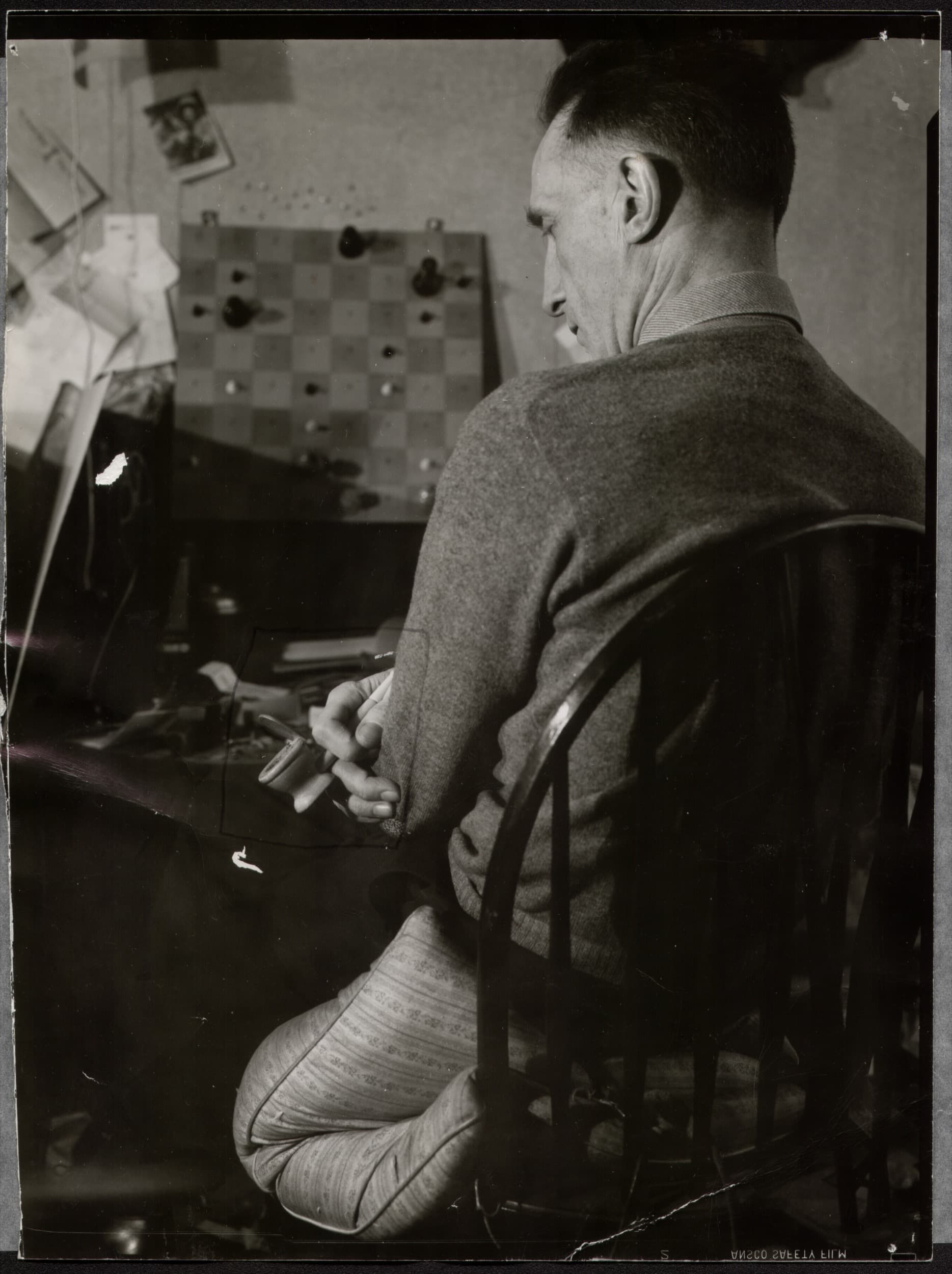
Percy Rainford, Portrait of Marcel Duchamp, 1945. Gelatin silver print. Archives of the Austrian Frederick and Lillian Kiesler Private Foundation, Vienna, Austria. © 2026 Estate of Percy Rainford.
Word count: 827
Paragraphs: 6
The Marcel Duchamp retrospective exhibition that recently opened at the Museum of Modern Art (MoMA) offers visitors a once-in-a-generation opportunity to engage with the artist’s radical work and ideas. This is the sixth Duchamp retrospective, following Pasadena (1963), London (1966), Philadelphia/New York/Chicago (1973–74), Paris (1977), and Venice (1993). Each of these previous retrospectives and their accompanying catalogues played a crucial role in disseminating information about the artist’s life and creative output, leading to the inevitable question about the current iteration, which after its New York presentation will travel to Philadelphia and then Paris. What else is there to learn from bringing the artist’s corpus together and how will a new generation of artists respond? To answer these questions would be pure speculation at this point, but what we have learned from past retrospectives is that they inevitably inspire artists, art historians, critics, and curators alike to find new meanings and different aspects to explore in Duchamp’s open-ended oeuvre.
Differing from her predecessors, Ann Temkin’s scintillating installation at MoMA pointedly refuses to present a new, overriding theoretical framework for understanding Duchamp’s work, preferring instead to leave the works on display free from interpretation in line with the artist’s belief in the interactive role of the viewer in “completing” the work of art. Whether visitors are captivated, inspired, intrigued, bored, or annoyed really has nothing to do with Duchamp since, as Thierry de Duve has persuasively argued in Duchamp’s Telegram, the artist was the messenger and cannot be held responsible for how the message is understood by subsequent generations.
It should be remembered, however, that Duchamp was still very much alive when American and European artists began to respond to his message in the 1950s and early 1960s. His response at the time was to offer a prophecy that very few artists heeded: “the great artist of tomorrow will go underground.” Duchamp made this statement at the Philadelphia Museum College of Art on March 20, 1961. He delighted the audience with a verbal assault on the rampant commercialism of the art market, which he believed had turned art into “a commonplace product like soap or securities.” The only hope, he asserted, was an “ascetic revolution” (a delightful pun on aesthetic revolution) that would allow artists to work outside the gallery system in a kind of hermit-like underground seclusion. It was only after his death in 1968 that Duchamp’s own underground activities were revealed though the posthumously unveiled Étant donnés, which he constructed in complete secrecy over a twenty-year period, during which it was widely assumed that he had given up making works of art.
One of the few artists to respond to Duchamp’s advice to go underground was Ray Johnson. A great admirer of Duchamp’s risqué puns and quixotic word games, as well as the gender ambiguity of his salacious alter-ego Rrose Sélavy, Johnson used the postal service rather than the gallery system to share his artistic production with the world. In 1971 he publicly announced his allegiance to Duchamp through the formation of the Marcel Duchamp Fan Club as a subgroup of his New York Correspondence School (the official-sounding name he coined to describe his mail art activities). On September 19, 1973, Johnson attended the Duchamp retrospective exhibition opening in Philadelphia, but true to his reclusive nature he never left the museum parking lot. Hidden in the bushes, Johnson spent the evening spying on the invited guests, including many well-known artists who claimed to be disciples of Duchamp, while assiduously ignoring his request to go underground. Johnson’s furtive behavior at both the 1973 retrospective opening and his subversive mail art activities until his death in 1995 underscore his career-long commitment to answering Duchamp’s underground clarion call.
I am hoping that the current Duchamp retrospective will inspire other artists to do the same. If so, they will follow in the footsteps of Duchamp, Johnson, and David Hammons, who perhaps best exemplifies the notion of going underground today through his fierce independence and studious avoidance of the art market. As the self-proclaimed head of the Duchamp Outpatient Clinic, Hammons has found a way out of the frustrating dead-end that the readymade gesture has become for artists in the twenty-first century. To Hammons, the idea of presenting found objects as “witty and irreverent” responses to the readymade (think of Maurizio Cattelan’s duct-taped banana) has become a commercially driven virus of epidemic proportions: “It’s so easy to make a bundle of money. Throw Duchamp into the mix and you go off to the bank.” Through his impeccable integrity, refusal of gallery representation, avoidance of a single style or mode of expression, and profound commitment to creating unforgettable artworks informed by Black history, Hammons provides an antidote to this enervating crisis, one that is firmly rooted in the underground ethos espoused by Duchamp. What will Hammons make of the latest Duchamp retrospective? I would love to see the exhibition with him, but he may just want to stay in the parking garage.
Michael Taylor
Dr. Michael R. Taylor is the Artistic Director and Chief Curator at the Virginia Museum of Fine Arts (VMFA). His exhibitions include Giorgio de Chirico and the Myth of Ariadne (2003); Arshile Gorky: A Retrospective (2009); Marcel Duchamp: Étant donnés (2009); and, most recently, Man Ray: The Paris Years (2021). Dr. Taylor served as Curator of Modern Art at the Philadelphia Museum of Art from 1997 to 2011, before being appointed as Director of Dartmouth College’s Hood Museum of Art. Since 2015 he has worked at VMFA, where he is currently working on a major expansion project scheduled to open in 2029.