Word count: 4524
Paragraphs: 42
Barnes Foundation
March 21, 2026–January 18, 2027
Philadelphia
Sky Hopinka is from the Ho-Chunk Nation and Pechanga Band of Luiseño Indians. Hopinka was born and raised in Ferndale, Washington, and spent a number of years in Palm Springs and Riverside, California; Portland, Oregon; and in Milwaukee, Wisconsin. In Portland, he studied and taught Chinuk Wawa, a language indigenous to the Lower Columbia River Basin. His video, photo, and text work centers around personal positions of Indigenous homeland and landscape designs of language as containers of culture expressed through personal and non-fictional forms of media. On the occasion of Hopinka’s commission for the Barnes Foundation’s Annenberg Court, Red Metal Dust, the artist joined Chenoa Baker on the New Social Environment (Episode #1334).
Installation view: Sky Hopinka: Red Metal Dust, The Barnes Foundation, Philadelphia, 2026. © Barnes Foundation.
Chenoa Baker (Rail) Sky, I’m so grateful to be in conversation with you and am excited to dive into your work. I wanted to start by acknowledging the complicated time we’re living in, and how—at least in Philadelphia—there’s been a lot of talk of the 250th anniversary of the United States Declaration of Independence. We’re in this moment of reckoning, especially with what those words mean in the world that we’re occupying today. I am curious to hear from you about the commission and how you feel about making work around this milestone?
Sky Hopinka: I mean, it’s complicated and it’s heavy and it’s real—it’s also something I didn’t really think too much about up until the opening, primarily because I didn’t know. When the Chief Curator, who is also the Director of Collections, Nancy Ireson, reached out and we had a conversation, it was more of an afterthought. Like, “We want you to do this installation. So why don’t you do something that you want to do? And, oh yeah, it’s also the 250th anniversary.” So it became something I never felt too beholden to address. On the other hand, the fact that it exists adjacently or parallel to the making of this is something that I knew was inevitably going to be part of the conversation—like most things that have to do with Native people are.
Rail: Definitely. I think there’s a sense of freedom in the decision to not make work directly about this milestone. It just happens to be at the same time, and it will create its own contextual reverberations. I’d love to talk about the medium and installation choices. Dimensions can be variable in video work and photography, but the size is really determined by the chosen container. How did you arrive at the decision to use these eleven panels and the size of the work?
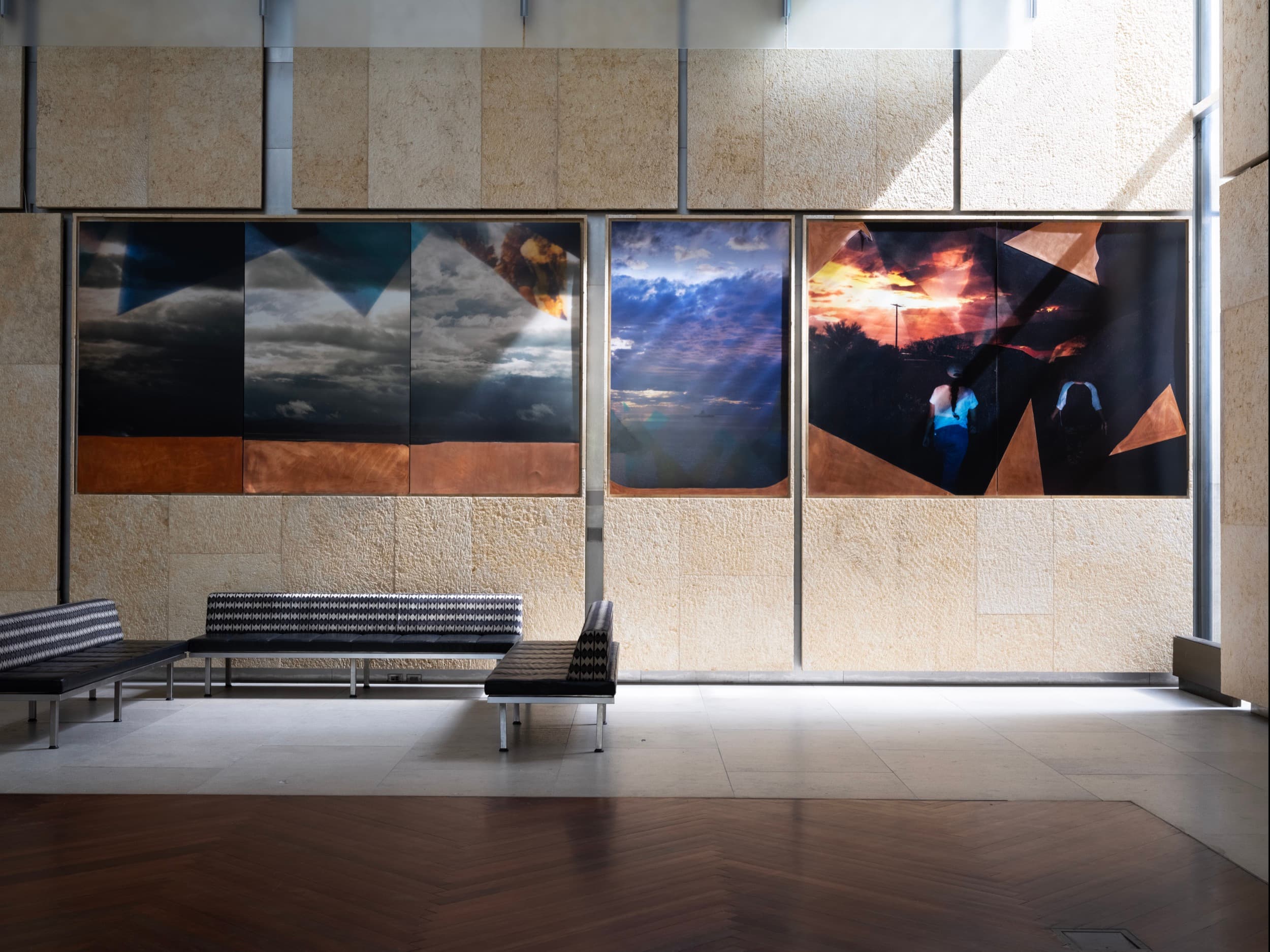
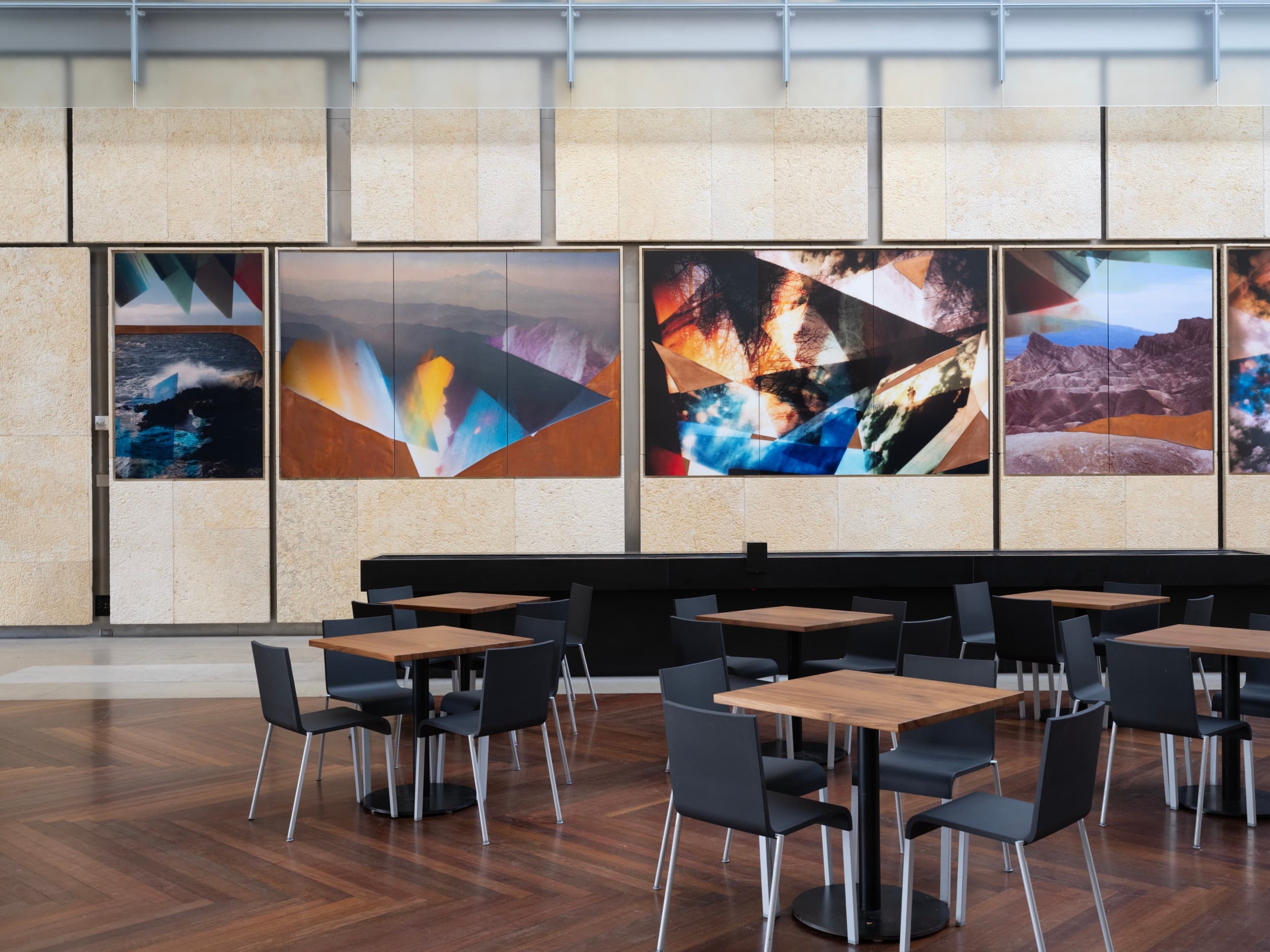
Hopinka: That wasn’t so much up to me; it is the space that they have. It’s a long entrance hall that that leads to the main galleries of the Barnes collection. There are eleven panels, all 86 inches tall. And the widths vary from 56 inches to—I think—205 inches. So, right away I had these containers to then build the work into, which I think was helpful in some ways. The work is designed to fill the space. The works are hung about three or four feet off the ground. So yeah, it was something that was predetermined by the parameters of architecture.
Rail: I like thinking about, and understanding, how the realization of the work is a collaboration between the site, creating the site-specific work, and you as the artist. I know that you brought copper as a material into that conversation, and during your opening, you spoke eloquently about copper and landscape as a living, changing material. Can you talk about how you decided to use copper as a surface, or medium, for display?
Hopinka: Copper is something that I have been thinking about for a long time, as a material, as an object, as a thing that is used in different ceremonies and for decorative purposes—not only by my tribe, but by tribes across the United States, in Canada, and in the lands beyond. I liked the possibility of incorporating it in these photos, because I’ve been thinking about other ways to affect the surface of the photo. In previous works, what I have done is print out photos, edit and manipulate them, and then etch into the surface with a little handheld rotary tool. I’ve been doing that for a number of years and have been thinking about ways to try something different, while still building on this idea of affecting the surface. Copper was an exciting choice because I’ve never worked with it before.
In Ho-Chunk mythology, copper is a living thing. It is descended from these other metals that are part of life on this earth. I was also thinking a lot about who gets to decide who is living and who is non-living. This comes from a book that Elizabeth Povinelli wrote, called Geontologies. She opens up this kind of questioning, and that helped me frame my own understanding of this material, and to be considerate of the dynamics and hierarchies that are created around the living and the non-living. Who gets to determine that, and what are the powers and hierarchies around that distinction? I think often about how my work questions these different mythologies, or presents different ways that they can exist in a contemporary time, or brings them out of the past and into the present. So working through these ideas was another way to try to attempt to question what that looks like through these different forms. And since it was the first time for me to be working with copper, I figured, might as well go big or go home. [Laughter]

Installation view: Sky Hopinka: Red Metal Dust, The Barnes Foundation, Philadelphia, 2026. © Barnes Foundation.
Rail: Definitely. I know that you talked about how in previous works you’ve done etchings, but it feels like there are moments in the work where text is implied but not explicitly shown. For example: there’s a billboard that is blank, but it reflects the copper as that language that you were just talking about. Can you say a little bit more about that decision to include the copper in that way? What are you choosing to withhold or suggest, rather than display?
Hopinka: Yeah, I mean, I guess it goes back to the process of making the photographs. The foundational photographs are from a series that I had taken on a medium format camera and a 35 millimeter camera over the course of a year prior to this installation. So I wasn’t so much trying to decide which medium to use. These are the photos that I had. After deciding upon these foundational photos, I thought about the place where they’d be shown, and the different possibilities available. For example, the triptych is the result of the limitations of the photo paper. I think the largest that we could use at the lab where I was working was 62 or 63 inches. So just like that, it became a way of giving the photographs the room they needed. The triptychs were better than trying to make it just one long piece.
And then after that, I revisited a technique that I’ve used in the past, where I print photos on transparency paper, get an overhead projector to project that onto a wall, and then photograph the projection. So with the photograph transparencies—where I would also cut them up and arrange them in different configurations—I’d then take a photograph of those, and then overlay them on top of the original landscape photographs, and then print them out.
And once they were printed out, then it became a process of looking at each of the images and asking, “What do I want to highlight? What do I want to obscure?” So it was an intuitive approach in that part of the process, but I was also just looking at ways to respond to the outlines of each of the different photographs and landscapes. In some ways, the response was more direct to what was in the image itself, and in other ways, it was a response to the overlapping of the transparencies on top of the image.
I’d also been looking at silhouettes, in particular from the 1800s. There are two that I was looking for, because a lot of silhouettes were done of Native peoples in the 1800s before the invention of photography. So in the Met’s Drawings and Prints collection, I came across two silhouettes made around the 1850s by Auguste Edouart of the Ho-Chunk people, Winnebago people—my tribe. But I couldn’t see them, because they weren’t scanned in the collection. That got me thinking about the idea of something that I can’t see: how should I respond to the sort of withholding of a photograph? It raised the question of what gets photographed or scanned in a collection. What is accessible and what isn’t?
So it just became a way to riff on this idea of a silhouette and what is being outlined. And like, what is the purpose of making them? And how can an outline of someone or something not only evoke a sense of an identity, but establish that as an identity that has to be looked at? So, the geometrics and the abstractions—just kind of following the lines of the shade of a surface and the interaction of the transparencies—began as an intuitive sort of response, but then it took on a life of its own, in terms of questions like, “What does the copper outline? And how does that withhold?” But then also, “How does that gesture towards this idea of withholding or refusal?”
I mean, I’ve been thinking about these different layers of production, where I would take the photographs of medium formats, and that’s one life. And then I digitally overlaid these transparency artifacts, which is another sort of mediation. Then they’re printed out. And then the final one is the overlay of the copper on the surface of the photograph itself, where it is part of them, but it’s also not.
We didn’t treat the copper with museum wax or anything, so it’s going to oxidize—I believe it’s already started oxidizing. I was really drawn to that as well. Over the course of the duration of its installation, it is going to respond to the people who pass through the Annenberg Court and look at these photographs and spend time with them, so I was also thinking about different ways that the copper could react to that.

Installation view: Sky Hopinka: Red Metal Dust, The Barnes Foundation, Philadelphia, 2026. © Barnes Foundation.
In one of the works there is a large swath of copper, and there’s something about how that creates a landscape itself. I found very quickly that copper is a sensitive material. It reacts strongly and immediately to pressure, to touch, to breath. It’s a material that I don’t think is pristine, and shouldn’t be pristine. It’s more of a conceptual idea of beauty to me, how the copper is responding to the environment around it. So it became a question of when to have larger pieces of copper, when to have smaller ones, and when is it too much? And then also looking back, what does this mean? Or what is the aboutness of this, when it comes to the surfaces and it comes to the images themselves?
Rail: I’m thinking about all the ways that copper shows up in our lives, and how we either notice it or don’t notice it. I’m thinking about the penny, and how it’s kind of apropos insofar as we’re getting rid of it, but it’s something that’s still exchanged and constantly there, altered by our touch. I’m also imagining what the work would look like after ten or so months, if it will have more of a green tinge, which would be exciting. I wanted to talk a little bit more about the lands represented in the work. I would love to know which lands are represented, where they are, and maybe how you chose some of these images.
Hopinka: Yeah. I should maybe take it back to your original question about the billboard. I mean, that’s in Tahlequah, Oklahoma, and I was on a trip with a friend who went to film Agalisiga Mackey, who’s this really amazing Cherokee country musician—and Tahlequah is one of the bigger towns in the Cherokee Nation. That was a day where we had done some filming, and we stopped at that restaurant right there in the corner—you can see it. [Laughter] It was a beautiful day with some beautiful clouds, and I wanted to take some photographs. That’s part of my process too: I’ll just photograph for the light and for a composition without a clear idea of what I’m going to use that image for, or how it’s going to appear in a finished piece of whatever it is.
When looking through the photographs I had taken over the past year, I asked myself which ones felt like a way to offer a memory without trying to claim some ownership of it, or a place, or location. Because we all move to these different places, and we all have different relationships—complicated relationships—with the land and landscape. Now for me, with the outlines of the billboards, that kind of came second or third, because I wasn’t quite sure if I wanted to do that there. But it also was a pointed gesture towards something when it comes to the way that these landscapes are also occupied. They’re all so full of life in different and complicated ways.
I feel like the landscapes offer a different way for me to not only remember where I was, but to offer a subjective look at the memory of a place in the landscape. The places vary from airplanes, from Washington to California to Wisconsin, to different parts of the Midwest and all across the country. They’re from when I was on road trips, or when I was on the train. I was really trying to not think about doing a survey—like from sea to shining sea—but more selecting the places that stood out and that I remembered for one reason or another. Because I do think a lot about a mnemonic relationship to things through my work, or also just an effectual one. And how does that relate to things that are often tied to, or difficult to try to explain, or difficult to try to unpack, where it is a resistance to the sort of ethnographic history lesson, or the didactic? Like this means this, and this represents that. There are certain things that I’m thinking about, but that isn’t the only way.
Because making a work that’s going to be on view in a public space, or a semipublic space, for something like ten months—there’s a lot of different people from a lot of different backgrounds who will pass through and spend time. That’s complicated in itself. What will these things remind them of? Will they take you somewhere? And how do these different gestures—whether it’s the transparencies, or the copper, or the way that the photographs offer an effectual way of relating to them on one’s own terms—meet so many people who are all bringing their own experience to this place?
Installation view: Sky Hopinka: Red Metal Dust, The Barnes Foundation, Philadelphia, 2026. © Barnes Foundation.
Rail: There are so many elements that are just so beautiful. To give the readership some context, I’m a little taller than five feet, and I was looking up at these works. I noticed that there are people who appear in the images, so it isn’t just landscapes. I was curious if you had relationships to the people who appear in the work? And if so, how do these relationships inform the way that they’re depicted?
Hopinka: Yeah, I do. But I want to stress that they’re portraits of moments rather than portraits of people. I don’t often include people in the more abstracted work that I do. What I think about is how people are in these places. And it doesn’t matter if you know who they are—it’s about knowing that they’re there. I’m still thinking through that and what that means.
Part of the challenge with this work was that the first time I’d seen them all together was when they were installed. There’s something to seeing how they exist in the left-to-right order, or in the space with different lights at different times of day. I think that for me, there’s also some excitement of discovery—maybe seeing something that I’ve done, or asking myself, “What does this mean? What was I doing? What was I thinking? What does it mean for there to be people in these places?”
In the first image I sent the Barnes Foundation, you can see the image before the copper was placed on the image itself. This is in Arizona, during a culture retreat, and it was just a beautiful day and a beautiful sunset. I’m a sucker for sunsets. There’s something about moving through the space and the walking, and it’s just a certain sort of assertiveness that I feel is important, because it got me the idea to title the work “Red Metal Dust.” Mąąs is the Ho-Chunk word for copper. It’s a red metal. And dust—there’s certain stories, especially around the creation of some of these beings, that dust is the thing that gives life. That’s where life comes from. And so much about the presence of people in these different places is often neglected or forgotten about. But then also, what are the ways that Native people can be present? There’s a certain accumulation and survival around it. Signs of life, signs of environment, signs of infrastructure, signs of interventions and presence were a way for me to do that—not necessarily using some of the same techniques that I had in the past, like writing or inscribing texts on the surface of the photographs itself.
Rail: Something that really stood out to me too is, again, how you were saying you’re gesturing towards life and towards people being in these environments without showing their faces, and therefore keeping them anonymous. I think that there’s a lot of power in showing that relationship, but also, like you were saying, just protecting their identity. Even having the gesture of people in this sequence, it really starts to make you personify the land. How do you think about responsibility, or even accountability when working with land and community?
Hopinka: Well, there’s different ways to approach these things, and I’m thinking through that. It’s like with the 250th anniversary, you know? When someone asked me about that, I was like, “Cool. So what?” Because these things are happening regardless—a Native presence on this land, resistance to these things. I don’t know. Someone asked me, “Who are these people?” And my response was basically, “That’s none of your business.” I don’t want to be too flippant about it, because I think that the underlying idea around this is that there’s a resistance to the ethnographic extraction, a resistance to the entitlement of knowledge—where you see something, and therefore you must know what it is and what it means. I think there is something to refusal and denial, but not where it is about the act of denying or refusing, because that sort of prioritizes the person or the institution, or those in power who are asking the question. Do you know what I mean?
It’s a tricky tightrope. I used to describe my work as “ethno-poetic,” but I became tired of the “ethno-” prefix, because it felt like I was always doing something in reaction to the history of ethnographics, or ethnographic art, or ethnography as a mode of knowledge. It’s the same thing with the 250th anniversary. I mean, 250 years is a small container to look at the history of this land and the people who have occupied it. This land is older than America. These peoples are older than America, and it’s important to remember that. What are the next 250 years going to look like? I think that’s a lot more interesting and a lot more pressing for many people who live on this land. It’s the same thing with how to think about the material itself, like copper: it’s been used by tribes and Native communities across continents for thousands of years. It isn’t just tied to the penny or the Statue of Liberty. And so I’m trying to find out how to move beyond these different frameworks of looking at these things and these objects and these people and these landscapes and offer something new.

Installation view: Sky Hopinka: Red Metal Dust, The Barnes Foundation, Philadelphia, 2026. © Barnes Foundation.
Rail: Thank you for pushing back on that question. I appreciate that. I want to sort of switch gears to talk about your process and the intuition that you mentioned being part of your visual language. I know that copper is a newer medium that you’re working with. Were there moments in this process that surprised you or that caused you to change direction?
Hopinka: So many! [Laughter] I mean, there’s so many things that don’t quite turn out the way I expected. But I knew that going in, and that discovery is also part of my filmmaking process—just gathering materials and seeing what sort of twists and turns they take, or how they interact with each other and can create something new or unexpected.
I mean, the dimensions were always challenging—not too challenging, but just in terms of how those would come out, in terms of the triptych or diptych or quadriptych. Then there were also the big questions—the copper itself and how it was going to adhere—like I mentioned before: “Do we seal it? Let it oxidize? How perfect do I want it to get?” And there were some last-minute changes to these over the course of a few days. Like, “Maybe I don’t want copper here, maybe I want it there.” So just kind of being responsive to that. And also like I said, I had no idea what they looked like finished, because we were working up to the deadline getting them done.
Rail: I’d love to know more about how you thought about sequencing the work. I understand that the overarching work—the exhibition—has a title, but the individual works are still untitled. I’d love to hear a bit more about how you thought about that and how you sequenced it to make this story.
Hopinka: I numbered them one through eleven to make it easy on myself and the fabricators, and to see how they’re installed. It didn’t feel appropriate titling them yet, because I didn’t spend time with them. But I have been thinking about how I want to title these pieces. Do I want them to be in Ho-Chunk? Do I want them to be in English? Do I want them to be long? Short? Poetic? Straightforward? I’m not sure.
Because even with the editing that I do in my more experimental video works, it is somewhat of an intuitive process, where I’m not quite sure of the linear arc around how something might play out. I’m asking myself, “How do these different sections of our scenes or shots fit together? And how does their orientation or juxtaposition against one another affect someone’s experience?” So with these pieces, I leaned into the dimensions as a way to figure out what would go where. For example, the three shots of Tahlequah with clouds—I think I had more than three photos, but these are the three that I thought kind of fit together. So I had space for a triptych. I was like, “Okay, I’m going to put three of these, and I’m not going to be concerned with the edges and the boundaries.” And so how could that create a singular piece? Something I do like to do is to respond formally to what and how I’m making something. And then, you know, to ask, “What’s the bigger picture? What is it that I’m doing? Where does the intuition come from?” So I don’t think of these as necessarily a narrative. It is not going from east to west, or west to east.
It is something that is put together in a way that is responding to the environment, and from there, I think that there’s something to be interpreted from it. But then other questions arise: “What happens once the run of the show is over? Are they getting separated? Are they going to stay together?” I have no idea. That’s kind of exciting for me, because I think that these things live beyond—or hopefully they live beyond—the place that they were first installed.

Installation view: Sky Hopinka: Red Metal Dust, The Barnes Foundation, Philadelphia, 2026. © Barnes Foundation.
Rail: That leads me to a question about audience experience. So sometimes, like you were saying, the work comes from a very subjective perspective, right? A lot of artists—and I’m sure you do this as well—make work for themselves first, but then, when it’s shown in this semipublic place, like you were saying, it’s opened up to all of these different ideas and perspectives. I’m curious about how you envisioned visitors moving through the Annenberg Court and interacting with your work?
Hopinka: I don’t want to sound like I had this all planned out, because I didn’t, but when you’re walking in from the Barnes’s entrance, the first thing that you see is the people that are walking away. And then you see these other images—one of boats, and then one of the copper on the bottom. And I think that’s something—I don’t know what—but it is something. But then you turn, and you see them all kind of laid out to the right.
I mean, I like thinking about how people enter a space and how they move through it, and what they look at first, and what they look at next, and where they’re trying to go. Some people are just trying to go to the collection; some want to hang out and sit on the couches and read, visit, and chitchat.
But there’s also something to the things that surround you when you are doing other things, like reading, visiting with friends, drinking some coffee. I hope people spend time with these, and I hope that the experiences that they have in their own lives are things that they find recognizable in the photographs, even if there is no correlation. Because not everyone passing through the space will be Ho-Chunk people, they’re not all going to be Native people. It’s going to vary. I was thinking about the title as well, or the titling of each of these different pieces, because I don’t think that these things exist in a vacuum. We know that they don’t—there’s a big old didactic on the entrance giving some of the writings that I’ve done around this work. I don’t want to give everything away, but I want to guide as much as I can. I don’t want to burden the works with explaining what they are. Do I believe that? I don’t know. Maybe I want to burden them with saying what they are, but not explaining what they are. I don’t know if there’s a difference there. I’m still thinking through it.