Word count: 5822
Paragraphs: 37
Matthew Brown Gallery
May 15–June 20, 2026
New York
While many artists borrow from the past, very few collapse historical timelines with the raw, unsettling energy of Sedrick Chisom. He merges the iconography of the American Civil War, medieval mythology, and speculative sci-fi into a single, distorted world-building project. His canvases function as an ongoing catastrophe where history returns like a persistent ghost, blending a deep, daunting seriousness with a neurotic, unhinged humor.
On the occasion of his new exhibition at Matthew Brown, Chisom spoke with curator and writer Ginevra de Blasio. They delve into a practice that treats the canvas as a physical skin, exploring how the “Russian doll” layering of the past simultaneously produces and constrains our present agency. The dialogue touches upon his latest body of work, exploring how a recent shift to London and the spatial constraints of the theater have informed his newly staged, apocalyptic compositions.

Sedrick Chisom, A Son of Soil Dreamed of Horses on the Camping Ground of Annihilation, 2026. Oil and Acrylic on paper mounted to canvas, 54 × 72 inches. Courtesy the artist and Matthew Brown Gallery. Photo: Eva Herzog.
Ginevra de Blasio (Rail): Your new exhibition at Matthew Brown continues a body of work you began in 2018. In it, you study, alter, and draw inspiration from various histories and mythologies, converging past, present, and future on your canvases. With references spanning from antiquity to the American Civil War, I want to start here: when pulling from such vast timelines, where does your research begin, and where does it end—if it ever does?
Sedrick Chisom: I work with a really large amount of references. It’s more that the ideas guide which references I use, not the other way around. One reason for that is because my practice is ultimately world-building, so I obsessively think about the world I’m imagining and depicting from every angle. Another reason is because my view is that we share a single, complicated, semi-intelligible history on this planet, not histories—we might have various particular quantitative chains of events, but history as I understand it progresses through discrete qualitative world shifts. I’m nowhere near the first to say this, but history repeats. The way I represent this repetition of history is through collapsing temporalities from antiquity, medievalism, the eighteenth through nineteenth century, and the various twentieth-century articulations of speculative futures such as dystopias and post-apocalyptic settings. In my work this looks like an ongoing carnivalesque catastrophe. So the sensibility of time in my work is closer to mythopoetics than to chronological fidelity.
My painted world is mainly set in the landmass that the US currently occupies. As a result, and with regard to references, the focus point of my research is centered on the American Civil War, the Antebellum South, the American Revolution, and the open range era—the unconscious forces that shape the circumstances our subjectivity and agency as Americans emerge from in the twenty-first century. I also make various references to the kinds of texts that would be familiar to someone who worked for the Southern Poverty Law Center, such as the “Turner Diaries”—which is not a page turner. More peripherally, the works reference Western mythology and antiquity as well—Medusa, Oedipus, Narcissus. There are also medieval references, humoral theory, miasma theory, and the compendium of the monstrous races.
I’ll speak to the last set of references, as it may seem obscure and pretentious as its own end. The compendium of the monstrous races catalogued by Pliny the Elder played an important ideological role in antiquity and medieval thought. The monstrous races were partially human and partially monstrous beings who existed at the edge of the “known world.” This compendium explained cultural and then eventually Christian hierarchy. Such monstrous race figures included the Cyclops, the Cynocephali, the Blemmyae, the Pygmy, and the Ethiopian. The monstrous races were categorical edge cases with regard to the question of “What counts as human?” Despite being an ancient ideological worldbuilding tool to organize full and partial humanity, the notion of the monstrous races in its original sense lasted into and beyond the seventeenth century. Really it only ever shed its aesthetic edifice, but its underlying logic never truly died. Notions of partial humanity haunt the categorical split of primitive versus civilized, racial pseudo-science, modern cultural hierarchies, and the human rights atrocities rampant in our present world. Its logic played a significant role in the American Constitution and the subsequent Civil War. So yes, history is ongoing and never concludes but mutates in form repetitiously. Perversely, in relation to your question, it’s more like the starting point of my research has to do with where things end.
Rail: You’ve mentioned the concept of eschatology to me before, and looking at this exhibition, that focus on “the end of things” is undeniable. It comes through so clearly in the apocalyptic dimensions of your work and your portrayal of societal extremes. Can you elaborate on your interest in that?
Chisom: Eschatology, in religious studies and philosophy, is the study of ends or endings—how humanity ends, how people endure the apocalypse, how people are spared from it. It occurs multiple times in the Bible—the book of Revelation, the Last Judgment, but also the flood narrative in Genesis. The apocalypse exposes the truth—it retroactively shows the structure of human history and how it unfolds. In my work, I’m focused more on eschatology in terms of how humans endure the apocalypse. Eschatological narratives are structured around inclusion and exclusion—who’s spared, who’s not, who’s pure, who’s wicked. There’s always this underlying in-group/out-group logic in such narratives. My intuition is that this has to do with the separation between the sacred and the profane being ruptured. The sacred intervenes specifically on the profane. You also have to understand that in a frank intuitive sense, eschatological narratives, with regard to the underlying logic of an in-group/out-group splitting, are like collective revenge fantasies. The in-group is often on the side of cleanliness, righteousness, purity, and the out-group is often on the side of uncleanliness, sinfulness, and impurity. It’s very easy to guess which group will ultimately be obliterated and which will be chosen to survive, endure, or be spared in the aftermath.
Rail: How do these apocalyptic themes translate to the physical figures we see in your paintings?
Chisom: I think one of the most obvious features of the work is that it doesn’t primarily focus on the representation of Black figures. I’m Black obviously, so my own presence in the paintings, in the fact of the work’s articulation, haunts that absence. What comes into tense focus, due to this particular tense absence, instead are the structures in American history that determine the partially intelligible present. The figures, with racially ambiguous—and to a degree horrific—features are mostly drawn from the American Civil War, the American Revolution—they exist almost like they’re in an afterlife, but in a world they’ve constructed and continue to reproduce. They can’t escape it. So instead of mastery over the landscape, which you’d expect in frontier imagery, they’re awkward, lost, dazed, and defeated—kind of in a stupor.
Rail: That ambiguity seems to be exactly the point. Your paintings obviously reference history, but because you mix so many different eras together, it’s hard to pinpoint just one. You mentioned to me the other day that you see history almost like a Russian nesting doll—an accumulation of events compounding into a specific moment. How do you navigate this layering of histories on the canvas?
Chisom: At first it can feel like a lot—compounding symbolism, metaphors, references. But for me it’s not about linear chronology, it’s about the metabolism of history and the throughlines of that metabolism. So you can look at something like Roman expansionism and see it reanimate into modern economic ideology—the same imperative of expansion, just in a new arena. When a Roman emperor lost territory, he could also lose his head. When an American president oversees three periods of negative economic growth, the country now loses its symbolic head. That’s how history, at first appearing dead, persists. I keep saying this, but history doesn’t die—it distorts, reconfigures, and returns, almost like a zombie. The references are combined in associative constellations that break linearity but still hold together, because the internal logic of the painting performs those ideas.
Rail: Is that also why there are recurring elements in your paintings—specifically figures, machines, and animals? I notice you mostly focus on figures of authority. Does this constant return to the figure of authority connect directly to what you were just saying about how historical ideologies persist and repeat themselves?
Chisom: The figures of authority in my work are interesting because they’re invested in their authority for its own sake. That’s not a particularly new idea. Authority always comes down to an infinite regress. Authority derives from a population that grants authority to authority under the belief that their structure of authority has the legitimacy to have authority. There is no ultimate origin to authority. It’s a hall of mirrors. Yet, and to speak to the notion of apocalyptic revelation, the belief structure that justifies authority has collapsed in the world I paint, but the figures continue their rituals anyway—this bureaucratic proceduralism without any real aim or end. With regard to the animals, something Katherine Bradford pointed out is that they often appear more human than the humans—their expressions, their eyes. So the humans end up feeling hollowed out, like the systems they’re enacting.

Sedrick Chisom, The Historical Reenactment of The Empire's Counterattack on The Monstrous Races, Restaged as a Minstrel Comedy, 2026. Acrylic on Canvas, 89 × 89 inches. Courtesy the artist and Matthew Brown Gallery. Photo: Eva Herzog.
Rail: So, who exactly are the figures in your paintings? Are you trying to represent someone specific with this figure of authority, and are they always white? I ask because I know you wrote a sci-fi play set in the year 2200 about a world of white supremacy experiencing a disease outbreak. Is the narrative of that play still a grounding influence for your work today? Are these figures part of that story?
Chisom: Yes. I should talk more about that. I wrote a play, which is still unproduced. All of the paintings and drawings I’ve made from 2017 until this moment exist in that same world. Probably north of 95 percent of the work I’ve made occurs before or after the play, and only a few paintings are imagined as scenes from the play. The play was initially my written thesis that I submitted for my MFA at Rutgers University. It’s three acts long. The most basic premise is that the prevailing ideology of that world, where Black people have been spirited away on space vessels to do the Star Trek thing, is the ideology of a world that exists in the aftermath of a right wing revolution. The play is mostly set in Monument Valley. Soldiers who resemble Civil War soldiers have been sent there to retrieve their mythological past, their “Aryanness in Other Places,” due to the outbreak of a disease that darkens their skin pigmentation and causes it to decay. There are some larger than life supernatural, mythological, or historical figures depicted occasionally in my work. More often than not, the paintings and drawings focus on anonymous soldiers. The references and research I gathered in order to write my thesis became incredibly useful source material to generate that world over the past decade. Like the play, my paintings and drawings mainly focus on these soldiers and their occupation of landscape. In MFA speak, they’re signifiers of authority. They’re not part of the story, they’re the thing that moves the story. These figures are basically the engine of the narrative—the bureaucracy, the standing army of that ideology. They were born from white people. They identify as white, but their bodies don’t align with that identity. That mismatch, that gap between their phantasmatic sense of self and their actual embodied circumstances is what drives them—they keep reproducing the conditions of their own collapse. That internal mismatch causes their desire to return to a mythological past while making such a return impossible. There’s always this tension between the social appearance of unity and an underlying substantial disharmony. In all of the work, from the play, to short stories, to paintings and drawings, that tension expresses itself as a kind of death drive. They’re not literally Confederate soldiers; they’re like distorted echoes and the persistence of that imagery—something that keeps returning in altered form, always exceeding official history’s attempt to repress it. In our own social realities we see the same tensions play out. Official history describes certain questions as historically settled because liberalism survived as the dominant ideology of the twentieth century, but the underlying social contradictions that justified those political projects were only repressed. These contradictions symptomatically returned in the twenty-first century like a ghost that refuses to die, as political, and even religious, nostalgic distortions of the twentieth century.
Rail: What about the machines and mechanical elements in the works?
Chisom: The machines are actually quite fun for me to paint. There’s a basic fidelity to older technologies—steam technology, nineteenth and early twentieth century technology—alongside sci-fi elements like visors. One thing I found interesting in researching apocalyptic scenarios, is that we could always revert to technologies like steam. They’re quite rare in my paintings but they do occasionally show up. Mostly as naval vessels, cannons, and tanks. In earlier presentations of work I painted figures in atmospheric gear with explicitly sci-fi elements. I wanted this equipment to feel a bit sparse or rare however. So I always make quotas of how little technology should appear in my work. Technology has a concrete effect in grounding the viewer to a stable sense of time. I keep the appearances of technology sparse and sometimes contradictory. There’s a political dimension to presenting a future where technology declines and doesn’t match our expectations of progress—it breaks that assumption of linear advancement. I guess it might come from taking school trips to Lancaster County and seeing Amish people with modern shoes when I was a kid. I don’t buy that because that just sounds way too neat. I’m gonna put some Air Force 1s on one of my soldiers at some point just to fuck with the viewer.
Rail: I want to shift to your painting process now. I feel like your physical layering mimics how you envision history—as a compounding of moments rather than isolated events. You made a great point the other day about the Berlin Wall, saying you can’t just study its fall in isolation, but must look at everything leading up to it. How do you translate that philosophy into the physical act of painting and layering?
Chisom: Yeah, that’s probably the key question for me. I think with regard to the Berlin Wall conversation I was simply talking about how the endpoint of a historical arc makes the trajectory of events that led up to that moment look obvious and foreseeable. That’s an illusion however. Events in history aren’t particularly intelligible in real time, and up until a certain point they look mostly contingent. At a certain point events have developed from a quantitative to a qualitative state; meaningful constraints emerge in terms of what kinds of decisions can be made, or even what political outcomes or solutions are imaginable to begin with. Constraints show up well when something is impossible to imagine. Between 1946 to 1988 the world seems like it’s in the long haul for an axiological struggle. Between 1988 to 1989 the collapse of the Berlin Wall is developing as a near certainty but still isn’t apparent yet to the vast majority of people. History begins to move in a determinant trajectory. History develops through constraints, and those constraints are where agency manifests. In painting, one’s paint surface as well as one’s approaches to priming the surface determines what can happen on the surface. Each layer, additive or subtractive, opaque or translucent, muddy or vibrant, etc., sets the condition for the next. There’s a mix of intention and contingency—accidents, ruptures, things that happen materially that you could never do on purpose. You think you have to respond to them, that you have to preserve them, or improve or remove them. The process mirrors that idea of accumulated constraint and emergence. The surface itself in my work is probably the most evocative content, at least it is in my opinion, and that content intervenes on the subjects I paint.
Rail: I imagine this is also why your paintings are unstretched and stapled directly to the wall rather than stretched over bars. Curatorially speaking, encountering these raw, heavily layered canvases creates a unique viewing experience. Does the physical process demand that kind of display?
Chisom: Yeah, the canvases become like a skin or a film. At the level of studio activity, my process is quite ritualistic. I’d say at this point, after a decade of working, the main things I depend on for my studio practice, outside of my research and being obsessive about developing an archive, is just the act of showing up to the studio every day. The canvases really sort of endure me showing up repeatedly. They accumulate a sensibility over time from those encounters. Because they’re unstretched, the paintings take on a life of their own. There’s that shift, once again from quantity to quality. Another way of talking about that shift—to pivot from sounding like I even know what I’m talking about, is to say that the paintings exceed my conscious intent and the surface application it experiences. The painting happens in that space of excess that is opaque to me. I guess you could say that this resembles something like historical actors being driven by forces they’re not fully aware of. With layering, at a certain point, there’s a kind of qualitative transformation. The surface becomes something else—like fresco, tapestry, or even decay. And the scale is determined by the space itself, not preplanned—it’s constrained by the wall I’m working on. And probably the door.

Sedrick Chisom, The Ironclad and its Virginia Bluejackets Pulled Toward the Point of Extinction, A Minute of Latitude at a Time, 2026. Acrylic and Casein on linen, 87 1/2 × 80 inches. Courtesy the artist and Matthew Brown Gallery. Photo: Eva Herzog.
Rail: How does this intense layering process, along with your reflections on color and materiality, relate to Abstract Expressionism and Color Field painting?
Chisom: I start typically with an unstretched canvas that’s stapled to the wall and then thin acrylic paint down to a watery consistency. The initial layers of paint application involve a lot of intensive staining and soaking. Eventually the surface becomes semi sealed after about fifteen or so layers of successive color. I start applying thick layers of paint irregularly. I sand a lot as well. I love the surprises you get when you unearth color buried in five layers of paint. I’m usually alternating various kinds of really intense application methods. It’s really quite physically exhausting if I’m being honest. But I get completely immersed. I often experiment with the surface and priming. One painting in this exhibition is paper mounted on canvas. I decided to paint that one in oil because I knew materially the process would take me for a ride. Many large and small paintings in the show are also on burlap mounted on panel. They’re like slabs of paint. I absolutely love to paint on surfaces that fight back. I can’t really explain it but it makes me feel alive.
Abstract Expressionism was a rupture in painting history. It was a rupture in what one means when they discuss the internal logic and inner necessity of a painting. The use of industrial paints and materials and the subsequent innovations in method changed everything. To be specific, for me it’s particularly Color Field painting—the logic of bands of densely saturated vibrating color, with negotiated edges, lined up against one another. When I start a painting, those are always the very first decisions I make. Yet I understand myself as a pictorial painter. I paint figures, figures displaced by landscapes, ruins, animals, architecture, interiors, etc. However, I paint these subjects with the material practices of Color Field abstraction smuggled in and metabolized. I think about the exact ways paint disperses—drips, sprays, splatters, or layers—when one introduces a material that is corrosive to its binder, or when one introduces surfactants to it. One of my main prohibitions in the studio is the mode of painting via rendering. I don’t even use certain brushes because they’re too small. In some ways, the instincts of abstract painting contaminate the sensibilities in pictorial painting. In abstract painting, one is working with a reduced syntax of sorts. A brush stroke can be a foot wide and run in an undulating horizontal direction for close to four feet. Prior to this point, I think it’s fair to say that the internal logic of a painting could gesture towards a solution where the bottom section of a painting should be filled with a rug, or ceramic tile floors, or something descriptive such as grass. Yet I think we all intuitively know by this point that it could simply be a plane of semi-opaque color that occupies this portion of the painting, or, if you lose your nerve, perhaps a solid color with a shadow as a subtle temperature shift there. You cannot go back to painting trees without going through Franz Kline, you cannot paint rock formations without seeing Clyfford Still. Before you see the landscape, Mark Rothko already sees you in it. You’re always passing through that history when returning to representation. Yet I don’t want to give the impression that I’m simply preaching some kind of self hatred for figurative painting, or an elevation or an apologetics for abstraction, when pure abstraction has its own particular limitations. These instincts of mine come from a really naive origin. A misunderstanding, actually. When I was very young, I basically believed that Abstract Expressionism was the dark ages. I literally thought that painting’s goal was to be as pictorially convincing as possible, until I was probably fourteen. Since Abstract Expressionism came chronologically later than Impressionism, Post-Impressionism, and Expressionism, I thought of it as basically a regression at the time. I thought that Ab Ex painters had literally forgotten how to paint. This misunderstanding meant that I thought the intention of a Rothko painting was to be an inhabitable space. I thought that this inhabitable space Rothko was aiming for could be fog, water, heaven, or a cloud, but he just sort of fumbled the execution along the way. It’s really funny, but after spending a few years looking at Abstract Expressionist paintings that way, and not being able to figure out why painters suddenly sucked at academic drawing, I just intuitively realized that technically learning to draw and render wasn’t really that hard to do. Of all things in an art education, it’s actually the most teachable skill if you’re committed and can let go of your ego. I’m not diminishing technique, I’m just saying that these realizations made me question the premise my teenager brain was working from. I just had these realizations. And so after a while I was just like, “Maybe Still and Rothko aren’t dumb. Maybe they had a different intent with painting altogether.” So anyhow, I went to art school and in my final year at Cooper Union, I began to get into the idea of misunderstandings as a strategy for painting. Like mishearing, misreading, or misseeing. It’s been over ten years, but I remember once I was turning around, and probably really exhausted, but for a second a man in front of me looked like his features had all been smeared out. That moment of misseeing has really stuck with me to this day. I think misunderstandings are really genuine experiences. We’re too quick to discard and leave them unexamined, when actually, it’s how we break out of reality. When your perception isn’t lining up to reality, it says something that’s mostly true about yourself. I mean, I guess that thought is only profound if you’ve never gone to therapy and aren’t aware of your insecurities. So suffice to say that thought was super profound to me when I was in college. [Laughter]. At the time, I had this idea that Color Field has this potential as an inhabitable space. I also saw Katherine Bradford’s 2016 show at Canada Gallery, Fear of Waves, which really solidified my convictions around this. I’ve talked to her about this, so I know she thinks the same way. So I took that idea really seriously. At first I treated it as this shallow landscape or fog, then the space became a primordial abyss that figures emerged from. Eventually I was negotiating horizontal bands of color like they were landscapes and using colors that made it feel like the figure was being struck by lightning or a wormhole was opening up in some corner of the painting. To this day, I operate from the premise that Color Field abstraction can be misunderstood as an inhabitable space.

Sedrick Chisom, Untitled, 2022. Oil on burlap, 18 ¼ × 24 inches. Courtesy the artist and Matthew Brown Gallery. Photo: Ed Mumford.
Rail: I’d like to focus a bit more on your current show. There are noticeably more figures in these new paintings than usual. I’m wondering why that is.
Chisom: It partly just happened through what I was drawn to, the photography, illustration, film stills and other references I was working from. In the past I was really drawn to making and viewing paintings with lone isolated figures in them. I really liked paintings where there would be maybe a single displaced figure in a landscape that dwarfed the figure in scale. I thought, in this painfully sincere way, that being physically isolated was probably the loneliest thing ever. The paintings had this intensity that I thought I couldn’t get with crowds of figures. I’ve since learned that it’s actually really possible, especially in our current social reality, to be lonelier than ever even in a crowd. Alienation doesn’t have much to do with lacking access to the other, but not being present to the other or even to the self. So aesthetically I was open to crowds this time around. I also moved to London and spent a ton of time on my own working and processing life, and I developed a different relationship to my solo time. That shift in environment definitely affected the images I pulled from. I can’t even say how fully, it isn’t intelligible to me in the here and now, but maybe if I look back and reflect it’ll be obvious. I think the shift to multiple figures reflects a shift from mythological, singular, larger-than-life figures, to a collection of figures who individually lack aura—the soldiers as a unit, as the engine of ideology. Their identity is contingent on each other, like a pack of subordinate animals.
Rail: I also thought this shift might have to do with an increased interest in theatricality. You mentioned recently that you’ve been going to the theater a lot. Did those experiences inspire this kind of composition?
Chisom: Yeah, definitely. That’s really funny. It’s sort of obvious, but yeah when I got to London I just decided to go see some theater. It’s really not a passive experience. How you set your attention in theater affects your viewing experience in a very different way than how your attention functions in cinema. For example with opera, you make the choice to primarily engage with the content of dialogue and lyrics, or you just stop trying to follow it, you lean in, and just let the whole experience wash over you. In plays there’s often multiple actions happening at the same time. It usually takes a couple of seconds for your eyes and mind to register that something is happening in the corner of your line of sight. Then when you shift your focus to that thing, a new action happens at another part of the stage, or the light shifts, or someone enters, or something else happens. They’re obviously working with some major limits. You couldn’t adapt a Michael Bay film to theater. But within what they can do, they have a way of mining even the tiniest actions and punctuating them. So yeah, I’ve been going to the theater a lot here, and I’m really drawn to its limits—spatial limits, perceptual limits, how the viewer is positioned. That logic carries into painting. The majority of the compositions in my show with Matthew Brown are deliberately structured like staged theatrical spaces, with lighting and arrangement influenced by the stage. There’s some play between the landscape feeling like a projected image behind figures, or dramatic lighting, and some play between interior and exterior. I’m really inspired as well by the endless number of painters who have engaged with theater in various ways across the tradition of painting up until this day. Hopefully down the line I’d actually get into some actual scenic painting.

Sedrick Chisom, An Altrightland Reconnaissance MapMaker Scaled the Valley of The Rocks Wary of Monstrous People Reportedly Roaming The Savage South, 2022. Oil on linen, 68 × 66 ¼ inches. Courtesy the artist and Matthew Brown Gallery. Photo: Ed Mumford.
Rail: The titles of your works are famously long and absurd. For instance, The Historical Reenactment of The Empire's Counterattack on The Monstrous Races, Restaged as a Minstrel Comedy, and The Ironclad and its Virginia Bluejackets Pulled Toward the Point of Extinction, A Minute of Latitude at a Time (both 2026). Can you tell us what you are trying to achieve with these?
Chisom: The titles extend the work—they create continuity across paintings. They accumulate detail but end up producing opacity rather than clarity. There’s this bureaucratic, pseudo-explanatory voice that doesn’t actually explain anything, so you’re left with way more questions in the end. Although, I’ve gone through tragic lengths to make sure that the immediate narratives in the paintings, as opaque as they are, are always internally consistent. Some psychopathic art historian could actually reconstruct the historical timeline from them if they tried. There’s contradictions but not accidental contradictions. What I mean by saying that there are no “accidental contradictions” in the titling (aside from that probably turning out to be the cockiest and most false thing I’ll ever put into print) is that I recognize after the fact that certain contradictions in titles do occur that contradict what’s being described sometimes or contradict events in other paintings. But I’ll just leave them most of the time because the contradictions are generative.
Rail: I feel like the titles perfectly capture this contrast between humor and seriousness in your work. In a way, it reflects you as a person—you are incredibly funny, but you can also be dead serious with the heavy facts you bring up. How do you balance those two elements in your paintings, allowing them to be funny, but also very serious, and at times, almost daunting and eerie?
Chisom: Hey, you know, in your draft question, you said I was one of the funniest people you know, not just “incredibly funny”! This is such a demotion! [Laughter] To be honest, in my head I have the most serious thoughts like ever all the time. Much more serious than anything I’ve said here today. I would be pretty embarrassed if someone could read my mind. But then when I’m in a shitty mood, my thoughts in my head are actually pretty funny. In real time I don’t appreciate those thoughts as being funny because I’m just reacting. But when I lift myself out of that mood, I can look back and laugh at the unhinged, neurotic, or petty thoughts I had. The funniest paintings ever are all from the early renaissance, and in the same image they’re incredibly metal as well. I’ve read enough history to understand that—while our circumstances, environment, and relationship to technology make us people who are particular to certain time periods—we’re driven by the same combination of instincts. So my gut tells me that the painters who produced those late medieval and early Renaissance Christian paintings were experiencing and recording all kinds of moods all at once, including humor. Painting is kind of by default cooking with bad ingredients when it comes to trying to be funny. Although painting is quite funny when it flirts with intention or awareness, it’s not really certain if the painter or institution presenting the painting is in on it. Probably the funniest painting of the decade is the monkey Jesus painting that was badly restored, for example. The recent painting of King Charles III is funny as shit as well because of the over the top fiery blood. I mean, explaining humor is a lost cause. You can’t account for something that happens physiologically by engaging the part of your brain that appreciates logic. Explaining a dream is like that as well—you sort of just have to be there. We definitely live in an era where people are trying to perfect tonal consistency. I don’t really buy into that project. It was tough sitting through three hours of that Robert Pattinson Batman movie because it’s just raining nonstop, the funeral march theme is constantly drumming, or if not that then Ave Maria is playing repeatedly, and the whole movie is just really visually dark and cold. I liked the movie, by the way, I just wouldn’t watch it again on purpose for the rest of my life. I don’t want that for my own work. I don’t want a single mood. There’s a multiplicity—tragedy, comedy, something eerie, even tender. The most serious things can become funny, and that tension is part of the experience.
Rail: For my last question, I want to bring things back to the present. Although your work draws so heavily on history, I’m curious about its relevance today. With so many wars and crises currently happening, how do you approach making art—and specifically making pictures—that speak to the reality of conflict today?
Chisom: I think conflict is identical to society—there’s no final resolution to contradiction. It’s constitutive. That might sound pessimistic, but it isn’t. I don’t want to be that guy who’s like, “What do you mean by ‘relevance today’?” But there’s no such thing as pure presence, as a pure and fully intelligible “today,” and therefore no way to determine what’s most relevant to today until years later. The present only looks like a checklist of topical trends when it mistakes its own limits for truth. The past and future both leave a portion of their residue in the present. All the present ever does, haunted by what refuses to die, and what’s not yet born, is make the past itself more intelligible. This is how I think of responsibility—as an obligation to not just the present, but to the dead and the unborn. I’m not prescribing that you should or shouldn’t care for the dead or the unborn, by the way. The internet has made it clear by now that you’re free to believe basically whatever you’d like to. It’s your life and what you believe is between you and God. I am just speaking to how I see the world. The present shapes both past and future and it is shaped by both. To end on a really serious note, my life is the consequence of people who fought for freedoms that they would never achieve for themselves. The politics of climate science, for example, are incoherent without a similar responsibility to the unborn. That is why I emphasize history so much, and why I project a world into the future.
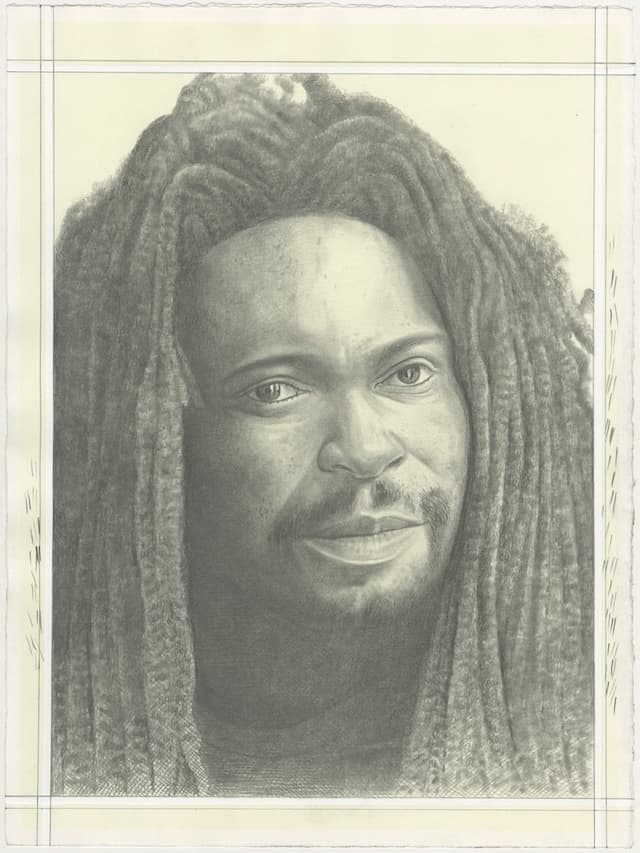
Ginevra de Blasio is a Rome-born curator and writer, currently based in New York City. Her practice bridges institutional and independent projects, with professional experience at the Drawing Center, Performa, Fondazione Corsini, 99 Canal, and Paula Cooper Gallery. She collaborates with professionals, including Adam Weinberg, Director Emeritus of the Whitney Museum of American Art, and Joachim Pissarro, founding member of the Global Museum Strategy Group. She was recently awarded a grant from the Italian Council to support her curatorial research on textile art, a project that includes lectures and public programs at leading museums internationally. In parallel, she serves as curatorial assistant for the forthcoming retrospective of Isabella Ducrot, travelling from MADRE (Naples), to Astrup Fearnley (Oslo), and MoMA PS1 (New York).