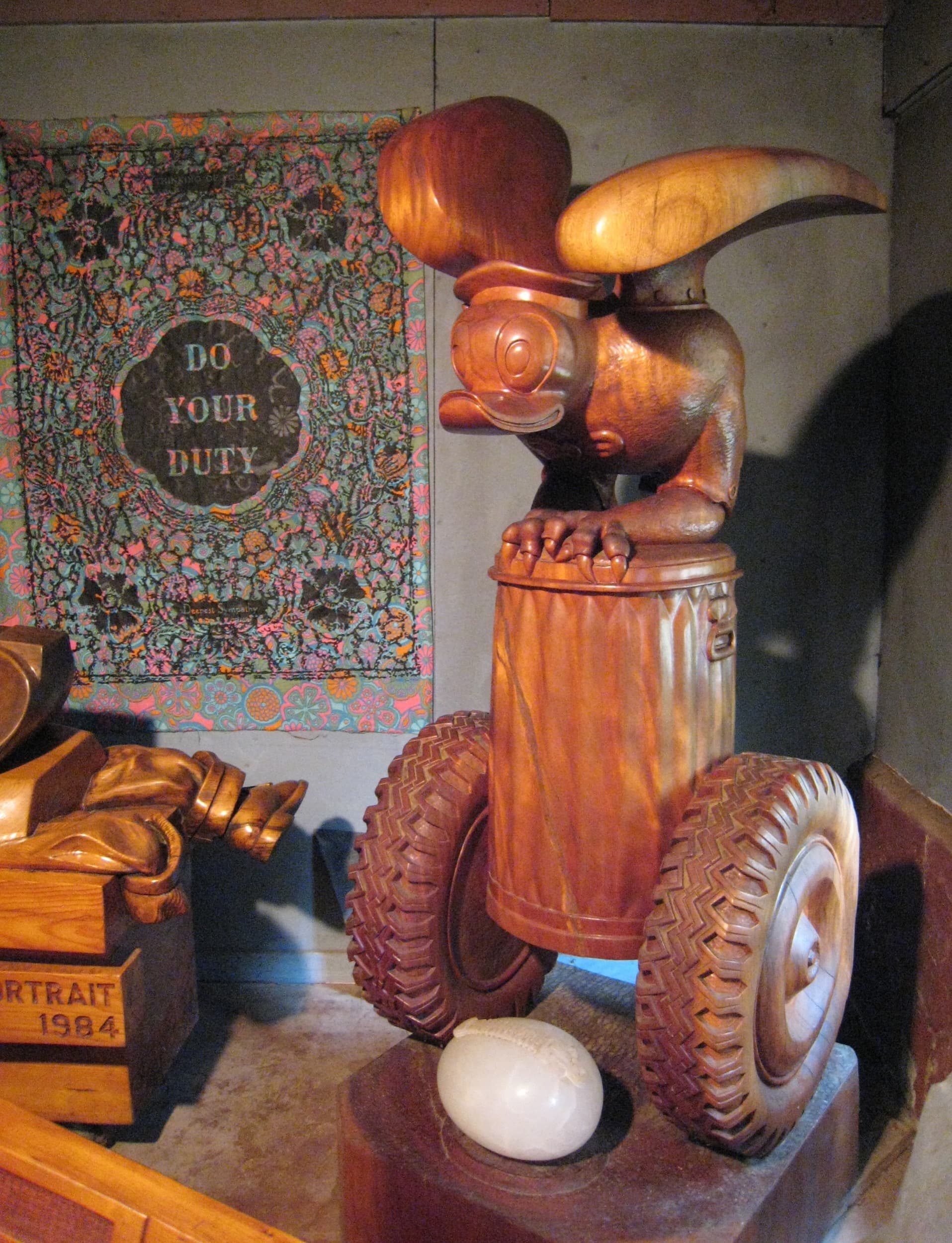
William Kent, D.Duck #1, 1977–78. Mahogany and Alabaster. Courtesy William Kent Art Foundation.
Word count: 3197
Paragraphs: 24
The Irving Sandler Essay Series
Edited by Alexander NagelThis essay series, generously supported by an anonymous donor, is named in honor of the art historian and critic Irving Sandler, whose broad spirit was epitomized in the question he would ask, with searching eyes, whenever he met someone or saw someone again: what are you thinking about? A space apart from the press of current events, the Sandler Essay invites artists and writers to reflect on what matters to them now, whether it is current or not, giving a chance for an “oblique contemporary” to come in view.
*
In 2010, at the age of twenty-three, while living in Berlin, I was wandering the backroads of the internet when I happened upon an article published in a small Connecticut magazine about an outsider artist and wood sculptor. It was a finely written essay by the journalist Alan Bisbort, and it documented the intertwined life and work of a man named William Kent, who had been making monumental wood carvings and slate prints in a barn on a lonely country road for a half century. The article described how Kent went about his solitary work while listening to public radio or classical music, completely ignored by the art world. His wood carvings piled up by the hundreds in his barn, and he kept at them, undeterred by his lack of recognition. All of this was interesting enough, but I probably wouldn’t have given it a second thought if my attention hadn’t been arrested by an abrupt sentence at the end of the article, in italics, which took the place of a final byline. It read: “Anyone interested in Bill Kent's work can contact him directly at 269 Howd Road, Durham, CT 06422, or 860-349-8047.” I did not yet fully understand, though I sensed, that this was not merely desperate salesmanship. It was the shorthand for a mighty signature, much longer and more ambitious and more unsettling than what I’d just read. It was a self-portrait in paradox: the hermit with an open house.
So began my fascination with William Kent, sculptor, born 1919. I resolved that day in Germany to visit the barn at Howd Road when I returned to the United States, but by the time I was settled in New York two years later, I learned that Kent had died. I went up to Durham, Connecticut all the same, and I met there the small but fervent community of patrons and neighbors who had taken care of this profoundly difficult and lonely man at the end of his life.
And so I walked into the world of Kent’s barn at 269 Howd Road, and came face to face with the thing that had called so obscurely to me at the end of Alan Bisbortʼs article. I have elsewhere written at much greater length about Kent, and I have described his imprint on the barn as something like an abandoned city, a planet, a cosmos—I can’t help but dilate the metaphors until they reach for the very circumference of reality. When I first saw it, the place was falling to pieces, and as human habitation it was modest in the extreme. But as the repository for a vision, it felt to me as spiritually capacious—as prophetic an admixture of time and intention—as Chartres or Teotihuacan or the Roman Forum. In this modest former dairy were hundreds of huge wood carvings, frozen in the midst of an appalling and hilarious conversation. Gigantic sensuous shell beans on Brânçusi-esque bases; beside them, heroic depictions of everyday objects in laminated striations of various exotic woods: shoehorns, a lady’s stiletto, a set of false teeth—all twenty times larger than life, glowing in sheaths of lacquer. Surrounding this monochromatic forest of Beckettian prodigies were hundreds of prints made on brilliantly colored fabrics and glowing swatches of satin. In riotous color they showcased a bizarre mixture of iconographies: New England tombstone rubbings, doily-style greeting card ornamentation, Greek vases, fifties advertising, photographs of political figures, ugly tropes of the hippy era, naturalist drawings of insects and fish. In contrast to the mute sculptures, these colorful things shouted profanities. On the prints were slogans like “BALLS,” “SHIT,” “DO YOUR DUTY,” “AVOID THE TRAP OF MARRIAGE,” and “LEAVE THE MOON ALONE!” (he meant that last one quite seriously: it was an angry letter to NASA; get your dirty industrial hands off that pristine celestial body).
Let me describe in detail one of the massive wood sculptures that until recently inhabited this place. It is called D. Duck #1 (1978). Picture a wood sculpture nearly six feet tall, made entirely out of burnished mahogany. At the bottom is a pair of snow tires. Mounted between them, as if on a Segway, stands a classic trash can, the kind that Oscar the Grouch lives in. Perched atop the trash can is the American eagle, its wings outstretched in a pose of asymmetrical grandeur. Certain body parts of the eagle have been mechanized: its tail is a wind-up key, its breast is covered in armored plating. And then, up top, there is a final, outrageous desecration: the eagleʼs head is actually Donald Duckʼs, with the goofy up-turned bill and the little sailor hat from the classic Disney films. All of this is carved with a virtuoso-baroque-naturalism worthy of Gian Lorenzo Bernini: the treads of the tires, the curve of the eagle talons, the striations on the sides of the garbage can, complete with unexpected depressions where it has been “dented” (he must have used a real trash can as his model). And all of this, remember, rendered in luxuriant tropical mahogany.
The sculpture rests on a plinth; also resting on this base, right in front, between the two tires, is an egg made from milk-white alabaster, about the size of a football. Across the top of this alabaster egg a zipper has been carved. Joan Baer, an art collector who undertook the difficult labor of being Bill Kent’s champion and caretaker at the end of his life, once asked him, “Why the zipper?” He looked up at her with his pursed, tiny little mouth and said, “How else could you get out?”
William Kent has been on my mind for the better part of fifteen years. In 2015 I published a long essay about him. Since then I have lived with many of his artworks and tried in various ways to draw attention to his art. But the occasion for me writing about him now is the marvelous show of his work that was mounted at the Ricco/Maresca gallery earlier this spring. William Kent: Trust the Peeple is the first gallery show Kent has had in New York, to my knowledge, since the 1960s (he was the subject of a small exhibition in 2013 at the Museum of Sex). The show at Ricco/Maresca foregrounded his garishly vibrant political prints.
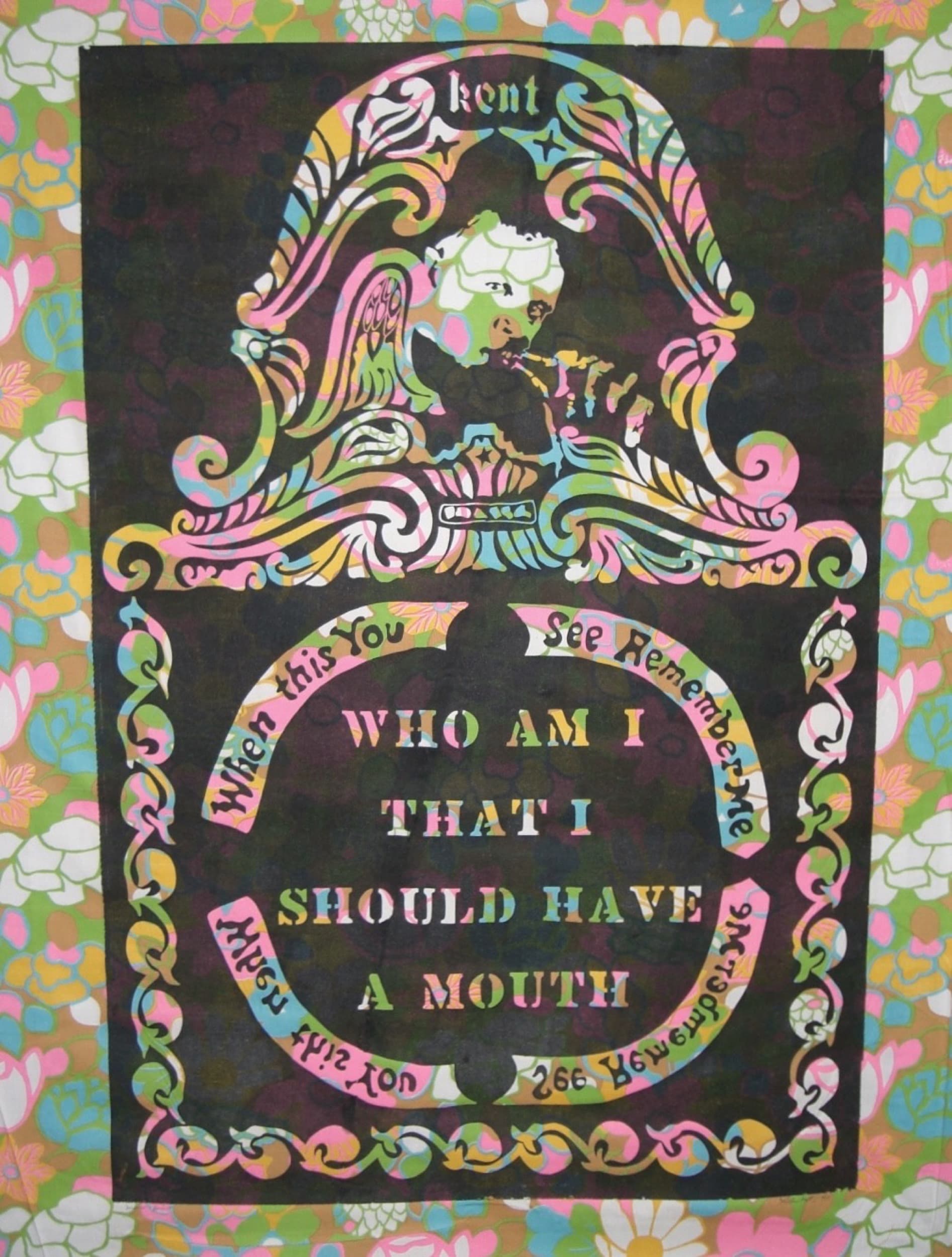
William Kent, Who Am I That I Should Have a Mouth, 1966. Monoprint on fabric. Courtesy William Kent Art Foundation.
Kent was, in printing as in sculpting, an ingenious craftsman. He had collected a series of huge blackboard slates from a primary school that was going to be demolished. He carved the print matrices directly into those slates, with a chisel or a sandblaster for some of the more complicated patterns. Then, developing his own method of inking with some slight wetting of the back of the fabric or paper, he managed to pull intensely saturated and even sometimes slightly three dimensional images, as if made into bas-reliefs. Kent had originally trained as a composer, studying with Paul Hindemith at the Yale School of Music in the 1940s. But he felt academic training had ruined him as a musician, and as a visual artist he was proud of being self-taught (nevertheless he rejected the outsider artist moniker as demeaning).
The prints on display in this show are one half of the equation of William Kent: they represent the printmaker, the political commentator, the agitator (though so far as I can tell, he only ever attended one protest in his entire life, and what he was protesting was the inclusion of amateur artists in a local art festival in New Haven which he felt should be reserved for him and his “professional” colleagues). The other half of the equation was William Kent the sculptor, who was also William Kent the cosmologist, the philosopher of a nature seeking redemption through its own terrible, post-human ruination. Discussing the two hand-in-hand in the year 2026 might tell us something important about the relation of the material reality around us to the political disasters we cannot seem to escape.
From the 1940s, when he began to carve, until his death in 2012, Kent’s making dramatized a profound philosophical journey, which might be best described as a natural history of the present. Early in his career, he made elegant modernist animals, monkeys and goats and a fine-looking peccary. Then he began to obsessively carve arthropods and cephalopods—huge, haunting, detailed insects and squids, on which he lavished his ever-growing technical prowess. In the early sixties he made a conceptual leap and created a series of spooky monumental sculptures showing humans fusing with insects: a man cradling a flea, another kneeling as he is overwhelmed by a gigantic praying mantis, and the magnum opus Portrait of the Artist Self-Crucified (1960), in which a man (artist) with his pants pulled down is nailed to a cross, while a Death’s-head hawk-moth stretches its wings modestly over his midsection, and a caterpillar looks sympathetically over at him, like an insectoid Joseph of Arimathea. Notable in these chimeras is the contrast between the obsessive detail with which the insects are depicted and the mask-like simplicity of the humans, whose faces are schematically painted onto flat circles of wood (“He could carve every nick on a bug’s ass,” said his friend the artist Dalia Ramanauskas, “but not a face”).
These works are the high-water mark in Kentʼs fusion of nature and man. After that, the two bifurcated in his work. This rupture coincides with the moment when his fledgling career in New York abruptly ended, when he was fired from his job as a curator in New Haven, when he was arrested for having sex in a men’s bathroom, and when he cast his friends and acquaintances away for a deep isolation. In the 1970s and ’80s—his years in the wilderness—he carved enormous depictions of everyday objects. A clothes iron crushing a shirt and a pair of blue jeans; a huge shoehorn; a ladies’ slipper; a pair of salad tongs. Alongside these immense essays in everyday objecthood, he carved a series of twisting, sinewing shell beans.
The whole sequence tells a story that, to my mind, goes something like this. Metamorphosis is the true and healthy state of nature. All of us are meant to be like moths and crickets, shedding our carapaces, emerging from chrysalis, losing limbs only to regrow them, passing in and out of form with such ease that the cycle of death and rebirth is but a change of season. But we humans developed a fear of change, redescribing it as death and injury. That fear made us into the Homo sapiens that we are and set us on the path to creating an artifactual world. We wove a vast net of objects in order to insulate us from change, to protect us from it: hence our endless profusion of walls, chairs, clothes, fences, tools, stuff. We hoped that they would absorb the shock of the world for us, and change accordingly so that we didn’t have to.
But the promise became a prison. We found that we became incapable of truly changing, we were separated from the unending metamorphosis that was our actual nature, and the objects that were meant to protect us instead inflicted misery upon us as they wrecked themselves and the world. The vast overspreading Hegelian civilization of modernity is the apex of this self-crucifixion, the impaling of our living selves on the artifacts that are meant to live on our behalf, but instead suffer and groan from our weight as much as we do from our unfreedom.
How to escape? At first Kent thought, perhaps we could return to insect-Eden. But then he realized that this could not solve for the vast garden of desolate objects around us. He realized it was their suffering that had to be transformed back into organic reality. So he collected, on his forays outside of the barn, the cast-away things, the useless things, from flea-markets and secondhand stores. The model for his sculpture of the lady’s slipper is not actually a lady’s slipper; it’s a plastic keychain in the shape of a lady’s slipper. The sculpture of a man’s watch is modeled on a novelty clock shaped like a watch. The shoe too small for any foot, the watch too big for any wrist. These are the exiles of the object world, which Kent wanted to remake in living wood.
To reach that communion, you had to realize that the social world was a lie, that language itself was a lie. This is the meaning of the angry political prints that frame the spiritual sculptures. The dissimulations of politicians are framed by greeting-card ornamentation and tombstone willows—a stylized, stereotyped nature that is actually a siren non-nature. Meanwhile, in some of the prints, the outrageous florals of sixties dress fabrics struggle to push through the image, sometimes even visible as a ghostly outline in the ink. Let nature come like a cancer and sweep this all away. But such an unveiling will only be possible once weʼve learned that we cannot talk without dissimulating. One key print in his oeuvre shows a New England tombstone with his self-portrait in the place of the presiding angel. His mouth is stopped up with a Coke bottle, and the slogan on the tomb says, “Who Am I That I Should Have a Mouth.” The artifactual world has made language impossible; it has stopped our mouths. Only if we can learn this lesson can we redirect ourselves to the falling away that is the unspoken communication of organic life in its mere changing cyclical reality.
Hence the alabaster egg that our trashed out and cancerous civilization is still incubating (and it really is our whole civilization brooding this rough beast of a hatchling: Kent once told his friend Marv Beloff that the trash can beneath Donald Duck represented the dome of the US Capitol). Eggs are no longer eggs. Eggs are meant to be containers for metamorphosis, and it is essential to the eggness of the egg that the creature inside be able to break out when it’s mature. Our eggs no longer permit a natural escape into maturity—they are puerile alabaster prisons which never hatch. Art is the one final artifactual transformation that frees us from the artifacts: it creates a zipper on the egg that no longer opens by itself, so that we can, after all, get the hell out.
One reason for the appeal of outsider artists is, paradoxically, that they are some of the only true insiders post-industrial civilization has produced. By this I mean that Kent, Henry Darger, Forrest Bess, and others like them inhabit a cosmology that they can truly mirror in their life and work. They are not desperately trying to capture, or cynically trying to game, a universe that is indifferent to their existence. Instead, they have felt their way into a vision of reality that they believe they can describe, that inspires in them the (glorious, terrifying) prophetic urge to make such a description. They are makers of cosmograms, and cosmograms imply the existence of a cosmos that can be diagrammed.
The cosmogram gives intrinsic meaning to objects, while liberating them from the need to justify their own value. In that sense it is the opposite of the commodity, which alienates the object from its true meaning, even as it ruthlessly demands that the object expend nearly all its energy projecting value.
Outside of capitalist regimes of meaning, the cosmogram is a near-universal human phenomenon. I live now in rural Alaska, on the territory of the Tlingit people. The Tlingit clan system is intimately connected to crests, which are often animal in nature; these crests give contour to kinship relations, oratory, artwork, and ceremony. They also bring mass consumer objects to life in the most marvelous and unexpected way. The Wooshkeetaan clan, for instance, carries the shark as its primary crest. Alongside their beautiful shark beadwork and appliqué, I’ve seen Wooshkeetaan Clan members wear Jaws T-shirts to ceremonies or dance in plush shark-shaped beanies. As my friend and colleague Maggie Spivey-Faulkner once pointed out to me, the Jaws T-shirt is here given its place within the larger cosmogram that is the crest system. The Kaagwaantaan clan formally adopted the US Navy into its ranks in 1904. As a result, the women of the clan wear white sailor hats in Ceremony; these hats are a true slice of the universe, even if they are mass-produced in Shenzhen.
We are in desperate need of a new relationship to the things we make. Modernity tried to remake the world into an all-encompassing artifact; now, after two centuries of unparalleled abuse, the world-artifact and the organic reality from which it was fashioned are both in revolt. Proposed alternatives are in short supply. The glorification of the artwork as the anti-commodity within the museum system, for instance, has only succeeded in creating the most grotesquely inflated commodity market of all. And while there is clearly some deep connection between craft and cosmogram, the attempt to directly replace the commodity with the neo-medieval craft object in the spirit of John Ruskin and William Morris has failed as a project for economic reform. Perhaps we need a re-thinking of the relationship between the cosmic and the created. Among other things, the cosmogram changes our relationship to choice. Instead of the decision paralysis triggered by infinite consumer goods and infinite regimes of taste, there is a clear guidepost: I must choose the thing that matches my place in the universe. (This is again an insight I owe to two years of thrilling co-teaching with Maggie Spivey-Faulkner.) The cosmogram is the zippered escape hatch, the portal out of the egg of infantile desire and into the adult world of meaning beyond the self. To me, the shark shirt shows that such meaning is still achievable in a mass-produced world and can still be a catalyst for community.
Community was the thing so obviously, so painfully absent from the great life-work of William Kent, the thing he dared not name in that little sentence at the end of Alan Bisbort’s article. The Romantic ideology of the artist-martyr made it impossible for him to take his otherworldly insight and make anything but a negative image of the living world. How to couple inspiration with fellowship is a question that the mainstream discourse of artwork and artist has failed to answer. We must look elsewhere for such wisdom. Without it we will never repair our bond with the objects that have taken the world hostage in our name.
Matthew Spellberg is the founding Dean and Chair of Literature at Outer Coast, a new institution of higher education in Sitka, Alaska.