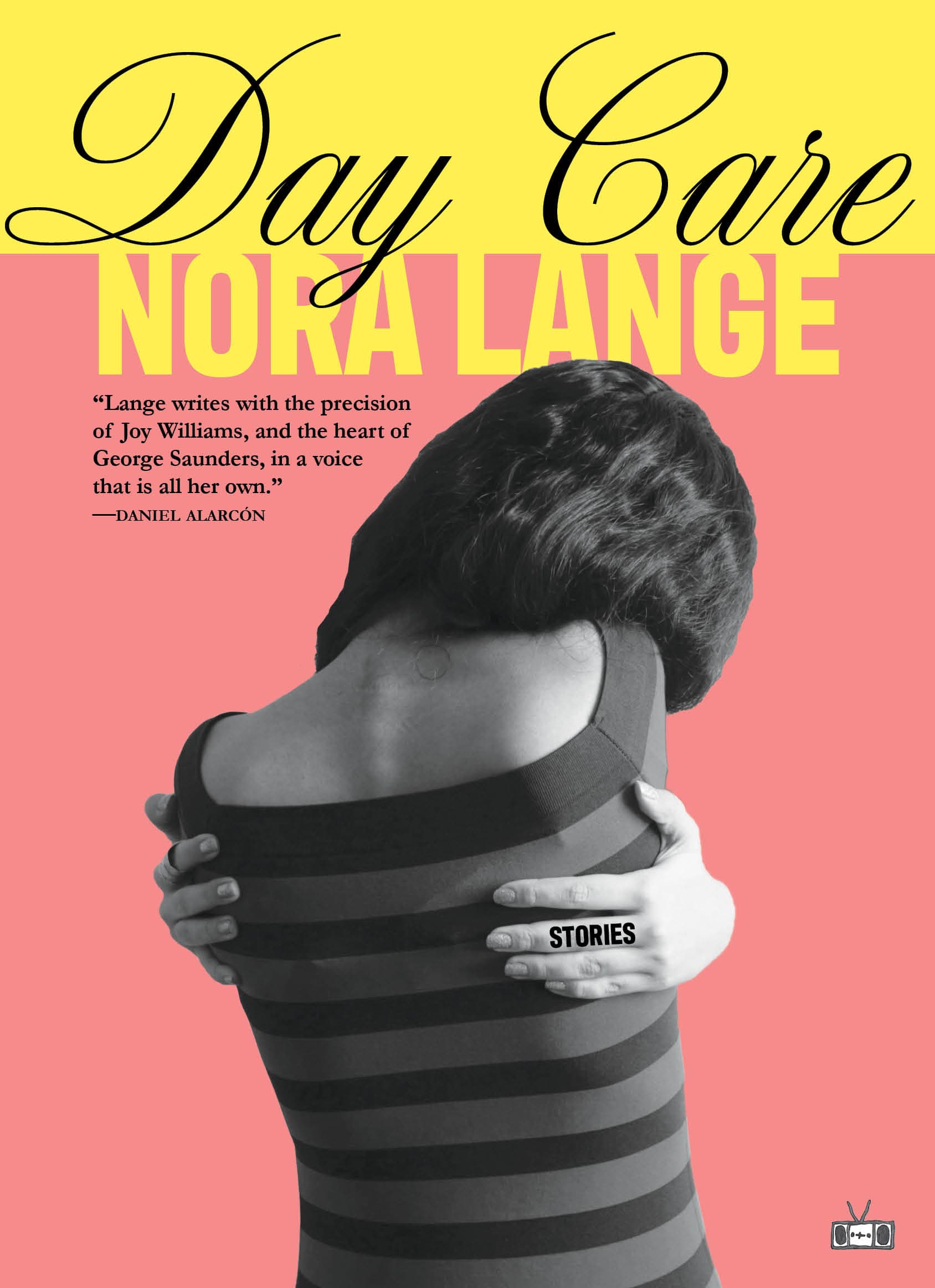
Nora Lange’s Day Care
Word count: 1062
Paragraphs: 12
Day Care
Two Dollar Radio, 2026
Watching shit spiral down a toilet bowl, one of Nora Lange’s narrators reflects,
Humans have a need to deposit our output into some kind of physical vessel. Lovers, landmines, too. Progeny. Burying deep our marbled psychologies, miscalculations in judgement, our politics, our impacted soil, our children, our subconscious, our landholdings. In the stories we start and spread. In the secrets we store. But it would and does seep out of our bodies.
It is these buried things and their seepages that preoccupy Lange in Day Care, her first collection of short stories, a follow-up to her brilliant debut novel, Us Fools. In her novel and her stories, Lange is a chronicler of all that is strange and secret about people, mining that strangeness for comedy and pathos.
The particular narrator in question, from the story “Landfills,” is a nameless mother, raising her daughter near a large landfill, which she thinks about constantly, filling her basement with drawings and research, to the chagrin of her husband and child. Lange, as readers of Us Fools will know, has a fondness for autodidacts and obsessives and is adept at blending esoteric references (ranging, in this story, from the Bible to contemporary art to ancient myth to Lydia Millet to the work of the Center for Land Use Interpretation) seamlessly into her own idiosyncratic worldview. The landfill, for the narrator, figures as a scapegoat for society’s many sins. Lange often writes in this mode, a kind of funhouse mirror of ecofeminist criticism; her women tend to be deadpan wits in a dying world. In “Landfills,” the narrator and her husband “held out hope that time itself still had prospects. But that, too—time—I had come to believe had diminished just as other resources had due to the changing climate.”
This bleak sense that time is running out returns in the titular story. In “Day Care,” the main character is a new mother whose husband took a job in another state. While she contemplates joining him, she steals snacks from her wealthy employer and attempts to solve the riddle of her own fear and desire by arranging daytime sex via dating apps, until her mother arrives for a visit. She and her mother have a difficult relationship, but “They became especially warm when returning to the subject of the dismantling body as it aged. About birth: giving it, receiving it. About pleasure. About feeling like yourself again, and how online new mothers talk about getting ‘it back,’ but what did that even mean when calculating time passing? How could that mean anything other than to stick your head in an oven?”
The body, a symbol at once of desire and decay, is a recurring theme for Lange, and it is often the fulcrum on which the relationships of her many mother-daughter pairs turn. In “Dog Star,” for instance, Honey, the narrator reflects that “I looked at my mother because I was a version of my mother. I looked away from my mother because I was a version of my mother. I was me. But I was also her—my mother—and I understood this all too well.” Of her mother, Honey explains, “her materials, the ones from which she was constructed—the ones that had been promised to last longer than her mother or father had—were breaking down quickly in the toxic liquids that filled our world.” At one point, her mother begins “bloody-murder screaming our personal anthem—I am doll eyes, doll mouth, doll legs, I am doll parts, bad skin, doll heart, Yeah, they really want you, they really do!” making the connection between mother and daughter both material and metaphoric. The story, it emerges, is set in a snow globe, where the teenage Honey lives with her toy family, but their world is a microcosm of our own. Honey comments that she lives in “a glitchy histrionic era,” the tiny people subjected to constant surveillance, a poisonous climate, and miasmic despair. In school, Honey is taught slightly propagandistic and certainly absurd lessons (the feast in a Norman Rockwell painting is “an homage to a more bountiful and harmonious time,” and that, the plastic children are taught, is “why we continually failed to make it”). “I would like to point out,” Honey says to her teacher, “that we’re given trampolines, but we’re told not to jump on them,” a comment on “the endless contradictions in our world,” those paradoxes and half-submerged secrets Lange loves.
Through Honey, Lange is able to excavate the conditions of teenage girlhood. “There wasn’t privacy where I lived,” Honey says, a comment that speaks to the specifics of her glassed-in life but also to the conditions of girlhood on a larger scale. But just as Honey is also a version of her mother, the teenage girl is a dress rehearsal for the adult woman. In “Letting Snails Go,” a woman named Birdy has moved back to her hometown just, unfortunately, in time to be badgered into attending her high school reunion. Reflecting on the time she caught a classmate masturbating at a sleepover, Birdy thinks, “People delighted in shaming other people, especially when it came to pleasure, especially women and pleasure, especially in high school. Though, as Birdy would later find on reaching adulthood, that wasn’t accurate either. Shaming women and their pleasure would go on indefinitely.” This shaming is a kind of surveillance mechanism, like the snow globe of “Dog Star,” like the drones the mother-narrator in “Last Boob Feed” sees on her daily walks.
Honey, in “Dog Star,” explains the origins of her world thus:
Story has it that long ago some influential individuals—which was to say our creators that existed outside in the larger world, those people who made all the decisions about what went on inside where we lived out our days—were jostled awake by an overwhelming feeling of emptiness. Unable to shake it, desperate to feel again on top of the world, they built a coping mechanism in the form of a translucent sphere and stuffed it with miniature configurations like me that made them happy until some malfunctioned and made them miserable, again.
This reads as commentary on capitalism and control, but also, perhaps, as a description of storytelling. What is a story if not another leaky vessel for human hopes and errors and secrets?