Terrence Arjoon’s The Disinherited
Word count: 920
Paragraphs: 12
The Disinherited
Ugly Duckling Press, 2025
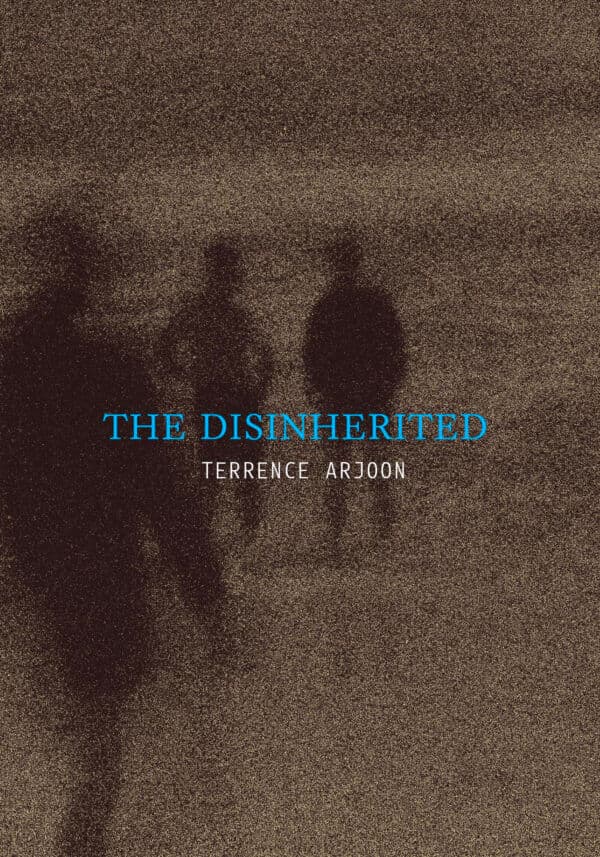
In The Disinherited, Terrence Arjoon’s debut full-length poetry collection, we find we are not alone in a post-colonial world that seems to deny meaningful, shared interpretations of history. Arjoon translates French Romantic writer Gérard de Nerval when he writes, “You think you’re the only one thinking / in this world where everything explodes all the time?”
Throughout the book, Arjoon deftly blends original poems with translations of Nerval’s 1854 sonnet sequence, The Chimeras. As an introduction to Nerval, a writer underrated in the Anglosphere, Arjoon’s work excels. And then there is much to enjoy for the close reader who wishes to explore the unanswerable questions that arise when reading translated poetry. Arjoon sequences the seven translations between his original poems without clear demarcation, encouraging the reader to consider the translations as new sites of intertextual subjectivity alongside originals that interrogate and expand upon Nerval’s project.
Nerval was himself a translator during the tumultuous decades between the two French Empires. Arjoon’s championing of a notably ambiguous, symbolically dense writer is prescient in 2026, when we’re positively drowning in the ambiguities of an unending deluge of new symbols and propaganda that vie for our attention and obsession.
In his short prose preface, which provides a brief biography of Nerval, Arjoon writes, “I, like everyone, am lost in the wilderness of this century.” This begs the question: which century was not a wilderness? The long nineteenth century’s colonialism might be seen as a dark forest from which the seeds of the twentieth century’s horrors emerge, and therefore our current emergencies and inequalities. Arjoon’s translations reach back through this inky wilderness from our time when the rights won in Nerval’s day are constantly undermined, and the horrifying extent of colonial extraction is better understood. Through Arjoon’s Nerval, we hear a voice from the past, insisting the crisis of subjectivity isn’t as new as it seems. Without giving way to cynicism, Arjoon and Nerval have tried to “move beyond” this wilderness.
Could the acts of translation and interpretation help us with this movement beyond? There is at least pleasure in sifting through Arjoon’s highly referential, dense lyrics.
In his original poem “Moth Light,” Arjoon writes, “Pelagic confusion it is or it isn’t.” “Pelagic” refers to the open ocean that is neither coast nor seafloor, an area that is easy to abstract onto a textbook diagram but impossible to point to with exactitude. One abstracted concept mingles with the next without objective differentiation, like heterogenous rocks. Nerval and Arjoon both make great use of the slippery nature of scientific jargon.
Recurring characters like the Cinnabar Kid, the Astronomer, and Eight-Bog Marie provide much-needed, messy human perspectives to otherwise mute landscapes. The Cinnabar Kid first appears in Nerval’s “Horus”—translated by Arjoon as “The Hours”—in place of the old Egyptian creator god Kneph, in a bold act of creative translation. The Cinnabar Kid, in his titular poem, an Arjoon original, is associated with Terlingua, the West Texas cinnabar-mining ghost town turned tourist attraction. Cinnabar is a bright red compound of mercury and sulfur, from which we extract mercury for industrial use. Long stanzas at the beginning of the poem eventually give way to single isolated lines, which mimic both the industrial process of refining minerals into purer forms and the breakdown of a natural environment from harmonic coexistence into degraded isolation.
The Cinnabar Kid’s narrative arc also mirrors the ancient history of mineral extraction. The Cinnabar Kid “shook the universe,” like empires that own mines, and still has to go to drudge work, like those empires’ slaves who do the mining. Later, “the Cinnabar Kid fell out of an airplane in Idrija,” far from Terlingua, Texas. Idrija is also a historic mercury mining town, this time in Slovenia. National borders don’t constrain mineral veins or the Cinnabar Kid.
This character, who so easily jumps through contexts and times, and even between creators, forces the reader to consider the materials, minerals and gases, and how companies and nations extracted and alchemized these special objects into the infrastructure of the first world, often by decimating the natural environment of their colonies. With Arjoon’s prodding, we see material production—of let’s say, airplane fuel—as an act of translation, from crude oil to refined, and so too the natural process by which oil is generated, from dead, underground organic material into a murky fluid that helps humans fly.
Arjoon’s translation of Nerval’s “Vers Dores,” which he translates into “Golden Lines,” contains a line that could roughly translate to “Fear, in the blind wall, a gaze that spies upon you.” In Arjoon’s words, this mysterious line becomes, “Beware the blank screen’s gaze.” Arjoon’s “blank screen” is the never-ending black hole of the smartphone or laptop, which spits up a concoction of media, languages, symbols, and discourses that beg to be interpreted, so those interpretations can be posted and themselves be interpreted. Here, Arjoon’s book culminates as he perfectly merges form and content through this aggressive translation. The reader must reckon with the miasma lurking in their pockets and sitting on their dinner tables, these computers generated through obscure minerals and refining processes, and through which we spy and are spied upon. Through these powerful objects, translated from precious metals, we construct meaning out of our personal lives, histories and imagined futures, seemingly endlessly, not towards any definitive end, but because we are compelled as if by an unknown creator or the powerful nations and companies that have corralled our attention for centuries.
Reid Kurkerewicz is a writer from Wisconsin who lives in Brooklyn. His poems appear in Back Patio Press, Dream Boy Book Club, Creative Writing Department, and elsewhere. His chapbook Man of the Law was published by SLAB. You can find him on Instagram @sweetoreido