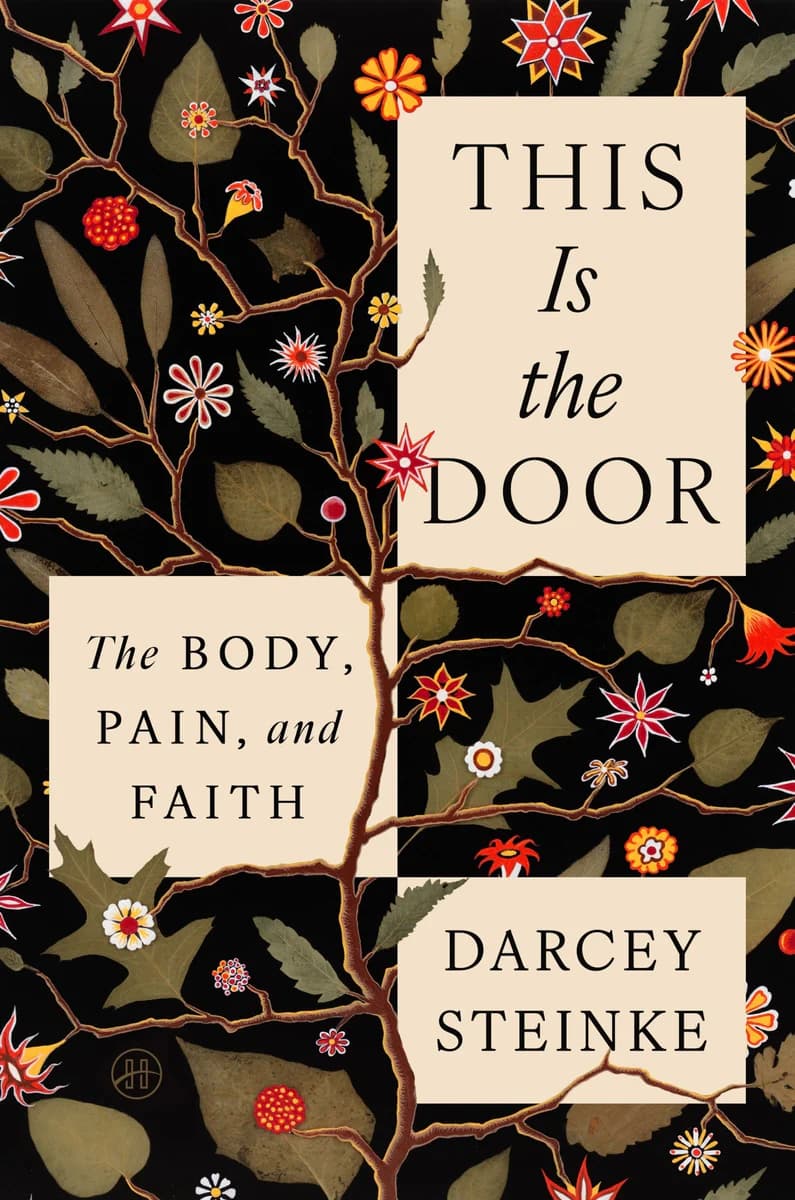
Darcey Steinke’s This Is the Door
Word count: 1979
Paragraphs: 29
This Is the Door: The Body, Pain, and Faith
HarperOne, 2026
Pain does not begin as language. It arrives first as sensation: pressure, voltage, heat. A fracture, a burn. And then, only afterward, does vocabulary attempt to surface, a delayed translation at best. This seam between body and language is not incidental. It unsettles the hierarchy Western thought has long assumed: that understanding precedes feeling, that intellect governs sensation, that the body is merely where knowledge occurs rather than the instrument that produces it.
Darcey Steinke’s most recent book, the memoir This Is the Door: The Body, Pain, and Faith, is less a narrative than a sustained argument against that hierarchy. What her work proposes, with both lyrical patience and philosophical rigor, is that pain is not merely an object of understanding but a mode of understanding.
Early in the book, Steinke describes pain as “a corporal experience, but also a spiritual one that points to the body’s possible calamities, its mysteries, and most of all, its darkness.” The sentence slides across categories—anatomical, metaphysical, phenomenological—as if disciplinary borders were conveniences rather than truths. Pain, she suggests, is not reducible to nerves or tissue. It is an event that reorganizes perception. In other words, to hurt is to see differently.
It is an insight that runs through Steinke’s work long before This Is the Door, visible, for instance, in Flash Count Diary (2019), where menopause becomes not a decline but a threshold. A hot flash, Steinke notes, is an event that forces her into acute awareness of her body’s material reality and mortality. “With every flash, my psyche is pushed to grasp what it does not want to let itself know: that it is not immortal.” Both “terrifying” and “a rare opportunity,” the sensation, Steinke notes, reminds her that the self is inseparable from flesh, and that this confrontation with physical limitation can produce a strange kind of insight. Rather than treating the experience as purely medical or inconvenient, she interprets it as a moment of existential exposure, a revelation that collapses abstraction and returns her to the undeniable fact of embodiment.
Taken together, these books form a philosophical project rather than a memoiristic one, in which Steinke is not documenting pain but theorizing it.
Modern medicine depends on pain being legible. It must be classifiable, measurable, localizable. Yet Steinke repeatedly encounters the failure of such translation. The standard descriptors—burning, stabbing, throbbing—seem to her insufficient, “without vigor or force.” Pain, Steinke maintains, exceeds its vocabulary. What clinical language calls data, the body experiences as diminishment. Put plainly: medicine turns pain into numbers, and the body feels that translation as loss.
Lisa Olstein’s Pain Studies (2020) provides a conceptual frame for this problem. She writes that pain is “vivid even in its opacity, vague even in its precision,” at once reducing and expanding experience. The paradox is not accidental; it is structural. Pain, she suggests, occupies a rare category of experience whose reality is undeniable even as its form resists articulation. Olstein’s formulation clarifies why Steinke turns instinctively toward metaphor: not because metaphor beautifies pain, but because it may be the only language capacious enough to approach it.
In Steinke’s writing, the clinical encounter becomes an epistemological standoff. Doctors seek stabilization; pain resists it. Authority depends on translation; sensation refuses equivalence. Throughout This Is the Door, this tension surfaces again and again, producing a subtle but persistent friction in which the sufferer risks appearing unreliable, excessive, or unintelligible. In this sense, Steinke’s project is not only literary but political: to insist that pain contains knowledge is to challenge the very institutions that claim to master it.
If the clinical encounter in This Is the Door stages a struggle over interpretation, what pain ultimately unsettles is something more fundamental: the illusion of bodily transparency. In ordinary life, the body recedes from awareness, functioning as infrastructure rather than subject; pain reverses that relation, pulling the body into the foreground of perception, narrowing time and sharpening attention until sensation itself becomes the dominant fact of consciousness. Throughout the book, Steinke returns to this condition as a liminal state, a threshold in which the self feels at once familiar and estranged, housed and yet unsettled within its own flesh.
As Maurice Merleau-Ponty argues in Phenomenology of Perception (1945), the body is not an object we possess but the very condition through which the world appears to us. Steinke’s work demonstrates this claim rather than announcing it. In her accounts of chronic pain, narrative continuity fractures; the stable story one tells about oneself as autonomous and whole gives way to interruption and recalibration. Pain, in this sense, begins to resemble what cultural theorist Jack Halberstam describes in The Queer Art of Failure (2011) as a productive breakdown—not collapse, but exposure. It reveals the scaffolding of autonomy, the hidden supports of identity that falter under strain.
In the months after my daughter’s birth, I began to recognize a quieter version of this threshold in my own body. The physical aftermath of childbirth unsettled the continuity I had long assumed between body and self; muscles felt provisional, and sensation arrived less as injury than as instruction. Pain did not register as damage, but as evidence that something fundamental had shifted. When it receded, I no longer trusted the shift I felt within myself, uncertain whether it was real or only perceived. What failed was not sensation but language; my body had become an unfolding text whose meaning outpaced my ability to interpret it.
Steinke’s work inhabits this same interval between sensation and language. Her prose lingers where explanation has not yet caught up to experience. What she offers is not description but attunement.
To read Steinke alongside other thinkers of embodiment is to see that what might appear as private bodily narrative participates in a philosophical lineage, one in which sensation becomes method and embodiment becomes epistemology. This is a tradition in which the body is treated not as an object to be interpreted but as a source of knowledge in its own right. In The Cancer Journals (1980) and later in A Burst of Light (1988), Audre Lorde insists that feelings must be voiced if they are to be “recognized, respected, and of use.” Pain, for her, is not an interior inconvenience but a source of information. If suppressed, she warns, it “will detonate inside me, shatter me, splatter my pieces against every wall and person that I touch.” Sensation must move outward in order to become knowledge. To deny its language is to deny its authority.
Across her work—most notably in her 2011 memoir The Chronology of Water—Lidia Yuknavitch argues that when women narrate their bodies in their own terms, they unsettle the systems that presume to interpret them. The problem is not simply visibility but control over meaning. A body that speaks resists being reduced to a symbol, diagnosis, or spectacle. For Yuknavitch, the body is not an object waiting to be explained but the ground from which the self emerges.
Within this lineage of feminist thinkers of embodiment, Steinke’s work appears less singular than continuous. She is not inventing a language of embodied knowledge so much as extending one. The body, in her work, is not the obstacle to understanding but its instrument, not the site where meaning is applied but where it originates. Across these writers, the body functions simultaneously as archive, instrument, and oracle. Knowledge does not descend from abstraction into flesh, but instead the opposite, rising from flesh into thought.
One of Steinke’s most distinctive formal strategies is syntactic accumulation. Rather than isolating a sensation, she layers metaphors until perception itself begins to feel crowded. Pain emerges not as a discrete event but as an atmosphere.
In passages describing migraine or spinal distress, imagery proliferates—electrical currents, splintering glass, constricting wires—so that the reader feels sensations multiplying rather than resolving. The effect is not decorative but experiential: the prose recreates the cognitive density of pain, in which perception intensifies and refuses simplification.
Nowhere is this commitment to embodiment clearer than in the architecture of Steinke’s sentences. Clauses lengthen, pivot, and recur, mimicking the looping persistence of chronic sensation. Where clinical language compresses experience into diagnosis, Steinke stretches it into duration, reproducing the temporal drag of chronic pain. Pain, in her rendering, is not a point on a scale but an environment through which consciousness must move.
Lisa Olstein observes that pain is both “simple” and “complex,” a paradox that illuminates Steinke’s stylistic choice. Her syntax sustains both truths at once: immediacy and multiplicity. By refusing to resolve that tension, the prose preserves the lived instability of suffering rather than translating it into coherence.
Another recurring strategy in This Is the Door is juxtaposition. Steinke places bodily sensation beside theological speculation and medical anecdote beside philosophical reflection, creating a textual space in which no discourse claims absolute authority. Pain becomes the organizing principle that brings these modes into conversation. The theological reflection does not explain the sensation away; the medical anecdote does not contain it; the philosophical speculation does not override it. Instead, sensation remains primary. Rather than using theory to interpret pain, Steinke allows pain itself to produce the thinking that follows.
The final chapters of This Is the Door turn explicitly toward the question that shadows all narratives of illness: not why we hurt, but whether we can stop. To interrogate that question, Steinke travels to Lourdes, the Catholic pilgrimage site synonymous with miraculous cures, to interview sufferers and witnesses of healing. The sanctuary becomes a charged site where medicine, faith, spectacle, and hope converge. She describes it as a place “where pain and faith intersect,” a phrase that crystallizes the book’s central tension: healing promises resolution; pain resists it.
Watching pilgrims gathered with candles, she observes the first rows filled with people in wheelchairs and on stretchers, their flames flickering like stars across a dark field. The image is quiet but devastating: suffering arranged as a constellation. Pain appears not as a pathology to be erased but as a shared condition.
Steinke resists the seductive simplicity of cure narratives. She notes how both religious healers and alternative practitioners promise certainty, offering step-by-step protocols that reduce suffering to a solvable equation. Such assurances, she suggests, flatten pain by translating it into a problem with a guaranteed solution. To insist on easy healing is to mistake pain for error rather than experience.
This refusal of resolution allows her to arrive at a subtler conclusion: healing may not be the opposite of suffering but a transformation in one’s relation to it—not eradication, but reorientation.
By the closing pages, Steinke’s inquiry has shifted from question to practice. Pain is no longer merely the subject of investigation; it has become the method through which investigation proceeds. Under its pressure, perception sharpens and attention deepens. The world contracts even as it grows more vivid, so that ordinary phenomena, like birds outside a window or light shifting across a wall, feel charged with significance.
The book’s ending gestures toward loss without dramatizing it. Steinke confronts the more immediate task of accepting absence, “the total absence of the first body… that I loved,” which functions less as a conclusion than as an aperture. What emerges from Steinke’s work is a radical but quiet proposition: pain is not the opposite of meaning but one of its primary instruments. It fractures certainty, dismantles illusion, and exposes the body as finite, permeable, and relational. In that exposure, something becomes legible: mortality, attention, relation, mystery.
Years earlier, in Flash Count Diary, Steinke had written, “I’d run away, but how does one flee one’s own body?” The question lingers here. The door in Steinke’s body does not lead out of pain but through it. On the other side is not cure or transcendence but knowledge—the kind that comes only from remaining inside what one would rather escape.
Caroline Shannon is a writer. Her work has appeared in The Cut, Vice, Narratively, DAME, and others. She is currently seeking representation for her work in progress, Mother-Eaten: Notes On My Postpartum Body and Identity, a lyric memoir that explores motherhood, care systems, and the narratives we impose on birthing bodies. Connect with her @bycarolineshannon.