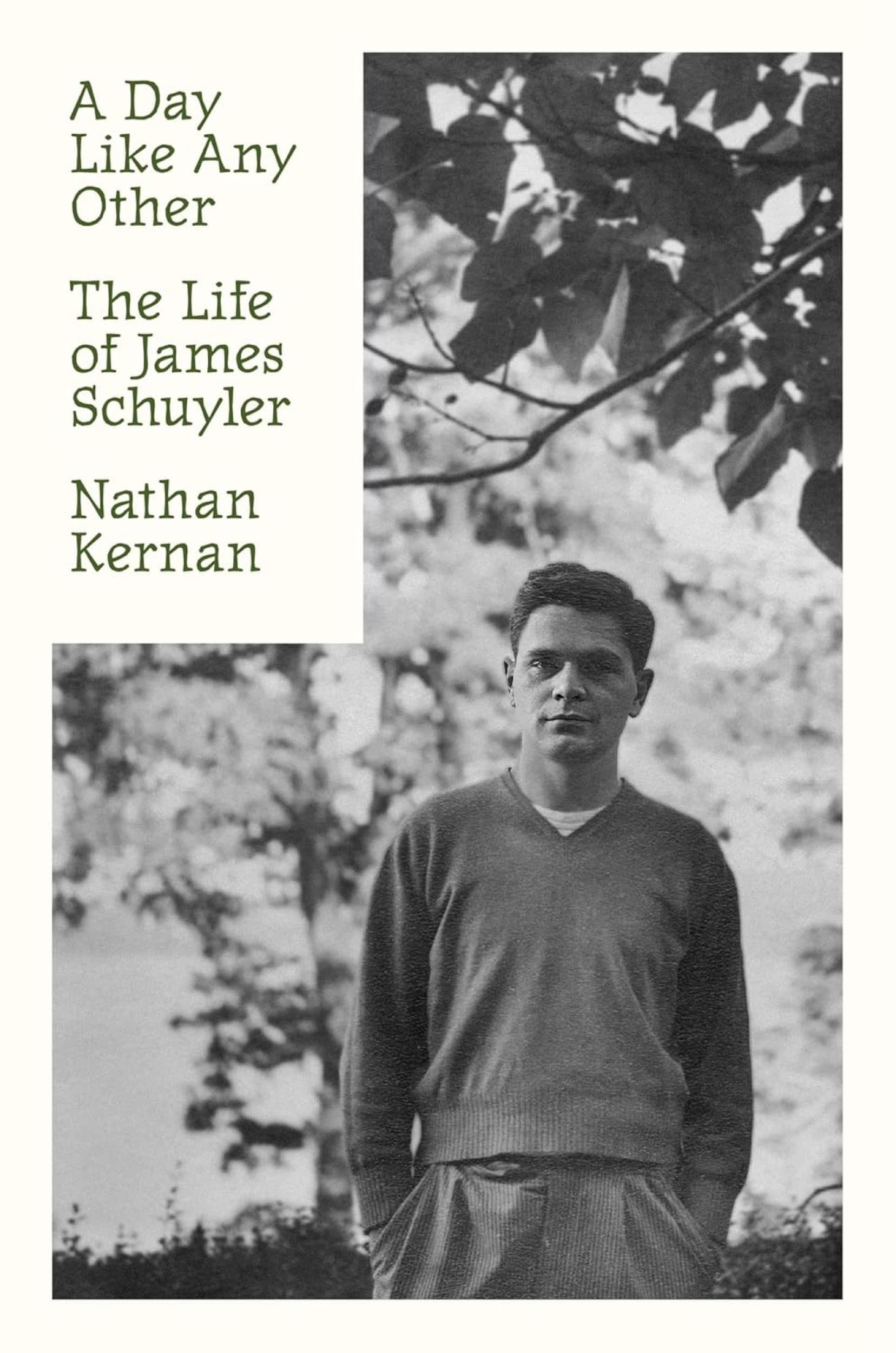
Nathan Kernan’s A Day Like Any Other
Word count: 1151
Paragraphs: 12
A Day Like Any Other
Farrar, Straus and Giroux
2025
I once heard a poet recount a lifelong debate with his twin brother. The two men were close, their interests intertwined, their careers alike—but they differed in one respect. The brother was in the habit of asking himself, from time to time, “am I happy?” The poet just rolled his eyes. That, he said, was “not a question worth asking for an adult.” They remained at odds on the issue.
Often while reading A Day Like Any Other, Nathan Kernan’s authoritative, empathetic new biography of the poet James Schuyler, I thought about those two brothers. I wondered who had it right. Schuyler’s life (1923-1991) was ceaselessly difficult, pockmarked by lengthy stays in hospitals and psychiatric wards, ever dependent on the generosity of his friends, health and finances always amiss. Awards and prizes arrived late in life, and they were paid toward debts due. Even youthful pleasures were inexorably followed by break-ups, breakdowns, and denouements. Schuyler could “exude a sense of oppression and gloom,” writes Kernan; there were afternoons when Anne Porter could “almost see the black cloud over his head”; weeks when Joe LeSueur found him “more dead than alive.” It’s hard, reading Kernan’s account, not to ache for Schuyler, who once told John Ashbery that “life had been after him with a sledgehammer.” That remark, Ashbery said, became “a self-fulfilling prophecy.” And yet: in the midst of this life of turmoil, agony, and despair, Schuyler penned some of the finest poems of the twentieth century. Happiness—is it even a question worth asking?
Perhaps turning the question on its side might yield better results: did Schuyler’s unhappiness do anything? The poet Eileen Myles suggests to Kernan that it was the turbulence in Schuyler’s life which led him to seek such serenity and surefootedness in his poems. Myles, who worked as Schuyler’s assistant in the 1980s (paid from a fund organized by friends), once watched the “ravaged” poet write his way through a breakdown. Somehow Schuyler “compos[ed] a universe of calm out of complete franticness”; the “beauties that he assemble[d],” Myles contends, were “a construction of his needs.” Or as Schuyler put it in “Await”: “The scars upon the day / are harsh marks of tranquility.” In such lines of attunement, Schuyler could dissemble his hurt. His magic was syntactic: “How the thing said / Is in the words, how / The words are themselves / The thing said…”
Schuyler’s world was so often ablaze: twice his own bed went up in flames. He had a habit of passing out while smoking, supine, first in 1960, in an apartment found for him by Fairfield Porter; and then again in 1977, in an apartment found by Darragh Park. The second incident was grave: Schuyler suffered third-degree burns. The partner of one close friend lived in fear that Schuyler would burn down their own home, should he ever be invited to stay.
Help from concerned, connected friends—whether a roof over his head, or dollars in his pocket—became a common theme. “Jimmy had a real talent of being taken care of,” Kynaston McShine tells Kernan, “and finding people to take care of him.” The best years of his life were spent as a sort of avuncular, depressed poet-in-residence at the Southampton home of Fairfield Porter and family, where Schuyler “came for the weekend and stayed eleven years.” It was an unusual arrangement, made more complicated by Porter’s loosely-requited love for Schuyler, both ignored and indulged by his tactful wife Anne. Schuyler might have stayed longer if it hadn’t been for the Porters’s daughter, Katie, who pushed for his departure in the early seventies (the word “parasite” had been thrown around). It took three years of negotiations before Schuyler finally left. On moving day, he played the suicide scene from Madama Butterfly at “earsplitting volume” on his stereo.
It was a painful departure—not least for the looming threat of solitude. “I don’t really like,” Schuyler once admitted to Porter, “the days when I’m altogether alone. After five o’clock a kind of endlessness sets in.” Yet Schuyler was stunningly productive in his remove: even while committed at the Vermont State Hospital, Schuyler allowed he was “lucky, because I could keep scribbling.” Like those writers during the pandemic, quietly thrilled by their isolation (what Slavoj Zizek called “the best years of my life”), Schuyler could be generative in withdrawal. “The poor non-poets!” he lamented: how tortured they must have been by “weekend[s] with utterly nothing to do.” Schuyler had many; he learned to use them.
The poems he wrote in this seclusion—and outside of it—are marvelous, unlike anything by even his talented peers. Schuyler’s style is distinct and recognizable: perhaps most famous are his enjambed lines, which startle every thought before its completion; then there are his delightful doubled phrases (“What is, is by its nature, on display”) and perfectly unexpected juxtapositions (“Two dog-size lions face each other / at the corners of a roof. / It’s the yellow dust inside the tulips”). But more subtle is a certain estrangement of language: Schuyler returns words to their appropriate mystification, demonstrating the marvelousness to be wrung from each syllable. Theodor W. Adorno used to complain that modernity had made language literal, that the word had “become a straightjacket” in which things “are no more than what they are called.” Schuyler is his antidote.
It’s about a third of the way through A Day Like Any Other that Schuyler’s poems begin to dot the pages, and Kernan hits his stride. He’s wonderful in walking us through a work, piecing together a line, and breaking a fourth wall in the process. “This reader has always envisioned,” he interjects after a hundred-odd pages, and this reader’s heart leapt at the invocation. Kernan sometimes errs on the side of austerity, but his restraint is well-justified, since Schuyler’s life easily invites cliché (the tortured artist, “like an electric light burning too too brightly” [Bob Dash], ever undone by “tristesse at sundown” [Schuyler)].
Things darken by the book’s end; Schuyler’s unhappiness seems oceanic. Perhaps that isn’t an observation worth making. But the tension feels unavoidable in this account of a remarkable poet’s remarkably tragic life: one can’t help wonder whether there was a relation between the two. Kernan, for his part, does not insist on a clear answer: that would hardly have been in the spirit of Schuyler, who was diffident about declarations. He wanted “merely to say, to see and say, things / as they are.”
It was only in Schuyler’s final years that he began to read his work aloud. At his last readings, he liked to begin with his most famous refrain, by then something of a personal and poetic credo: “Past is past, and if one / remembers what one meant / to do and never did, is / not to have thought to do / enough?”