Francis Naumann’s Impossible: The Love Affair between Marcel Duchamp & Maria Martins, and the Artwork it Inspired
Word count: 1476
Paragraphs: 13
Impossible: The Love Affair between Marcel Duchamp & Maria Martins, and the Artwork It Inspired
Abbeville Press, 2026
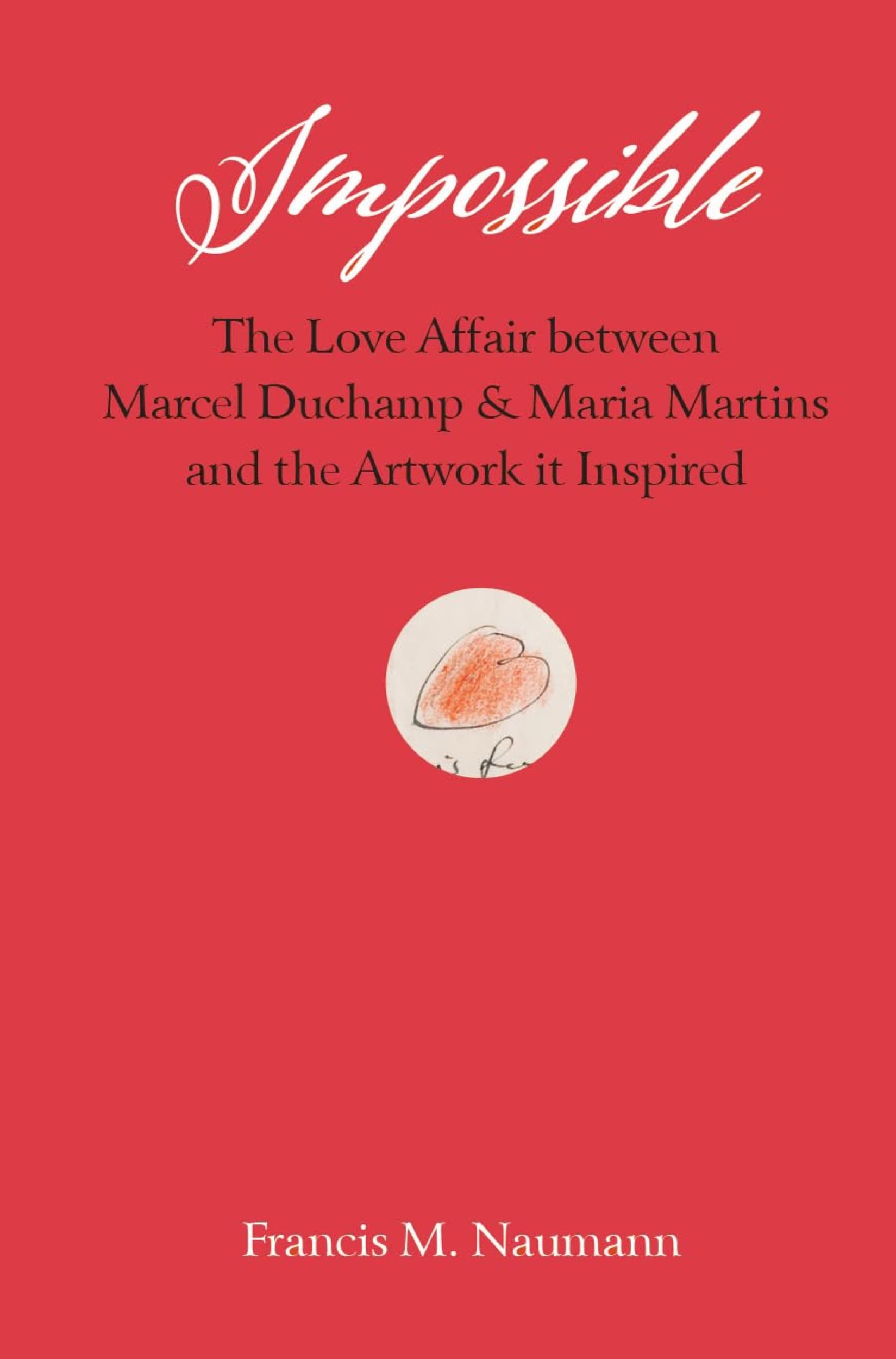
Francis M. Naumann has been among the leading scholars of Marcel Duchamp’s art and life for decades, including his consequential interactions with the well-to-do and well-connected Brazilian artist, Maria Martins, who kept a studio in New York during the 1940s. A thoroughly illustrated little monograph, entitled Impossible (after one of her sculptures), provides an account of the romance between Duchamp and Martins alluded to in his letters to her. These were first published and discussed at length in the essential 2009 exhibition catalogue by Michael Taylor, Marcel Duchamp: Étant Donnés. They revealed his rather unrealistic and ultimately unrealized hope that she leave her husband and children to live with him.
In chapters arranged like those in a romance novel or a sketch for a film script, with occasional flashbacks, Naumann imagines their romance from the evening they met in March 1943, at the opening for simultaneous exhibitions of recent works by Martins and Piet Mondrian. Almost immediately, according to Naumann, Duchamp gets involved in her acquisition of Broadway Boogie Woogie (1942–43), supposedly refused by the Museum of Modern Art, and they deliver it together, as an anonymous gift. (Had Martins ever made such a donation before? Museum records do not indicate that the work was ever refused, only that she anonymously provided funds for the purchase.) Duchamp supported himself by helping artists and collectors. Naumann does include information about how Duchamp arranged for Martins to purchase a René Magritte painting in 1947, and about the sale of his own early painting Coffee Mill (1911) to her in 1948. (Maybe because coffee comes from Brazil?) These transactions are briefly noted in the Chronology section at the back of Impossible, rather than in the more narrative chapters that emphasize romance over business.
Imagining what might have interested the loving artists in one another’s works, Naumann’s text is an account of their mutual infatuation, their promotion of each other’s careers, and Martins’s role as the life model for a very important Duchamp work in progress. But Impossible does not consider how Martins reacted to Duchamp’s demonstrative sexual humor. What about Duchamp’s then-ongoing self-portrayals as Rrose Sélavy, for example? Naumann does mention how Duchamp shaved his body hair and insisted that his first wife shave hers, but why then does he not specify what type of Duchamp’s hair Martins kept in a locket attached to her charm bracelet?
The affair ended in 1951 when Martins’s family returned to Brazil, and three years later, Duchamp married Alexina “Teeny” Sattler Matisse. When Martins visited New York more than a decade later, Duchamp showed her the work begun when they were lovers, completed in secrecy and finally ready to be inscribed in her presence with its title, signed and dated “1946–66.” With all this in mind, Naumann understands Étant donnés as a sort of climax both to Duchamp’s work as an artist and to his abiding love for her as his muse. Naumann does not refer to Salvador Dalí, who helped Duchamp with parts of the work. But, of course, Dalí’s own ongoing incorporation of his beloved wife/muse Gala into his art offers parallels to how Naumann understands Martins’s role as the model in Étant donnés.
Both Martins and Duchamp recognized obvious sexual overtones in one another’s works. When they met, Duchamp was likely aware of her recent affairs with European modern artists exiled in New York, such as Jacques Lipchitz, from whom she sought advice about bronze casting. In 1946, Duchamp gave Martins one of the deluxe copies of his idiosyncratic Boîte-en-valise (a portable compilation of all his works in reproductions), provocatively enhancing her copy with a “drawing” entitled Paysage fautif [Faulty landscape] (1946), made by ejaculating on a sheet of transparent plastic mounted on black satin. When they briefly met up in Paris, Duchamp gave her a copy of his so-called Green Box, or La Mariée mise à nu par ses célibitaires même [The Bride Stripped Bare by Her Bachelors, Even], a compendium of replicas of notes he had made in 1934 while working on his never-finished “painting” on glass with that title. He included in her copy the original compositional drawing for this most ambitious of his works to date. “There is no question,” writes Naumann, “that Duchamp was informing Maria that in no uncertain terms she was his Mariée, the Bride of the Large Glass that he desired more than thirty years earlier, but who had finally arrived in his life.”
Meanwhile Martins’s career flourished. By 1946 she was welcomed into the Surrealist group in New York, and two of her fanciful, sexually charged figurative sculptures were included in the so-called “Rain room” conceived by Duchamp for the triumphal 1947 Exposition internationale du surréalisme in Paris. In Naumann’s opinion, her sculpture entitled Impossible, installed on a pool table in this exhibition, summed up her feelings:
In having selected the title Impossible for this sculpture Maria was unquestionably referring to the impossibility of her relationship with Duchamp … There is little doubt that [Duchamp] inspired the making of Impossible, for in coded form, it expresses precisely her sentiments about their tortured relationship: no matter what they might have felt for each other … [it was] a relationship that was virtually impossible to sustain.
Back in New York, at the end of 1947 Martins posed for Duchamp’s work secretly in progress. Inscribed “Étant donnés, Maria, la chute d’eau, et le gaz d’éclairage,” Duchamp’s drawing of her as a headless frontal standing nude shows her exposing her sex by spreading her upraised left leg. Naumann suggests that Duchamp likely took inspiration from an etching that Martins included in a portfolio she published in 1946 showing a reclined nude with pubic hair raising her left arm.
Shortly after her posing session, Martins moved to Paris where her ambassador husband had been transferred from his Washington post. During 1948, she and Duchamp were only together briefly when she returned to New York to close up her apartment. But she remained very much on Duchamp’s mind, as he transformed his 1947 drawing into a small painting that shows the exact same nude, now missing its arms and feet, and so no longer appearing to stand, but rather to recline—and without pubic hair. He inscribed this to her as a gift: “Cette dame appartient à Maria Martins / avec toutes mes affections / Marcel Duchamp 1948–49.”
Duchamp’s Étant donnés evolved considerably after Martins returned permanently to Brazil. Among other things, Duchamp positioned his nude without pubic hair on an uncomfortable bank overgrown with leafless bushes, less like a siren than a crime victim. Naumann suggests that Duchamp might have been inspired by the strange vegetal bottom sections of reclining female creatures in works by Martins, such as Ma Chanson (1944) or Je crus avoir longuement rêvé que j’étais libre (1945).
One often-cited example of Duchamp’s unabated affection for Martins is how he installed his Large Glass permanently at the Philadelphia Museum in 1954 opposite to a glass door that overlooks where a sculpture by Martins was installed in 1942, when the museum acquired it. But when John Vick presented the 2018 Fiske and Marie Kimball Society lecture, he pointed out that Martins’s sculpture was moved in 1949 and thus was no longer visible outside this door in 1954.
For me, what’s missing in Naumann’s delightful monograph is how Duchamp’s references in Étant donnés include far more than Martins and her works. When he was evolving as a cartoonist and young painter in Paris at the outset of the twentieth century, many artists depicted their lovers, wives, or models as reclining nudes. In 1904, his older brother Raymond Duchamp-Villon exhibited a life-sized plaster of his nude bride reclined in bed, jokingly entitled Semper eadem. As for pubic hair in art, Duchamp’s emergence as an artist coincided with multiple controversies when artists ignored French obscenity laws. Portraying his wife as a frontal nude with exposed pubic hair, Kees van Dongen’s Tableau was removed from the Salon d’automne in 1913; and in late 1917 the police closed an exhibition at Galerie Berthe Weill because of the pubic hair visible in Amedeo Modigliani’s works. In 1969, when I first saw Étant donnés installed at the Philadelphia Museum, I figured that the odd, pubic-hairless nude was somehow a flashback to Duchamp’s failed attempt, in 1921, to film Man Ray shaving a female model’s pubic hair as a comedic response to such ridiculous taboos. Such a film would have been similar to the pornographic shorts that men could watch in arcade stereoscopes. Peephole humor about the inevitably pornographic male gaze is ubiquitous in Duchamp’s art. His love of Martins notwithstanding, I still wonder if, among so many other things, Étant donnés might be an outdated art world joke.