BooksApril 2026In Conversation
MARK FORSYTH with Riley Moore
Word count: 3936
Paragraphs: 68
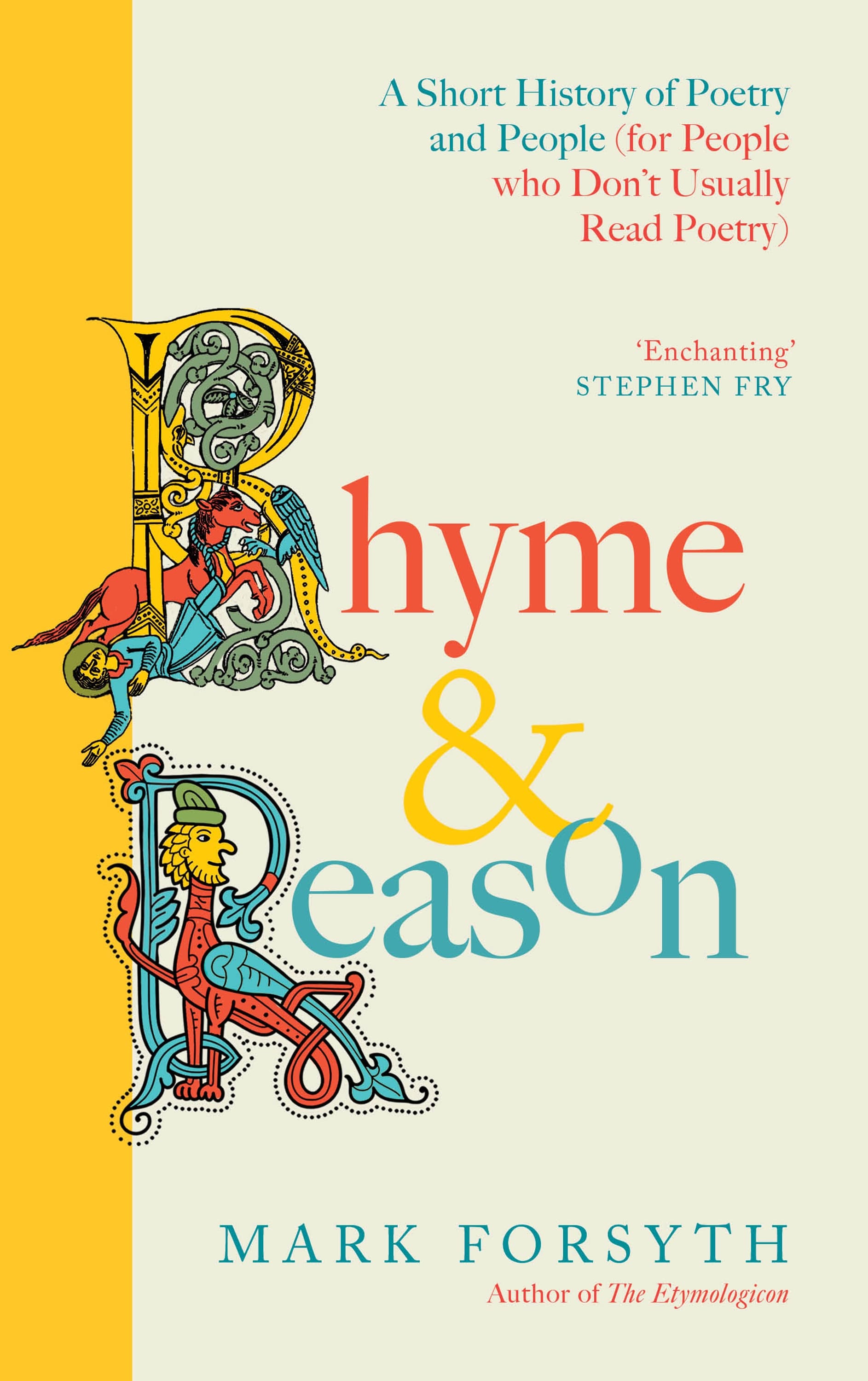
Rhyme & Reason: A Short History of Poetry and People (for People who Don’t Usually Read Poetry)
Atlantic Books, 2026
I discovered Mark Forsyth accidentally. I had been shopping for a dictionary at Book Culture, and found, in the reference section, a copy of The Etymologicon, with its lengthy subtitle: A Circular Stroll Through the Hidden Connections of the English Language. It was there, in that Book Culture, entranced by The Etymologicon, that I learned that dream comes from the Anglo-Saxon for happiness (Old English dream: joy, mirth, noisy merriment). The sentence, “I had a bad dream,” therefore, literally means, “I had a bad happiness.” Or that pandemonium is the antonym of pantheon. Pan (all) theon (gods) = house of the gods. Pan (all) demonium (demons) = house of the demons. I was to learn, also, that pandemonium was coined by John Milton, alongside impassive, lovelorn, exhilarating, cooking, criticize, irresponsible, stunning, terrific, enjoyable, depravity, on and on. Milton even coined the word wording.
What’s impressive about The Etymologicon is not only its information, but the manner in which it is presented. Forsyth is hilarious. His humor is five-hundred percent English. His frame of reference is classical (Shakespeare, the Romantics) but one feels his style—and the quality of his wit—is more contemporary, closer to Evelyn Waugh, or Kingsley Amis. Take, for instance, his summary of Pocahontas:
Pocahontas was a princess of the Powhatan tribe, which lived in Virginia. Of course, the Powhatan tribe didn’t know they lived in Virginia. They thought they lived in Tenakomakah, and so the English thoughtfully came with guns to explain their mistake.
Clive James once said that humor was common sense operating at a different speed. Forsyth’s use of thoughtfully is evidence of an Olympian common sense.
Forsyth’s latest book, Rhyme & Reason: A Short History of Poetry and People (for People who Don’t Usually Read Poetry) has the funniest opening of the year: “It has been said that poetry comes from pain, but English poetry comes from somewhere far worse. English poetry comes from France.” Rhyme & Reason is less a history of poetry, and more of a history of poetry readers. Who were poems intended for? Who was reading them? Why were they so popular? How did the “Romantic movement” start? Forsyth tracks English poetry from Geoffrey Chaucer to W. H. Auden. It is expertly written, easily accessible, and instantly unforgettable.
I contacted Forsyth via social media, and asked to speak with him about Rhyme & Reason. We Zoomed for an hour. He was generous with his time. And he was funny. Thoughtfully funny.
Riley Moore (Rail): You write, “We think today of The Poet who wants to say Something Important to the whole world. But that did not exist for Wyatt or for Wythorne. Poetry was for talking to your friends or flirting with your employer.” John Stuart Mill once claimed that “Eloquence is heard; Poetry is overheard.” Do you think that earlier poets had a kind of privacy that modern poets have lost—that poetry was once a whispered art rather than a broadcast one?
Mark Forsyth: It’s a question of publication, really. And people are often strange about publications. I’ve seen people writing about even ancient texts, like, you know, Mark decided to publish his Gospel. But Mark didn’t publish a Gospel. There were no publishers, there were no printing presses, there were no launch parties. You were back in a world where things only existed when they were copied out by hand.
In that sense, absolutely and definitely, a poem was a far, far smaller thing. And you think about just how long it takes to copy something long out by hand. Any book before the invention of the printing press involved somebody working for days and days just writing this thing out. Books were very rare and very expensive.
There’s a wonderful little detail I discovered once: there were very few Bibles in the medieval period, because to have a whole Bible copied out is such a massive, massive task that only a big cathedral would have a full copy of the Bible. Instead, the books of the Bible were literally books on a bookshelf, which meant what actually constituted the Bible was much more ambiguous and changing because it depended on what was on your bookshelf. And if I add another book to my bookshelf of the books of the Bible, then it’s now part of the Bible, if you see what I mean.
But very much it’s a question of direct communication. That’s one of the things that really came out of thinking about the history of poetry. You have people writing for people they know, people who were in the room with them, which is a very different thing from writing for the whole world, because it’s very hard to write for the whole world. If you are sitting at a dinner party chatting away, then you can think of something to say that will interest the people at the dinner table. Whereas if you are trying to think, “What shall I say to the world?” you say, “I’m very concerned about Sudan,” or something like that.
I often have this at book signings. People often say to me, “Can you write something witty?” And I think, “What? I mean, I can write witty stuff about something. That’s what I do for a living.” But just like: something witty? You have to have something to start with—a person, a subject, a person you’re talking to.
People often say that poets have to have something to say. But really, I like to think of it the other way around, and that’s what I was trying to do with the whole book: readers must have something they want to hear. Because that’s the way we socialize generally. I’m talking to you about my book; I’m not talking to you about the terrible cold I’ve got over the last couple of days and my sore throat, because you aren’t here for that. And we adjust everything we say to our audience.
I’ve thought of this also in terms of novels, or people trying to write novels, because storytelling is something we do socially every day. We say, “Oh, this weird thing happened to me on Tuesday, I was on the bus and….” Most of us are very competent storytellers. But when people sit down to write a novel, they forget all their knowledge of how to tell a story. So the same person who would say, “Oh God, I’ve got to tell you what happened on Tuesday, it’s amazing,” suddenly starts writing: “It was a sunny day, clouds resting gently beside the puddles,” and you would never say that aloud. You would never say that aloud to a human being. Why are you writing it?
Rail: It’s a totally valid point. One of the handrails for novel writing is when you introduce a character, you introduce them as if memory is chronological. But you would never do this in reality. If I asked you about your mother, you wouldn’t tell me about the first time you met her. Or if I asked about your best friend, you wouldn’t say, “He’s five foot nine with blue hair.”
Forsyth: Do you know the author Mark Leyner? There's a little joke he has on that in Et Tu, Babe, where he starts a chapter with, “I was a short, thick-set man with a fleshy, brutal face.”
Rail: I don’t know Leyner, but that’s a great way to prove the point. Back to the poetry point, and writing for a select audience: one of the last natural resting places of the second-person address is letter writing. Do you think that letter writing today is almost the same kind of medium that poetry was then?
Forsyth: Well, probably not letter writing—more texting and emailing. But we are very much back in an age of written communication. I’m old enough—I’m forty-eight—to have been a child in the 1980s and 1990s when we communicated entirely by telephone, by which I mean speaking on the telephone. And writing was out; no one was interested.
The thing about writing is it’s communication that you get to stop and think about. You get to text the girl you love, and then you write the text, you look at it, you think, “That’s not right,” and you go back and change a word here and a word there. That’s what writing is: the consideration, word by word. What am I going to say? What impression will I give? Is this going to make her love me back? All that sort of stuff.
So we have moved back into an age of writing in that sense.
Rail: You note that by 1557, English poetry had been going strong for nearly two centuries, but it was thriving only among the court, the aristocracy, and the universities. You write that publication was vulgar, common, and crass. Why had publishing seemed so base or low-class?
Forsyth: Because publishing is about trying to make money out of your writing, which you shouldn’t be doing. And that was still true in the early nineteenth century. Lord Byron didn’t take money from his poetry. He didn’t get royalties. He said, “I don’t need those. I’m a lord.” A lord was not meant to work.
This was true right up to the mid-twentieth century: a gentleman should not need to make a living, a gentleman should have some sort of private income.
Also, an awful lot of what someone like Thomas Wyatt wrote was very personal. It was for his friends or his lovers. Right now, I would never consider publishing all the texts I’ve sent to my girlfriend because that would be weird and unusual and I don’t want people to know that. And also, taking money from it—if I had to tell my girlfriend, “I published all our texts to each other because I needed the cash,” I would have no girlfriend very quickly, I should think.
So yes, it’s from both ends. Poetry was thought of differently, and publishing was thought of differently.
Rail: You mention two figures in Rhyme & Reason who changed the course of English verse—Richard Tottel and Voltaire—and write that “The idea that Britain has any literature worth reading is only three-hundred years old.” Could you sketch their contributions? Did they have any sense that they knew what they were doing?
Forsyth: It’s hard to find the right analogy, but the one I came up with is: we don’t listen to foreign pop music. In Britain or America we don’t in general listen to Finnish-language pop songs. There may be very good Finnish pop songs—we’ve never even thought of them. And basically none of us have ever thought of learning Finnish because why would you, unless you absolutely had to do business in Finland.?
An even better analogy, if you’re old enough, is Korean pop music. Because in the 1990s, when I was a teenager, if anybody said, “Do you want to listen to Korean pop music?” you might as well have said Indonesian pop music. It just wasn’t something that existed for us. And yet Korea has built up a cultural reputation over the last couple of decades such that K-pop is now a thing. It’s changed over my lifetime from something nobody would even dream of thinking about to something people are obsessed with.
That is exactly what happened to English literature over the course of the eighteenth century. It went from being nothing—something nobody would ever have thought of reading—to being the thing.
And yes, Tottel made what was an aristocratic form available to the middle classes. Voltaire is the one who takes English literature to the continent and persuades people to read it. He was a massive Anglophile. His Letters on England are all about how wonderful England is—or rather, they use England as a stick to beat the French government with. “In England they have freedom of speech… they have freedom of religion…” and so on. He discovered English literature and took it back to the continent. He discovered English science too. Isaac Newton’s theories were spread across the continent largely by Voltaire. They would have got out anyway, but he made them famous.
Rail: One of the charms of Rhyme & Reason is how full it is of overlooked details—that Alexander Pope was four foot six, that Christopher Marlowe died in a bar fight, stabbed above the eye. Were there any stories or details like those that you love but were ultimately left out? Or, among the ones that made it in, do you have a favorite?
Forsyth: There’s a theory that Marlowe was assassinated. Nobody really knows what was happening in that. He was definitely stabbed in a bar. This book came out just a few weeks ago arguing it was an assassination, because he was in the secret service.
I love that you can fact-check the famous first verse of The Ballad of Reading Gaol:
He did not wear his scarlet coat,
For blood and wine are red,
And blood and wine were on his hands
When they found him with the dead,
The poor dead woman whom he loved,
And murdered in her bed.
You can fact-check it because it’s about a real guy. First of all, because he was a guards officer, it wouldn’t have been a scarlet coat. It would have been dark blue. So Oscar Wilde is wrong. There was no wine on his hands when they found him with the dead—he wasn’t drunk. And he stabbed her just outside her front door. So he didn’t murder her in her bed. To take some of the greatest lines of English literature and fact-check them is so silly and yet so fun.
Rail: You write, “The true artist, so the idea goes, dies alone and ignored. The successful artist, decked with awards and stuffed with money, must be a sellout, a phony, and a fraud. Chatterton is the beginning of that idea… and Chatterton also invented dying young.” The sense that art and success can’t coexist seems to begin there. Do you at all buy into that conception?
Forsyth: No, I don’t. Because in terms of dying young, you can obviously pick out a few people who died young who were brilliant. Kurt Cobain killed himself, but then you can say: what about Paul McCartney? Is he not a genius? Keith Richards is still alive at one-hundred-and-eight or whatever he is now, despite everything.
If you think of all the great artists and writers who lived to a ripe old age, the “dying young” thing doesn’t statistically mean anything at all. It’s just something we like. It’s something we fixate on as a culture.
Here’s an interesting one: Hank Williams died of a painkiller overdose in a Cadillac on New Year’s Day, being driven between shows. So he died what is ostensibly a rock-and-roll death before rock-and-roll deaths had been invented. By the 1970s that was the correct way to die—“rock and roll.” But almost nobody remembers how Hank Williams died because he died in 1953, before rock and roll had really got going.
It’s the same thing, but without the cultural resonance. He would have been the archetype if he’d died ten or twenty years later.
Rail: In your chapter “The Romantic Myth of The Romantic Movement,” you describe how the so‑called Romantic movement wasn’t seen as a movement at the time, but was later “cobbled together” to make literary history look neat. The Big Six—William Blake, William Wordsworth, Taylor Coleridge, Lord Byron, Percy Bysshe Shelley, and John Keats—are now considered the best poets of the age, yet you point out they weren’t actually dominating the poetry scene (with the exception of Byron). Why is that? And is the reverse also true? Are there any poets writing during that era that are largely unread today that ought to be read?
Forsyth: Wordsworth was doing all right, and lived long enough to become a living god fifty years after he’d written his best stuff. But yes—Blake was barely known. He sold literally in single figures. They weren’t the big poets. They’re a retrospective idea of what is good and what is bad.
We’ve deleted an awful lot of the ones who were much more popular. A very interesting one is Felicia Hemans, one of the best-selling poets of the nineteenth century. She was massive. She visited Wordsworth; everyone thought Hemans was great. She was the standard poet you had to memorize at school in the Victorian period and into the first half of the twentieth century.
Then in the 1950s and 1960s she suddenly disappears from the canon. She goes from being one of the great poets—above Keats and Shelley—to being a nobody. I’ve always thought it strange that the rise of feminism coincides with the disappearance of the woman who had once been considered the greatest female poet in English. But she disappeared largely because she wrote poems about patriotism and bravery and other things very unpopular in the 1960s and 1970s. But she was a huge deal.
Rail: Late in the book, you write, “Poetry has no place in the modern world. I don’t mean that metaphorically. I mean it literally. The hearthside recital has gone. The music halls have all closed. There aren’t even public executions anymore.… The only place poetry has left is the classroom.” Why do you think the classroom—a place we think of as the home of high thought—is the wrong house for poetry?
Forsyth: The best analogy is with music. Take a song like “Twist and Shout.” If somebody puts it on at a party and turns the volume up, we know what to do—we dance. We don’t analyze it.
If your knowledge of “Twist and Shout” came only from looking at the sheet music in a classroom and pointing out, “There’s a flattened ninth in this chord,” then you’d never understand what that song was, culturally.
The idea of practical criticism comes from I.A. Richards in the 1920s—the idea that you take a poem completely out of context and analyze it “correctly,” which implies there is a correct reading. It’s like saying there is a correct way to dance to “Twist and Shout.”
If you don’t understand the circumstances of poetry, it’s never going to make sense. A love poem written by one guy to one girl in 1550—you have to think about how she would have taken it.
And with music, there’s music all around us. We know the difference between an advertising jingle, a pop song, and a film soundtrack. If you don’t understand what an advert is, you won’t understand the jingle. If you don’t understand the context of poetry, you won’t understand the poem.
Rail: You also write, “The poet has been wandering further and farther away for centuries. He can be seen with a telescope (borrowed from the university), on Mount Everest’s highest ridge, with his back to us, moving with considerable alacrity.” You tell the story of an eleven‑year‑old who said, “Why can’t poets just say what they mean?” because he’d been taught that they don’t. Do you think the problem is that poetry is presented as difficult, or that modern poets have deliberately wandered off to make it so?
Forsyth: The emphasis is in the classroom: the idea of interpreting poetry is something from only the last one-hundred years. With that comes the idea that poetry isn’t comprehensible on the surface, that there must be something beyond the surface—a secret political message, whatever it is. That’s basically untrue of poetry before the twentieth century. The idea that you can’t read a poem properly unless you have a degree in English literature—degrees in English literature are only about one-hundred years old. People have been taught that poetry is difficult.
Whereas with music and pictures, we assume they are simple. If I have a picture on my wall of a nice landscape, you don’t go, “What’s that?” It’s a nice landscape.
The idea of writing an essay on a poem—interpreting it—is something nobody would have been asked to do in the eighteenth century. And the idea that you write an essay that gets a grade… this idea you wouldn’t have for anything else. Two cars: write an essay about that? No—you just say, “We’re going to ride in that one, it looks cool.”
It’s a bad development because it makes loads of people hate poetry or feel intimidated by it. So many people tell me they learned to hate poetry at school. They feel they don’t understand it.
I’m not against studying poetry, any more than studying music or art history. I’m against the idea that the only way to look at a poem is to interpret it, to convert it from fourteen lines of verse into a thousand words of prose.
Rail: Throughout Rhyme & Reason, you don’t center Shakespeare. I noticed it the whole time — even in the footnotes, when you jokingly reference him, you won’t speak his name. Then suddenly he arrives at the end, and the reader has been waiting for this. What’s the advantage of looking at the history of the average poetry-reader without mentioning Shakespeare?
Forsyth: Shakespeare is such a wonderful poet that it’s very easy to see English literature as being the lead-up to Shakespeare and then the aftermath of Shakespeare. And it’s easy to see Tudor theater as just Shakespeare and the others, which isn’t how it was at the time.
It’s interesting to take it from another angle—to see the stories of the other people. Take Shakespeare out, and poetry is still very much there.
Shakespeare was not a huge deal at the time. He was the most successful playwright of his period by a long way, but people didn’t know the name of a playwright any more than we know the name of a screenwriter when we see a movie. People knew the actors—not the playwright. People went to see a Richard Burbage play. Richard Burbage was the male lead in almost every Shakespeare play. They were his lines in the public imagination.
The advantage of not centering Shakespeare is that he’s already centered. And if you’re going to make general statements about poetry or theater, you ought to be able to say them without relying on one particular person. Otherwise it’s like saying everything about twenty-first century American culture is Taylor Swift.
Rail: Was there, in your view, an era when poetry was working at its highest pitch? When the form, the intention, and the audience were all in harmony?
Forsyth: I think it would be the seventeenth century. But I think it’s true of all art forms: the best eras are when you have every level, from what we call high to low. In the 1960s, pop music was very good because you had loads of live bands—every dance hall had a band, then the bigger venues, then the tower up to the Beatles and Rolling Stones. Whereas now small venues don’t have bands. You go to a nightclub and it’s prerecorded music. You lose that connection.
Same with portrait painting before photography—everyone needed a portrait, so you had bad portraits, middling portraits, and then Rembrandt. When you have the full spectrum, you get greatness at the top.
Everyone was writing poetry in the seventeenth century—some very well, some publishing—but you had everyone doing the same thing.
Rail: Thanks so much for your time. It’s a wonderful book.
Forsyth: Thank you very much. It’s been a pleasure. Very, very interesting questions.
Riley Moore is a contributor to the Brooklyn Rail.