John Wieners’s Behind the State Capitol: Or Cincinnati Pike
A View of Gestures Coalescing
Word count: 1593
Paragraphs: 10
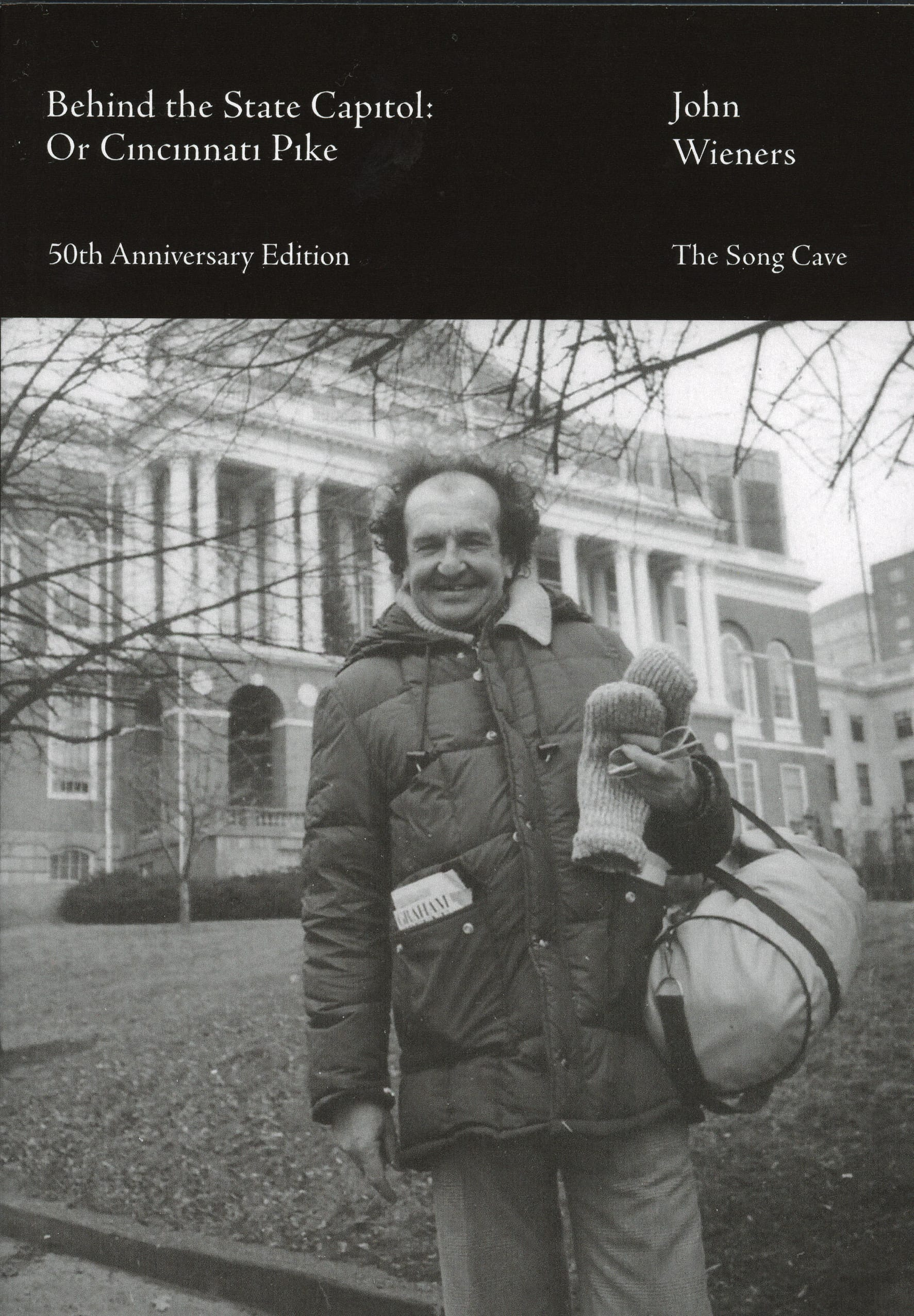
Behind the State Capitol: Or Cincinnati Pike
The Song Cave, 2025.
In an astute observation printed on the back cover of Behind the State Capitol: Or Cincinnati Pike, the editor of this long awaited reprint, Raymond Foye states that “Wieners creates a complex schizo-analysis of language, capitalism, incarceration and state power.” Upon carefully poring over this collection, I’m compelled to see John Wieners’s poiesis as an outgrowth of a creative madness, in a modified Platonic sense. In the Phaedrus, Plato outlined the 4 types of mania: the poetic, amatory, hieratic, and the mantic or prophetic. However, the visionary poet partakes of a wider range of vision by showing how these facets manage a shared space with one another. The passions rarely operate in isolation. Along these very lines Aristotle’s insistence that drama should reflect the world to be realistic is the standard borne by Wieners’s art but it is one that by necessity dismantles its own categorical foundation. The fact that life is fragmented, barbaric, exciting, passionate and not bound to make sense at all begs the question—how could its portrayal demonstrate otherwise? The poet’s fearless eye entertains this reckoning where the disruption of order is de rigueur for John Wieners.
Behind the State Capitol sets a multi-layered stage based on streetlife, homosexuality, travel, interpersonal relationships, mental health, drugs, the silver screen, and more in its theater. The challenge of being with this poetry is that it is often as unsettling as it is revealing. Of consequence in this vast collection is the mix of prose poems coupled with pieces comprised of visibly versified stanzas. Thankfully, the publishers saw fit to reproduce the text in its original facsimile typography, replete with terms often comprised of large capital and lower case characters. These playful constructs present themselves as a sort of creative code typified in “TO A PREMIER” with “thirdly art BOSTon it seemed lost in a gallery.” Whether these ciphers were ever intended to be entirely broken and/or taken as word play is perhaps a moot issue. The fact that they continue to present a source of thrall for fifty years now is gratifying. Moreover, this precise edition suitably marks that anniversary with a newly commissioned essay by Robert Dewhurst, “A Different Momentum” that provides invaluable insights into JW’s approach to editing along with his important contribution to the greater milieu of zines both straight and gay. James Dunn’s piece, “Drinkin Lonely Wine” is equally invaluable as it relays contextual clues for the poetry’s genesis along with its historiographical significance in the Boston literary scene. Overall, these expositions significantly enhance as well as expand upon the composition, reception, and legacy of this book.
The more easily accessed of the poems, but not always, are in verse. They frequently offer condensed accounts served up in more manageable portions from JW’s tumultuous banquet; an exciting and at times frustrating combination of the beautifully simple contrasted by more abstrusely complex pieces. For instance, through a particularly penetrating passage in “FOR WHAT TIME SLAYS” JW addresses “Whitman’s / poems to MANHATTAN, ‘give me the splendid silent / sun’ all the crowds now dead” concluding with “For I have looked down into the pit and turned / away trembling.” Unlike Geoffrey Firmin, the British consul in Malcolm Lowry’s Under the Volcano, JW is not terminally dragged down. However, the poet is not spared suffering by a long-shot. For in the following piece “C H I L DREN OF THE WORKING CLASS” he confesses “I feel I shall / have to be punished for writing this… I am witness… [to] the / poorhouses, the mad city asylums and relief / worklines.” He consummates these observances scintillating brilliantly in his vision, the magnitude of which threatens while simultaneously projecting a Whitmanesque vitality, “Yes, I am witness not to / God’s goodness, but his better or less scorn.”
Like Sir Thomas Browne, who intimated at the close of the Religio Medici in reflecting on his happiness, “Thy will be done, though in my own undoing” JW is unraveled by the muse’s hand. This tenuous undertaking is probably expressed nowhere more poignantly than in the prose piece “A POPULAR BELIEF AS PRACTICES: INDISCRIMINATE PROMISCUITY.” I am reticent to refer to it as a prose poem since it reads as a hyper-lucid essay although there is no reason that it cannot be both poem and exposition. This piece calls into question the tendency to experience sexuality along drawn lines. Even a queer perspective is subjected to JW’s merciless dissections. Ultimately, drugs, orgies, promiscuity, latent homosexual as well as homosexual activities are all taken within perspective and reduced to symptomatic pathologies when devoid of feeling. In fact, for JW all behavior is suspect in the absence of love. And in the aftermath he observes: “There’s no reason sexual seasons should pass away, one must openly in his work, / and thereby and therefore family, Society, and teachers admit these facts.”
This reckoning serves as an opening into his trepidation expressed in a previous piece, “To have known death-in-life / is to have lived without a wife.”
And to further call these fundamental matters into question JW issues in the prose poem “INTRO” that starts off with a critical view of two classic films, The Two Mrs. Carrolls and Double Indemnity:
Tense, enigmatic,
phlegmatic in success. The various duties and lethal promote
destiny’s vote.
When we look at related passages from other pieces and attempt to organize them within some definable continuity we are apt to label such a train of thought as potentially uneven and fragmented which would not be entirely mistaken. To consider the individual poems for their overall accessibility and general appeal is a simple affair. But to conceive of the work in toto as a collective voice poses a challenge. In reflecting on their experiences together, at Black Mountain College in 1955, Michael Rumaker observed a young JW who was shocked that: “You dare to have the two men kiss like that? he asked...which revealed his own uncertainty about putting to use in his own work that vital aspect of his existence.” JW does anything but shy away from the forbidden in Behind the State Capitol including uncertainty itself. The shards of his misgivings are embraced and even coveted. But to say that these pieces lack contiguity is to miss the forest for the propagating trees. I am instantly reminded of the opening lines of Hart Crane’s “Emblems of Conduct,” “By a peninsula the wanderer sat and sketched / The uneven valley graves.” Such a seemingly asymmetric landscape from the onset may appear “uneven.” But as the assimilated components of the artist’s inscape, JW’s topology is anything but haphazard. I will confess I found myself desperately seeking a greater sense of cohesion until I eventually allowed the collection to dictate its own terms. The fragments’ collisions eventually formed a montage affording an expansive room with a view into the psyche’s wounds and ecstasies. This resilient body of work showed itself emerging from the world’s merciless blows inflicted upon the self and by the self. Approaching JW’s poetry from this vantage point, what doesn’t initially jive or cohere eventually makes its own sense. And as valuable as it is to see JW’s poetry exemplary of the schizoanalysis that Gilles Deleuze and Félix Guattari suggest in A Thousand Plateaus: Capitalism and Schizophrenia, to say it fits within this schema incontrovertibly is not altogether clear. Even though JW pushes the envelope of poetry’s ability to tout innumerable layers in constructing its own discourse; as we have seen, he tends to undercut his claims in owning up to instability’s ever-present solvency. JW’s ultimate act of defiance doesn’t arise entirely from his self-generated logic and analytics but by confronting it with the prima materia of raw emotion and intuition. As a result, all analyses are reduced to a house of cards collapsing at a touch because of feeling. JW’s paramount concern is that strife and love, found within poetry or anywhere else, yearn for recognition that is its own realm.
To ascribe aspects of the insensible as indicators of mental illness therefore may be a mistaken assumption without providing some allowance for a gray area between sanity and its absence. In this case, perhaps certain readers will find these erratic components unsettling when reflected by the mirror of their own dis-ease with dissolution. It is as if the poet were hieratically signaling us to beware—hazardous conditions ahead—with the potential for greater visionary insight into the psyche’s meeting ground. JW’s complex and multi-valent work subsequently challenges us to regain an adoptive position allowing for the ingress of inconsistency and conflict as truth in life and poetry. To force the poetry into a pre-established structure geared for ready-made comprehensibility is to miss his gestures’ accretions. Comfort often distracts from the truth, whereas instability or rather, the appearance of instability’s appurtenances in poetry not only translate pain and irrationality but transmit it as well. A perverse but very real gift. In the skilled hands of JW these seemingly maddening devices become transformed not only into a graspable but aesthetically charged gnosis where contraries pair off to demonstrate the beauty of exchange between oppositions. Mania blossoms in the cooperative act. So to appreciate these allusive conflicts the reader must be willing to lend a malleable ear to their discursive impact. But this way of listening is not without some risk. The poet’s motions threaten the stability of interpretation as well as reflection revealed through art, warranting not only our focused but wayward attention.
Robert Podgurski is an author. His work include The Sacred Alignments and Sigils.