Sophie Taeuber-Arp: la règle des courbes / The Rule of Curves
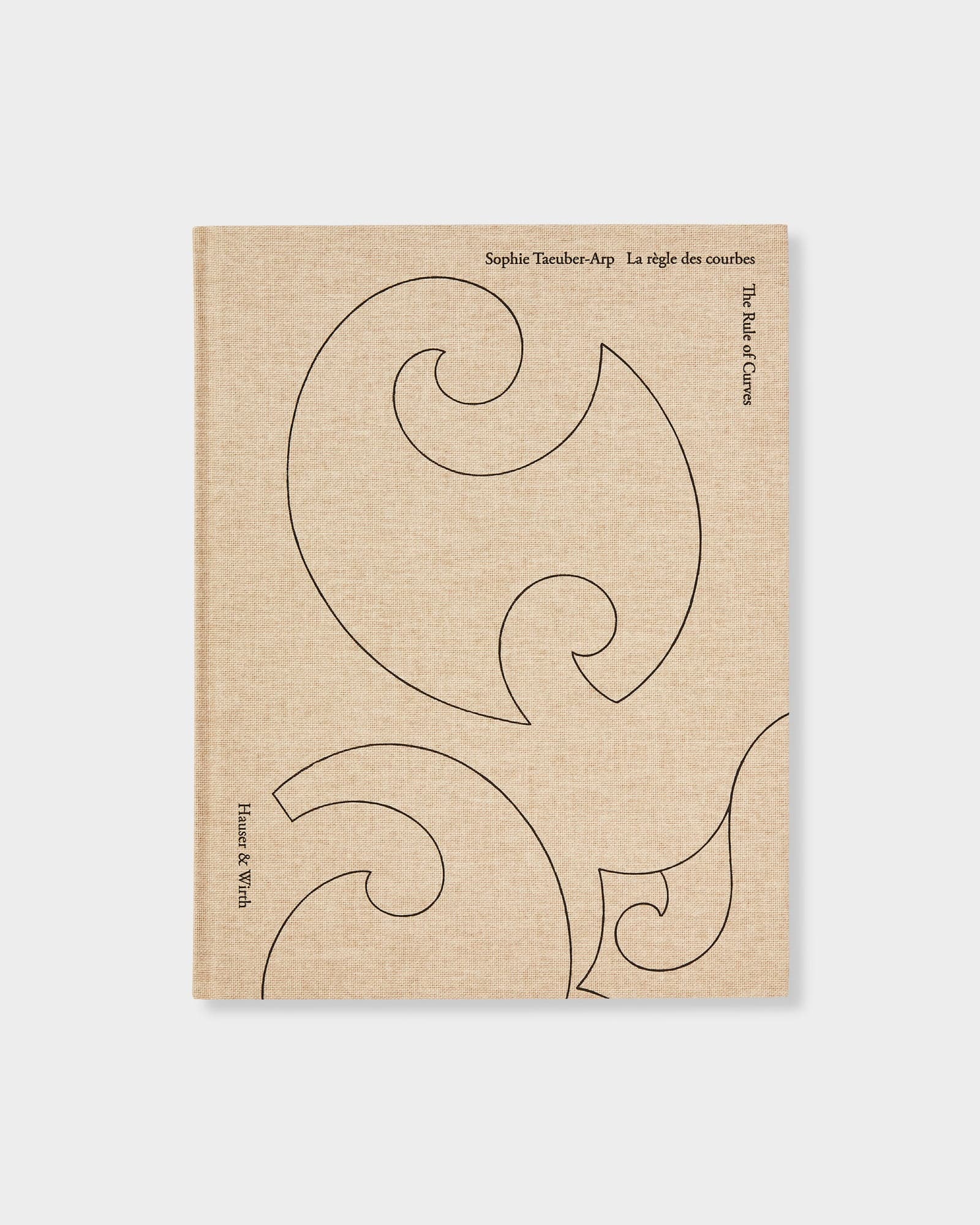
This book not only introduces the breadth of her production but of the thinking and methodology behind it.
Word count: 741
Paragraphs: 9
Edited by Briony Fer
Hauser & Wirth, 2026
The Swiss artist Sophie Taeuber-Arp (b. 1889, d. 1943) is perhaps best known as an active participant in the Zurich arm of the Dada movement, spearheaded by her husband Jean (Hans) Arp, alongside other artists who took refuge abroad during World War I. But her output was much vaster, cross-pollinated between fine and applied art. She worked as a painter, educator, writer, and designer (of textiles, stage sets, and interiors). The book not only introduces the breadth of her production but of the thinking and methodology behind it.
Sophie Taeuber-Arp: la règle des courbes / The Rule of Curves, published in French and English in tandem with an exhibition of the artist’s works at Hauser & Wirth in Paris in early 2026, emphasizes Taeuber-Arp’s formal choices with great—obsessive—scrutiny, from the exercises she was exposed to in her applied arts education to her tendency to “compound the schematic and the decorative in dizzying combinations,” per art historian Briony Fer, in one of two catalogue texts.
She worked freehand as well as with drafting tools to enable her work to “polymorphically play out,” incorporating “strange hybrids that straddle nature and industry,” Fer writes. Complementing the array of geometric images, Fer delves into how Taeuber-Arp “amalgamated languages of decoration and technology, as well as those of Dada and Constructivism, and ignored the stricter protocols and doxa being laid down by others.” The artist deployed organic forms not to reflect nature but to highlight their “belonging to a wider network of ideas about how the world is structured,” especially through repetition and variation.

Exclusively interrogating the relationship between the artwork and the drafting—and looking at her work purely academically—can feel dissociated from the lively whimsy and latent energy these works contain. One example where Fer concedes this is when writing about Taeuber-Arp’s 1933 cover design for avant-garde magazine Transition: An International Workshop for Orphic Creation. “These are not static pictorial compositions so much as samples of mobile, working components,” Fer writes. The sense of the mobile underpins a lot of the artist’s work: Taeuber-Arp’s magazine cover for Transition was even flipped and was just as workable that way. The seven circles on one cover, and the rectangle containing a parallelogram on the other, against a cream backdrop, are simple forms. But Taeuber-Arp’s approach to layout allows for an appealing mutability. (Both versions are illustrated in the text.)
Accentuating the formalism at every turn eclipses the playfulness of the result: methodology overshadowing iconography. Fer states that “the dynamic of the curve and the grid becomes a kind of micro-drama,” and that micro-drama holds a certain fascination on its own terms. With a painting like Lignes d’été (1942), the undulating shapes and haphazard reds and blues and greens read as giddy to the point of agitation or ADHD: a delirious feeling that supersedes however they were executed. In Rythmes verticaux-horizontaux libres, a gouache and graphite-on-paper work from 1927, the lines of a grid lean until they’re aslant, tilting like an optical tug. Cercles mouvementés, a 1934 painting of blue and gray and black circles, contains a tacit but sprightly bounce, evoking marbles ready to roll.
Taeuber-Arp’s work exists at a larger scale within France. She and her artist husband frequently teamed up; their collaboration at its most substantial scope also folded in Dutch artist and theorist Theo van Doesburg. The trio completed the Aubette building in Strasbourg as a collective and transdisciplinary work of art. (The local Alsatians did not like the result, and the design was covered up a decade after its 1928 inauguration, before being restored to its origins in the early 2000s.) In 1929, Taeuber-Arp and her husband moved to Meudon, southwest of Paris, where she custom-designed their house and studio; the venue became a foundation as of the late seventies that one can still visit today. The couple’s art world friends drifted in, including Sonia and Robert Delaunay, Wassily Kandinsky, Marcel Duchamp, and Joan Miró.
These considerable projects, alongside her personal and smaller-scale output featured in La règle des courbes / The Rule of Curves, celebrate a creativity that was always unbridled and never compartmentalized. How Taeuber-Arp executed this creative approach reflects a meticulous, curious mind. The shapes themselves remain, however, all the more enchanting because they don't feel overly rationalized, but rather like they were conjured.