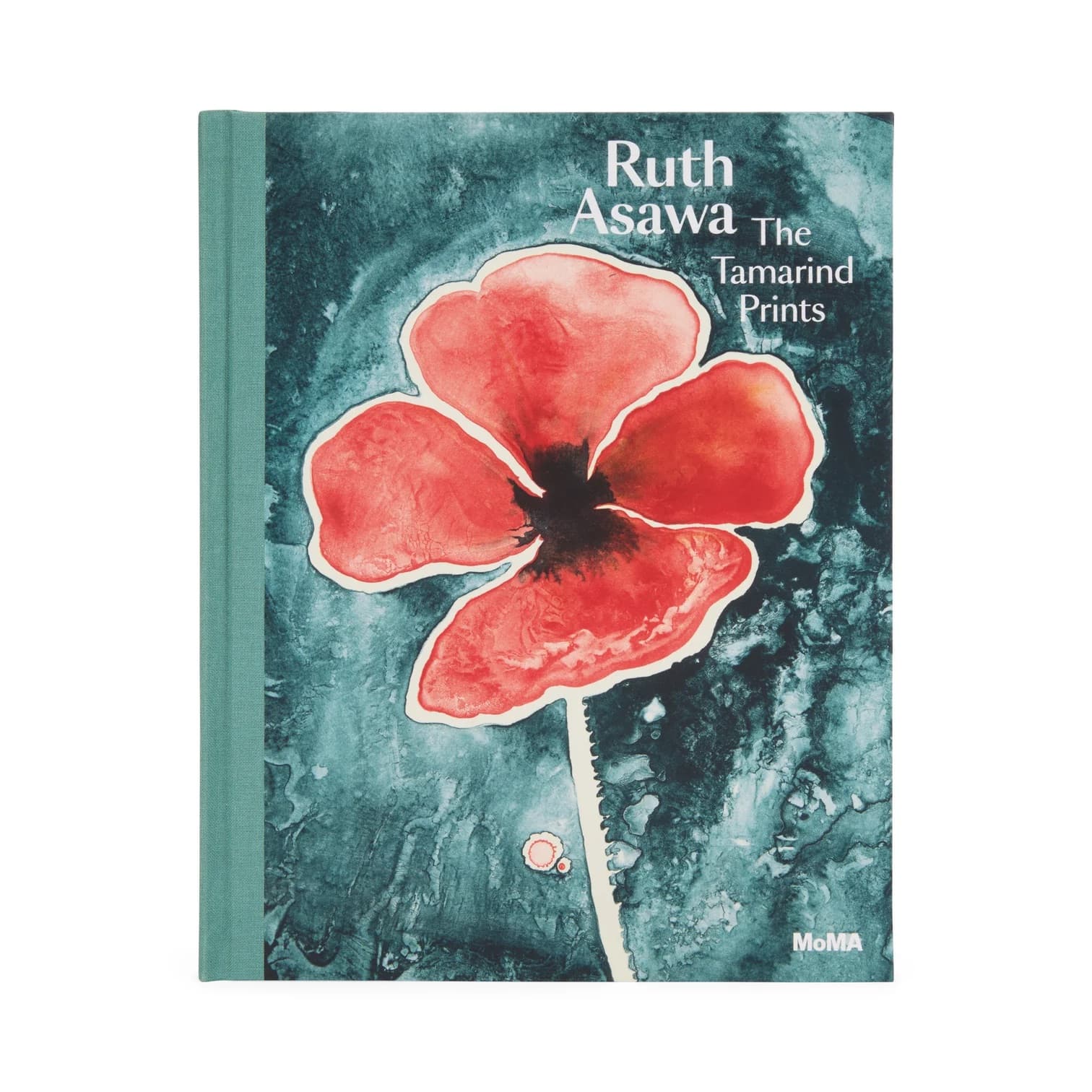
Ruth Asawa: The Tamarind Prints
This book positions the Tamarind residency as connected to Asawa’s interdisciplinary ethos, formal interest in figure-ground relationships, and advocacy for arts education.
Word count: 916
Paragraphs: 8
Edited by Cara Manes and Dominika Tylcz
Museum of Modern Art, 2025
According to printmaker June Wayne, the Japanese-American artist Ruth Asawa had the magic touch for artmaking. “She could make art out of a mud puddle if she chose to,” Wayne wrote. Known for her undulating sculptures made of looped wire, Asawa drew inspiration from the rippling, shifting forms of the natural world. In addition to making sculptures, she was also a prolific creator of works on paper, as evidenced by the 2023 Whitney Museum of American Art exhibition Ruth Asawa Through Line. Though she had previously made prints in the 1950s using a potato as a matrix, Asawa’s most extended foray into printmaking came in 1965, when Wayne invited Asawa for a residency at Tamarind Lithography Workshop in Los Angeles. Leaving San Francisco behind for a two-month period, Asawa produced fifty-four prints of startling beauty and inventiveness at Tamarind, as chronicled in the Museum of Modern Art publication Ruth Asawa: The Tamarind Prints.
Founded by Wayne with a Ford Foundation grant in 1960, Tamarind aimed to reinvigorate the moribund practice of lithography, a planographic printing technique that, at its most basic level, operates on the repulsion of oil and water. Typically, the artist draws or paints with oil-based pigment on a piece of limestone, and the image is then fixed to the stone through the application of chemicals. After this treatment, the “blank” areas of the stone will absorb water and repel ink, while ink will stick to the “ghost” of the image. The stone thus acts as a printing matrix, enabling drawn or painted marks to be replicated with their hand-wrought texture intact. By the time of Tamarind’s founding, lithography had fallen out of favor from its nineteenth-century peak, leaving few trained practitioners in the United States. The workshop aimed to remedy this state of affairs: Wayne invited artists to collaborate with printers for a short but intense period of time, a mutually beneficial set-up that allowed artists to produce work in a new medium and advanced the printers’ education through collaboration. Tamarind-trained printers dispersed and founded their own workshops, disseminating their knowledge and the practice of lithography throughout the country.

Ruth Asawa: The Tamarind Prints accompanies a comprehensive retrospective of the artist’s career that originated at the San Francisco Museum of Modern Art in 2025, recently traveled to MoMA, and is subsequently slated for display at the Guggenheim Bilbao, Spain and Fondation Beyeler, Switzerland. Timed to coincide with the MoMA presentation, this slim but trenchant publication begins with an illuminating essay by Cara Manes and Dominika Tylcz, both of MoMA’s Department of Painting and Sculpture. They convincingly position the Tamarind residency as connected to Asawa’s interdisciplinary ethos, formal interest in figure-ground relationships, and advocacy for arts education.
The essay is followed by lush color reproductions of all of the prints, which haven’t previously been illustrated in full in a single publication. Seen together, Asawa’s keen interest in reversal and sequencing becomes clear. She created four distinct portraits of her father, Umakichi, by altering the same stone: in the first, his bright face emerges from a dark surround; in the second, additional ink has been applied to the negative space so that his features appear to glow; in the third, flowers have been added to the background, and in the fourth, the relationship of negative and positive space has been reversed through a transposition technique executed by the printer, so that Umakichi now appears as a darkened form against a light background. As a result of these subtle, progressive changes, each portrait vibrates on its own emotional register. Similarly, Asawa produced three different versions of the same composition, a highly detailed still life of chrysanthemums in a pot, with varied cropping and colors.

The vast majority of the prints depict either flora or family members, though a select few venture into wilder territory: a nude woman reading a book atop a heap of billowing shapes, an owl shooting out from the darkness, an abstract composition crowded with reticulated blobs and inked in bubblegum pink. Asawa’s meticulous craftsmanship, evidenced in the tiny forms that make up her looped and tied-wire sculptures, is on view in the repeated shapes that make up her depictions of succulents, nasturtiums, hydrangeas, chair caning, and striped fabric. Charming portraits of her sons are rendered through economic clusters of line, while the twelve prints in the portfolio “Flowers” showcase Asawa’s facility with color and shading.
While the Asawa retrospective has its own hefty catalogue, this book honors Asawa’s time at Tamarind as a pivotal part of her artistic trajectory, both separate from and apiece with her work in three dimensions. In line with the expanding focus on the artist-printer relationship in contemporary print scholarship and display, Manes and Tylcz underscore Asawa’s close collaboration with Tamarind’s seven printers (Kinji Akagawa, Ernest de Soto, Robert Evermon, Ole Jürgen Fischer, Walter Gabrielson, John Rock, and Clifford Smith), noting their contributions in the essay and naming the printer responsible for each work within the checklist. The printers’ technical knowledge pushed Asawa in new directions, and their convivial relationship is underscored by a photograph towards the close of the book, which shows a laughing Asawa surrounded by Tamarind printers in Groucho glasses. Through its succinct focus on one chapter in Asawa’s career, the publication solidifies the Tamarind prints as a body of work abundantly worthy of independent examination and appreciation.
Jennie Waldow is a curator and writer focused on postwar American works on paper, ephemera, and 1960s and 1970s Conceptual Art.