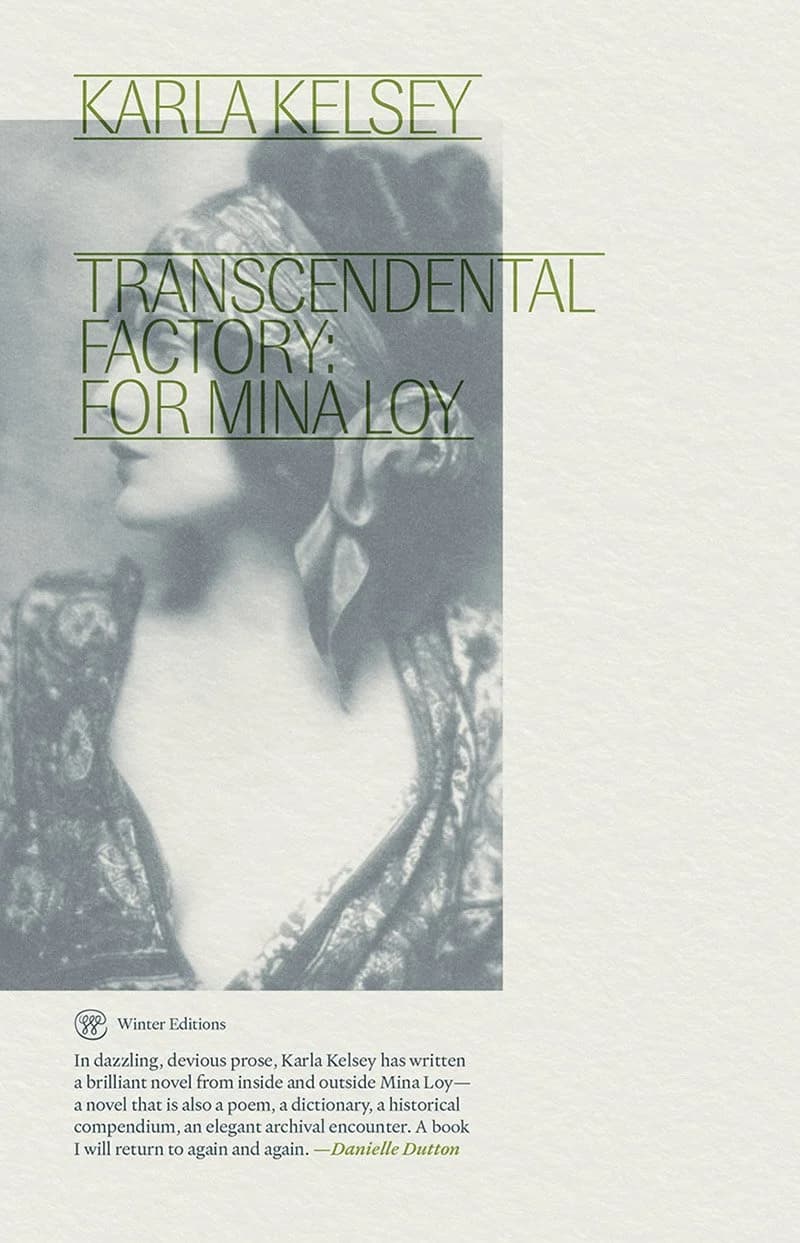
Karla Kelsey’s Transcendental Factory: For Mina Loy
The Dissolvable Shape of a Shared Self
Word count: 2081
Paragraphs: 10
Transcendental Factory: For Mina Loy
Winter Editions, 2024
“The history of a poet in this form,” Boris Pasternak writes of autobiography, in his own autobiography (1958’s Nobel-awarded Safe Conduct) “is completely unthinkable.… It can’t be found under his name and must be looked for under someone else’s, in the biographical columns of his followers.” For Jacques Derrida, “nothing risks becoming more poisonous than an autobiography,” a mode of intersubjectivity that he likens, in The Animal That Therefore I Am published after his death, to “infection.” Gertrude Stein could only write an autobiography, first by performing in the voice of longtime lover Alice as her own biographer in The Autobiography of Alice B. Toklas, 1933, and later, through the mobilization of indeterminacy offered by indefinite pronouns, the collective—and anonymous—someone, each one, anyone, and everyone of Everybody’s Autobiography, published upon Stein’s return to the United States in 1937 after almost three decades abroad in France, underscoring the complexity that any act of personal remembering is fundamentally social and collective but also mutable and migratory. It is not just one’s presence that flees representation, but one’s past: internal and public histories resisting the logic of periodization and the offices of authentication.
There is, of course, a violence to this, the threat of disappearance or actual omission, the ever-present negotiation and contestation over the authority to remember and thus commemorate and memorialize, as well as the legibility of the subject, what and who is forgotten or obscured, since any detail can only come from the splicing of a whole—think, again, of Derrida, whose earlier “circumfession” (from Jacques Derrida, written with Geoffrey Bennington in 1993) discloses the severing ritual of individuation as a binding of the self to a community of others. Karla Kelsey’s Transcendental Factory: For Mina Loy begins here, on the play of image, pose, performance, life, but also on the foul play of attribution, re/citation, what gets passed down and how or how come and why not. Her portrait of the protean modernist artist—poet, painter, playwright, novelist, designer, but also mother, wife, reader, muse—a composite picture culled from meticulous research and the lyrical, inventive intensity of Kelsey’s training as a poet. The book moves back and forward in time, zooming in and out with a kaleidoscopic lens that Kelsey adroitly harnesses to inhabit temperatures, both cultural and internal, collaging the figures of a biographical Mina Loy with the imaginative reenactments of “Mina” and her own personal accounting, the “I” that nevertheless dissolves alongside “my” and “me” in the sacred plane of existence, the writing of the self as living, as trace. “Are they the same,” Kelsey writes, early into her excavation, “the self and what is said of the self?”
Passages of each chapter are broken up, or rather knitted together, with looping ribbons of Os, Kelsey’s repurposing of Loy’s own section-break markers evidenced in her manuscript drafts. Such imbricated slippages—the encyclopedic rehearsal of worldly affairs overlaid by intimate portrayals of Loy’s every day and the author’s reflections and observations of the present-looking-back; thrilling moments of process grafted onto the narrative track—are further heightened in the moments where times and spaces are not relegated to the realm of isolated (and isolatable) facts but situated associations and, moreover, associated situations: the infectious quality that Derrida understood as intrinsic to the composition of autobiography and that we might understand today in the parlance of media as both signal and noise, each dependent on and constitutive of the other. The effect is hypnotic, hallucinatory, immersive, refractory. “After all, being conscious,” Kelsey observes, “consists of remaining with one hand in the realm of possibility penning a dream notebook awake.” Pages later, Mina becomes Kelsey becomes Loy again, the same but also different, an act of rapid self-dispersal whose charge is underscored by the violence of the scene, the transgenerational reproduction of the patriarchal urge to possess women before and after silencing them.
Passing children playing in the streets, passing Casa Azul where in 1918 ten-year-old Frida Kahlo is a flick of black braids, a yellow dress in a tree. Colossus gives Mina their last centavos to feed a starving dog.
I walk the neighborhood with a bag of stinking meat until twilight to look for the dog, his outsized skull, his chestnut body. He is not to be found, and other, stronger dogs fight for the meat. It is one hundred years in the future, and I by my own first husband am pushed face down on the bed in a luxury honeymoon hotel not far from this impoverished Mexican street. A raw splitting from anus to brainstem, claws digging the down bedcover, and from then on the sky had a streak of blood in it, regardless of the many sugar skulls offered up to the tarantula in her glass cage. As this happens and re-happens the dogs fight for the prize of meat, and it is still 1907, and Haweis still trains his pistol upon Loy as she walks across the room.
I watch the horizon, and sand pours from my body. I watch the horizon, and Colossus pours through a hole at the top of my head, slides a slow liquid gold through my chest cavity to settle in my womb.
The birth, or reanimation, of the self as subject is understood here and throughout as voluminous, vapor, volatile, diffuse, detonative, delayed. “What might be ‘I’,” Kelsey muses, “explodes the moment thought slips into language, swills on the palate like fine drink, then lingers on the lips even after one swallows or spits it out. Or perhaps ‘I’ is only constructed in the act of speaking, is never anything more than a paper version.” Kelsey, poet, scholar, essayist, editor, who, while writing Transcendental Factory, also ushered into print Lost Writings: Two Novels by Mina Loy (Yale University Press, 2024) understands that to write a life it is necessary to attend to the many drafts through which a life, like a text, may circulate. “In the reading room,” she writes, “a visiting scholar leans over my shoulder to study my desktop photo of Mina Loy, the one from the Weebly site where she turns in sharp profile to the right, paisley-patterned robe pinned to make a white diamond of her bare chest …” only to let Kelsey know that it’s not Mina Loy at all but another forgotten woman, cast or concealed in the glaze of celebrity (silent-film star Evelyn Brent, who died nine years after Loy). Smuggled in that misidentification is the testimony that there are no casual excursions in the archive. We dig, not always to discover, but to produce a capacious hole—that the methodical process of collection, cataloging, and display is itself subject to data leakage and the contamination of bodies: knowledge and its producers, each “feeding on decay. And feeding decay with defecation.” Kelsey knows that to blow up any image is not necessarily to see “the bigger picture” but to produce another—a displacement of the original against its material disappearance. “One image is lost, another circulates,” Kelsey will later write, this time substituting the lone image of Loy in New York City before she leaves for Mexico with a Robert Mapplethorpe photograph of Louise Bourgeois, 1917 and 1982, converging timelines to hitch a ride on cultural signposts or their residual clutter, not to arrive anywhere but to produce further waypoints from which to divert. Absent so much of the documentation necessary to re/cover a life in language, Kelsey jump-cuts through synoptic reportage of years in review, intermingling words coming into existence with animals entering extinction, births and epidemics and the emergence of military dictatorships and artistic movements as if, by gathering the conditions through which a life is lived, we might reassemble the vanished body.
Kelsey’s lucid viewfinder shifts again and again in a book whose manifold and intersecting stories resist the simple logic of chronology. Transcendental Factory, like its name implies, reorganizes narrative as piecemeal excavation, the shuffling of diaries and notebooks and letters and conversations and the imaginative encore of interwar peers—an orbit that includes Marcel Duchamp, William Carlos Williams, Djuna Barnes, Constantin Brâncuși, and a ten-year-old Frida Kahlo. What does it mean to commune the persons we haunt and whom we are haunted by in the solitude of writing in order to think, to conjure each figure, then cast them, as if flesh, on the page? “I go to the library always alone,” Kelsey writes. “Alone with soft lights creating the halo of space in which I sit, documented by security cameras and therefore inhabiting the quintessential position of the twenty-first century. Always alone but never alone.” Likewise, the paragraph morphs into a description of another image—material or made-up—Loy sitting with Berenice Abbot, Brâncuși, Tristan Tzara, Jane Heap and Margaret Anderson, the hyperdocumentation of the present rescued by the imperfect restoration of the past. Loy’s lamp shop on the Rue du Colisée, partially funded by Peggy Guggenheim, is now a sushi restaurant. Kelsey’s gaze further perforates the openings wrought by time’s incessant ruptures. “Who would answer if I dialed the shop’s number?” Kelsey wonders. “Digitized, does Loy live in the space between paper and screen?” These are questions that do not desire explanatory replies or tidy resolutions. Kelsey wants to ask, to linger in the beat produced by the undeliverable impasse of the past and the ubiquitous distortion of publicity. Loy is elusive, lacks the security of her contemporaries, the paper trail of posterity afforded by collaborators like Brâncuși, who, “in contrast,” Kelsey observes, “ensures the preservation not only of his works but also of the spatial configuration so essential to his practice by bequeathing his original studio to the French state upon his death in 1956.” Mina Loy, Mina Gertrude Lowy, Mina Haweis, Mina Lloyd … amorphous, iterative, itinerant, daughter of exile, exceeds subjectification by the state.
If autobiography is an insecure mode vulnerable to infection, Kelsey lets the wound fester, allows herself not only to be implicated in the folds of Loy’s unkept life, but meets her there, in the in-between zone of composition, the radical intimacy of reading that destabilizes any linear pattern of time, readjusting a continuous presence with a writerly camera-mind, its reclamation of soft focus. It’s easy to get lost in Kelsey’s sentences. The point is to get lost, to loosen the knot, to be further entangled in the heterochronic landscape of life writing, the convertibility and portability of everybody’s (auto)biography. The problem of all representation is recounted and ultimately countered in Transcendental Factory by its gossamer textual fabric, a porousness and promiscuousness that invites Kelsey’s own archive—fractured, migratory, photocopied—into the research, her account of entering graduate school as the World Trade Center collapses. Of the poem (“Anglo-Mongrels and the Rose”), Xeroxed from an out-of-print book by a professor, she writes:
Corner staple now rusted, the photocopy travels to Los Angeles to Mexico City to Pennsylvania to New York to Paris to Bucharest to Budapest to New Haven, boxed and unboxed with my books. Slipped into my backpack or carry-on. In Budapest I read the poem in cafés, in museums, in gardens, in the solariums of the city’s Art Nouveau thermal baths. In nearly every memory I’m alone. Alone in an abandoned Moorish revival synagogue in Budapest where I sit on the only chair to read of Budapest where Loy’s wealthy and refined great-grandfather had erected a synagogue / for the people and disinherits his son when he marries a woman from a lower class. This son dies young, leaving his own son, Ecodus, in the hands of his mother, who remarries within the working class. [… ] The Budapest synagogue moves into the reading room now far too warm. I place the poem draft into its manila folder, slide it into its document box, and return it to the service counter. “The reading room,” Mina says as we ascend the stairs, “I find elegant but a bit drab, although the tower of books,” she says, “I very much like ….”
Documentary is interrupted by fiction, the future intervenes in the past, the present can only be made legible through its capacity to absorb the force, the migratory current, of its ongoing re/construction. In its extraordinary reanimation of the larger field of life writing, Transcendental Factory also demonstrates a way of doing criticism that asks readers to refuse the distinction between analysis and narrative, research and experience, primary and secondary texts, reworking the boundaries of identity and experience to access the dissolvable shape of a shared self.
Chris Campanioni was born in Manhattan and grew up in New Jersey. His research connecting migration and media studies has been recognized with the Calder Prize and two Mellon Foundation fellowships, and his writing has received the Pushcart Prize, International Latino Book Award, and Academy of American Poets College Prize. His essays, poetry, and fiction have been translated into Spanish and Portuguese and have found a home in several venues, including Best American Essays and Latin American Literature Today. Recent books include the novel VHS (CLASH Books, 2025), a creative nonfiction called north by north/west (West Virginia University Press, 2025), a monograph on works of art born in translation called Drift Net (Lever Press, 2025), and the poetry collections Windows 85 (Roof Books, 2024) and Rolling Windows (Roof Books, 2026).