Margaret Morton’s Glass House
Departing from spectacle, Morton offers a stiller portrait of daily life at Glass House, rendering the squat not only viable but almost utopic in its offerings of space and community.
Word count: 1000
Paragraphs: 8
Margaret Morton
Penn State University Press, 2004
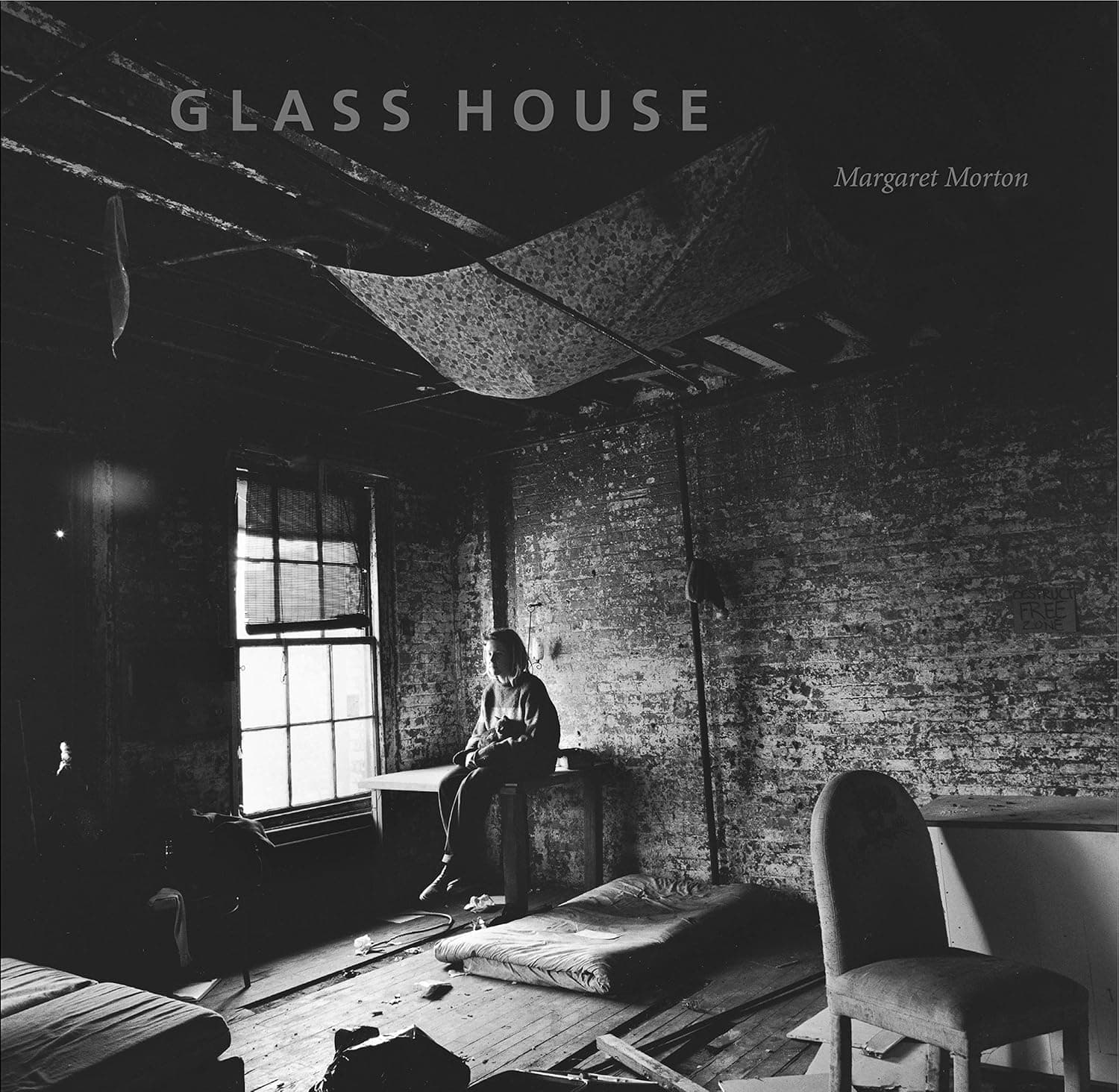
Nearly three decades after the close of the Lower East Side squatter movement, Through Padlocks, Behind Barricades, an exhibition at Interference Archive in collaboration with the Margaret Morton Archive (on view from October 2025–January 2026) returned to Margaret Morton’s 2004 photobook Glass House. The book presents her black-and-white portraits of the predominantly teenage squatters who inhabited an abandoned Lower East Side glass factory, alongside her writing on the neighborhood’s gentrification and interviews with former residents. While the book alone has long served as an intimate portrait of a single squat, considered in the exhibition alongside an array of printed materials on public debates and histories of squatters’ rights, Morton’s portraits seep further into their context, extending a soft interiority seldom seen in already sparse squatter histories.
After 1970s property values plummeted, many New York landlords opted to burn their buildings for fire insurance claims and default on taxes instead of collecting rent from already impoverished tenants. Suddenly, the city owned thousands of severely neglected buildings: rather than investing in repairs, officials boarded them up and pursued “planned shrinkage,” leaving a depopulated Lower East Side marked by abandoned structures and increased homelessness. Dozens of squatting communities proliferated in these conditions despite facing escalating eviction threats and police confrontations. By the early 2000s, most squats in the Lower East Side were either evicted or legalized under strict conditions. In today’s hyper-gentrified New York, “the material conditions that initially necessitated squatting have inverted themselves,” says Emily Drane and Justin Han, authors of an accompanying exhibition zine, “while the physical presence of squatting has faded, its politics have not disappeared.”
Comprising two massive six-story brick structures on Avenue D and East 10th, which sat vacant for two decades, Glass House was the largest squat in the Lower East Side and required extensive repairs. The first wave of residents arrived in 1992 from a neighboring squat, Foetus, after it burned down; upon arrival, the group quickly took to clearing rubble, erecting walls, and designating living spaces, all acts well-documented by Morton. In short thematic sections (“House Rules,” “Drugs”), Morton details how residents built systems to ensure mutual survival, pairing photographs with abbreviated interviews. “I ran away from home to escape all the rules,” Angela says, “There were even more rules at Glass House.” In addition to Sunday meetings and Thursday workdays, residents joined at least one working group, and rotated night watch, bike watch, eviction watch, and barricade crew. They routinely hauled water from a nearby hydrant to a home without plumbing and took group trips to dumpster dive on the Upper East Side. One night, they rigged electricity from a streetlight by trenching the sidewalk, laying cable, and cementing it all before dawn. “It worked,” Donny recalls, though as Chad interjects, “every time the ‘Don’t Walk / Walk’ sign blinked, our lights dimmed.” New members had one month to join four workdays, then thirty more days to demonstrate progress building their space. Despite stereotypes around the squatter movement, Glass House was strictly drug-free; many got sober after moving in, supported by others. “If we could work together as a group, we could live at a better level of subsistence than if we were all separate.”
In keeping with Morton’s other book-length projects documenting New York’s built homeless communities, the longest portion of the Glass House is devoted to individual photographs and interviews with residents. Calli reclines beside her window with her feet propped toward the camera; she recounts being on her own since age thirteen, living in sheds, wooded areas, and under a bridge until she learned about squatting during Gulf War demonstrations. Lisa, from rural Ohio, looks in the mirror to apply eyeliner donning a gold locket and metallic dress; she quotes her friend Lee, who tells her, “You come in and you look homeless and then you turn into a beautiful angel.” Most bedrooms are decorated one way or another, with posters, tapestries, murals, or graffiti. Across dozens of images, the logic of the building never becomes legible; each room appears as spacious and self-contained as the next. There is the sense that, while Glass House was fully occupied, there was room for anyone who chose to be there.
Squatting media may be too small a genre to divide neatly into tropes, yet documentaries about squatters map a spectrum of stereotypes. Mainstream outlets cast squats as havens for unruly punks, hippies, and addicts, while leftist documentation foregrounded solidarity and resistance. Distinct as they are, both perspectives frame squats as sites of action, depicting them as something to “put an end to,” whether through expanded housing access or forced removal. The recovered 1990s TV documentary Whose Neighborhood Is It, Anyway? leans into sensationalism, panning over shadowy rubble and graffiti to an eerie, Twilight Zone-esque soundtrack as young squatters describe a gritty punk scene. By contrast, Survival Without Rent, built from residents’ footage, shows daisy chains hauling materials, meetings on crowded floors, and clashes with riot police, framing occupations and rent strikes in direct opposition to the city’s failure to house its most vulnerable. Morton’s photographing of Glass House ended abruptly with the squat’s eviction by police in winter 1994. She didn’t begin compiling the book until nearly a decade later, when it became clear that the squats of the Lower East Side were not being remembered as they had been.
She contacted as many former residents as she could, and the final section, “Epilogue,” tells us where they ended up. The final photograph shows a memorial to one of the past residents, Merlin, brimming with flowers, ribbons, candles, and letters. Morton notes that Merlin lived under a tarp only blocks from Glass House, where he read and spoke with passersby until his death: “More than 150 people attended his memorial service.” Departing from spectacle, Morton offers a stiller portrait of daily life at Glass House, rendering the squat not only viable but almost utopic in its offerings of space and community.
Zoe Roden is a writer based in Brooklyn.