Peter Tomka’s Double Player
Play, desire, and possibility underpin the images in the artist’s first monograph.
Word count: 747
Paragraphs: 8
Peter Tomka
TBW Books, 2025
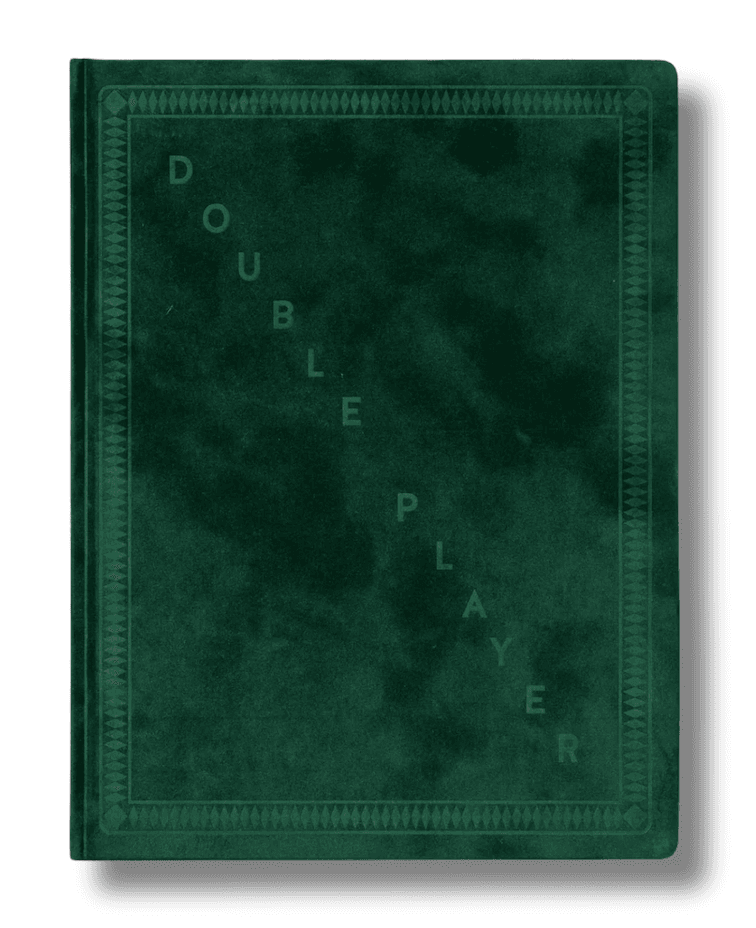
The act of compiling work into a publication is something Peter Tomka does in a contorted fashion. The artist’s first monograph, Double Player, is loosely envisioned as a Möbius strip, which the magazine Scientific American notes is both an “artist’s reverie and a mathematician’s feat.” Critic Alexandra Jacobs wrote about The Möbius Book by Catherine Lacey, which came out last year as a memoir/novella halfbreed: “Depending on how you twist, this book—defying the linear story, homage to the messy middle—is either delightfully neo-Dada or utterly maddening.” The same teetering point could be applied to Tomka’s Double Player. Designed by Paul Schiek, the pages on one side are printed right-side up while the pages across are printed upside down—the experience of flipping through is the same when rotated clockwise and counterclockwise. The casebound hardcover, published by TBW Books, features fifty plates viewable from either direction. The “concept” is more like a gimmick, in that it can supposedly be read jointly by two people, although the idea of trying to read in tandem with someone else sounds awkward, if not altogether annoying.
The cropped rectangular photographs are created by the artist or reappropriated from pop culture excerpts. Double Player encompasses five bodies of Tomka’s black-and-white work: “Bachelor Suite” (2024), “Heatwave Suite” (2024), “Watering Hole” (2023), “Three Works” (2021), and “Paternity Test” (2021). Below each image is an italicized text, providing glimpses of where the depicted moments originate from: whether a movie still (featuring John Wayne, Montgomery Clift, Tony Curtis or Rock Hudson) or snippets of lived queer life (featuring members of Tomka’s entourage). Often, the bodies look like abstract sculptures; the portraits are partial enough that there’s little backdrop from which to eke out information. Text and images alike reference artists of the past (Andy Warhol, Francis Bacon, Jackson Pollock), and Californian locations like MacArthur Park, Griffith Observatory, Gaylord Apartments, and Joshua Tree (with interludes in Fire Island and Des Moines). For the latter, the geolocalization takes on a particular flavor: “There is still surplus of youth that comes to Hollywood hoping to simulate the ascendency of those before them.” Tomka himself reveals he “came to Los Angeles on an offer to be a driver and stayed for love.”

Each page functions as a vignette. “This photograph reminds me of the way a tongue curls when you pop a pill into it—an anticipation, like catching a snowflake,” muses Tomka underneath a photo of two shirtless men looking ebullient. Throughout, there is a celebration of “gay camaraderie” as well as the “theater of the locker room” and more widely a sense of queer legacy. “I found significance in Peter Hujar and David Wojnarowicz,” Tomka writes of himself, a Peter, being connected to a boyfriend named David.
Play, desire, and possibility underpin the images. But perhaps most delightfully, Tomka equates gestures in the images themselves with the analogue process of making a photo. In an appropriated image in which champagne is poured over the head of Jerry Buss (then majority owner of the Los Angeles Lakers), to Tomka it evokes how “the physical print of this image experienced similar drippings when it was hung up to dry” (although he also, here, references piss play). When a friend sitting before Tomka’s lens blocks his visibility with his body, Tomka writes under the image: “this extension reminds me of the motion I make when I pull a large print out of the chemical baths.” He likens his shower rinse before and after swimming laps at Century Spa with being “like a print in the silver gelatin process, thoroughly washing to remove residual fixative.”
Here and there, his longer relationship to photography crops up. In resurfacing his Myspace profile picture, he notes the way representation evolved with digital: “The standard format of the selfie was being codified at the time, taking its roots from the glamour shot.” Later in the book, he explains that he had “given up on [his] bed, transforming it into an enlarger—insisting that the projection site of the latent image should originate from where [he] once laid [his] head at night.”
The book collides at the halfway point, where a nebulous image of wreckage is visible on both pages. The text below describes a “fantastical loop, endless playbacks of what could have been.” Ultimately, Double Player functions less powerfully as a formal trick and more captivatingly when it’s creating an homage to the photography medium itself.