Peggy Ahwesh’s Sourcebooks
This book provides the reader with a key to the ideas explored in the artist’s films.
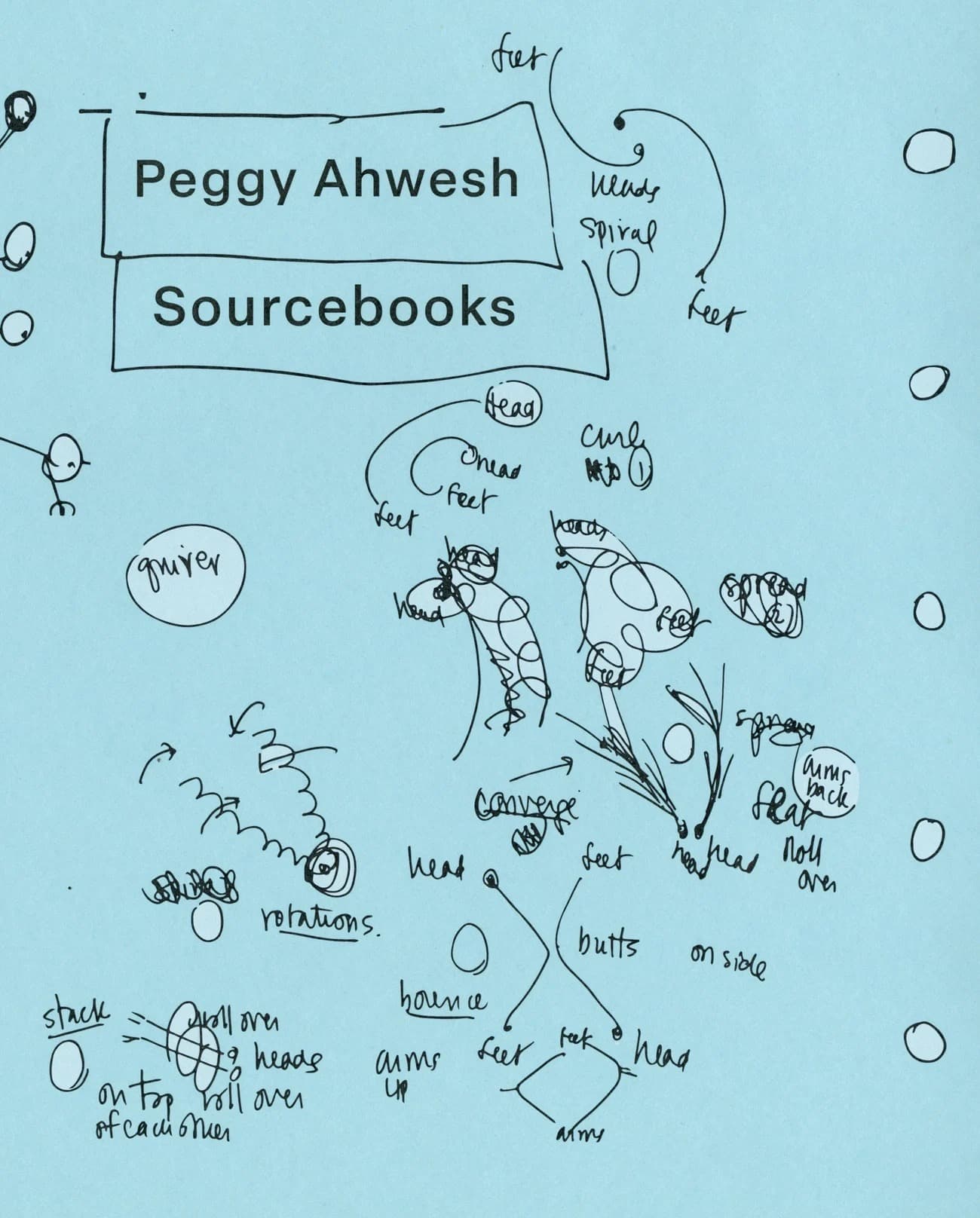
Word count: 858
Paragraphs: 7
Peggy Ahwesh
Visual Studies Workshop, 2025
Peggy Ahwesh’s filmography is often discussed in terms of pastiche, not only because she frequently uses found footage sourced from unlikely places—such as a Super 8 reels of porn from the 1960s rescued from a dumpster, or scraps of movies and advertisements salvaged from a shuttered cinema in Beirut—but also because her larger body of work does not reflect a signature style or aesthetic, resisting prevailing notions of authorship among the avant-garde filmmakers of her generation. This heterogeneity is apparent not only when looking at her larger oeuvre, which comprises work in nearly every filmic medium from Pixelvision to thermography, but also when considering her films individually; each work is a site of convergence for a network of ideas that play off each other within whatever format best suits the project. These ideas are embodied in the archive of documents presented in Sourcebooks, a compendium of the materials Ahwesh collected and composed throughout the development of five films spanning roughly a generation: Martina’s Playhouse (1989), The Deadman (1990, co-directed with Keith Sanborn), She Puppet (2001), Ape of Nature (2009), and OR119 (2022, co-directed with Jacqueline Goss). Each section concludes with a brief text by Ahwesh, and the book’s final pages feature a QR code which leads to a SoundCloud playlist of audio tracks recorded during the production of each film.
The materials presented in Sourcebooks range from production materials such as scripts, musical scores, stills, and production budgets; artwork and personal ephemera from friends and collaborators; exhibition materials such as schematic layouts, press releases, artist statements, and news items; research materials, represented by covers of the innumerable books she draws upon—everything from Jacques Lacan’s Feminine Sexuality to The Complete Prophecies of Nostradamus; posters for movies obscure and mainstream; reproductions of historical artworks and artifacts; and a trove of photocopied scholarly articles and critical essays, often bearing Ahwesh’s annotations. It is this latter category that provides the deepest insight into her filmography, offering a kind of syllabus for understanding the thematic frameworks of each work and emphasizing what film scholar Elena Gorfinkel has identified as one of Ahwesh’s overarching projects: “to unravel the way the performative encounter between camera and subject requires a tarrying with the surpluses, limits and edges of spoken language.” Like her films, Sourcebooks allows images and text to inform each other through proximity, providing the reader with a key to the ideas explored onscreen. These juxtapositions reveal the continuity of certain frictions throughout Ahwesh’s filmography, particularly the relationship between death, sexuality, and the mediation of our perception of reality by both social and technological apparatuses.
“[Lara Croft] and I share the dilemma of being trapped in an increasingly artificial world,” Ahwesh writes in her summary of She Puppet, a Betacam supercut of the virtual archeologist repeatedly dying throughout Ahwesh’s play of Tomb Raider III (1998). Interspersed throughout Croft’s semi-orgasmic death cries are voiceover readings from Fernando Pessoa’s The Book of Disquiet, Joanna Russ’s The Female Man, and an unnamed text by Sun Ra, each of which, according to Ahwesh, prompts our consideration of Croft as an orphan, clone, and alien, respectively. In addition to these sources, the She Puppet sourcebook includes screenshots of cheat codes for making it through certain levels of the game, an excerpt from Paul Virilio’s War and Cinema: The Logistics of Perception, images of various female automata including Daryl Hannah in Ridley Scott’s Blade Runner (1982), doll sculptures by Greer Lankton, and an article by Sadie Plant on pioneering computer engineer Ada Lovelace.
These materials are a few pages away from the section for Ape of Nature, a multi-channel film installation inspired by Werner Herzog’s Heart of Glass (1976), which Ahwesh reimagines in the American rustbelt, shooting actors in a dilapidated mansion in her native Pittsburgh, a city that, like the eighteenth-century Bavarian town of Herzog’s drama, finds itself in decline after the collapse of its industry. As Herzog’s actors ostensibly were, the actors of Ahwesh’s film were hypnotized for the duration of their performances, throughout which they deliver monologues drawn from their subconscious mind that vacillate between poetic remembrances and dystopic predictions. While She Puppet may at first seem thematically unrelated to Ape of Nature, sources such as an article on Sigmund Freud’s experiments with hypnotizing female subjects and a page from Gilles Deleuze’s Cinema 2 discussing the filmic image’s status as both “actual and virtual” clearly resonate with the concepts at play in She Puppet. In this way, Sourcebooks allows readers to recognize the leitmotifs of Ahwesh’s radically diverse oeuvre.
Indeed, one of the most compelling summations of Ahwesh’s prevailing concerns appears in the sourcebook for The Deadman, a gritty black-and-white film inspired by a Georges Bataille text, which contains a letter from visual poet Rick Pieto that seems to anticipate the concerns of Ahwesh’s later films: “have you noticed how everyone is talking or writing about either information or sex?” Caught in the torrent of time, commerce, and human communion, the materials in Sourcebooks remind us that intangible forces manifest material effects, and perhaps the only means to assuaging the anxiety of our information age is a curious mind.
Kathleen Langjahr is a writer and researcher based in Brooklyn.