Jennifer Sichel’s Criticism Without Authority
This book explores two writers who merged personal experience with political idealism and confessional immediacy with performative incoherence.
Word count: 960
Paragraphs: 8
Jennifer Sichel
The University of Chicago Press, 2025
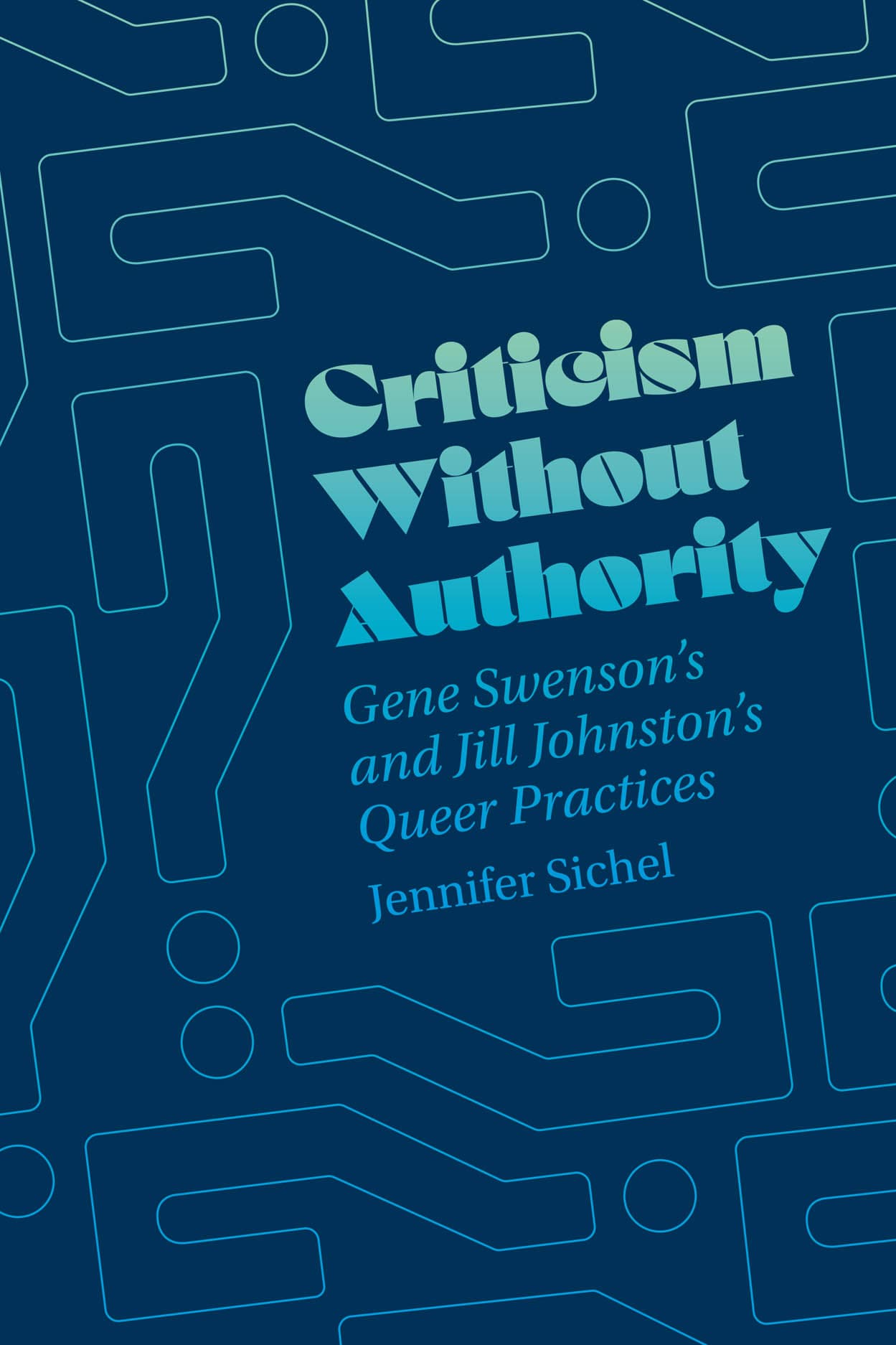
What could cultural criticism accomplish if the practice disentangled itself from its commonly held associations with expertise, judgment, and, above all, authority? Jennifer Sichel’s Criticism Without Authority: Gene Swenson’s and Jill Johnston’s Queer Practices, released in November, considers two historically rooted examples—both avowedly messy, imperfect, and contradictory—of what that very absence might look like. From apartments located just a few blocks apart in early-sixties New York, Sichel explores the intertwined lives of critics Gene Swenson and Jill Johnston, two figures who chronicled the early days of, respectively, Pop art and Judson dance. Both were writers that, as Sichel recounts, refuted a distinctly modernist authoritative voice by embodying “ways of being ambiguous and unmanageable” through their work: merging personal experience with political idealism, confessional immediacy with performative incoherence.
Criticism Without Authority follows moments when Swenson’s and Johnston’s lives intersected and echoed one another throughout the sixties. With careful attention to archival fragments, Sichel writes a history of their practices that “sputters and spirals” along with them. Both moved through similar communities, and both negotiated with queer feelings in their writing, in a pre-Stonewall era when forms of public disclosure carried different risks. Both also experienced the criminalization of psychosis—which was inseparable from the pathologization of queerness in the mid-twentieth century—as both were admitted, more than once, to the psychiatric ward of New York’s Bellevue Hospital.
Yet beyond the rhythms of biographic narrative, Swenson’s and Johnston’s practices also tell a story of the structural possibilities (and blockages) in this era of arts publishing. For instance, Johnston found consistent support in the Village Voice, which released her weekly dance reviews and welcomed—or at the very least, tolerated—her changing style, as her writing became increasingly loose and cacophonous, eschewing normative structures like consistent punctuation and grammar. Swenson, however, early in his career experienced an instructive moment of editorial heavy-handedness. Sichel introduces a previously unknown recording, documenting a 1963 conversation between Swenson and Andy Warhol (along with Gerard Malanga and two other friends) that would become the ARTnews interview that originated some of the Pop artist’s most iconic quips. (“I think everybody should like everybody,” to name one.) Enacting a close reading of the transcript, Sichel carefully unpacks the layers of disclosure, ambiguity, and flirtation in their exchange, which meandered between subjects like poppers, BDSM, and which Abstract Expressionist painters were possibly “closet queens.” All of this was removed from the final text, which ultimately helped cement Warhol’s blasé, strategically blank persona. Yet, as Sichel argues, while this significant—and consequential, art-historically speaking—erasure was undoubtedly influenced by the magazine’s editor, Swenson had a part to play in the obfuscation: “eliciting queer disclosures, redacting them, and replacing them with a public discourse full of gaps and distancing irony.”
As the sixties continued, Swenson’s and Johnston’s ambiguities would warp and intensify. The book’s following chapters cover their paths crossing in 1968, and their shared “ways of being, doing, and writing fueled by anger and marked by disintegration.” A key touchstone for Sichel is Johnston’s 1969 “The Disintegration of a Critic” panel discussion, the performative exercise wherein the writer sacrificed herself up for (chaotic) analysis from an audience of her community. Sichel provides another careful close reading of the event’s transcript and discusses Johnston’s writing, and queer life, as entwined practices in incoherence: “there was no way to be an integrated person (or critic) as a lesbian in the sixties.… To be a dyke was by necessity to exist as a fractured subject in contradiction to oneself.” Swenson’s interventions would grow increasingly inchoate: publishing polemics against art world corruption, disrupting public events, and for one month in 1968, participating in a daily, one-person protest outside the Museum of Modern Art, wielding a giant blue question mark. (As Gregory Battcock wrote: “The museum won’t let Swenson in, because they don’t know what to expect from him. They don’t know what he wants.”) As Sichel recounts, Swenson’s anger—both amorphous, yet strongly felt—would ultimately grow too unruly for his community to carry. Here, the refractions between Swenson and Johnston stop short: the latter’s writing would advocate for lesbian separatism into the seventies, whereas the former died in a 1969 car accident, his urgencies unfulfilled.
This returns me to the question of authority, a term that remains decidedly slippery in Sichel’s work. She is careful not to romanticize her subjects, devoting space to the difficult moments where their revolutionary visions undergird other prejudices: Swenson’s anti-institutional rage finding recourse within antisemitic conspiracy; Johnston’s pronouncements of lesbian nation-building, careening, on at least one occasion, into transphobia. But these moments are not simply sobering caveats—they also provide a productive wrinkle into the possibility of a criticism fully divested from the authoritative. It feels telling that both Swenson’s and Johnston’s efforts remained individualized: neither became fully involved in the coalition-based actions that would define the late sixties and seventies; forms of organizing that, at least in principle, aimed to redistribute authority through collective consensus. (Although Swenson’s premature death left his ongoing activism, sadly, speculative.) Instead, Swenson’s and Johnston’s queer modes of “writing themselves into being, over and over again” relied, in part, on the maintenance of certain socially ordained authorities (whiteness, cisness) that neither could fully see within themselves, let alone challenge. Describing her book as one about “unconsummated wishes [and] revolutions deferred,” Sichel recognizes that their efforts to dismantle authority were, ultimately, failed endeavours—and that these failures impact (but, crucially, don’t invalidate) the work of integrating both writers meaningfully into queer/feminist art history. Echoing Johnston’s phrasing, as quoted in Sichel’s introduction, perhaps their practices remain instructive for being “things that are certain about not being very sure about what they are.”
Daniella Sanader is a writer and reader who lives in Toronto.