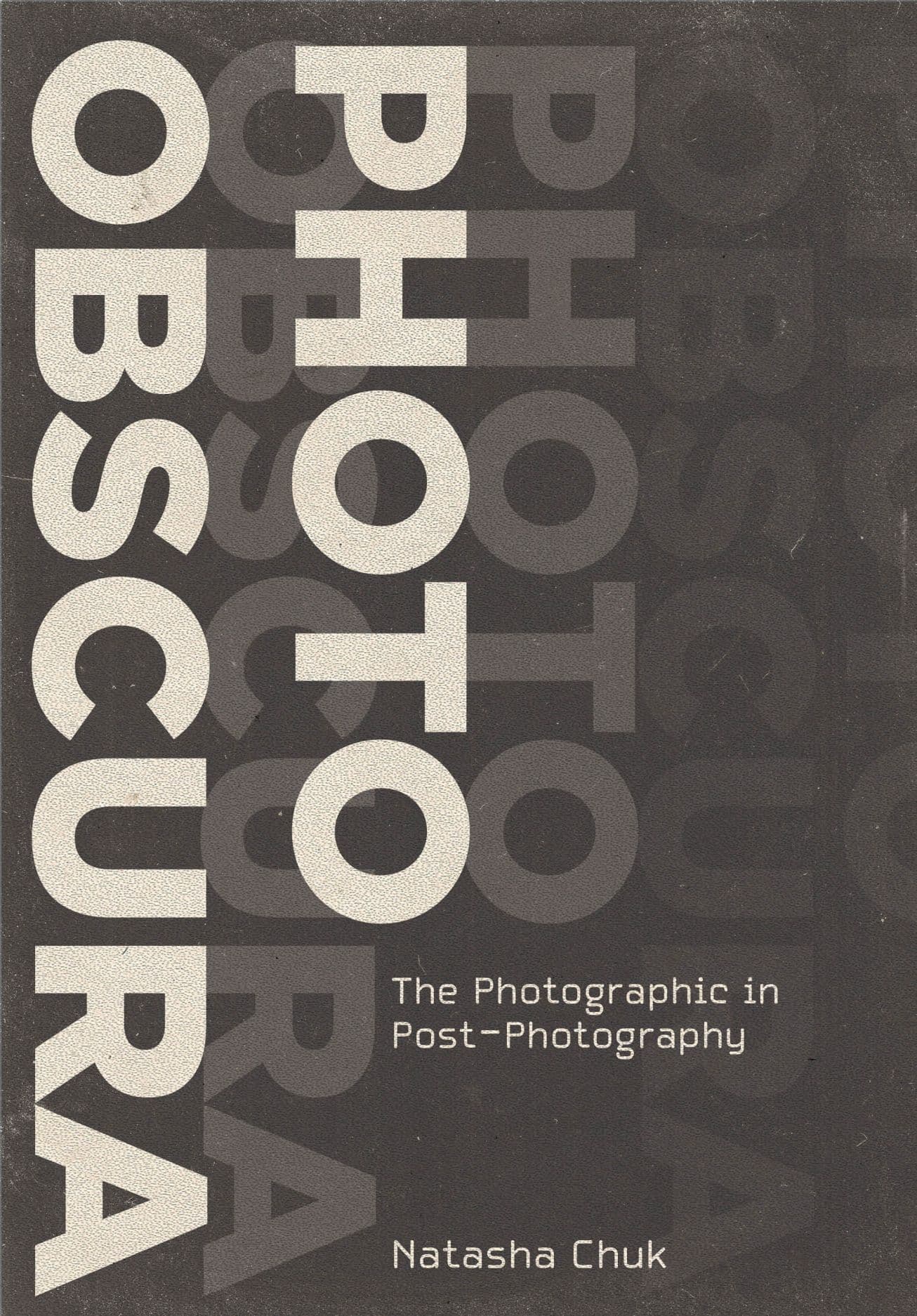
Natasha Chuk’s Photo Obscura: The Photographic in Post-Photography
This book tracks how artists inherit the DNA of the photographic medium and transform its new creative potential.
Word count: 822
Paragraphs: 10
Natasha Chuk
Intellect, 2025
If photography has historically been defined as a technology of seeing, then “post-photography” becomes the concept of what part of sight survives once the camera dissolves into software. Photo Obscura: The Photographic in Post-Photography enters into this uncertainty and positions itself as a guide through an expanded field of image-making practices where photographic logic persists even as tools, workflows, and cultural expectations of images shift. Rather than offering a single unifying theory, media theorist Natasha Chuk organizes the book into thematic constellations that track how artists inherit the DNA of the photographic medium and transform its new creative potential.
Instead of mapping a chronology of post-photographic practice, the artists selected in its chapters are deliberately curated, shaped by Chuk’s years of scholarship and observations as an educator. The recurring themes, which are organized into chapters, are: “Expressive Realities,” which addresses the emotional landscape of memory and identity practices; the differences in how materiality is rendered through lens and screens in “A Robust Flatness”; in-game photography and its multiple perspective shifts in “Virtual Landscapes and Hybrid Bodies”; the vastness of data and the many ways it can be represented in “Performing the Archive”; and “Photo Objects,” which foregrounds the photographic as something that can be re-materialized in three dimensions. The book highlights the practices of fifteen artists including Penelope Umbrico, Maria Mavropoulou, and Pascal Greco, all of whom share very close ties to photography, as well as Rosa Menkman, Stephanie Dinkins, and Lev Manovich, whose photographic influence is arguably more abstracted by technology.
As the public is increasingly tasked with interpreting images that are edited, stripped of their context, or algorithmically generated, the question becomes whether Photo Obscura meaningfully supports the project of visual literacy, and whether its organizing principles facilitate that concern.
The call to “dethrone” photography as a truth-bearing medium is central to the book’s framing, yet analog photography’s authority was never as stable as this gesture implies. Early photographs were mediated by metal and glass plates, coarse papers, and hand-coated light-sensitive emulsions, processes that foreground craft as much as the capture process. Their perceived truthfulness was anchored in the best available fidelity of the time, not some fixed understanding of objectivity.
That shift matters because fidelity is historically contingent, shaped by changing technologies and expectations. If photography’s authority has never fully rested on truth, but on a culture’s relationship to fidelity at a given moment, why are we still arguing to dethrone it at all? The answer lies in the stubborn belief that photography is monolithic, and that regardless of its current incarnation, it remains the best instrument for the job. The further new tools drift from an era’s expected capacity for trustworthiness, the more resistance they provoke.
When discussing AI-generated images, Chuk calls them “inherently photographic,” a proposition I agree with, despite it being a contentious one. Although, in making this argument, I wanted the book to spend more time conveying the very real connection between an archive of photographs and a dataset of images, and exploring the process of image generation. In glossing over some of the technical explanations and opting for a more philosophical approach, we miss the opportunity to underline how much synthetically generated images share with their camera-born predecessors.
What also remains largely implicit in the book’s framing is how economic and socio-political forces shape not only the technologies available to artists, but the aesthetic tendencies that emerge from them. In the last chapter, Chuk addresses the term “Luddite,” a person who “resists technological advancement,” and her own resistance to the black-and-white thinking that dominates present-day responses to technology. While I agree that the framing of AI, or any other vision technology, as wholly good or bad puts artists engaging with new modes of production on the defensive, photography, and by extension post-photography, is directly influenced by the conditions of labor, capital, warfare, governance, and media infrastructure, arguably more so than other art forms. From the industrialization of photographic production to the standardization of file formats and color profiles to surveillance technologies and policing strategies governed by reductive machine learning logic, the medium has consistently mirrored the systems that sustain it. Bringing those forces into sharper view and highlighting the technology’s complicity in those systems would better explain why certain creative practices cluster together and why they become legible in the first place.
The book offers an inviting point of entry into contemporary image-making practices, while addressing the near-impossible question of what makes photography photographic. It skillfully does not pretend to settle the debate, but gives readers a lively set of cross-disciplinary touchpoints, all the while keeping the photographic in mind, as it migrates across platforms, processes, and materials. Even where I wanted more sustained attention to underlying conditions, Photo Obscura succeeds as a generous, artist-forward, and intellectually agile guide that encourages the reader to keep looking, ever more carefully.
Danielle Ezzo is an interdisciplinary artist-writer-researcher based in Brooklyn, NY. Bylines appear in Ocula, the British Journal of Photography, The New Inquiry, Magnum Photos, and Dear Dave Magazine, among others.