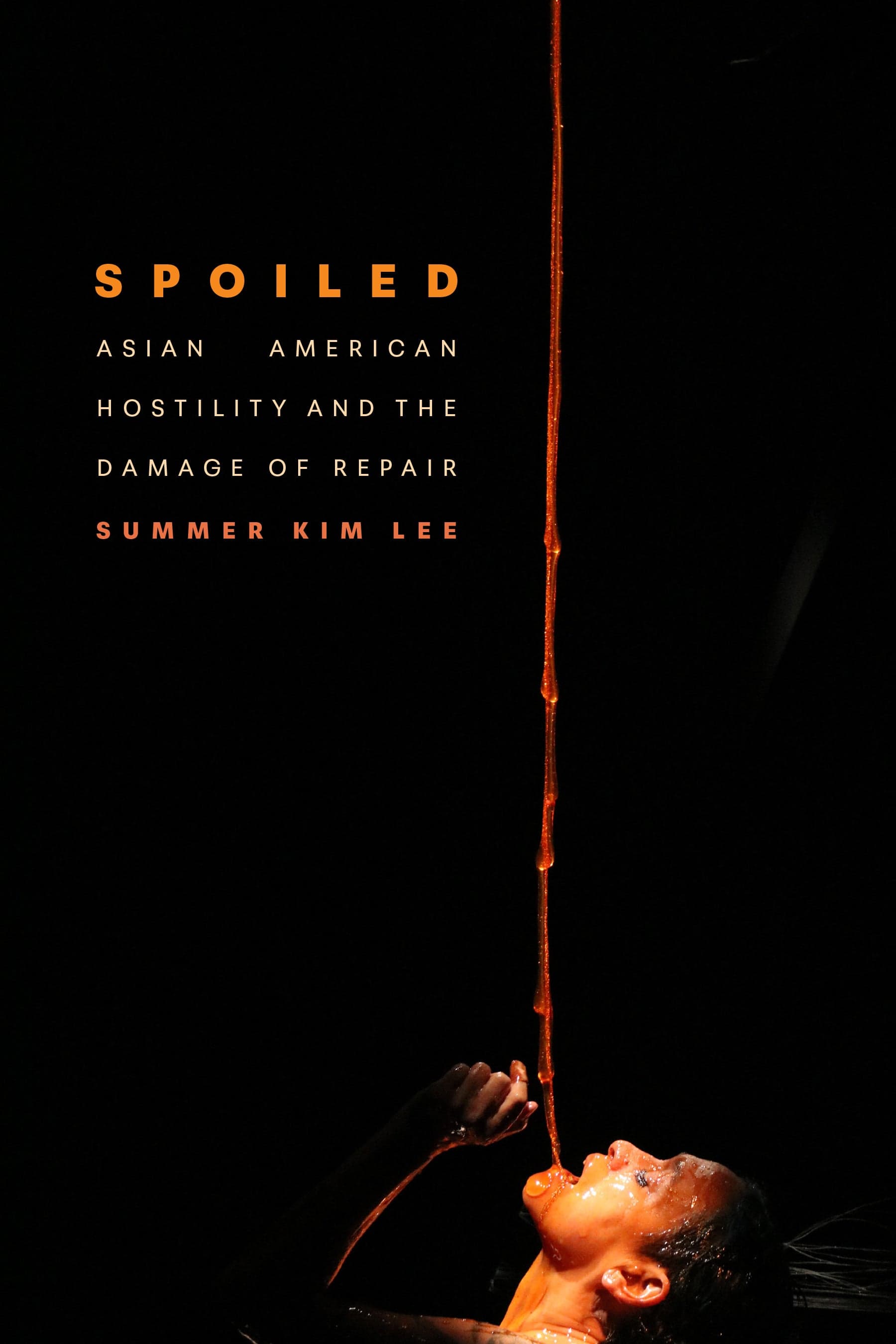
Summer Kim Lee’s Spoiled: Asian American Hostility and the Damage of Repair
In this book, varying definitions of “spoiled” function as means to critique the dominant culture in the US that expects immigrants to assimilate, which reduces Asian American identity into a category, or worse, a stereotype.
Word count: 898
Paragraphs: 8
Summer Kim Lee
Duke University Press, 2025
Recent books on Asian American art have focused on the ways in which it avoids the trap of assimilation by either being unnamable, as advocated for by Asian American Studies Professor Susette Min, or by being inscrutable, according to Gender Studies Professor Vivian Huang. Summer Kim Lee’s Spoiled: Asian American Hostility and the Damage of Repair represents a formidable effort to turn away from these modes of indecipherability, toward presence and voice. In this book, varying definitions of “spoiled” function as means to critique the dominant culture in the US that expects immigrants to assimilate, which reduces Asian American identity into a category, or worse, a stereotype. “The spoiled aggravates categorizable identities and recognizable subject positions in the preoccupation with the body’s sensation, matter, and form,” Kim Lee writes. “Through the spoiled, the artists here insist on the deidealized, deforming aspects of Asian racialization that critically irritate cathartic, affirming representations of Asian American subjectivity and social life.” Through aggravation and deformation, Kim Lee pushes away from modes of being incomprehensible, to create openings for legibility.
The first chapter promotes “Staying In” as a form of critique, “disidentifying with the stereotype of the awkward Asian American recluse.” Kim Lee convincingly turns to the performance of musician Mitski in her music video for Your Best American Girl (2016), where staying in is all about being embarrassingly honest about self-gratification, as the lead in the music video chooses to pleasure herself rather than compete for the attention of an “all-American boy,” thereby creating opposing affects to dominant norms. It is important to note that self-sufficiency is not disengagement, as at the end of the chapter, Kim Lee leaves room for the possibility of choosing to go out alone, and connecting with others.
Chapter two sees quotations and “the risk of speaking as someone else,” as spoilage in artist Wu Tsang’s video artwork For how we perceived a life (Take 3) (2012). Kim Lee carefully unpacks the dynamics of the performances as they repeat lines from Paris is Burning (1990), a film about the ball culture of the 1980s Harlem drag and trans community. Kim Lee traces the way each of the performers’ lines are recorded and lip-synched, cogently revealing the complicity and the ambiguousness of using others’ quotes as acts of spoilage, clouding the original subjects’ intent. “[Tsang] becomes a student who risks spoiling her sources with her own desire to learn what she does not know,” argues Kim Lee. Here, Kim Lee adeptly takes apart the opacity of the skewed power relations in quotations through performance, revealing a political possibility of accountability.
In the third and least successful chapter, being frigid toward the predatory objectification of Asian femininity is a form of spoilage, signaling submission yet disapproving of the attention. Kim Lee argues that this posture would reverse the objectification onto the perpetrator of the violence, as the slippery epidermis of the stereotype accumulates into their unreturned desires. Kim Lee’s analysis of artist Alison Kuo’s performances in works such as Bone Bath (2017), in which the artist lies in a bathtub of a luxury apartment filled with gelatin, acutely demonstrate how, “Cold leftovers can frustrate not only a hungry appetite for racial, gendered fantasies, but also the political desire for relatable, representable forms of Asian American subjecthood.” Her overall message regarding fetishization permissively placates the violator’s desires, rather spoiling their fantasy. More troublingly, Kim Lee’s recovery of Asiatic femininity through a reversal of the yellow woman trope neglects South Asian bodies, who are altogether nearly absent from the book, even as she refers to José Esteban Muñoz’s notion of brownness.
The final chapter deals with broken, spoiled bodies as represented in the sculptures and installations of Jes Fan and TJ Shin. Kim Lee ruminates on Fan’s uses of hormonal and biological fluids and glass in works such as Testo-soap (2017) to materialize what we discard for the sake of wholeness, and Shin’s aestheticization of the intoxication that non-native plant species like mugwort enact in the Americas, as made apparent in the work The Vegetarian (2022). In both cases, “the act of relating, of drawing comparisons, remains destructive and ephemeral.” Kim Lee asks: what are the stakes of visualizing the discarded as being Asian American? To that end, the coda analyzes the performances of HONEY (2024) by Julie Tolentino and Stosh Fila, as showcasing the accumulation of excessive spoilage. The book ends on this sticky point, about transmitting communication beyond language, as bringing about “sweet, selfish ends” without a proper closure.
Altogether, Kim Lee moves beyond triangulation, where Asian American subjects are caught between the Black and white binary, by activating this subjectivity as a trope remade into an analogy. Asian American as, rather than is, helps avoid the pitfalls of essentialization, and by extension, instrumentalization. While circumventing the Black and white binary, the book neglects to address the settler colonialism of Asian Americans that contributes to the displacement of Indigenous peoples of the US, as much as the invasiveness of Fan and Shin’s works allude to the subject. The book does raise necessary points about being unapologetically obnoxious, but not all arguments are salient. In the age of Trump, one wonders if becoming “cold leftovers” is equivalent to playing dead. Should that be what life as Asian Americans boils down to?
Liz Kim is an assistant professor of practice in art history at Texas A&M University-Kingsville. As an art historian and critic, she specializes in late-twentieth-century American art, psychoanalysis, queer theory, moving images, and digital media.