SARA LEVINE with Kathleen Rooney
Word count: 4165
Paragraphs: 56
The Hitch
Roxane Gay Books, 2026
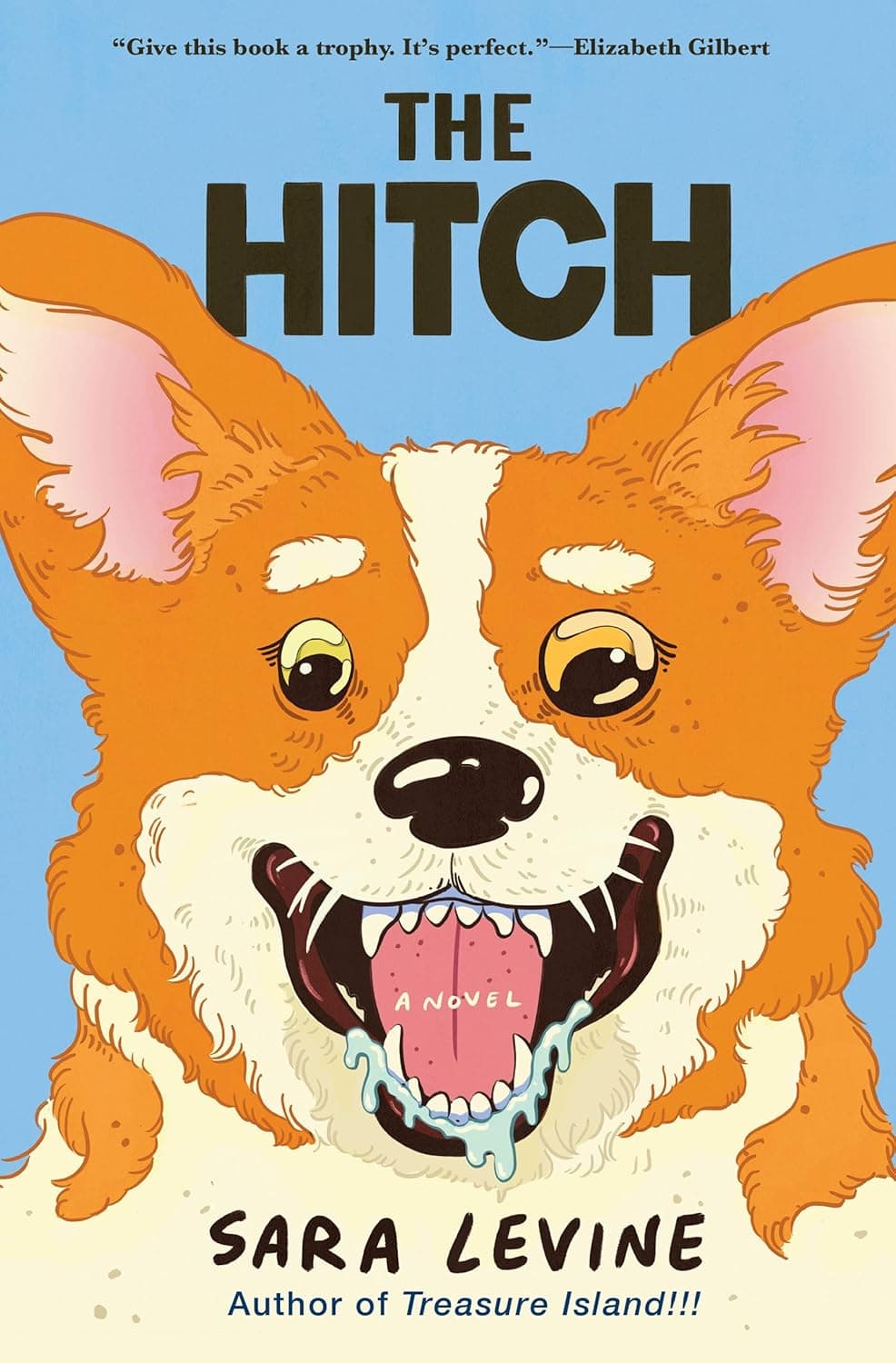
If ever there were a character who could benefit by reading Dale Carnegie’s How to Win Friends and Influence People—straight through, ASAP—it’s Rose Cutler, the dyspeptic protagonist of Sara Levine’s laugh-a-minute novel The Hitch. As the spiritual healer she eventually hires on behalf of her nephew observes, “You’re sincere but misguided” and also a “noodge.” The (mostly) well-intentioned but self-superior, grouchy, and now stridently vegan founder of an artisanal yogurt company called the Cultured Cow, Rose lives in the Chicago suburb of Evanston, where she dotes on her enormous and ill-behaved Newfoundland, Walter, as well as her six-year-old nephew, Nathan, who her brother and sister-in-law grudgingly permit her to see for two hours every Saturday. When they take an eight-day vacation to Cancun to repair their fraying marriage, they let Rose persuade them against their better judgment to leave Nathan with her. Right away, Walter snaps the neck of a hapless corgi named Hazel in the local dog park, causing Hazel’s soul to leap into Nathan’s body. Rose must spend the remaining days of her nephew’s stay grappling with how to execute the necessary exorcism, while badly managing a work crisis and examining her past relationships and questionable motivations.
The Hitch is a hoot, but it’s also an exploration of the ways people create prisons of their own making then lash out about the bars, blaming everyone but themselves for their unfortunate predicament. The comedy is nonstop, but the jokes are interspersed with real revelations and insights as to why people act the way they do and how maybe—maybe!—they can change.
Kathleen Rooney (Rail): Your debut novel Treasure Island!!! came out in 2011 and took you about ten years to write. How long did The Hitch take, and when and where did you find the spark of this story?
Sara Levine: “How long?” is a funny question for me, because I wrote a different novel between Treasure Island!!! and The Hitch. That book, called Leave It, is set in the same world as The Hitch and contains seven different points of view: Rose (the protagonist of The Hitch), a nine-year-old girl who lives next door, both her parents, Astrid, Victor, and Nathan. The book had multiple story arcs and the bleakest of endings. I didn’t want to publish it. I polished the heck out of it, but it didn’t seem like a book that needed to be read so much as a book I needed to have written.
Leave It took seven to eight years. Then I decided to center Rose and wrote a draft in which she’s recording a series of voice memos in her car, parked in front of Victor and Astrid’s house. That structure was a lot of fun, but caused more storytelling problems than it solved. So, I ditched the experiment and started writing this version in 2020, which I sold to Roxane Gay in 2024. So I could say it took me four years to write The Hitch, but that misrepresents the journey.
Rail: The concept—a corgi (or, technically, a corgi-chihuahua mix) imparting her soul into the body of a six-year-old human boy—is absurd and brilliant. How did you come up with it?
Levine: Hard to say. I know my first thought was that the corgi would haunt Rose, like Banquo’s ghost in Macbeth. (“Hence, horrible shadow!”) I wrote some scenes with the corgi hunkering under the sofa, but they didn’t satisfy. It felt like Harvey, that play about a drunk who becomes friends with a six-foot, invisible rabbit. Then I thought, “What if I put the corgi inside Nathan?” A possession plot gave me a set of conventions to work against, and I love toying with genre. Also the “inside dog” let me focus on Rose’s struggle to love Nathan for who he is, as opposed to who she wants him to be. I liked the corgi as a character, but she also served as a metaphor for the qualities one might like to banish in other people.
Rail: Rose’s Newfoundland, Walter, is poorly trained and kind of intimidating, even though as his owner, she cannot see these facts. “I loved him to the point of lunacy,” she explains. “Even when he peed on the rug and slung tangles of fur and drool on the wall, I didn’t think, My sister-in-law’s right, dogs are a lot of work, I should take him to the shelter. No, I thought, this dog is magic.” Why are many people nuts over dogs? Are you a dog nut? Why is it crucial to Rose as a character that she have this pet in her life?
Levine: I do love dogs. I asked my daughter—who keeps a digital photo album of every dog she’s ever petted on the street—if I’m a dog nut, and she said, “Not really. I mean, not as much as I am.” I guess dog nuttery is relative.
It was crucial Rose have a dog, because she’s chosen not to partner with a human. I think of Walter as her “other half.” He’s good for her. He keeps her from being a total neat freak, and, for a while, he’s less complicated than a person would be. Dogs don’t complain that you’re emotionally distant or hypercritical; they don’t accuse you of being a poor listener. Dogs never wait for weeks to tell you about their feelings. They’re straightforward.
Rose gets Walter a couple years after Nathan is born, which is no accident. It’s like she’s competing with her brother. “You had a baby? I’ll get a puppy.” Unconsciously she’s trying to reel Nathan in by offering him the world’s best toy—which makes her sound awful, when in fact I don’t discount the higher aspects. By getting a dog Rose is trying to love someone. Her relationship with Walter isn’t perfect. Part of the comedy—and tragedy— comes from what she can’t see about Walter. In the beginning, she “has” a dog in the same way she “has” mid-century ceramics. By the end, I think maybe she sees Walter and herself more clearly.
Rail: Also crucial to Rose’s self-concept is her identity as a vegan. Vegans can be notorious scolds, and Rose certainly is one, which is hilarious unto itself, but also a great way to build her unreliability and toxicity. How did you decide to give her this trait, and did you always know you’d intersperse vegan recipes throughout the story? Are you a vegan?
Levine: I’m vegan at home, but vegetarian in the world. But the first time I ate vegan, I immediately felt so much better that I wanted to shout about it. So it’s my own impulse to evangelize that I’m skewering there. And I do think it’s hilarious how once you give up something you can totally lose perspective. Like, “Are these sweet-potato-and-applesauce brownies delicious, or have my husband and I just eaten so many bad vegan brownies we can’t tell they taste like sand?”
I wanted Rose to have a midlife crisis. That’s why she’s an artisanal yogurt entrepreneur who has suddenly turned vegan. All her ties are to the dairy industry. Will she have the courage to get out and start over? But the recipes came into the book relatively late. I had her weekly meal plan, and I wanted a more direct way for her to talk to the reader. So it occurred to me she might include her recipes. Because she’s got that zeal. She’s the type of person who presses articles on people and never seems to ask herself, “Did this person even express an interest?”
Rail: My spouse and fellow writer Martin Seay and I are in a book club, and whenever it’s our turn to host, we theme our food accordingly. Your book is a treasure chest of potential themed food: my favorites are the White Bean Tomato Soup and the Tofu Chocolate Cream Pie, but I also like that somebody hosting a meeting for your book could just as easily order a bunch of McDonald’s and still be thematically attuned. What are your favorite recipes from the book, and why?
Levine: I hope someone does a McDonald’s-themed book club and joins Rose in sacralizing the French fries. That would be great. Also I recently made an Instagram video about that chocolate pie, and I can attest it really does take less than ten minutes. But I favor the tomato soup, too. It pairs nicely with a crusty baguette and a green salad. I also like the lentil loaf Nathan is forced to take to lunch in a compostable bag. Rose discounts it, but it’s actually pretty good. (I based it on Gena Hamshaw’s recipe.)
Rail: Another way you have Rose express her exacting personality is through her attachment to what might be termed “good taste,” or the “best that money can buy.” She purchases a fancy Italian chess set for Nathan even though he clearly prefers plastic toys from Target, and hires “the Michelangelo of house painters” to paint his room in her house. She rants about the evils of capitalism at the same time as she tries to bring herself peace and get in the good graces of other people by way of pricey gifts and financial gestures. Why do you think some people get so caught up in material trappings, and why does Rose do so?
Levine: Well, Rose is an American, and America is, objectively, the most consumption-heavy culture in the world. So she’s part of that culture, and she’s made enough money that she can use it, often unconsciously, to manipulate others. Some of her consumption is motivated by aesthetics. She’s made herself a beautiful home which she thinks of as a sanctuary. Then she tries to make Nathan a sanctuary. He needs a place to crash, and she’s building a boy’s room out of a magazine. I think she’s unconsciously driven by a need to do-over her own childhood. I’ve seen this with myself as well as other parents. You want to give your kid what you didn’t have, but your kid is not a mini-you.
She’s also a spirited collector. She knows a bit about art history, and it seems like a legit hobby—she’s particularly invested in mid-century ceramics. But then you see her on eBay, numbing out when she could be spending time with Nathan, and you learn she got thrown off “the mid-century pottery and glass forum” for making inappropriate remarks. So collecting might seem like a way of avoiding people. She definitely takes refuge in the safety of objects. Her superiority complex complicates the notion of her “good taste.” She knows a good piece of furniture when she sees it, but she loves to use that knowledge against other people—particularly her sister-in-law.
Rail: The book is, by necessity, claustrophobically hemmed in by the perceptions of Rose, but your other characters are fascinating, too. I especially like her gay best friend, the scuba shop owner Omar. Rose says “Omar is ten years younger than I am and thinks every difficult experience is a trauma.” This is a moment of devastating critique of what might in some circles be termed a victim mentality or a snowflake mindset, but so too is it a critique of Rose’s blanket dismissal of the existence of trauma. How did you decide what to send up and what to give legitimacy in terms of your characters’ attitudes?
Levine: I think a novel is interesting if it allows space for multiple points of view. This may seem surprising since I’m doing first person singular, claustrophobic. But I try to dramatize the conflicts. The question of how much trauma shapes identity quietly hums through The Hitch. I don’t think it’s the novel’s big question, but it’s there, partly because Rose is our filter, and Rose has no desire to dwell on the past or on her suffering. When my editor (the highly astute Roxane Gay) read the novel, she asked, “Are we going to find out what happened to Rose?” So I went looking for an opportunity to state more clearly what happened. I ended up adding a bit more about the family background (cold and joyless parents), but my answer was essentially, “No, we’re not going to find out explicitly.” Because the fact is, Rose doesn’t know what happened to her. Until she gets to therapy, she probably won’t ever know.
Anyway I’m glad you liked Omar. As you said, Omar is gay. He’s younger, mixed race and estranged from his own mother. For lots of reasons, he’s more attentive to human suffering in all its gradations. Which is not to say he’s right about trauma, only that the novel needs him because he reads Rose differently than she reads herself. Omar would say, “Rose lost her parents early, took on the role of raising Victor, refuses to grieve. She coped with life by focusing on what needs to be done immediately and trying to do it well. But are those coping mechanisms still serving her?” And Rose would say—well, you can imagine!
Rail: At one point, Rose has the insight that, “The mind is a powerful instrument, capable of magnifying problems, masking solutions, casting dark shadows over the path through the forest!” It’s a delight to see Rose struggle and self-sabotage as she tries to find her path. What made you choose to create a protagonist who is self-righteous about other people and yet almost wholly unaware of her own shortcomings?
Levine: I find it fascinating that well-intentioned people, in order to feel good, often need to make somebody else wrong. In theory, we all like the idea of people having different ideas. But in practice, it’s easy to tilt into self-righteousness when others—those idiots!—disagree. That’s one reason I created a protagonist who’s self-righteous. Blind spots are funny, and I think we all have them.
Another reason is that I’ve spent a lifetime wondering, when is zeal good? How do you know when you’re showing an appropriate amount of passion for a cause, and when you’re just being an asshole?
Rail: Rose is clearly a difficult person (she learns from her nephew that her brother and sister-in-law refer to her as Aunt Rant). But you get us—or me, at least—to root and feel sympathy for her. How did you strike this balance?
Levine: I think of Rose as someone who’s deeply out of touch with the tumult inside of her. She’s unaware of how she marshals her opinions to avoid tuning into her own inner world. It’s easier to feel angry or self-righteous than vulnerable or sad, so she rails at Victor about the history of pancakes rather than admit she feels abandoned. I’m glad you felt sympathy for her. She’s an extreme case, but does anyone have absolute mastery of their inner world? Obviously, if you were to meet Rose in real life, you might run. But you aren’t meeting her in real life; you’re meeting her on the page. Her energy is controlled and given shape. There are jokes. I hope the pacing and energy of the plot pull the readers along. I also assume readers don’t need to be spoon-fed and can enjoy detecting the emotional confusion that lurks beneath the narrator’s well-groomed surface.
Rail: This book is extremely funny—laughs on every page. But it’s also illuminating about human nature and the need for connection and the sense of belonging. One of the most moving moments for me came when Rose asked herself, “When was the last time I felt something as fragile and filamentary as hope?” Why did you want to create such a hopeless narrator?
Levine: Every culture needs stories that uplift and remind us of our best human qualities. But we also need stories that acknowledge the dark or shadowy side. When you feel hopeless, it’s easy to feel alone. Everyone else appears to be basking in the sun.
Rose has been down a long time. And she’s made a bad habit of being outraged. It’s dismaying how outrage seems to drive so many conversations right now. Not just online. It’s pretty easy to go out to dinner with friends and find “community” by blasting whatever upsetting thing has been going on. But that doesn’t feel to me like deep connection. It’s us against them—and can leave you feeling empty.
When I was writing The Hitch, I was thinking about how Rose’s superiority complex feeds her sense of separateness. Her win/lose attitude, her focus on success in the outer world, her need to always win the argument—maybe these qualities helped her when she was young and trying to establish herself. But now they’re more of a hindrance. She doesn’t need to fight for her survival. She needs to eat, as Mary Munn would say, a Happy Meal.
Rail: Another chilling moment is when Rose observes:
You don’t realize how small your life has become until something wreaks havoc, until the pin is removed on which the threads of reality hang. I had friends besides Omar, but suddenly they seemed more like friend-proxies: people I socialized with in the dairy industry, acquaintances with whom I occasionally had coffee or lunch.
Rose’s loneliness seems in some ways exceptional, but in others pretty common. How do so many people get so lonely and how can they get less so?
Levine: Robert Putnam wrote a book in 2000 called Bowling Alone in which he argued Americans had lost trust in our institutions. We weren’t getting out there and joining things. We were becoming a nation of loners. In 2023 the (former) Surgeon General Dr. Vivek Murthy declared loneliness an epidemic. We’re politically polarized; we’re still reeling from the pandemic; people are addicted to social media. None of this is news. I’ll tell you what has been my experience as a teacher. I teach three-hour seminars at the Art Institute of Chicago. My graduate students, on the class break, pick up their phones rather than turn and talk to the person next to them. They didn’t used to do that. Post-pandemic, undergrads ask if they can do advising appointments by email, because they’re too anxious to meet me in person. It seems like people are losing their social skills, assuming they ever had them.
That said, I recently went to a winter solstice party and was very moved to see a key rack in the hosts’ kitchen—they had maybe eight sets of house keys, belonging to friends. The invitation to the party began, “Gorgeous people: Let’s have some fire, soup, and fellowship to kick off the longest night!” They invited guests to “bring something meaningful to burn” and built a bonfire on the beach. I won’t divulge what people burned, but it was beautiful. Then we all went back to their place to eat and drink. I felt about two hundred percent happier after attending that party. But now I’ve got to figure out the rest of the year!
It’s a hard thing to navigate if, like me, you’re an introvert and a writer. I thrive on solitude but I know I need connection. I think everyone needs community, but you have to be creative about how you get it. You can’t expect one group of people to fulfill all your needs. But you need to connect to other people, and you probably need to play a useful role in somebody’s life besides your own.
Rail: Hazel the corgi quotes Shakespeare all the time—how come?
Levine: Because Shakespeare is amazing and his body of work belongs to the world, but some people exploit him as cultural capital. For example, when Rose watches her puppy play with Nathan, she throws out an allusion to The Winter’s Tale. I see that beat as a flex. She’s quoting the play to exclude Astrid; she knows her sister-in-law doesn’t know the play. Then Hazel comes along, this corgi spirit who is a trickster figure. She loves messing with Rose and teasing her with Shakespeare. She uses Shakespeare to signal that she is there; Nathan doesn’t know a line. But Rose misses the randomness of Hazel’s quotations. She thinks she’s in a revenge tragedy and is going to be punished. She hears a bit of Macbeth and imagines the ghost is out to get her.
Rail: Same question on the knock-knock jokes—why does Hazel ask so many and how did you come up with them? My favorite is the one that goes “‘Knock knock.’ ‘Who’s there?’ ‘Toucan.’ ‘Toucan who?’ ‘Toucan share one body!’”
Levine: I’m glad the knock-knock jokes passed muster. I’m not a natural at those. I stole what I could and invented the rest. Hazel asks knock-knock jokes because she tunes into Nathan’s taste. Unlike Rose who wants Nathan to grow up fast and embrace her taste. (Hence, the Mahler invitation: “Pick a number, any number.”) I wanted to contrast Rose’s hierarchical worldview with that of the corgi who’s enlightened enough to enjoy everything. Rose calls knock-knock jokes “the cheapest form of wit,” which is pretty harsh. But the other reason Hazel asks so many knock knock jokes is because the book is about boundaries. Rose has terrible boundaries. She enters without knocking, so to speak. And Hazel is playfully trying to teach her to knock first.
Rail: Did you have to spend a lot of time on occult message boards and websites researching soul possession or were you already well-versed? Did you find anything in your research that was especially weird and great but that you were not able to use?
Levine: Yes, I owe a debt to subreddits and anyone who spoke online, sincerely, about being possessed by demons or about being gifted enough to remove them. I didn’t know anything about soul possession when I started the novel. I bought a bunch of books which I read on the Metra in brown paper wrappers. Especially useful were William J. Baldwin’s Healing Lost Souls: Releasing Unwanted Spirits from Your Energy Body, and Edith Fiore’s The Unquiet Dead: A Psychologist Treats Spirit Possession. I didn’t find anyone, anywhere, claiming to be possessed by an animal spirit. But I read several useful books by Penelope Smith who is a “pioneer in the field of interspecies telepathic communication.” Smith talks to animals, whether they are alive or dead, and I wish I could have used more of her stories. Initially Rose consulted an animal psychic, trying to get a better read on Walter’s feelings about having killed a corgi. But I ended up cutting the scene.
Rail: Rose is an Olympic athlete of judgmental behavior and self-satisfied scolding. At one point, a friend casually uses the phrase “mother lode” and Rose thinks (but uncharacteristically refrains from saying out loud) that “Not everyone’s mother is a rich gold vein, let alone a source of desirable qualities.” At another point, she wonders, “Who even wears earmuffs anymore?” The range of her complaints is precise and ridiculous—how did you select which peeves she would have and are any of them yours?
Levine: Story rules. How does the peeve serve the story? I had a bit about the Queen of England and how she poured gravy into her corgis’ bowls and gave them awful names like Dookie, Honey, and Sugar. I did, for me, a considerable bit of research so Rose could rant about the royal corgis and make it seem like being anti-corgi was being pro-democracy. But in the end, the story didn’t need that rant.
Some of the peeves are mine, some of them belong to people I love, some of them are entirely fictional. I’ll only say this: I have no beef with earmuffs.
Rail: You have Rose reflect that Albert Einstein said “the most important decision you make is whether you believe we live in a friendly or a hostile universe.” I like how we see Rose’s answer to this question evolve. What kind of universe do you believe in?
Levine: I believe in a friendly universe. But I didn’t consider the possibility until I was well past forty.
Rail: What books did you read as inspiration for this one?
Horacio Castellanos Moya’s The She-Devil in the Mirror and Barbara Pym’s The Sweet Dove Died. Specifically for the exorcist plot, William Peter Blatty’s The Exorcist, Ira Levin’s Rosemary’s Baby, Sara Gran’s Come Closer and Paul Tremblay’s Head Full of Ghosts. Hilary Mantel’s Beyond Black was in the back of my mind, and John Wyndham’s Chocky was in the front. Vladimir Nabokov and Jane Austen are my literary parents, though I don’t know if anyone would see a family resemblance.
Rail: And what books have you read recently that you highly recommend?
Levine: All of Lucy Prebble’s plays, Alan Hollinghurst’s Our Evenings, Karel Capek’s War with the Newts, Dana A. Williams’s Toni at Random, and Robert Liddell’s Elizabeth and Ivy.
Rail: What’s next?
Levine: I’m working on a novel that is behaving like the lovechild of P.G. Wodehouse and Mary McCarthy’s The Group. Please wish me luck!
Kathleen Rooney is a founding editor of Rose Metal Press, and a founding member of Poems While You Wait. Her latest novel, From Dust to Stardust, was published by Lake Union Press in September of 2023.