BooksMarch 2026In Conversation
LIAM CAGNEY with Tadhg Hoey
Word count: 4389
Paragraphs: 53
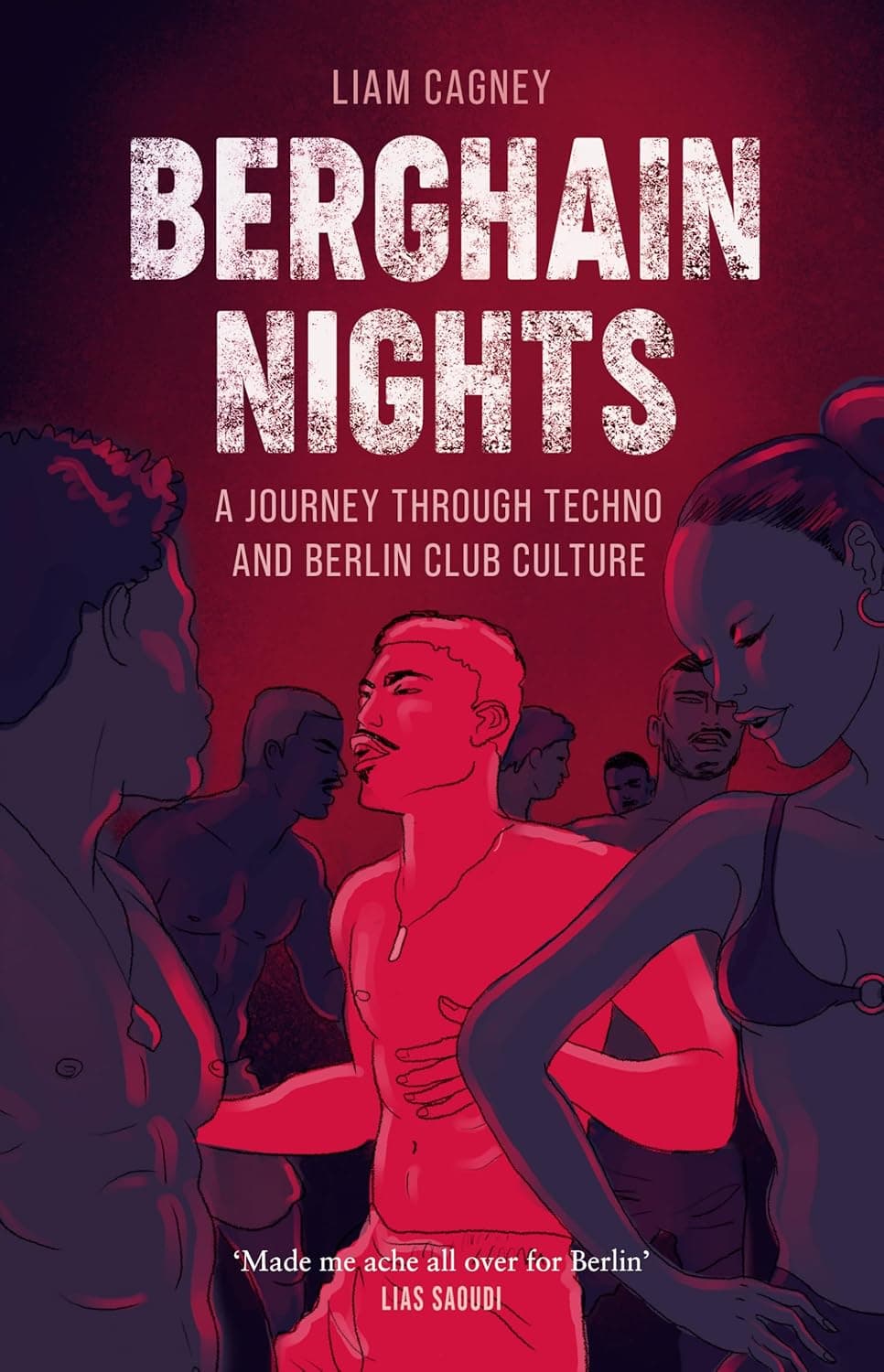
Berghain Nights
Reaktion, 2025
Berghain Nights, Liam Cagney’s personal account of his love affair with Berlin and the techno that fuels the clubs with which the city is synonymous, feels like an answer to a question he’s been asking himself all his life. Part memoir, part cultural anthropology, part genealogy of techno—it can also be read as a manifesto for a new way of living, or, at the very least, as Cagney’s attempt to understand what drew him towards the life he has embraced.
Cagney, who completed his PhD in spectral music, is an expert in early French spectral music. In Berghain Nights, he brings much of that same curiosity and intellectual rigor to examining the evolution of techno. I caught up with him recently and we had a long, interesting chat about the important role clubs and dancefloors can play in breaking down and rebuilding our identities and conceptions of others, how Berlin has been changed by the pandemic, as well as his disillusionment with how Berlin’s progressive, purportedly inclusive club scene failed to respond to Gaza.
Tadhg Hoey (Rail): Your book is very formally promiscuous. It’s memoir, it’s cultural anthropology, theory, interviews. There are novelistic accounts of nights out. Did you have a model for it? Were there works that gave you inspiration as you were writing?
Liam Cagney: Writers like Doireann Ní Ghríofa, Mark O’Connell, Kevin Breathnach. The Irish essayists, autofictionists, people using life-writing and ideas and fusing them together. That was a model. I’ve been thinking about why there’s been so much recent Irish autofiction. I think it’s the latest iteration of modernism. Modernism means dissatisfaction with established literary conventions, stripping things away. That’s similar to how I ended up writing a clubbing autofiction, by not wanting to jump over the hurdles of novel form. By wanting to write a narrative free of any creaky literary conventions.
I’m trained as a musicologist, so my approach would have theory threaded in. I had this realisation early on after chatting to someone who works in publishing. When I said to her maybe it would be better if I got rid of the theory stuff, in case it scared casual readers away, she replied—correctly—no, that’s what you need to keep in the book. Because if someone wants to read journalistic prose about Berghain or techno, you can Google it and you’ll get hundreds of articles. What gives your book added value, she said, is the fact that you’re putting ideas in there, which was right.
I liked Maggie Nelson’s The Argonauts (2015) around that time along with everybody else. I love how hard it goes immediately. That opening scene—it’s just such setting out your stall, mixing graphic sex and theory altogether, this idea of auto theory. And, actually, the last book to mention is Yoga For People Who Can’t Be Bothered To Do It (2003) by Geoff Dyer.
Rail: I think it’s my favourite Geoff Dyer book.
Cagney: Such a pleasure to read. He also has a funny Harper’s Magazine essay “Dead Ball Situation,” in which he takes the pretensions of academic writing to task. I related to that as a refugee from academia. The things that feel unique about Berghain Nights or distinct—that mixture, as you mentioned, of memoir, hallucinatory stuff, cultural anthropology, musicology—that was a scary prospect when I was trying then to sell the book, and I was grateful that Reaktion Books totally got it.
Sometimes I think we don’t actually have a core identity in Ireland. We’re fed Guinness and grey skies and Italia ’90 and all that. But that seems like a collective hallucination. The absence of identity—a void coming out of colonization—puts you in a good spot as a writer. You’re writing in that void. It’s inspiring for me to see Irish writers who are taking liberties with the form.
Rail: Your book is firmly among them now. Interesting you mentioned Kevin Breathnach. His book Tunnel Vision (2019) is really good. In parts, yours also reminds me of parts of Rob Doyle’s book Threshold (2020), and even Tim MacGabhann’s new book, The Black Pool (2025).
Cagney: Tim’s book is my favourite new book I read this year.
Rail: It’s such a good book. I loved it. It’s hard to categorize any of those books we just mentioned there, and I think yours is hard to categorize as well. One thing I thought was exceptional about your book is how well you write about the actual music. Many people capture what it’s like in the club, but you do justice to the DJs, the producers, the people creating the texture of a night out. How did interviewing the DJs and artists enrich your understanding of the scene? I learned so many interesting details from your interviews with people like Rrose or Luke Slater, and particularly about pre-unification. The people you spoke to bring so much historical perspective to how the scene evolved over time.
Cagney: There’s entertaining writing about Berghain and clubs in Berlin out there, but one thing that often struck me was that the writer would usually not mention who the DJ was or what the music was like. So coming from a music background I wanted to do it differently. I did a bunch of interviews that served different ends. There were ‘name’ artists like Eris Drew and Ellen Allien and Function who I asked about clubbing as an experience and techno as an artform. They all gave insights. Drew spoke about removing the club experience from categories that have been programmed into us from the culture industry, good or bad, and all that. Then there were older-school Berlin club figures like Disko, DJ Aroma and Stefan Schwanke, who filled me in on the nineties Berlin club scene. And then, there were some men who helped me understand the background to Berghain in the gay BDSM club SNAX, people like Adrian, Heiko, and Frank who’d been guests at those parties, and the artist Viron Vert, who did wonderful artwork for Berghain and used to work as a bouncer there and at the Lab.Oratory. When I asked Vert about the original club Ostgut and what had made it so good, he replied that a lot of it was down to the owners being such good hosts. I thought that was interesting, framing parties in terms of hospitality. Hospitality being an old concept, culturally.
My previous book was a history of early French spectral music. My position with spectral music was the same as with techno: you can’t fabricate an accurate theory until you’ve established a historical basis of what exactly happened. I did that with spectral music, and then there was a hangover of that method when I threw myself into Berghain Nights. I wanted to meet people who had been there on the ground to know a bit about the background of Berghain. That’s difficult, because there’s an omertà [silence] with regard to the inner workings of the organization, which I respect. There are things that I learned about the owners that I didn’t put in.
Rail: Out of respect, as you say.
Cagney: If they’ve taken such pains to be private about themselves, you have to respect that. Another thing I found is that, in relation to Berghain, everybody’s got a different story. You hear an anecdote and you’re like, wow, that’s really interesting. Then you’ll ask somebody else about it and they’ll say, no, that’s not true. It’s hard to know what to believe. Take everything with a grain of salt.
Rail: On the subject of conflicting narratives, you really complicated the narrative I’d come to understand about how dance music evolved. I knew about the cross-pollination between the Detroit, Chicago, New York axis with Germany, but I hadn’t really known just how important British synth-pop and electronica was to that as well. It makes complete sense with Gary Numan, the Human League, Depeche Mode, Throbbing Gristle, etc., but it’s really interesting to see where people were getting inspiration from.
Cagney: There was lots of cross-pollination going on. Gary Numan, the Human League, and Ultravox influenced Cybotron. Derrick May used to play a remix of Depeche Mode’s “Get The Balance Right.” It was all in the pot, these different influences: Italo, industrial, Chicago house, Parliament-Funkadelic, all of that. My second chapter, where I trace the history of the term techno back to the mid-seventies, might rub some people up the wrong way. They might object to it on moral terms because it’s a bit different from the story that’s usually told. I’m not saying of course that Detroit techno is not the main source of club techno, because it is, but that it’s more accurate to consider Detroit as the main node on a complex global network.
Rail: I found it fascinating. I started to hear the links between sounds that I had, for whatever reason, categorized separately or just had some made arbitrary distinction between the sounds like, oh, this is more related to punk or this is actually a more of a hip-hop–electro sound. Your book ties those threads together. I was reading an interview with KRS-One a while ago and he mentioned hearing a Gary Numan song for the first time—I think it was “Are ‘Friends’ Electric?”—when he was growing up in the Bronx and he said he remembers someone playing that on a boombox and it blew his mind. It’s very interesting to see the influence these sounds go on to have, and how people interpret these sounds. Your book mentions that Juan Atkins says that while these English musicians were making all of this, people like him in Detroit were kind of reclaiming the sounds and making them strange.
Cagney: Kodwo Eshun’s book More Brilliant than the Sun (1998) is good on that. He was already saying a lot of this in a beautiful style quite a while back. Perhaps these Detroit artists were making themselves into synthetic American aliens by doing what George Clinton was talking about in that mid- to late-seventies, Parliament-Funkadelic stuff: decoding, recoding, scrambling codes of what was supposed to be Black music and what was supposed to be white music. As a strategy, you can see it in early Detroit techno. Rik Davis of Cybotron uses the moniker “3070” and affects an English accent.
It struck me that more recent histories of techno, for reasons that are understandable enough, lean more towards cultural nationalism. We’re familiar with that historically in Ireland, when we learned about late-nineteenth-century cultural nationalism, male heroism, and romanticism. I think reducing techno to Black nationalism only gets you so far, because techno was also always about looking forward, about scrambling codes, about networks and decentralized thought and moving beyond identities. To some extent, I felt like if there were to be a history of techno it should be a history that’s written in keeping with those principles. Rather than a history that’s written as if techno were a branch of nineteenth-century romanticism.
Rail: Beautifully put. I think your book will be an important part of that conversation, and it’s both complicated it, and made it legible in an interesting way.
Cagney: I felt like, having committed to the project, I had to put everything in there. There’s an old memoir-writing chestnut that says you should write as if you were a hundred years in the future. As if everyone you know is dead. Meaning you’re liberated to write openly. Taking a hundred-year view had the result of making my nonbinary-self emerge more empathically towards the end of the book. Being nonbinary for me means experiencing life simultaneously inside and outside of identity. Like what Legacy Russell talks about in Glitch Feminism when she mentions “the right to be blurry, unfixed, abstract.” This linked the queer aspect of club space to the futurism of techno as I experienced it. José Esteban Muñoz’s book Cruising Utopia (2009) says “queer” is something that’s ahead of us. Tavia Nyong’o’s Afro-Fabulations (2018) likewise talks about queer Black club identities as showing a people to come. If people read my book and it stimulates them to think about these things in some way, I’ll be satisfied. I came to realize that there was no word for whatever I was. When I said this to someone, they replied that that’s why there’s a plus at the end of LGBTQ+.
Rail: You quote someone who talks about how capitalism loves identities so that it can better categorize and market everything more efficiently, and also how dance floors and the scene around them can be a very interesting way to push back against this kind of idea of productivity, of marketing to clearly defined identities. Essentially, it’s a unique space in that people get to try out new identities and, in a sense, is resistant to some of those market forces that we have to contend with during most of our nine-to-five lives.
Cagney: It’s from Jenny Edkins, that quote:
Pinned down like a specimen insect . . . the person is immobilised and made present, available to the gaze of a bureaucracy, an administration . . . It does not allow for the being as such, human or not, a being never fully present, displaced, always arriving too late or too early, escaping categorization, unknowable – a being who is always missing, never fully grasped even by themselves.
Identity categories are useful for organizing, for empowering people into groups. When you claim a name for yourself, it’s not just about giving yourself an identity, it’s giving yourself a community. So, a gay cis male does not just have that identity, they’re also assuming that community. That’s the power of identities, politically. But, eventually, it can reach a limit. As Emma Dabiri points out, to affect some kinds of deeper societal change, it’s necessary to reach across identity categories at that limit—that’s the next step. Because identity categories can inhibit you, and, as you say, capitalism loves diversity because diversity means more markets.
As opposed to club space, I’m interested in the idea of club environments. In an environment things are holistic. They’re dependent on each other and upon the environment in order to generate them. For me, the club is a kind of counter-environment, because you pass into it and then you respond to that environment. You enter into becoming with things around you, with the darkness, with the queer selves, and that can affect a liberation. There’s an academic article by Johan Andersson about Berghain as a space of disorientation, where he calls Berghain an anti-gay conversion therapy machine. Two of my interviewees had that kind of experience, the artist Sophie Ruston being one. I relate it to what Detroit techno said about deprogramming.
Rail: When I interviewed Kneecap in 2024 we spoke about Dancing on Narrow Ground (1995), this amazing documentary made about how raves and ecstasy helped a generation of people across the North get along with each other, weekend after weekend. These were groups of people who, and they say it themselves, hated (or were afraid of) each other Monday to Friday. Which is not to say that was their fault—they were brought up in a society where sectarian hatred was so normalized. And then suddenly, each weekend, hundreds, if not thousands, from each side went to parties, got high and suddenly saw those differences as meaningless. It seems to me that dance music really often brings together big cross sections of a population—many of whom have little in common with one another, and who may even be politically opposed. I think dance music had such a bad reputation in Ireland in the nineties, like it was exclusively for antisocial people who wore tracksuits and took drugs, but then you watch a documentary like that and it’s a pretty incredible example of it clearly being so much more.
Even in your book, you show that there were some different, very different, kinds of politics in early German electronic music. There’s a feeling that dance music can be a sort of big tent, even progressive, in a way, and I think that’s something that a lot of people miss when they think about it—though, I completely understand why people might miss it. I’d like to hear what you think about why dance music endures as a type of music that unites people—beyond, you know, drugs. And I’m wondering what you think about all this in conjunction with what you said about the spaces and how they make people feel and the relationship to drugs and how those experiences translate to the outside club environment.
Cagney: I wanted to contribute towards changing the narrative around what the club experience is. Because it isn’t just about hedonism and it’s not just about mindless thumping beats. It’s about self-expression. It’s about community building, it’s about innovation, and optimism. We’ve gotten so habituated in this neoliberal phase of pessimism around our future. There was a lot to be said about the kind of blue-sky thinking of the rave movement when it hit Ireland in the nineties. Kelly’s in Portrush was a bridging place for communities during The Troubles. Kelly’s was rave in the countryside in Ireland, rave and entrepreneurship. I see rave in Ireland as of a moment with World Cup ’94 and Sinead O'Connor and Jack Charlton and our coming out of the long economic slump. A more optimistic era.
You mentioned liberation in terms of freeing people up from conflict, breaking down boundaries—that was really the case in post-’89 Berlin. They say it was on the dance floor that reunification first happened, culturally, because on the dance floor you couldn’t hear somebody’s accent: you didn’t know whether they were from West or East. It didn’t matter. I like that a lot about the dance floor, that it’s a nonverbal, non-semantic space. It frees you up from semantics, which means identity and representational thinking, and it can free you up from yourself as well.
The one thing I was told about how you could distinguish back then between someone from East Berlin and someone from West Berlin, a former club owner who I asked told me, just look at the person’s shoes. If they were from East Berlin, they had good sturdy footwear. If they were from West Berlin, they’d be wearing a pair of shitty trainers.
Rail: So, West Berliners were wearing something fashionable, but East Berliners had the built to last gear?
Cagney: Yeah. I still buy clothes in Army surplus stores here in Berlin because they last. Even the t-shirts last way longer than fast fashion.
Rail: I wanted to ask you about the response the electronic music community, the clubs, and even Germany has had to what’s going on in Gaza. I was talking earlier about how dance music is often kind of a big tent politically and for a variety of reasons often brings communities together. What I know of the scenes in cities like New York and Berlin, there’s often a leftwing, inclusive ethos to a lot of the parties. How has it been witnessing a community like this ignoring, or, to put it as generously as possible, staying totally silent about what’s going on.
Cagney: That’s the thing I come back to, the silence. That’s been one of the most difficult things for someone living in Berlin during the genocide. People who I know and love and have partied around, people who present as queer, people who present as alternative, people with tattoos, people with piercings, liberal white Germans, people who march for Black Lives Matter, people who have modular synths, people who take drugs, people who go to Berghain—seeing them say nothing about the Gaza genocide whatsoever. Being around them and experiencing their silence left me disillusioned. Never more so than a year and a half into the genocide, during the weekend of the Internationalist Queer Pride (IQP) parade.
In Berlin there’s a main pride parade, which is the mainstream one and it’s got big corporate floats and all the rest. Then there’s a counter demonstration and it’s grassroots queers—queers of color, anti-colonial queers. It’s the people who make the club scene happen, the people who threw the first brick at Stonewall. Pride weekend was the last weekend of July and I was going to Berghain that weekend to see a friend play. The motto on the Berghain wristband that weekend was “Never be silent again!”—“Nie weider stille!” Which was the motto of the corporate pride parade. And already seeing that, never be silent again, coming from Berghain during the genocide, about which it hadn’t said a word, rubbed me up the wrong way. But at the International Queer Pride parade, the police went in and beat people up in the parade in the most brutal way—police brutality against queers. When I was at Berghain the day after that happened, and there was a wristband saying “never be silent again,” and meanwhile Berghain is being totally silent about it. My friend’s group Decius was amazing. One for the books, as they say. But apart from that, all I could feel was the silence. I felt like, what are we doing here? What are we really doing here? Distracting ourselves?
For my part, non-clubbing people would say, why are you still going there? Why don’t you boycott Berghain and other German cultural venues when the clampdown’s happening? When what happened to Oyoun was happening? When what happened to Jewish Voices for Peace was happening? I started going a lot less. When I did go, in some sense I felt like if I’m writing about it, witnessing it, I’m able to critically engage with it and critically write about it, maybe that’s of value.
Rail: I think so.
Cagney: I’ve come round to the idea that, instead of shouting at people online and just telling them they’re wrong, it’s better to try and have a conversation and be a bit lighter. I think that can be more effective because, I mean, everybody in Germany is brainwashed. Institutions of what Louis Althusser called the Ideological State Apparatuses, from kindergarten onwards, media and TV, are brainwashing people to the State narrative. To get them out of that, conversation can be more effective than shouting.
Rail: It’s bad here in America, but I’ve been shocked by the scenes I’ve seen from Germany and just the violence of the police towards protesters. I mean, I think everyone in Ireland probably saw that video of the Irish protester being punched. It was horrific. Not to diminish that in any way, but I’ve seen even more shocking things happen, too.
Cagney: It’s predominantly brown people who are getting beaten up and predominantly white people looking the other way. There was the video of the activist Kitty O’Brien, when she got two black eyes and she had her arm broken. I was having a discussion about that with a now ex-friend of mine, somebody who lives in Germany and who presents as very alternative. He said: I think the German police are doing an excellent job. So then you realize, okay, this is a racist person and I don’t want to be friends with them. And this is somebody who I was friendly with for years. There’s been a lot of that.
Rail: Oof. That seems like a gap that can’t be bridged.
Cagney: Yeah, you put it well, a gap that can’t be bridged. There are some people about whom you have to be optimistic that you might change their mind. But there are others with whom that gap can’t be bridged.
Rail: You mentioned it earlier on when you spoke about being on the twentieth floor of that building you lived in Plattenbau and asking yourself, how the fuck did I get here? In some sense the book is one long answer to that question. By the end of the book, you seem changed by your experience, and the timing of this coincides, roughly, with broader changes in Berlin relating to COVID-19, the housing crisis, and maybe even the music scene. I got a sense that you had come to a deeper understanding of your place in the scene.
Cagney: The end of the journey thing is a literary trope, obviously, but it was genuine. Things did change. On a personal level I came to own how I’m queer and I also realized I was autistic. And in a wider sense Berlin felt different. There were a lot of ways in which I felt Berlin was becoming like London. People at Berghain were talking to you about crypto. That’s gentrification.
In the book’s opening chapter, David, my old friend, had said to me that Berghain is a place that reflects you back to yourself. Because it’s this open space, it kind of makes you start to ask yourself questions about yourself. Going there repeatedly over years and recognizing why, partly because I was autistic, partly I wanted to be in queer spaces around queer people, combined then with reading and learning about techno’s history, did actually put me in a place, now, where I’ve got a different sense of myself and I’m confident enough to have that.
Sun Ra is the epigraph for the book. I find him inspiring. “It is important to liberate oneself from the obligation to be born, because this experience doesn’t help us at all,” he said. He often reminds me of Clarice Lispector. “I can scarcely believe that I have limits,” she writes, “that I am cut out and defined.” There’s a deeper truth there than any ethnographer could access, when they measure experience like a cartographer and then package it up in abstractions.
I now own the sense that I don’t belong regardless of which community it is, and I’m confident now and empowered in that, as a techno person. I don’t really feel like I am fully from this place or that I fit within whatever the narrative is that we’re all supposed to be living inside, whether it’s academic or social. I’m the surplus. I do come from nowhere, as a nonbinary person and generally. I had a change in my sense of self for sure. How well I articulated it—I think in some ways it’s unorthodox, but I hope people can cut the writer some slack.
Tadhg Hoey is a writer. Hoey's work has appeared in The Stinging Fly, Dublin Review of Books, BOMB, The Millions, Los Angeles Review of Books, and elsewhere.