ArtMarch 2026In Conversation
PAT OLESZKO with Dan Cameron
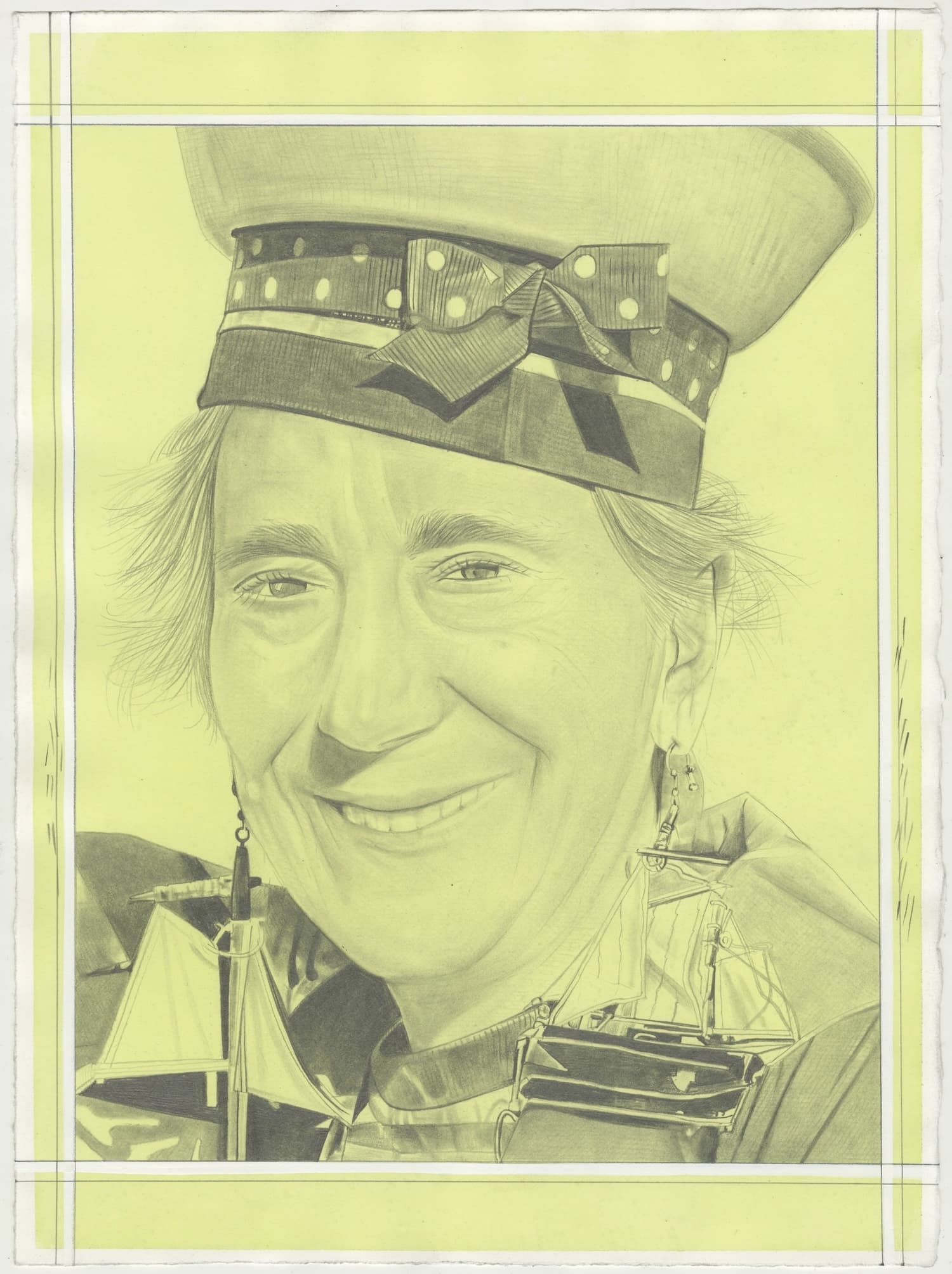
Portrait of Pat Oleszko, pencil on paper by Phong H. Bui.
Word count: 5332
Paragraphs: 102
SculptureCenter
January 29–April 27, 2026
Queens
Pat Oleszko was born on May 19, 1947. At the age of seven, she dreamed of “being a puppeteer, or maybe Ferdinand the Bull.” Those dreams came true: she has crafted puppets, elaborate costumes, props, larger-than-life inflatables, and more public spectacles than an archivist can count. For three years in a row, the artist was forcibly removed from the Macy’s Thanksgiving Day Parade, dressed as a large turkey—the third year, the cops escorted her all the way onto a subway car, and waited until it left the station to return to their posts. As she discussed with Rail Editor-at-Large Dan Cameron on the New Social Environment in early February, everybody has a thing, and hers is sculpture. Hers just happens “to walk and talk and fart and fuck.”

Installation view: Pat Oleszko: Fool Disclosure, SculptureCenter, New York, 2026. Artwork courtesy the artist and David Peter Francis, New York. Image courtesy SculptureCenter, New York. Photo: Charles Benton.
Dan Cameron (Rail): I am honored to be able to have this conversation with you Pat. You’re an artist whose work I’ve followed for my entire adult life. You were very much part of the alternative art press, including Art-Rite and Artforum and other magazines in the mid-seventies. When the announcement first came out for your exhibition in 2024 at David Peter Francis gallery in Chinatown, I remember thinking to myself, finally there’s a gallery presentation of your work as sculpture. Happily enough, you’ve just come off what sounds like an incredible opening at SculptureCenter.
Pat Oleszko: Thank you Dan. It’s my great pleasure to be featured in this esteemed institution of the Brooklyn Whale. I’m glad to be in its wake. [Laughter]
Rail: You’re from Detroit, but you studied in Ann Arbor at the University of Michigan when it felt like the center of the universe. There was Students for a Democratic Society and John Sinclair. There was the MC5, and the Stooges. There was Motown, even though it was a little further away, but it was happening and spilling over. You would have been getting your undergraduate degree when society was in full transformation, or at least it felt like it. Can you reflect on that period of your development?
Oleszko: I’m glad you mention it in such glowing terms, because I think that Ann Arbor really was the cultural center of the whole alternative movement of the sixties. Other campuses like Berkeley or Madison were more political, but in Ann Arbor there was a panoply of different arts going on. I’m thinking of the Ann Arbor Film Festival, which was the first underground film festival in the US. It was started two years before I got there by one of my mentors, George Manupelli. There was also Milton J. Cohen who made highly influential performances and unforgettable classes. They encouraged anybody; it wasn’t strictly about films. It was about any kind of expression of live art that could be done. It was done in the halls. It was done in the streets. It was done in the parking lots.
There was this constant stream of folks coming to visit, like Andy Warhol, Claes Oldenburg, Morton Feldman; Robert Rauschenberg performed a piece on top of the parking structure. It was so exciting. The art school was the center of this universe, and it was very crowded. There was so much going on that I never wanted to go home. [Laughter] I just thought, okay, I’m going to be here because it is, well, thrilling! My neighbors were the Weathermen, and one of the first Black studies programs in the country was taking shape. So even though I couldn’t afford to go out of state, I felt I got the best possible education in the classic sense and the Platonic sense.

Installation view: Pat Oleszko: Fool Disclosure, SculptureCenter, New York, 2026. Artwork courtesy the artist and David Peter Francis, New York. Image courtesy SculptureCenter, New York. Photo: Charles Benton.
Rail: Did you go directly from Ann Arbor to New York?
Oleszko: Yeah. I was doing performance from the first semester, but there was no word for it then. There was no study of it either. I thought if I was going to continue learning and developing my work, it would be done in the great metropolis. I figured, well, if I’m here long enough I’ll just wiggle my way onto the bench.
Rail: Was your thinking about your work performance driven? Because at a pretty early point, you started making on-camera works, where you were creating a costume or a situation specifically to be photographed in. Or do I have that mixed up?
Oleszko: No, that was part of it. I was doing stuff live, I was doing pieces for films. I was doing events in the streets and on the stage—I started on the stage at the Ann Arbor Film Festival. But I also won the amateur striptease contest in Toledo, Ohio and became Pat the Hippie Strippie, a name given to me by the Chief of Police.
I have used the idea of putting on clothes and taking them off seductively, or hypnotically, or absurdly since then. It was a truly wonderful experience that was given to me by Rose La Rose, the famous stripper who ran the Esquire Theater’s burlesque. I had my name on the marquee! There are photos of it at the SculptureCenter.
Rail: Wow. I am speechless.
Oleszko: Well, you should be.

Installation view: Pat Oleszko: Fool Disclosure, SculptureCenter, New York, 2026. Artwork courtesy the artist and David Peter Francis, New York. Image courtesy SculptureCenter, New York. Photo: Charles Benton.
Rail: In New York, I think performance art became associated with Franklin Furnace, PS 122, The Kitchen, and other places where you regularly performed. But when I think about this early generation of artists, I don’t think so much about the costuming of the figure as a sculptural statement. You can look at Robert Wilson, for example, and say the furniture he made was extraordinary on stage, and then you put it in the gallery, and it was still extraordinary. But when you’re making something that you wear or perform with, you don’t necessarily expect it to continue to be beautiful or meaningful after the performance is over, and it’s only there as an object. We do expect that from high fashion, but I think of what you’re doing in the art world as rather unique in that you’ve kind of created a strategy, you’ve created an approach that really belongs to you.
Oleszko: I can’t agree with you more.
Rail: Your show is happening at SculptureCenter, and you don’t have to be performing—everything works as sculpture. That’s something the art world is coming to terms with right now.
Oleszko: I think of myself as a sculptor who happens to be using my body as the armature and the vehicle for the ideas. But in reference to other folks who were in the performance business, I mean it was so new and different that everybody was rather singular. There weren’t that many of us, and we were all exploring and doing different stuff. Everybody had one kind of thing that they were known for, like Laurie Anderson was music, Eric Bogosian had his verbal loquacity, and mine was sculpture. It just happened to walk and talk and fart and fuck, but it has always been a fact that I had to have strong visuals. My ideas are first and primarily visual, and I activate them through my words, through movement, and through situation.
Rail: I love that you do not shy away from humor. You embrace humor. There’s a lot of word play going on.
Oleszko: Well, it helps to be a linguistic chameleon when you’re dealing with the idea of absurdity in daily life. I don’t see that much difference between what the word play is as compared to what the costumes on the body are. I mean, words are like ready-made clothes. You alter them by juxtapositions and interiors and that’s basically the same thing I’m doing with the sculptures that I’m wearing. And so the language can be absurd and obfuscating and challenging and fun.

Installation view: Pat Oleszko: Fool Disclosure, SculptureCenter, New York, 2026. Artwork courtesy the artist and David Peter Francis, New York. Image courtesy SculptureCenter, New York. Photo: Charles Benton.
Rail: Let’s talk about some specific works, like Libertease A Broad (1976). What’s the story here?
Oleszko: Okay, that piece has a long and beautiful, histrionic past, but it was originally done for a Fourth of July parade in Bristol, Rhode Island. I rode the rolling Liberty Island on two-foot tall shoes emulating the stone base, which was pulled by an old boyfriend in my tugboat, Tug-a-Luggin’ (1975). I was plied with beers by the participants in the parade and getting drunk; I eventually fell off my stand and was then pushed up the hill by the local Portuguese fishermen, dismayed to see Liberty splayed on the street. It’s become a signature piece, and it’s gone in many different places, in many different directions. In the crown, there are all these little tourists looking out onto the world.
Rail: Is it included in the SculptureCenter show?
Oleszko: No, it’s not because in these challenging times, she will be more necessary in the protests. Very early, I was entranced with the kind of caricature of women that was going on in the cities, women in their ordinary dress. So I created the “The New Yuck Women.” One was DAR (Daughter of American Revolution), another was the Women’s Libber, and there was the Playboy Bunny (all 1971), which has a glorious past getting kicked out of the Playboy Club back in the day, which—
Rail: When that meant something.
Oleszko: Yeah, those of you who are younger have no idea what it was like, but it was a private club. They had bunnies. Gloria Steinem actually, as a reporter, worked in the Playboy Club. And there was also the Model Model (1971). For her, I made platform shoes out of two-pound coffee tins, so I’m about seven and a half feet tall. These nine characters were hanging in the Museum of Contemporary Crafts, and I would go in every day and put on a different character and go about the city doing whatever that person would ordinarily do, kind of like a sociological experiment.
Rail: Was the Museum of Contemporary Crafts (now the Museum of Arts and Design) at Columbus Circle then?
Oleszko: No, no, it was right next door to MoMA.
Rail: Of course. Now I remember. Jumping ahead, what’s going on in The Push-off Xmess (2006)?
Oleszko: Okay, this was my giant inflated Christmas ball, which I made at the MacDowell Artist Colony, and did a performance there. It includes the sixteen-foot ball with me dressed as a Christmas tree. I thought I was going to just push the ball along the road, but it was in a huge meadow covered with three feet of snow, the wind caught it, and the performance became this rather slapstick rendition of me as the Christmas tree chasing after the runaway ornament in deep snow.
Rail: This was twenty years ago, but you began using the documentation of your performances as photography early on. I read somewhere that one of your teachers at Ann Arbor encouraged you to use photography for the performance as illustration. Do I have that right?
Oleszko: Yes, sort of. That was the idea for how I was going to make a living in New York. He said, “Well, you don’t want to be a hired freak at a party,” which has happened anyway, but never mind. He said, “So if you use the costumes in terms of illustration, then you can go to magazines and try to sell them the idea that you can use yourself photographed as a concept.” And back then in the early seventies, magazines were extraordinary, very experimental and wonderful vehicles for art. So I went to Esquire, and I went to Ms. Magazine. And I was in New York Magazine and Playboy and Penthouse and National Geographic and Sesame Street Magazine. It was a way to make a living off the work.

Installation view: Pat Oleszko: Fool Disclosure, SculptureCenter, New York, 2026. Artwork courtesy the artist and David Peter Francis, New York. Image courtesy SculptureCenter, New York. Photo: Charles Benton.
Rail: I can’t think of anyone else who was doing that at the time, although if you think about the world we’re living in today, it seems like a template for a contemporary influencer.
Oleszko: Yes, well, in addition to waitressing, it was a way to make money. Anyhow, somebody had to be first, so it might as well have been me—she said immodestly. [Laughter]
Rail: The Coat of Arms from 1972 and The Handmaiden from 1975 are among your best known pieces, and they’ve been shown many times over the years.
Oleszko: The Coat of Arms was originally made for a party that was celebrating the anniversary of the Surrealist Manifesto. And, you know, some of my best ideas were developed at parties. I think that’s the M.O. for a lot of artists, particularly when they’re in art school. I did the piece to wear to that party, and then it became a theme that I continued throughout a lot of other works. The Handmaiden is a piece that I stripped out of. With the male version, The Coat of Arms, all the hands are extending out, and with the female version, all the hands are reaching in. To a chant of puns about arms, armor, amore, and hands, I peel off all those clutching, grasping hands and get down to nothing.
Rail: Down to your birthday suit?
Oleszko: That would indeed be my birthday suit that always fits me perfectly.
Rail: Did anyone else ever perform in it? Or is it always you?
Oleszko: It’s always me. It’s a signature piece, so I don’t let anybody else wear that one, and I don’t let anybody else wear The Coat of Arms.
Rail: Are you still performing in The Coat of Arms and The Handmaiden?
Oleszko: Well, not The Handmaiden, not at this advanced state of rage that I’m at right now. It’s not really appropriate. But I have been known to wear The Coat of Arms often. And I’ve taken the idea of hands and gloves and expanded it. For example, at the opening at SculptureCenter I was wearing a plethora of multicolored hands as my costume. And I must say, I looked kinda snappy.

Pat Oleszko, Red Dick, 1993. Nylon and blower, 88 × 56 × 26 inches. Artwork courtesy the artist and David Peter Francis, New York. Image courtesy SculptureCenter, New York. Photo: Charles Benton.
Rail: I’m sure! Tell me about your incredible piece, Knee-o-Fashism: Wendy Wear-With-All and Her Sole Sister, Ms. Trixie, from 1994.
Oleszko: That piece was a commission from the New York Times Fashion Magazine. They asked maybe six artists to interpret the fashions of that particular spring. They coupled me with Anna Sui who sent me a bunch of materials she was using that turned out to be plastic and with that I created the “Knee-o-Fashism” girls.
Rail: The punning here is placed over a situation where it’s almost like you’re predicting the times we’re living in right now. I have to say, I really admire your ability to keep being funny even when dealing with some very dark themes. But that’s kind of a signature move of yours too.
Oleszko: It is, and I do believe that as artists, we don’t have that much agency really. There’s a span of work that goes from tragedy to comedy, and most people are kind of solidly in the middle. But you know, my muse is “a-Muse” and if I have an idea about something, whether I’m dealing with a social construct or iniquity, or any number of things that I find difficult, if I can find a way to turn it and abuse it and make it amuse me, then I know it’s valid. Let me tell you, it was a lot harder to do something about 9/11 with humor, but I eventually made that happen as well.
Rail: Can you talk about that?
Oleszko: It’s a very complicated story. When I first moved to New York, I was on the Bowery and then moved to Tribeca. The World Trade Center was not finished, it was just seventy stories tall, and so I have had lots of experiences with the Trade Center. There used to be a Buskers festival there. There was also the Avant-Garde Festival that Charlotte Moormon started. I had a relationship with the Trade Center on many levels. I once took the elevator to Windows on the World at the very top in the middle of the night with some Croatian guy I picked up. It was completely empty, and we ended up drinking their cognac and making love in all four corners of the restaurant. So I’ve had this rich past with the Trade Center, which was also right outside my window.
When 9/11 happened, I went down there immediately to see what I could do to help. I worked in the reclamation during those first couple of horrible weeks and at a supply center at Chambers and West Street. Because it was such a grueling, horrific experience I couldn’t think of, or comprehend creating art in such a circumstance. At one point, I was talking with a cop, telling him that I didn’t think I’d ever make art again, and he said, “Well, I know you will, and I trust you will.” And then he gave me a long hug. Which was wonder/fuel and what I needed but, I’m a person from the sixties, and I’m in embrace with a cop? I’m hugging a pig for chrissake, okay!?! And like the Grinch, my heart grew ten times that day. Different times, diffident climes.
Eventually I was able to use the earlier material, the funny anecdotes that I have of the Trade Center, and also all the curious and wonderful stories that I had from working trying to organize help downtown. I always knew that I could make people laugh, but I had no idea I could also make people cry. It was a piece I did all over the country, and it was a piece where people could discuss their responses to the event afterwards. These were always truly riveting conversations. I was kind of a medium, but also during the first half of the performance, it actually was amusing. Then I rendered the fall, the fire, the firemen, the response. I didn’t think I could’ve ever done something like that, but it was profoundly moving for both me and the audience. Now of course, of curse, we’re in a different time. Now we’re in a different godawful time. On that happy note…

Pat Oleszko, Padettes of P.O. Town (Maquette), 1982. Celastic, wire, and paint, 27 × 40 × 19 inches. Courtesy SculptureCenter, New York. Photo: Charles Benton.
Rail: Wow. Okay, yes, let’s move on to talking about another one of your signature pieces, Padettes of P.O. Town (Maquette) (1982).
Oleszko: It’s pronounced POtown, like Motown. I always wanted to be a Motown vocalist, but it didn’t seem like that was ever going to happen. So this was the character that I made from that notion. I’m the dummy in the middle. I call them the primary-colored group, and they dance to the Temptations in ever-perfect sync. When I wear it on the street, I literally am followed by kids no matter where I go. [Laughter] Very rewarding!
Rail: Jazzmin (1992) is a work that really fascinates me. And I wonder, again, if this sculpture-costume was made just for this photograph?
Oleszko: Jazzmin was a commission for Interview Magazine. They were doing a jazz issue and asked me to interpret the idea. I made this costume, which was admittedly pretty two-dimensional. It is one of the only pieces I’ve ever made that was strictly for a photograph. I think no matter what I make, I find some way to perform it. So, yes, I made this for a photograph and then it became a postcard as advertising for a show. Okay, one thing got through the cracks, but never again.
Rail: One of the things I like about it is the lighting. I think it’s beautiful, the way it shifts from one color to another and the way the shadows work. It’s just beautifully lit.
Oleszko: Well, that’s Neil Selkirk, who has photographed a lot of my stuff. He is a brilliant photographer.
Rail: It’s always interesting to talk to someone who’s a performance artist, to realize that they have relationships with the photographers who document them, and you can actually think about their work in terms of one photographer over time.
Oleszko: Yes, I think that’s true.
Rail: There’s so much I want to touch on. Can we talk a little about Tool Jest (1984) and some of those characters? Like Mike Hammer and Tom Saw-yer from 1980.
Oleszko: Yes, well, there are ten characters called “The Tool Jest” that were developed for Herman Miller. I have desperately tried to “sell out” as much as possible, so I developed a whole series of characters that were tools for their Designer’s Saturday, put people in the costumes and had them placed in front of all their competitors’ showrooms. Later, I used them in various performances of my own and made a film of them called Tool Jest, which is pretty absurd, about this anthropomorphic tool set that will come to your house and fix everything that you want when you are incapable of doing so.
Rail: Did this start as a commercial commission, but then you took it on for your own performances?
Oleszko: Yeah, which is pretty much always the case. I’ll do something for a company and then I usurp it for my own proclivities. One of my challenges to myself is if I’m going to sell out, I have to use the works in my own practice, so that I have not sold my soul just to, like, feed it.
Rail: Something else is added to the deal.
Oleszko: Exactly.

Installation view: Pat Oleszko: Fool Disclosure, SculptureCenter, New York, 2026. Artwork courtesy the artist and David Peter Francis, New York. Image courtesy SculptureCenter, New York. Photo: Charles Benton.
Rail: I’m eager to hear about My Thanksgiving Turkey from 1973.
Oleszko: Well, this was a piece that I did for the Macy’s Thanksgiving Day Parade, which has a historic and tortured past. A person who makes a costume of their own design and construction and performs in the parade to the delight of the audience is not welcome in the Macy’s Fascist Organization Thanksgiving Day Parade. [Laughter] So the first year they threw me out before the television cameras got to me. The second year, they remembered this turkey, and once again, apprehended her before she got on TV. The third and last year, they had sent a memo about this renegade Thanksgiving turkey, and they surrounded me like ICE does today—ten guys made a flying wedge into the crowd and took me down into the subway, put me on a train and waited until it was out of the station before they were convinced that this turkey wasn’t going to return and plague their Thanksgiving Day Parade again.
Rail: Now may I ask, if this is not a dumb question, what did they object to? Was it the independence of your vision, or—
Oleszko: I believe it was that, and it was also that I was much more entertaining than anybody else was.
Rail: Is there a historic precedent for what you did? Can a single person be part of the Thanksgiving Day Parade if they show up with something imaginative to wear?
Oleszko: Well, they do now. There’s a whole section of the parade where people can join in, but I have a problem with authority. I wanted to rock with the Rockettes, or, you know, march in formation with the marching McDonald’s band or whatever. I would emulate their motions and, maybe it caused a slight bit of confusion with the young kids or the professional dancers, but it was amusing. But I wasn’t in the right place, by their accounts, which is often the case. I mean, I have gotten thrown out of the Easter Parade, which is just the avenue closed down for the people, because I didn’t fit with the aesthetics of the cops that were involved. People don’t want to see someone who has enough cajones to walk their vision down into their narrow lives, and so I always am getting in trouble with authorities.
Rail: I can see why that might happen, but you say that people don’t want to see it—I would just rephrase that slightly and say authorities don’t want to see it. Maybe the reason authorities don’t want to see it is because people really do want to see it. And like you said, you were more entertaining than the other performers. What you were doing was funny. Maybe they don’t want you to get across to the people who would love what you’re doing? I think that’s authority coming down on your work.
Oleszko: Yeah, I agree with you. I’m not part of their parade. So I am, ostensibly, a loose cannon.

Pat Oleszko, Octopussy (from The Rat That Stole the Tiber), 2003. Nylon and blower, 23 × 8 × 9 feet. Artwork courtesy the artist and David Peter Francis, New York. Image courtesy SculptureCenter, New York. Photo: Charles Benton.
Rail: I think it’s great. So, let’s talk about the work you installed in the great hall at SculptureCenter. There are all these amazing inflatable sculptures.
Oleszko: Sure—for one thing, they’re all from different performances. I use inflatables for stage props as large sculptures and extra actors without having to worry about a heavy armature. It all started small, and I just kept making them because they’re easy to travel around with. They occupy different aspects of my performing career. Even though they’re sort of stationary there, some of them seem like they’re breathing. My great emphasis is that everything I have created is for a performance of some kind. It’s all active presentation, even though it seems to be static there. There are videos where you can watch some of the performances. They might be characters I interact with, or they might be the stand alone—literally Big Feet (1995), which were sort of influenced by the Wicked Witch of the West. Anyhow, they all look truly glorious in the giant room.
Rail: How do you make a big inflatable? Is it a hands-on studio process, or do you have fabrication assistance? How does the making process work?
Oleszko: I sew everything—and that makes it different from a lot of artists who have things fabricated. I make. I’ve been making costumes for years, so it wasn’t that hard for me to figure out how to make something that was, like, thirty-seven feet tall. But I did have an assistant when I was making the inflatables, and I would cut things out, and she would sew. We were working as fast as we possibly could, because you could not see what the work looked like until it was filled with air.
Rail: Right.
Oleszko: I mean, I have a studio that keeps getting smaller as every year goes by. However, I do have a roof, and sometimes I try things out on the roof, but somehow they just grow up and out by themselves, and it didn’t seem to be a real problem. There are some very large pieces that, even to this day, I have no idea how I made them in my small studio.
Rail: Are you still making them?
Oleszko: I sort of stopped when I saw—in a half a block around me—six or seven elves and Santa Clauses and snowmen inflated on people’s porches, in Triburbia where I live. I thought, well, maybe it’s time that I move on.
Rail: The neighbors spoiled it.
Oleszko: Well, overseas spoiled it. I won’t name countries, but, you know…

Pat Oleszko, Three Bozos (from Bluebeard’s Hassle: The Writhes of the Wives), 1985. Nylon and blower, 21 ½ × 10 × 9 feet. Artwork courtesy the artist and David Peter Francis, New York. Image courtesy SculptureCenter, New York. Photo: Charles Benton.
Rail: Another work I love is Udder Delight from 1987.
Oleszko: Udder Delight was part of a performance called Bluebeard’s Hassle: The Writhes of the Wives, where I focused on the wives of Bluebeard rather than Bluebeard himself. Each one of them was an example of one of the seven deadly sins, and how they overcame it to become stars in their own right. Udder Delight had many different obsessions. She was alcohol driven and later turned to drugs. But she resolved all her other addictions after she discovered and happily settled into rampant sex.
Rail: Was this a seated performance, where the people would watch it happen on stage?
Oleszko: Yes, it was a piece that I did at PS 122. There are all different kinds of performances. There’s the stage shows, there’s events I do in the street, there’s pieces I do as movies. There’s stuff I do for protests, for parades, for interventions. I do works that are concerned with ecological problems or difficulties in various communities that I visit, but one of the main platforms of my works are presented on the stage as a theatrical presentation, not theater per se.
Rail: I was thinking more like the distinction between a five- or ten-minute experience versus something that goes on longer, many characters come through and do things, which is how I’ve experienced your work in the past. Is the Yupasaurus (1987) part of Bluebeard’s Hassle: The Writhes of the Wives?
Oleszko: Yes. The Yupasaurus is about an artist who is always moving because her neighborhood keeps getting gentrified by the ever-avid Yupasaurus eating up the properties. Finally, she builds her dream house and is able to resist the consummate energy of the douchebag yuppies.
Rail: I don’t remember people publicly talking about gentrification in 1987. It was much more common to talk about it ten years later. It seems like you’re ahead of the curve with this piece.
Oleszko: Well, it was happening in my neighborhood and was something that I saw early and awful.

Pat Oleszko, Womb with a View (from Nora’s Art: P’at Too), 1990. Nylon and blower, 8 ¾ × 16 × 18 feet. Courtesy the artist and David Peter Francis, New York.
Rail: Perhaps one of my all-time favorite works is from 1990, Womb with a View. Would you talk a little about that piece?
Oleszko: Womb with a View featured as the vehicle—the ark—in a performance called Nora’s Art: P’at Too where the premise was: what if I had been chosen as the one to save the world and build an ark? So that was the nature of that particular performance, and the ark became Womb with a View. It’s a long story. There was a media storm, interviews for those to be included on the Ark, and at the end, everybody that was involved in the performance—and I had a lot of people at that time—entered the Ark through the pussy, zipped it up, and it then rollicked back and forth like it was riding the high seas. It was a real showstopper, I must say.
Rail: How many times was it performed?
Oleszko: Many, many times, all over the country, in Europe. It’s a popular piece.
Rail: There’s one more piece I wanted to ask you about—the AstroNuts from Darwin’s Nightmare in 2013.
Oleszko: I was near Cape Canaveral, and I did a couple of pieces in response to NASA’s elimination of the lunar exploration. The piece was about how the moon module got stuck and was desperately trying to get back to Earth. It was a part of an eighteen-hour performance on the beach, which also featured my nesting and beleaguered Bottle-back Turtles that were also endangered.
So two endangered species, AstroNuts and Bottle-back Turtles.
Rail: Wow, wow.
Oleszko: People were just hanging at the beach, and then they’re just transfixed by these eight AstroNuts and their landed moon module with the Bottle-back Turtles in and out of the water—massive turtles made of floating and ostensibly ingested detritus. The audience just kind of happened on to it, which is the way a lot of these things go, and I’m okay with that. There are a lot of people who have images burned into their mind for the rest of their lives. [Laughter]
Rail: What happens to these sculptures, did you save all of them?
Oleszko: No. Patty’s Inferno (2009) is what happens when you have so much work and you end up paying for a storage unit that becomes a really formidable cost. So I do periodic ritual cleansings where I burn things down, which is a performance in itself. And I have to admit, I have burned a lot of things that I wish I hadn’t, but anyhow it’s a beautiful thing. It’s very cathartic; in the winter, it is also cath-arctic, and it does get rid of the stuff in a way that I no longer can do, because the work is not just made from natural fibers anymore. There’s a lot of plastic. So now I have to figure out some other way to get rid of my work. Maybe I’ll sell it. Anybody out there listening?
Dan Cameron is a Manhattan-based curator, critic, archivist and visual artist, who also co-directs the exhibition space La Capilla Azul in Los Lagos, Chile.