ArtMarch 2026In Conversation
RONA PONDICK with Barbara MacAdam
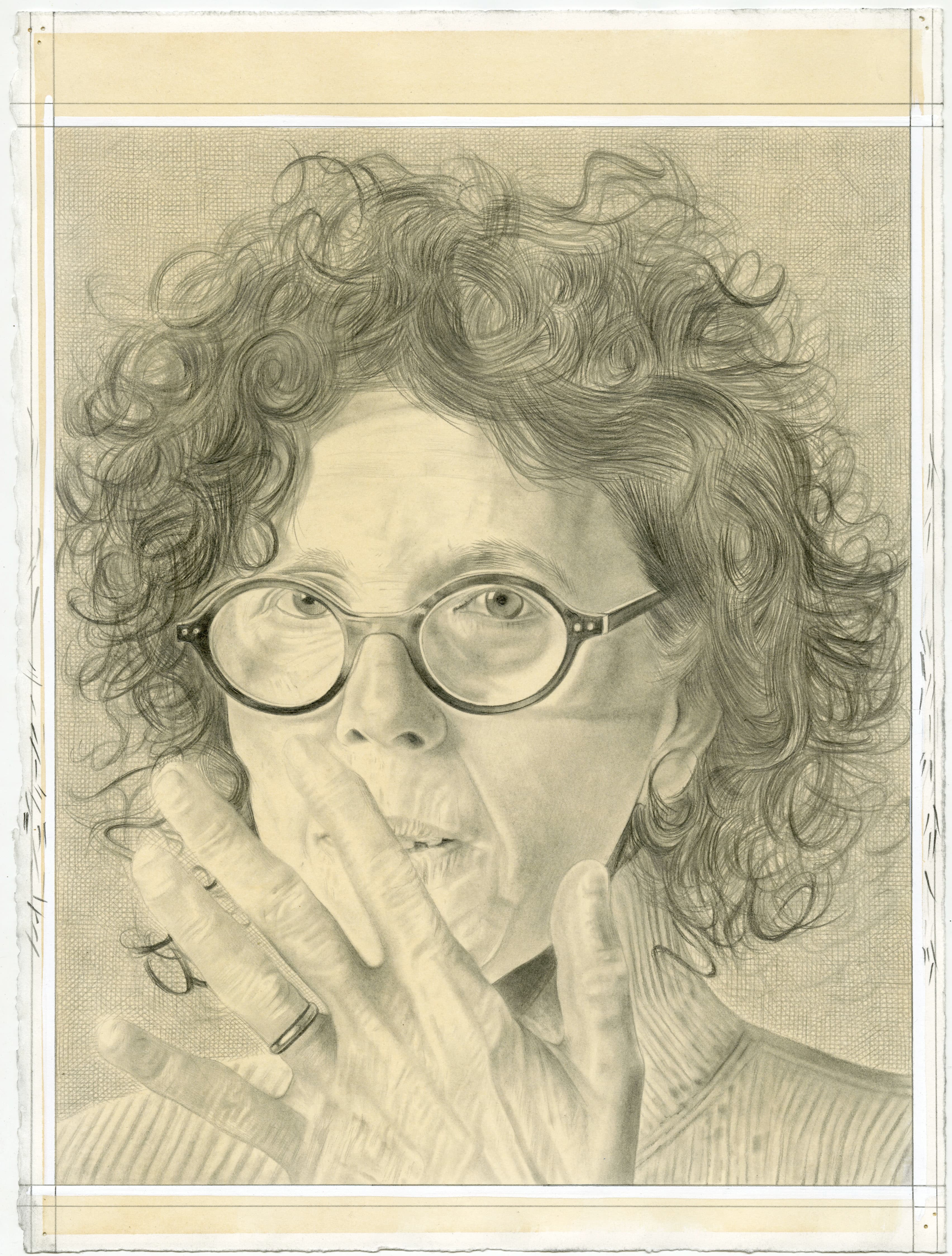
Portrait of Rona Pondick, pencil on paper by Phong H. Bui
Word count: 5196
Paragraphs: 123
Nunu Fine Art
March 6–May 30, 2026
New York
Rona Pondick and I have spent many hours pondering the complexity of her work and the bravery of her approach with her often shocking relationship to nature, in particular with the human, animal, and material body. What stands out as especially uncomfortable are her forthright expressions of sex and private emotions. In the process of assembling her work, she has said she has learned to live in the past, the present, and even the future, materially and mentally.
Barbara MacAdam (Rail): Rona, why did you choose Hans Bellmer and Bruce Nauman to include in the show Bellmer Nauman Pondick: Material Desire?
Rona Pondick: I see the three of us as being existentialists—that is, people grounded in self-determination—and, at the same time, we are artists of our own historical moment. For those unfamiliar with our work in this show, I try to use literary references and relationships to explain our affinities. I associate Hans Bellmer with the infamous writer Marquis de Sade; Bruce Nauman, with the bleak, broadly absurdist Samuel Beckett; and me, with the alienated, grotesquely and darkly comic Franz Kafka.

Installation view, Bellmer Nauman Pondick: Material Desire at Nunu Fine Art, 2026, New York. Courtesy Nunu Fine Art. Photo: Martin Seck.
Rail: Rona, you seem to have triggered amazing affinities in this current startling show and catalogue. You make us deal with the most uncomfortable of feelings, bridging the no-nos of our consciousness, the observations we don’t want people, even ourselves, to know we are seeing and thinking. The most surprising thing we can glean from the investigations you’ve been making is how you connect your awareness of the art of past worlds and cultures with your own observations and secrets to illuminate the present. When, where, how, and why did you begin to incorporate all of these factors into your own art?
Pondick: With hindsight, I am now able to understand how all of this developed—it began with my repeated visits to the Metropolitan Museum of Art and finding myself enticed by and engaged in the myths and magic of unfamiliar art, artifacts, materials, and surprising sculptures. Over time, I gradually established relationships with art that I came to love. That’s where I entered into my longstanding relationship with historical art, and I eventually inserted myself into history in my work and in the exhibitions like The Metamorphosis of an Object and Material Desire.
Rail: What led you, in effect, to establish a narrative structure for these elements and think about where you fit in this history? What did you hope to achieve in your approach to each of these exhibitions?
Pondick: Well, I had help. In 2009, the Worcester Art Museum invited me to weave my work into the museum’s collection, and I established relationships between my work and sculptures from different periods and cultures. Working like this was something I felt totally at home with. The exhibition was titled The Metamorphosis of an Object.
But the current show, Material Desire, had to be approached in an entirely different way because it was organized in a commercial gallery that does not have an encyclopedic historical collection. So, I decided to focus on two artists—Bellmer and Nauman, who I think of as kindred spirits.
Rail: To begin with, why did you choose Nauman? It appears to me that you connect with him on various levels—I see relationships between disturbing imagery in both of your works and in the ways you use materials expressively. I see Nauman manipulating his face like it is a material, and while photographing it, making it seem as though he’s producing a scream.

Rona Pondick, Back to Back, 1991–92. Wood, wax, epoxy modeling compound, shoes, lace, 18 x 15 3/4 x 34 inches. Courtesy Nunu Fine Art, NY / Taipei and Sonnabend, NY, and the artist.
Pondick: For this exhibition, I chose Nauman, because he is not afraid—he is always experimenting, conceptually, formally, or materially. He is comfortable, throwing himself off a mountain. And I relate to this!
Rail: While Nauman manipulates his face, like a material in his photographs, Bellmer uses his photography to a different end, fixating mostly on the headless La Poupée [The Doll] (1936) bodies that are highly sexualized and placed in unlikely settings. How do you see Bellmer?

Hans Bellmer, La Poupée [The Doll], or La Bouche [The Mouth], 1936 (printed 1949 or earlier). Hand-colored vintage gelatin silver print, 5 5/8 × 5 3/4 inches. Courtesy Ubu Gallery, New York.
Pondick: Bellmer is never afraid to act like a mirror. He said, “If the origin of my work is scandalous, it is because, for me, the world is a scandal.” Living in Germany during the lead-up to World War II, and when the Nazis came to power, had a big impact on what he thought and made. I often think that, as an artist, my job—if I have one—is to be a mirror and to deal with what it’s like to be alive at this moment.
For the time being, especially in the United States, we are reckoning with pervasive, disturbing attitudes toward morality, sexuality, and politics. I thought bringing the three of us together at this uneasy and confusing point just made so much sense, and with each passing day, it seems ever more relevant.
Rail: In what ways does looking at Bellmer and Nauman together shed light on their work and on yours in particular?

Bruce Nauman, Studies for Holograms (a-e), 1970. Screenprinted in yellow-green, 26 × 26 inches. Private Collection, New York.
Pondick: In the show Material Desire, I wanted to focus on Bellmer’s photography from the 1930s and consider how the mood and representation of the art and politics of the moment echo our current culture. I also wanted to highlight Nauman’s work from the 1970s, which underlines his engagement and fascination with Beckett’s use of time and humor. I see my own sculptures from the 1990s, focusing on shoes and teeth, as addressing some of the politics of our time with biting humor.
The catalogue offered us an opportunity to expand on these and other relationships between our work and to include work for each of us that was not in the exhibition.
Rail: What did you base your choices on?
Pondick: Bellmer, Nauman, and I investigate the body, thinking about relationships between color, placement, and materiality, and how they affect the viewer.
I often say, “I’m a material-holic.” I don’t think there is any material I haven’t used at this point in my work. I am obsessed with how materiality, form, and subject interact. The color, texture, translucency, opacity, and weight of materials affect a sculpture’s presence and determine its impact on the viewer.
Rail: I see that your division of the three sections in the catalogue, “Body,” “Color,” and “Placed”—not place—allowed you to explore relationships to one another and show how you each use body, color, and placement to make your work. It seems like it’s a clear starting point for each of you. Do you agree?

Rona Pondick, Ballerina With Teeth, 1991. Ballet slippers, rubber teeth, and epoxy modeling compound, 3 1/2 x 6 1/2 x 8 1/2 inches. Courtesy Nunu Fine Art, NY / Taipei and Sonnabend, NY, and the artist.
Pondick: I agree and hope the exhibition and the catalogue demonstrate this. Bellmer was unique and resourceful. His ad hoc bodily configurations—which he called La Poupée—were placed either outdoors in a landscape or in an orchestrated interior. Those locations helped make it possible for him to create unnerving, psychologically charged photographs, and when he hand-colored them, using vibrant, acidic colors, he intensified their psychological impact.
Nauman worked with the body, placement, and color to very different ends, and so many people don’t realize how important color is to him. When he created Yellow Room (Triangular) (1973) and the video Thighing (Blue) (1967), his use of the body and place were discussed, but his use of color was overlooked, probably in part because they were reproduced in art publications in black and white. While working on the Material Desire show and the catalogue, I discovered that Nauman—never losing his love for experimentation—has consistently invented ways to integrate color into his work.
Rail: How do you see the body in your own work functioning? How do you work with color? How do you decide what materials to use?

Hans Bellmer, La Poupée [The Doll], 1935. Vintage gelatin silver print, 25/8 × 23/8 inches. Courtesy Ubu Gallery, New York.
Pondick: The fragmented body has been in my work since the 1980s. Scale, placement, materiality, and color all influenced what I created and continue to shape what my sculptures look like. I think with my hands, and I want my viewer to feel my work viscerally in their own bodies. And I want my work to be emotionally charged and to invite psychological interpretation.
Rail: This is also true in your most recent work, isn’t it?
Pondick: Yes, in my more recent work, I’ve had people tell me they can taste the color. This is synesthesia, when senses cross. For someone like me, who wants my viewer to experience my work in their own bodies, it doesn’t get better than this.
Bellmer’s intimate black and white and jarringly hand-colored photographs, and Nauman’s very experimental use of color, heighten both the emotional and psychological readings of their work—something we all have in common.

Rona Pondick, Pink Baby, 1990. Shoes, wire, and epoxy modeling compound, 3 1/2 x 14 1/2 x 22 inches. Courtesy Nunu Fine Art, NY / Taipei and Sonnabend, NY, and the artist.
Rail: How do you equate psychology with color?
Pondick: Have you ever closed your eyes, tried to think about the color blue, and felt cool? Blue can make you feel cool or have a calming effect because of its associations with water or the sky.
Rail: Oh, that’s interesting. But don’t you think that the color blue can also conjure sadness? Or sexuality, as in the expression that someone has “blue balls”? It’s curious that you’re talking about it in terms of water and a calming effect, and I see the same color, and I think about sadness and sexual interpretations, and if we continued, we could come up with more associations and interpretations.

Bruce Nauman, Bouncing Balls, 1969. 9 min, b&w, silent, 16 mm film on video. Courtesy Electronic Arts Intermix (EAI), New York.
Pondick: Oddly enough, when you talk about “blue balls,” I can’t help but go to the two videos in the exhibition, Thighing (Blue), where Nauman is rubbing his thighs while sighing suggestively, and Bouncing Balls (1969), where Nauman is literally playing with his testicles. I have a piece called Blue (1993–95) that is reproduced in the catalogue. And I wish it were included in the show. Blue is made up of 237 parts, and its forms suggest stick figures and dildos, which are installed so that the different blues make an undulating effect that suggests water. I think Nauman and I are using the color blue to communicate psychologically and sexuality, to make charged meanings.
Rail: As we are talking, it makes me think how magical color is. You can’t define it easily.
Pondick: You’re right, color is magical, elusive, and has interesting properties. It has a temperature. And it’s hard to remember a color. For example, I can show you ten different reds, pick one, and ask you to remember it. Then, at another time, bring them all back and ask you to identify the one red we picked together. You will have a hard time remembering which red it was.
Rail: In order to remember a color, you need to be able to compare it to another color, or with an object, or with something else that you know. Another interesting quality about reading color is that it can have alchemical and hallucinatory effects. Do you see either of these qualities in Nauman, Bellmer, or your own work?

Rona Pondick Red Head & Loafer, 1991. Wax, wire, shoe, epoxy, chattering teeth, and push pin, 21 x 18 x 20 inches. Courtesy of Nunu Fine Art, NY / Taipei and Sonnabend, NY, and the artist.
Pondick: When Bellmer uses color in his photographs, it can look so heightened that the images look electric or psychedelic, and possibly appear hallucinatory. These highly sexualized images relate literally to Nauman’s fluorescent sculptures, his videos Clown Torture (1987) or Dirty Story A/B (1987), and to his photographs Feet of Clay or Bound to Fail (both 1966–1967, printed 1970).
Rail: I see color is an integral part of your work, from the brown waxes in your scatological pieces to Angel (1987), which was a pure but dirtied white. Or in Little Bathers (1990–91) and Dirt Head (1997), two pieces where the form is the same—a round ball with teeth—the color in both affects how differently they read, from the cartoon bubblegum pink with its “pop” associations in Little Bathers to the brown earth of Dirt Head where death dominates.
Pondick: I don’t think there is a sculpture I have ever made where I am not thinking about the material, its color, and how it affects the meaning.
Rail: What kind of coloring does Bellmer use in his work?

Hans Bellmer, La Poupée [The Doll], 1935. Hand-colored vintage gelatin silver print, 35/8 × 21/2 inches. Courtesy Ubu Gallery, New York.
Pondick: I think he uses watercolor, and aniline dye and hand-paints his photographs. [Shows Bellmer’s print La Poupée [The Doll], which is included in the show, and in the catalogue on page 96.]
Rail: That’s an incredible print. That really is great! The extreme use of the colors, with their translucent effervescent quality, heightens the fluidity of its reading.
Pondick: When Bellmer uses color, it is very sensitive, creative, and sexually charged.
Rail: Were you inspired by him, literally, in any way?
Pondick: Yes, I was inspired by Bellmer’s work. I was looking at his photos a lot in the 1990s. And at the same time, I was also looking at Nauman. Both Bellmer and Nauman had an impact on my work, and working on this show helped me realize how much they both mean to me.
Rail: In what ways?
Pondick: I love the variety in Nauman’s work. He is always experimenting with materials while working in a wide range of different forms. I don’t think I’ve missed a show of his in New York. Nauman is important to me. When I was looking at Bellmer’s photography, I was not aware that he made stand-alone sculptures until very recently. When I saw those sculptures, I could see how much of an impact he had on Louise Bourgeois, someone else I love.
Which brings me back to my constant effort to build my ancestral tree, starting with Egyptian, Cycladic, Mesopotamian, Greek, Etruscan, Roman—Hieronymus Bosch, Tilman Riemenschneider, Gian Lorenzo Bernini, Franz Xaver Messerschmidt, Odilon Redon, Alberto Giacometti, Constantin Brâncuși, Philip Guston, Louise Bourgeois, Hans Bellmer, Bruce Nauman. As you can see, I am not a monogamous artist; I have lots of loves.

Bruce Nauman, Thighing (Blue), 1967. 4:36 min, color, sound, 16 mm film on video. Courtesy Electronic Arts Intermix (EAI), New York.
Rail: What do you think Bellmer, Nauman, and you have in common?
Pondick: I think Bellmer, Nauman, and I are very similar in that we deal with edgy, challenging subject matter, and we each get under the fingernails of our viewers, and we don’t window-dress.
Rail: Each of you seems to irritate, poke, jab, and engage viewers while also allowing them to enter their own feelings directly with the space to feel dirty and embarrassed. It is as if we are implicated in the making of the work. Rona, you also have this grotesque yet funny side to your work.
Pondick: I am not sure what you mean.
Rail: I mean, it’s terrible, but it’s funny. I mean, you have the teeth and tits in your work!

Installation view, Bellmer Nauman Pondick: Material Desire at Nunu Fine Art, 2026, New York. Courtesy Nunu Fine Art. Photo: Martin Seck.
Pondick: Yes, I have lots of body parts, and they are not always where you expect them to be. I remember when I was young, watching people respond to my work. One person would say they found the work disturbing. They didn’t know what to make of it. And then, a half hour later, someone else would look at the same piece and be laughing hysterically.
Rail: And did that bother you? I still see this happening in your work; does this still bother you?
Pondick: I’m actually intrigued by the response my work gets. When I was younger, I couldn’t understand how it garnered such different responses. But I realized as much as I wanted to control the reactions of my viewers, it wasn’t and isn’t possible, nor is it desirable. No artist can totally control their viewer. We all bring our own histories to what we are looking at. In the beginning, it was not clear to me that my work was almost like a Hermann Rorschach.
Once I realized that my work elicited such contrasting responses, I wanted to push the multiple readings. I wanted the meaning to keep flipping on itself.
Rail: But that’s difficult to do!
Pondick: It is, but it also defines me and who I am as an artist. I love to experiment. I don’t like to know what I am doing all the time. I want to be surprised. I like to push myself technically and materially. Not knowing where I will land excites me.
Rail: You’re talking about unconsciously wandering in your work, and I wonder if there is a similar thing happening when you are looking at historical works in a museum, letting yourself meander through a museum, not knowing what you will discover.
Pondick: I do. I love to wander in both the museums and in my own studio when I’m making my work.
Rail: When we talk about the museum in relation to the studio, it immediately makes me think of how we are influenced by our surroundings and what we absorb. Not to be corny, but it brings up the question of originality. Can we be original? Do we want to be original? And what does it mean to be original?

Installation view: Bellmer Nauman Pondick: Material Desire, Nunu Fine Art, New York, 2026. Courtesy Nunu Fine Art. Photo: Martin Seck.
Pondick: No one is original. We are all taking from our surroundings and from each other, in the hope that we are making it our own.
Rail: Yes, I agree. I don’t think originality is really so important. We like to think our work isn’t exactly the same as someone else’s, and we might like the surprise aspect of that. But basically, originality is rarely what we think it is.
Pondick: Talking about museums and my practice makes me realize how comfortable I feel in these institutions; they are like another studio. And it reminds me of when Nunu Hung came to me and asked if I would consider doing a show with her in New York. I told her I wanted to focus on museum projects.
She asked me to share with her what I had in mind. I shared the idea for this exhibition, saying it is politically relevant, and it has difficult subject matter that could make it controversial. I also told her that I thought we needed collaborators to help, because securing loans typically made to museums would be demanding. And knowing the expenses associated with these loans, I thought Nunu would not want to do it alone. She shocked me and said, ‘Let’s do it!’
Rail: Once you started working on the exhibition, what difficulties did you come up against?
Pondick: To begin with, at the start of our collaboration, Albert Godetzky was going to curate the show and write the catalogue essay. However, he became overwhelmed with other work, and in the end, he was only able to write the essay; nonetheless, he did help flesh out ideas when I reached out to him. And I love the essay he wrote.
Rail: Funny that you say it like this, because I see Albert’s title for this essay is called “Fleshing Out.”
Pondick: Yes, his essay embraces the body and brings in collaborations with the past, in the beginning and end of the essay, where he discusses Albrecht Dürer, making very clear links between his work and that of the three of us.
Rail: I see such a clear relationship with the last photo in Albert’s essay, Three Studies of Dürer’s Left Hand (1493–94) and your reference to the way you think, which is with your hands.
Pondick: I am thrilled that you see a relationship like this!
Rail: Could you elaborate on why you thought it was important for Nunu to have collaborators and not do this exhibition alone?
Pondick: I knew we needed collaborators to get historical works by both Nauman and Bellmer. Obviously, because Antonio Homem of Sonnabend Gallery had a long history with Nauman, it made perfect sense. And it didn’t hurt that I’ve had over twenty-five years of working and talking to Antonio regularly. We have such a fluid dialogue.
I’m lucky Antonio was a collaborator because he encouraged me to approach the Material Desire show in the same way I did the Worcester Art Museum project. He convinced me that it made sense to take the lead when Albert couldn’t be the curator, despite my being hesitant to take on the role of organizer. I continued to talk with Antonio, Albert, Nunu, my assistant, Andres, and everyone at Nunu’s gallery, as well as Adam Boxer and his staff at Ubu Gallery, and my loving husband, the painter Robert Feintuch, who helped with the exhibition in innumerable ways. Over time, I got more comfortable assuming this role.
Rail: Did you have a relationship with Ubu Gallery before this collaboration?
Pondick: Yes, Ubu was the other collaborator, and my introduction to Ubu was a little crazy. Nunu and I were on our way to visit the gallery when Antonio called to remind me that Rosa Esman was one of the three partners who started Ubu Gallery. I was in my first group show with Rosa Esman in 1984, titled Exceptional and New. Antonio said, “Make sure you share that with Ubu’s staff.”
Rail: Yes, I remember that. Yes, go on.
Pondick: When we walked into Ubu, the director, Viera Karpiakova, said that Adam Boxer, one of the three original partners, knew my work and the connection to Rosa. They were happy to work with us. I was ecstatic because they had such a large inventory of Bellmer’s vintage prints that I wanted to work with, so we didn’t have to go anywhere else.
Rail: Wow.
Pondick: So, it all came together, and it felt magical.

Installation view: Bellmer Nauman Pondick: Material Desire, Nunu Fine Art, New York, 2026. Courtesy Nunu Fine Art. Photo: Martin Seck.
Rail: There’s a natural connection among all three of you. And it’s nice to see and talk with you about how it came together. Was Nunu always excited about this project?
Pondick: Bellmer’s vintage photographs require low-lighting conditions. Thank God Nunu was in Taipei when the electricians arrived and had to rewire the entire gallery to accommodate those requirements. Personally, I was freaking out when I saw what they had to do for our show, but she maintained her equanimity throughout.

Hans Bellmer, La Poupée [The Doll], 1934 , Vintage gelatin silver print, 31/2 × 21/4 inches. Courtesy Ubu Gallery, New York.
Rail: Was Nauman directly involved in the planning?
Pondick: No, Nauman has not been personally involved, but his studio has been very helpful. In fact, Nauman’s videos from the 1970s are available only for museum loans, and we had to get his personal approval for the gallery to borrow the two that are included. We also had trouble obtaining reproductions of his work for the catalogue, and the studio generously sent us high-resolution files.
Rail: Interestingly, you set up the catalogue by dividing it into three sections: “Body,” “Color,” and “Placed” with quotes by the artists. Your quotations also function graphically, which is unusual. What purpose do they serve?
Pondick: When we started planning the catalogue, I wanted to find a way to give a voice to the artists talking about their own work. The designer, Misha Beletsky, came up with the idea of running the quotes in large format type, giving each artist a chance to speak for themselves.
Rail: It is interesting that I perceive the text not running on the standard scale as another art form.
Pondick: And now we are trying to figure out which quotes to use and support the work in the show for the wall text in the gallery.
Rail: That is good.
Pondick: I am curious to see how Bellmer’s work is received.
Rail: Why?
Pondick: During the Nazi years, he was labeled a degenerate artist. He had to flee Berlin, and he joined the French resistance. He was captured and imprisoned, and when he was finally released, he stopped making La Poupée photographs. I find that really interesting.
In the 1990s, he was attacked for moralistic reasons in the US. The left and the right could easily attack him now. His work is highly sexualized, and I think it is misunderstood. I believe that categories and -isms can be horrible simplifications that can reduce the complexity of artwork, making it difficult to analyze.
Rail: Right.
Pondick: Bellmer made these photographs in protest against the fascists, attacking the ways women and femininity were used as Aryan symbols.
Rail: Right. We are talking about Bellmer’s photographs. Isn’t he also known for making sculpture, drawings, and paintings as well? I know I’ve seen a sculpture of his at the Museum of Modern Art.
Pondick: Yes, Bellmer made La Poupée to photograph, along with a few sculptures that were not meant to be photographed. A few stand-alone pieces have survived. I know of two museums in the US, MoMA is one of them, and two in Europe that own Bellmer’s sculptures. They are so rare.
Rail: You couldn’t get any of his sculptural work for the show?
Pondick: Sadly, we couldn’t get Bellmer or Nauman sculptures for our show. I am the only one showing three-dimensional work. I wish we could have. I think that expanding this show with their sculptures would be amazing.
However, it wasn’t easy to secure what we managed to obtain for the Material Desire show. And that’s one of the reasons we decided to include work by Bellmer and Nauman that we couldn’t get for the exhibition in the catalogue.
Rail: Hmm… Does this inspire you to do anything similar? In the future? Does this show trigger other ideas for the future?
Pondick: I am in dialogue with a number of museums about projects that are being planned, but unfortunately, it’s too early to talk about them.

Installation view: Bellmer Nauman Pondick: Material Desire, Nunu Fine Art, New York, 2026. Courtesy Nunu Fine Art. Photo: Martin Seck.
Rail: I know you say you are a ‘material-holic’ and you are constantly experimenting with color and form, but the recent changes in your color and materials look so different from those of the past. And I also see now why you say you are obsessed by materiality. What is next for you?
Pondick: When I look at all the work I have made, I see how it moves and grows with material and color changes and imagery that repeats and morphs on itself. What I heard at the beginning is still being said about my work—it feels odd, weird, funny, or disturbing, all at once. And I think this will be said about my work until the end. But I am not someone who wants to know what they are going to make before it’s made.
Rail: Yeah, and it’s as though, across the years, you’ve given yourself the start of a roadmap for all of this. I see your work unraveling and developing and continuing to cruise down the highway as your search for meaning never stops.
Pondick: I can’t predict how my work will be seen in my own time, let alone if it’s seen fifty, one hundred, or two hundred years from now. Context is so important.
Rail: Sure, but are you thinking about how people could view your work in the future anyway?
Pondick: You mentioned Dirt Head earlier. Each time it’s shown, it’s written about in entirely different ways. It was made for the Johannesburg Biennale (1997), where people often described the piece as if it dealt with voodoo and black magic. Then it was exhibited in Austria, where people talked about the Holocaust. When it was shown in the Lyon Biennale (2000), it was installed at the beginning of the genetics section. Every time Dirt Head has been shown, the geographic location has influenced how it was written about differently.
All of this was in my own time. I don’t think it is possible to predict how it might be seen in the future.
Rail: Oh! That’s fantastic. I mean it’s really wonderful. But do you still try to control it?
Pondick: Oh, of course I do, I’m a control freak. However, I now know from experience that I can’t control how my work is viewed or interpreted. All I can try to do is make my work rich and layered, and then let go, which is not easy. I also believe that art is a visual language.
Rail: Yeah. And that’s where emotion comes in, right? A visual language. It’s visual, and yet it comes from the air.
Pondick: When you say it comes from the air, it’s undefined. What do you mean by that?
Rail: Where do we get ideas? Where do they come from, and how do we form them? They don’t really have a shape, do they?
Pondick: Most of what we see and perceive is what we have learned, rather than what we are physically seeing. There have been books written about perception, discussing whether someone can see a shape moving and perceive its form as it changes in space. Where and how you have been educated can affect how you perceive everything.
Rail: Well, what we can hook it onto, that we already know.
Pondick: For years, I have looked at sculpture, examining materials and forms from different cultures and times. I have spent a considerable amount of time studying the technological advancements and material usage that affect the imagery in sculpture.
Hair is fascinating to study in the context of sculpture. Look at Greek, Roman, Gandharan, Asian, African, and the art of the Americas—there is a wide range of how hair is physically and materially depicted. In Gandharan sculpture, initially influenced by Greek and Roman sculpture, the hair flows. However, as Buddhist sculpture evolved, it developed into a spiral form that repeats in a distinct pattern. Why does this happen? What does the spiral mean?
When examining hands and feet in Egyptian stone sculptures, there is often webbing between the fingers and toes that serves as structural reinforcement to prevent them from breaking off. But after bronze is discovered and used, in the West, appendages lose structural supports, and the webbing between the fingers, toes, and arms disappears. Bronze is structurally strong, which frees up how the body can be depicted. But in Eastern art, the webbing remains. Why? Does the webbing take on a symbolic meaning?
Rail: Your description makes me think about architectural structure and how technological changes have affected what buildings look like. I understand your comparison to sculpture.
Pondick: Technology affects art directly. What materials are available, how things are made, and how we use those materials when they are first invented and after they become commonplace in our lives all affect making.
When we transitioned from cave paintings and early votive works, such as the Venus of Willendorf (ca. 24,000–22,000 BCE)—crafted in stone—to ceramics, fiber, metals, photography, film, and the most current technology—AI—look at what happened. I love to watch and see how each new technology produces new materials and how artists use these materials. I am always interested in trying to understand why something looks the way it does.
Rail: Right. Well, me too, and I love the idea of how we understand what we see, and why we like what we like. And what repels us, and what attracts us. Some of it’s way beyond us—to understand why we’re attracted to something, or seduced by, or drawn into things.
Pondick: I can’t agree more with you. And I know that most people want to believe that the history of art is linear in its development. I think it spirals and develops circularly. The human body is one of the oldest subjects in art and remains a timeless theme. The Venus of Willendorf is nearly thirty thousand years old. Bellmer worked, and Nauman and I continue to work to explore the various ways an artist can still engage with the body.
Rail: Well put. Can you talk about curating your next project? Can I push you a little to share some of your fantasy projects?
Pondick: I want to focus on museum-level projects like the Material Desire show. And moving forward I really hope to work with another encyclopedic museum with a good collection, where I can work with the curators to build a show like the Worcester project, before I croak.
Barbara A. MacAdam is a New York-based freelance arts writer.