Dan Cameron

Dan Cameron is a curator, art writer, and visual artist whose curatorial work focuses on expanding the limits of curatorial practice.

Pat Oleszko was born on May 19, 1947. At the age of seven, she dreamed of “being a puppeteer, or maybe Ferdinand the Bull.” Those dreams came true: she has created puppets, elaborate costumes, props, larger-than-life inflatables, and more public spectacles than an archivist can count. As she discussed with Rail Editor-at-Large Dan Cameron on the New Social Environment in early February, everybody has a thing, and hers is sculpture. Hers just happens “to walk and talk and fart and fuck.”
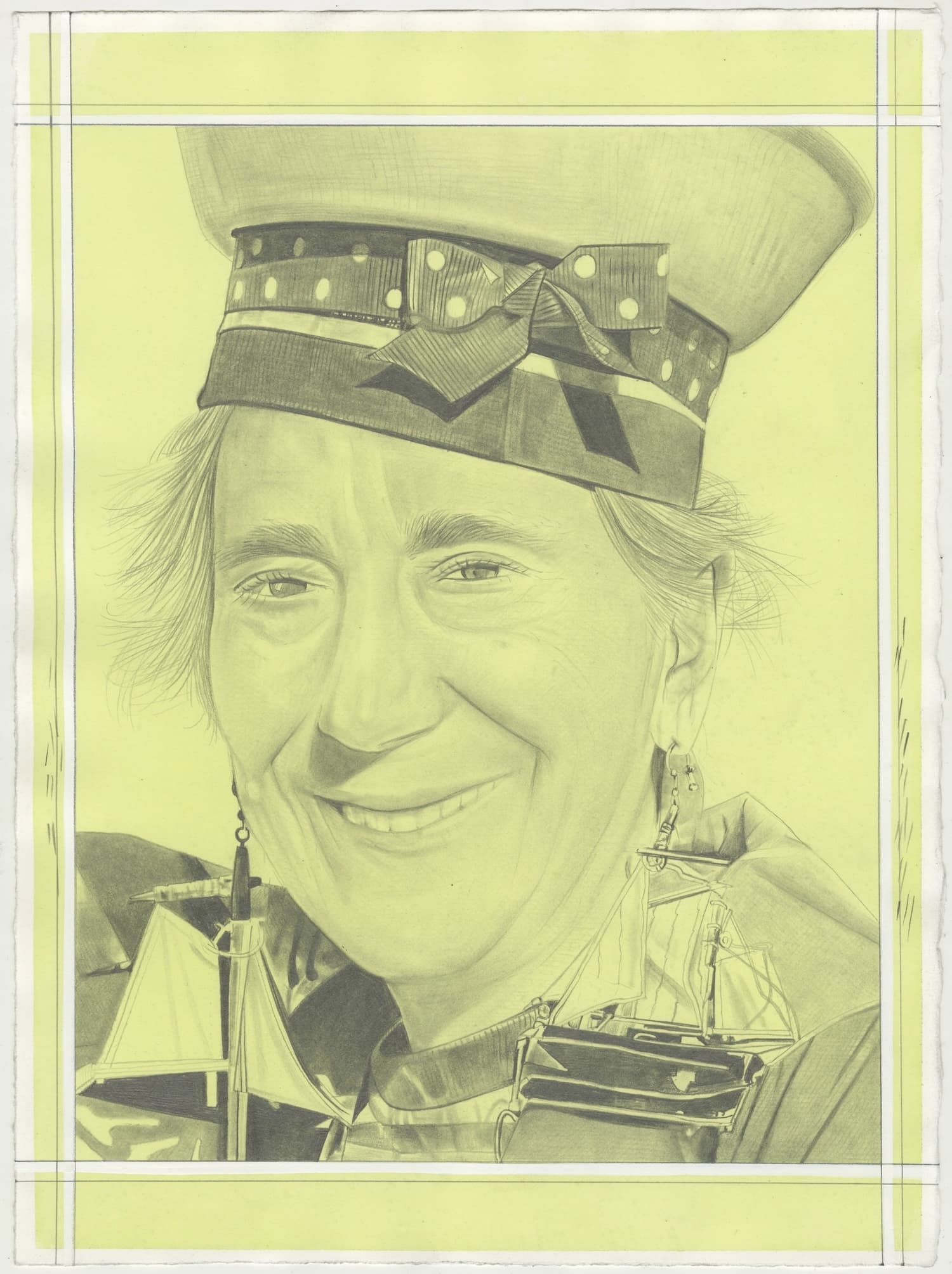
Portrait of Pat Oleszko, pencil on paper by Phong H. Bui.

Pepón Osorio is known for his provocative, large scale multimedia installations that merge conceptual art and community dynamics. Osorio has worked with over twenty-five communities across the United States and internationally, creating installations based on their real-life experiences. The artist spoke with Dan Cameron on the occasion of Osorio’s exhibition, Convalescence, at the Thomas Jefferson University medical campus in Philadelphia.

Portrait of Pepón Osorio, pencil on paper by Phong H. Bui.
Rock en español, in its endless variants and mutations, is the music most listened to at my home for what seems like forever. When we first met thirty-four years ago, my now-husband—who’d recently moved from Honduras and basically lives for music—couldn’t wait to play me all his favorite artists, just as I played mine for him.
Son Rompe Pera. Photo: Mirko Yuras.
Considering the towering presence of Elizabeth Murray’s paintings in the trajectory of American abstraction at the end of the last century, it has become somewhat rare to come across a full-blown exhibition of her drawings. Presumably this isn’t because of any shortage of works on paper, but more likely because anybody who was fortunate to get their hands on one—friends, family, colleagues, bidders at benefit auditions—has guarded it zealously.
Elizabeth Murray, Untitled, 1999. Watercolor pen and marker with collage on paper, 13 5/8 x 11 3/8 inches. © The Murray-Holman Family Trust / Artists Rights Society (ARS), New York. Courtesy The Murray-Holman Family Trust and Gladstone Gallery.
Matt Mullican is one of the artists I’ve followed the most closely over the years. Part of that has to do with the fact that when I was getting interested in his work nearly forty years ago, I reached out to him, and was lucky enough to have some interview sessions. Fast forward to 2023 and the incredible exhibition that’s going on right now at Peter Freeman. I feel like I’m starting all over again, that I’m needing more direct discourse with Matt Mullican so I can continue on the path of decoding and getting to the bottom of the iconography in his work.
Portrait of Matt Mullican, pencil on paper by Phong H. Bui.
Ever since bursting onto the scene during the East Village’s so-called Neo-Geo wave during the last half of the 1980s, Ashley Bickerton has tended to be the odd man out relative to the generation with which he is invariably compared. Although his early works were eye-popping and futuristically slick, Bickerton wasn’t especially interested in theories of appropriation or simulation, nor was he seduced by the doctrine of banality.
Portrait of Ashley Bickerton, pencil on paper by Phong H. Bui.
The art and life of Winfred Rembert (1945–2021) offers a double reflection of two of the most glaring injustices in the US over the past century: the forceful imposition of Jim Crow laws of racial segregation in former slave states in the South, and the explosive growth of the prison industry as a tool of social control over individuals and groups whom the system finds troublesome or a threat.
Winfred Rembert, All Me, 2002. Dye on carved and tooled leather, 31 1/4 x 31 1/4 inches. Courtesy Fort Gansevoort, New York.
In Monika Baer’s second exhibition of new paintings at Greene Naftali, familiar tensions are teased out between her fluency with the norms of academic realism, and an apparently superseding interest in the painting as a handmade object that can be perceived from a multitude of varied perspectives.
Monika Baer, Loose change, 2021. Watercolor, saw blade fragment, screws and coin on paper, 20 x 15 inches. Courtesy the artist; Galerie Barbara Weiss, Berlin; and Greene Naftali, New York.
Solmi’s recurring subject is the knowing abuse of power, and he has a bleak and urgent message for us regarding this particularly agonizing moment in history: it has happened before, it will happen again, and there is very little within our power to stop it. Bucking convention, Solmi even sees it from the perspective of the aggressors, whose greatest wish is to wall themselves off from the rest of us, the better to enjoy the fruits of their plunder.
Federico Solmi, pencil on paper by Phong H. Bui.
Rail Editor-at-Large, Dan Cameron, talks with Paul McCarthy about the trajectory of performance art, his interest in television as a medium, and his current collaboration with Lilith Stangenberg.
Portrait of Paul McCarthy, pencil on paper by Phong H. Bui.
Williams’s exhibition, titled Tracing Memory, builds on the tradition of apostate picture-makers with such confidence that the fact that this is also her debut exhibition at a commercial art gallery in New York City comes as a surprise. Many of the works on view lack any support structure at all, preferring instead to migrate across the wall with a breezy randomness that belies their precise deployment of shape, color, and materials.
Rachel Eulena Williams, Red Grey Clay, 2020. Silkscreen on card, dye and acrylic paint on hammock, canvas, and cotton rope, 72 x 62 x 3 inches. Courtesy the artist and Canada, New York.
Since Whitten’s death in early 2018 at the age of 78, a new and welcome focus of attention has been brought to his achievements.
Jack Whitten, Memory Sites, 1995. Acrylic on canvas, 126 x 140 inches. © Jack Whitten Estate. Courtesy the Jack Whitten Estate and Hauser & Wirth. Photo: Dan Bradica.
In comparison to Kaphar’s earlier work, these enigmatic new paintings are asked to bear a heavier burden of direct narrative, and the lack of an obvious relation between the absences and presences that Kaphar highlights here leaves us with a new and unfamiliar kind of disorientation.
Titus Kaphar, Twins, 2020. Oil on canvas, 83 3/4 x 68 inches. © Titus Kaphar. Courtesy the artist and Gagosian. Photo: Alexander Harding.
The installation functions as a veritable safe space, where we might gradually accustom ourselves to the voices and faces of people whose political opinions are diametrically opposed to ours, while perhaps attempting to perceive a crucial distinction along the way between the message and the messenger.
Krzysztof Wodiczko, A House Divided..., 2019. 4K video projection on sculpture, figure height: 98 1/2 inches, pedestal: 27 1/2 x 94 x 95 inches. © Krzysztof Wodiczko. Courtesy Galerie Lelong & Co., New York.
During our time scattered amongst the living, we are frequently on the receiving end of advice to the effect that death is the event we should fear the most—a reflex that has always bewildered me.
David Wojnarowicz, Untitled (face in dirt), 1991. Silver print, 19 7/8 x 23 3/4 inches. Courtesy the Estate of David Wojnarowicz and P·P·O·W, New York.
Donald Moffett (b. 1955) says he doesn’t know what kind of art to make—given the situation. It’s a moving thought for an artist who is showing fantastic new paintings in his seventh solo exhibition at Marianne Boesky’s gallery.
Portrait of Donald Moffett, pencil on paper by Phong Bui.
The ghost of Mark Lombardi hovers over recent exhibitions by Fernando Bryce, at Alexander & Bonin, and William Powhida, at Postmasters, both of which trafficked heavily in a fusion of text and imagery. This combination seems far easier for audiences today to digest than was the case 20 years ago, when Lombardi was one of the few working artists able to locate the proverbial sweet spot between things people want to read and things people want to look at.
Installation view: Fernando Bryce: The Decade Review, Alexander and Bonin, New York, 2019. Courtesy Alexander and Bonin, New York.
A product of the 1990s upheaval that transformed video art into video installation, Rottenberg’s videos are the focal point of an intricately linked material universe in which architectural elements and room transformations function as added liminal spaces by which one arrives at the screen.
Mika Rottenberg, NoNoseKnows, 2015. Single-channel video installation, sound, color, dimensions variable; 21:58 min. Courtesy the artist and Hauser & Wirth
.
Another troubling aspect to the infallibility principle of art criticism—by which the value of your opinion is determined by the proportion of artists you choose to write about who are still considered relevant 10 or 20 years after the fact—is that contemporary art is never affixed with an unwavering value, even after it’s no longer seen as contemporary.
Gonzales’s efforts to transform both the emotional raw material of her research, as well as actual patterns and motifs found in Shipibo textiles, result in compositions that seek to retain the freshness and urgency of her experiences, while opening up a space in contemporary artistic practice for a non-exploitative relationship to pre-Colombian cultures.
Tamara Gonzales, Videira de Cobra Para as Estrelas (Snake Vine to the Stars), 2018. Acrylic, spray paint, and pastel on canvas, 66 x 54 inches. Courtesy Klaus von Nichtssagend Gallery, New York.
Paul Anthony Smith’s first solo exhibition in New York, at Jack Shainman Gallery, arrives with the proverbial wind at the artist's back. Smith, who turns 31 this year, has already enjoyed multiple museum group shows and acquisitions around the country, and some mid career artists whose names would be familiar to most readers have been discreetly collecting his work for some time.
Paul Anthony Smith, Conviction of Righteousness (detail), 2018. Unique picotage on inkjet print, oil stick, colored pencil and spray paint, mounted on museum board, 40 x 30 inches. © Paul Anthony Smith. Courtesy the artist and Jack Shainman Gallery, New York.
There have always been multiple entry points for viewers to come to terms with John Sonsini’s bravura portraits of single or multiple male subjects, most of whom are Mexican day laborers, and “the age of Trump” has unexpectedly provided us with yet another.
John Sonsini, Roger, 2014/2019. Oil on canvas, 72 x 60 inches. Courtesy the artist and Miles McEnery Gallery, New York, NY.
Her groundbreaking works of 30 years ago seem to dovetail just as effortlessly with a contemporary interest in activism and ways that artists can deploy new developments in technology and communication without becoming subsumed by a consumerist ethos.
Installation view: Gretchen Bender: So Much Deathless, Red Bull Arts New York, 2019. Photo: Lance Brewer. © The Gretchen Bender Estate.

Close

Home