ArtMarch 2026In Conversation
KATHY BUTTERLY with EJ Hauser
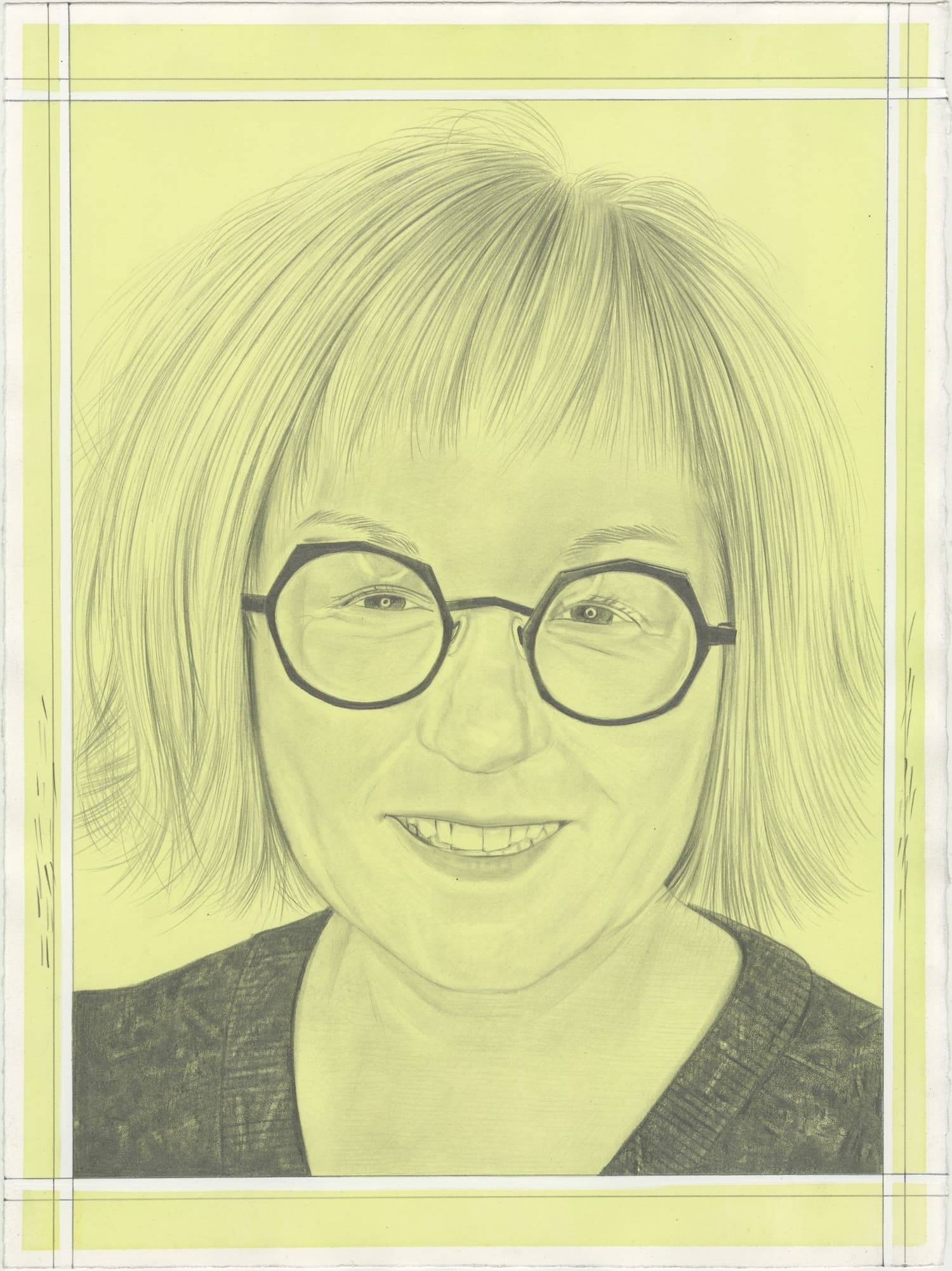
Portrait of Kathy Butterly, pencil on paper by Phong H. Bui.
Word count: 5979
Paragraphs: 54
Frances Young Tang Teaching Museum and Art Gallery
February 14–July 26, 2026
Saratoga Springs, NY
Kathy Butterly has been making artworks using the vessel form since 1986, when she was an undergraduate student at the Moore College of Art. Since then, her vessels have been shown in more than thirty solo exhibitions—most recently High Vibration at James Cohan Gallery, and currently at the Frances Young Tang Teaching Museum and Art Gallery in Saratoga Springs. On the occasion of these exhibitions, Butterly sat down for a conversation with the artist EJ Hauser. It is one in a long line of exchanges between the two artists, who describe themselves in turn as “a sculptor who paints” (Hauser) and “a painter who sculpts” (Butterly). They have found parallels in their fascination with color—where and how it is located and remembered—and a shared emphasis on listening: to the Lot Radio, to NTS, to their artworks. Here they discuss the trajectory of Butterly’s practice, finding beauty in reality and destruction, and the artist’s newfound mantra in art and life: “see me now.”

Kathy Butterly, Like Butter, 1997. Clay and glaze, 4 ½ × 3 ¾ × 3 ⅜ inches. Courtesy the artist and Frances Young Tang Teaching Museum and Art Gallery at Skidmore College.
EJ Hauser (Rail): I’m standing here in James Cohan Gallery with my friend Kathy Butterly on Tuesday, February 3, 2026. I looked to see when we started recording our conversations, and we started in 2021, so we’ve been having conversations about art and your practice for about five years now.
Kathy Butterly: You and I are on a strange parallel. Even though we don’t talk a lot, I feel like when we do check in, we’re thinking about similar things, possibly in different ways, and then we connect through different artists. I get you interested in this artist, and then you get me interested in that artist. It’s all parallel. It’s really interesting that we’re going through this together in our own world, and then we come together, and we just—what’s the word? Percolate. We percolate. I feel like we’re really connected on a lot of levels.
Rail: Many artists spend a lot of time alone, and that’s a really core part of our practices individually: having the time and space that it takes to make this work. I read the article about you in Plus Magazine that you sent me. What a beautiful article.
Butterly: I am so utterly thrilled with that article, because I feel like Jae Kim, the writer, really got the depth and the feeling of works on the level that I’m searching for in my studio. What I’m really after is not making things quickly at all. I’m trying to make something that has presence and feeling. It’s a very slow process. That’s also why, when I’m in my studio, I need it to be a calm place, a contemplative place, a place where I can really get deeply into my head and forget about the outside world. The outside world greatly influences and affects what I’m thinking about, but my studio is so private. I was thinking about this, growing up in a family with a few kids and having to share a room, and then raising two children in New York, in a loft where my studio is next to my husband’s studio. My studio is the only place in the world that is mine. It’s private. It has a door. I just go in deep. Being alone is so important to me. I get so into this like eight-inch space that’s in front of me, which is my work, which is the world, and I can tune out everything, and I can only do that in my studio.
Rail: Do you think that skill is a natural gift to you, or do you think it’s something you’ve really had to focus on and develop in order to make the work that you’ve wanted to make?
Butterly: That’s interesting. You know, I think I’ve always been that way. I’ve always really treasured my thinking space and my physical space, but I think it’s definitely something that I’ve learned how to use really well, more and more each year. I have my rituals now. I go into my studio, and I light a stick of incense, and I—
Rail: Grab a crystal. [Laughter]
Butterly: The crystals are all lined up on the window. And sometimes at the right time of the day, there’s a rainbow that hits my wall from some of the crystals. So that’s special. But I think what I’m getting after is, I have my ritual. I light the incense, I turn on NTS or NPR, and I look out my window and just see what’s going on. There’s a building right across the way that gets tagged every day, so I get to see what was going on during the night and the creativity and the language of people who are tagging.

Kathy Butterly, Worlds in Worlds in Worlds, 2025. Porcelain, earthenware, glaze, 8 ⅜ × 7 ⅜ × 7 inches. Courtesy the artist and James Cohan Gallery. Photo: Alan Wiener.
Rail: In that interview in Plus, you said something about listening, and I want to dig into this a little bit. You’ve mentioned that sound is very important to you while you’re making your work, but in that article you referenced “listening” to your work, and I’m curious if this idea of listening is connected to something you said to me the night of your opening. You said that this particular body of work was hard won. You mentioned facing challenges while making this work that maybe you had not encountered previously, or for a while, or that the challenges that you faced were unique to this body of work. So this idea of listening, getting into the energetic current of what it is we’re making, this idea that if we listen, we will be led—can you tell me some of the things that you felt you had to listen for in this particular body of work that might have been different from other bodies of work?
Butterly: I like listening to the sounds of my studio, to the quiet. Up in Maine, I just open the doors and I hear the world, the world of birds and of a leaf falling. There are so many worlds that we can tune in and out of. I’ll be working, and I can hear a bee flying by. So that’s part of my listening, which is very important, especially up in Maine. In terms of listening to the work in my studio, this was an incredibly important time for me in terms of development. It was hard to find this work, and I knew it was going to be when I set out some limitations, parameters for myself. I feel like I never want to revisit the work that I’ve done before. But I am so focused. I know what I’m doing. My muse is the vessel form. That’s my world. I can’t explain it other than to say that the vessel form is my canvas. It’s my square. It always has been. I feel very, very committed to this form. So how do I continue it and keep myself interested? For the body of work at James Cohan, I tightened the parameters, the screws, a lot. The show previous to this, also at James Cohan Gallery, was the first exhibition that I started using cubes to, as I would say then, be the podium for my top forms to speak. These are very different now. These are diptychs, so I don’t see that there’s any hierarchy between the top form and the cube. Now I consider them equal.
The parameter I gave myself when I began this body of work was to work with the idea of the circle and the square: the circle is the top form, and the square is the cube. I think another thing that’s really important to point out with this body of work, and with most of the work I’ve made for the last thirty years, is they all started from the same cast form. I designed a shape that I thought was the perfect shape for me to explore, which is a sphere with a really thick lip on top and a little bit of a foot on the bottom. All the works in the show came from the same form.
Rail: And this is a form you designed. Not a form you picked up at a store. In the past, you’ve found forms out in the world.
Butterly: Yeah. Now I am very clear about the scale. For this work, I don’t think the scale could be any more right, because I feel like I found the balance. They have a power to pull you in. They seem small, and they are physically small, but given the time, love, and care that goes into each one, I feel like they have a very large presence; they pull you in, and these small pieces hold you there for quite a long time. With this body of work, a lot of things were difficult. How do you take a circle and a square and give them presence? How do you get a square to have feeling? How do you make a square feel? Those were challenges for me. The other challenge was to reduce my colors. I wanted to get to a place where the color was really defining the form. These works are the most sculptural I’ve ever made, and it has to do with this balance between color and form. So that was interesting for me, but the challenge was: all right, I want to make a reduced palette and even go towards being monochromatic. How do I do it? Sure, I could just glaze these things blue and make them blue or glaze them green and make them green. But that doesn’t make any sense to me. I have to own it. I have to earn it, and I have to live it, and I have to understand it. And I do, and I did. It was really hard, and it was scary in a way. I was in that deep, dark place of just trusting my intuition and my instincts. I’ve been there so many times before. It used to really be scary and discomforting. I think I kind of like it now, because I know I’m going to work through something and get to a place I didn’t expect. I did not expect the works to look like this. I don’t envision what my work is going to look like. I just do it.
Rail: Amazing. And you don’t cast the squares; you build them by hand, which is interesting, because they look unified. There is a kind of regularity of the shape and where it is located in each piece.

Kathy Butterly, Dreaming in Stained Glass, 2025. Porcelain, earthenware, glaze, 9 ½ × 6 ⅜ × 6 inches. Courtesy the artist and James Cohan Gallery. Photo: Alan Wiener.
Butterly: If you look around, each square, each cube, is a different shape. It’s very important that I make them the way I do. The idea of the square, for me, is that it’s structurally sound. A square is a fact. There’s no denying what it is. Because the squares support the sculpturally emotive top form, they need to be constructed and conceptually solid. There’s a lot of psychology that goes into the work. I don’t enjoy making the bottom forms because I’m not emotionally attached to making a square. The top forms, I’m very emotionally attached to them. I recently started two in my studio, and it’s such a passionate love affair that I have with these works. I cast them and they’re thick, between an eighth of an inch and a quarter of an inch thick. Then I manipulate the form until I see something that is possible, and then I spend days, a week, possibly more, carving the form. Something that could be misleading, I think, to a lot of viewers is that these are not thrown on a wheel. They’re not made quickly. These are so labored over, and they’re back breaking. When you look at them, some of them are paper thin. They’re carved down to nothing. You can see through some of them. They’re translucent. The one you’re looking at is called Dreaming in Stained Glass (all works 2025). It is so much about translucency of form and color. In order for me to make this work, I need time to percolate, to digest and understand.
Rail: And in your process, the vessel shapes, the circles, don’t go onto the squares right away. There is a period of integration, trying to find the right diptych combination. What do you listen for in that particular choice?
Butterly: I had a different approach for this body of work. I changed the way I worked, and it is now the way I’m going to go forward. There were pieces formed in New York that I brought up to Maine, but when I got up to Maine I decided to just spend the first two months making forms. No color at all. I spent the first two months casting and carving and making forms. I lined up essentially a row of blank canvases on my shelf, and then I started figuring out color. When they’re sitting there on the shelf waiting for me, I look up at them, and I start thinking about what color I see. I’m like a deer in the headlights, because the first layer of color that goes on to them sets the whole tone. It sets the whole direction for these pieces. I can wait for an entire month for the piece to tell me what color it wants to be. Because you can’t go back; then they start getting multi-layered. I made two months’ worth of top forms, and then I said, all right, I’m going to spend the next two weeks just making cubes. So, then I had top forms and cubes. And then I would layer one color and fire it on the top. From there I would start figuring out the colors on the cube—figuring out how to start a conversation.
Rail: So you don’t start making the cubes until after the circular forms, the vessels, are well underway.
Butterly: Yes. I have multiple cubes that are already made. Then I start playing with: Does this cube want to overpower the top form and command it more? Or does it want to be tiny, like Thar, the turmeric piece with the sage bottom? If I put that piece on a larger cube, it wouldn’t have the power that it has now. Because it’s on the smaller cube I just feel like the form reads so well.
But now I want to go back. Earlier you were talking about the outside world, how it affects my work. This is so great, because I am realizing I have more time to think, now that my children are out of the house. I loved raising them, and now that they’re out, I find that I have more time for myself, more thinking time. I’m finding that the works have shifted from being more physical about a body—they still have that feeling of life, but they’re becoming more about planets and landscape and body all combined. They’re about being alive, really. They’re about being alive and being in this universe. I’m not just thinking about my world. There’s a piece in the James Cohan exhibition called Worlds in Worlds in Worlds. And I’m just thinking about the multiple realities of even just the world we live in now. There’s the universe, there’s the stars, then there’s our Earth, and then under my feet is another world—the greatest biome, the things that keep our Earth alive, the bugs and the soil. I’m thinking about all these things. I can say, collectively, this body of work is about the last couple of years where I’ve really given myself the gift of time, to percolate and think and travel. Travel has been so important, and slow time in Maine.

Kathy Butterly, Float, 2025. Porcelain, earthenware, glaze, 7 ⅛ × 7 ⅛ × 6 ⅜ inches. Courtesy the artist and James Cohan Gallery. Photo: Alan Wiener.
Rail: I spent some time recently looking at your earlier work, and one of the things I noticed was the idea of a base or a piece that elevates the top form. The early works had a kind of base that maybe a scholar’s rock has, you know? They had a kind of art historical notation. And now hearing you go through your making, this idea of how the form touches the pedestal or the table changes over the years of your making… I just wanted to touch on that, because I see you returning to this idea of elevating the forms like you were doing in your early pieces.
Butterly: That’s interesting. You’ll see that at the Tang show, for sure, because it covers thirty years of my work. You’ll see some of those early works, and some that were very much inspired by scholar’s rocks, definitely. I went to the Museum of Fine Arts in Boston, and I came across their scholar’s rocks. I remember thinking I wanted to elevate the pieces, and I wanted negative space underneath. I wanted some air under them. When I saw the scholar’s rocks, I took off on that. You never know where inspiration is going to come from. It’s a gift. I feel like it comes at the time when you need it.
Rail: Again, listening, listening.
Butterly: With this body of work in particular, I wanted to make things that are beautiful,
but that reflect the state of the world as I see it now, from my point of view. For years, I’ve been saying I want to make beautiful things, but how can I when the world is so complicated and there’s so much suffering and pollution? How do I make something beautiful? Over the last two years, there’s been an evolution. I’ve been collecting ways of finding beauty. I became aware of it more consciously when I was in India. The last time I was in India, I was in Mumbai at a time when it was very hot, very humid, and the weather pressure system had stalled. They were doing a ton of construction, and there was so much pollution in the air because it wasn’t moving, and all the concrete dust from the buildings was going up, and the sunsets were so stunning. They were the most beautiful, ominous, glowy lilac with this burning orange sun. And I was so taken with how incredibly beautiful the sky was, and then realizing it was beautiful because it was reflecting and being filtered by the pollution that was in the air. Then I came back to the US and there was the most recent round of wildfires in California, and friends were posting photographs online of the sky. The sunset was blazing red, and it was so beautiful, yet the conditions for its being were horrific. I think what I’m trying to pull out now is that this is the world we are in now, and I’m finding beauty in destruction. I’m finding beauty in extinction. I’m finding beauty in my garden. I’m allowing myself the time to really look, to really listen and find beauty, but also to acknowledge the reality that we live in. These experiences really helped me understand how I can use color to speak about a complex beauty that I’m seeing in the world right now.
My mind is blown all the time, laying on the grass at night and looking up at the stars, at the Milky Way, seeing satellites dashing around, and the occasional shooting star—I just realize how utterly small I am, and that I’m just a part of this big universe. But the word “beauty” also fails me a lot, because it’s so nailed to things that I don’t appreciate: patriarchy, capitalism, control of women’s bodies. There are all kinds of ways that beauty is used as a kind of cudgel, and lately, I’ve been trying to reframe the idea of beauty as something like the pleasure of looking.

Kathy Butterly, Thar, 2025. Porcelain, earthenware, glaze, 7 ¼ × 6 ¼ × 6 ⅝ inches. Courtesy the artist and James Cohan Gallery. Photo: Alan Wiener.
Rail: I wonder if you would tell me more about beauty inside the world of your studio, and about your relationship to pleasure through looking. I’m also thinking about how that might be connected to the way these works demand in-person looking. I’ve heard words like “collapsed” or “deflated” used to describe your work, and I don’t see them that way at all. I don’t see them as collapsed or deflated. I think you’re trying to broadcast your ideas about things that are alive. Things that are alive move, things that have energy move. There’s a subtle way that these pieces breathe, and the color contributes to that sense of motion. What do you think about all of that?
Butterly: This is something I’m very clear about: I talk about perfection a lot. It parallels what you’re saying about beauty: the perfect I’m talking about is not the perfect that the world at large is talking about. My perfect is perfectly awkward, perfectly off-kilter, perfectly sad, or perfectly beautiful. It’s about being human. My idea of perfection is the perfectness of the emotions of being human. I’m not after that ideal, “perfect beauty.” I’m after the ideal of perfect feeling: feeling tired, feeling exuberant, feeling glorious. People do sometimes see these works as “collapsing.” I’m always a little confused about it. Sometimes I can see that, but I make the forms, and I feel like I bring them to life. So I don’t see them as collapsing. I see them as evolving. I see them as breathing.
One reason for not wanting to part with these in my studio was that I would have them on the shelf in my wall, finished, and as I would work on other pieces—particularly High Vibration—I swear it was breathing, while I was working. The color is absorbent; it absorbs light, but it also radiates light at the same time. There’s the strangest push and pull to the colors that I’m working with, and as the light would change in the studio, the shadows and the highlights would shift on the piece, so the pieces were visually moving and breathing. It makes them feel utterly alive to me. That’s something I’m so excited about, with my next body of work. I don’t know where it’s going to go, but I do know that I am pursuing monochromatic works, and the forms are becoming very important. I need to get the forms. I need to keep carving them until they feel alive. When I’m carving them, I’m carving big holes and knocking off sections. They’re so fragile, because they’re raw clay, and I’m carving them with razor blades and tools. I have this love for the works—I’ll take days to repair them as I build. Part of my process is breaking them while I’m working, because I need to carve them so that they speak. Some of them, like Float, for example, you can see through it practically, it’s so thin in areas. It floats. The piece floats. But in terms of colors, the monochromatic colors, I’ve gotten to the point now that I’m combining and making my own colors. I don’t make my glazes anymore. What I do is I manipulate the colors. I’ve been channeling certain colors that I need, like in Thar, I needed to make a turmeric color. I combined a few glazes and did tests and tweaked and figured out what color spoke turmeric to me the most, and then I got it. It’s super interesting to me, because it’s a new challenge, and I’m really into finding the right color for the right form.
Rail: In this particular show, I feel like you’re finding out something about the form first and letting it choose its color instead of trying to use color to delineate particular areas on the form.
Butterly: Color is the form. Color is not always describing the form. The form becomes the color.
When I went to India most recently, I wanted to be as open to flow as possible, and just kind of take it in and have no preconceived ideas about anything. I just decided to let go. I have this mantra, basically, after coming back from India, and it’s called “see me now.” As I’m working and doing multiple firings, I used to have an idea of where I wanted the piece to go, and I’ve kind of stopped doing that. I would put the piece in the kiln thinking I knew what I wanted, and then perhaps it came out the way I wanted it, and perhaps it didn’t. So now I open up the lid of the kiln, and I look in, take the piece out and look at it at point zero again. “See me now.” See me how I am exactly now. Don’t see me how I was. Don’t see me how you think I should be. See me now.
Another thing that is interesting to me with this body of work is that they’re such individual characters. They all come from the same place, and it’s my job to enable them to be what they want to be. In this show, some of them are highly worked on and glazed and sculpted, with beads carved on them, lines built up on them. There’s a lot of visual energy. The labor is very apparent. And then with the monochromatic ones, the labor is different.
Rail: Is that something relatively easy for you to play with while you’re working? If you start something out with a high gloss, can you go back to matte? Can you go forwards and backwards in that decision making?
Butterly: Yes and no. With the monochromatic ones, you really only get one chance to get that perfect color. It’s a lot of build up of the glaze itself. But I think the other thing is, you do not see one brush mark on these. Somebody was asking me if I airbrush them. If you look at Syzygy, you do not see a brush mark on that at all. But that’s hand layered glaze. It’s a very slow, methodical build up of glaze.

Kathy Butterly, Syzygy, 2025. Porcelain, earthenware, glaze, 8 ¾ × 6 ¼ × 6 ⅜ inches. Courtesy the artist and James Cohan Gallery. Photo: Alan Wiener.
Rail: I love this one. I feel like it’s got kind of a Mark Rothko situation on the bottom.
Butterly: It does. That’s another thing. It just went into me. And I can’t say whether I was trying to channel Rothko or not, because the thing is, this is a perfect example of “see me now.” This cube, this base, I intended it for a different piece. I was making it for something else. And this is the underpainting. I was building up these colors, and the next glaze was going to be a bubbly off-white. It would be like a haze. But when I took this out of the kiln and I said, “See me now,” it was like, don’t you dare touch that. It sat there for a while, all lonely on the shelf, and then I made this form, put it on the top, and I kind of gasped. I had this thought: can I do that? It took me a few days. Then I realized, yeah, I can do that. Syzygy is a great example of my thought process. Up in Maine in the fall, I was taking my morning walk, and I noticed above the hill the moon and the sun were in perfect alignment along the horizon. They were both the same equal distance from the earth in a parallel line. And I was looking, thinking, that’s so strange. I thought, there’s got to be a word for that: Syzygy. So that’s how this piece made sense to me.
That’s the other thing: the pieces have to make sense. Like Thar: I made the form, and then I made the turmeric color glaze to go on it, and then I put it on the sage base, and my husband kept saying, “That’s done.” And I was like, “No, I think it needs one more thing.” I sat there for a month not knowing what to do. And then I was looking at it, and I realized it reminded me of the desert, the color and the form. And then I was thinking about Rajasthan, in India, and I was thinking, “Oh, what’s the desert that I’m going to visit in Rajasthan on my next trip?” It’s the Thar desert. I looked up pictures, and I saw these undulating, beautiful, rippling waves of sand that had a very unique color to them—not turmeric, but a beautiful, warm sandstone color. And I came up with the title, Thar, for the piece. And then I didn’t need to add any color, because it was complete. What I was waiting for was the connection to a reality that I understand.
Rail: This should be heard by every young artist, this idea of how things are finished. Sometimes it’s a material move, and sometimes it’s a psychological or conceptual framing.
Butterly: I needed the concept. The piece was done. It looked done, but I didn’t understand it yet. I didn’t make the connection. I needed solidity. Sure, I can make pretty things or nice things, but there has to be a meaning or a reason behind it for me.
Rail: I feel like Dowsing has a lot of humor, which is something I have thought about with your work in the past. Not so much with this show. This show doesn’t feel like it’s so much engaged with humor. I feel like it mirrors the natural world in a way that maybe some of the other work that you’ve made hasn’t. That’s what’s going to be so great about the Tang show—you’re going to be able to see these decisions come forward, go into the background, assert themselves again. And I think you’ll get so many ideas from seeing all of your work in one place.
Butterly: It’s going to be interesting to see these pieces again, because I haven’t seen many of these in twenty-something years. To have them together as a unified family is going to be a very loud conversation. This summer we had, you know, hundreds of Xeroxes on the floor of the pieces, and they were in a spiral around my studio. And when it was laid out like that, I realized, “Oh my god, this is my life before my eyes.” But also I saw distinct groups of work. So even though I’ve been working with the idea of the vessel form for so long, I saw these distinct moments of focus.
There was the focus on my body early on, and pregnancy—all the energy was in the belly area. And then after 9/11, I started making what I call “Heavy Heads,” because the pieces were these heads that couldn’t hold themselves up. Then I kind of moved on to forms that were equally interesting on the inside and the out, exposing that I can breathe now, I’m not that fearful anymore. There was this evolution, and there’s always been humor in the work, firstly because I think that’s my personality: very serious, but also funny. But I also think that historically, artists like Philip Guston or Peter Saul use humor to talk about these very serious issues. I think that is a way of coping or dealing with things.

Kathy Butterly, Heavy Head 2 - Toro, 2003–04. Clay, glaze, 3 ⅜ × 6 ½ × 4 inches. Courtesy the artist, Elizabeth Harvey Levine, and Frances Young Tang Teaching Museum and Art Gallery at Skidmore College.
Rail: I feel like I’m always talking about sound when I’m with you. Did you know that one of the desired qualities of some scholar’s rocks is that you strike them and they sound like bells? This vessel shape is like a mouth or a broadcasting instrument. When I look at them, I can’t help but think about the kind of sound they might make. Now I know that they say “see me now.” Do they ever talk to you after they’re done? Do you think that these ones that you’re going to see at the Tang that you haven’t encountered for a long time are going to say new things to you?
Butterly: Oh, for sure. This is a weird analogy, but growing up, my grandmother lived in Florida, and we would go visit her each year, and each year we would go to Disney World. So I would see it with a kid’s eye. And then as I got older and I had kids, I would take them, and I started looking at it differently. I was thinking about the mechanics of how Disney World works. How do they get all these people in here? How do they do things? So now I’ll be seeing my work from a different vantage point of age and experience. I do know what I was thinking about. I can look at a piece, and with certain pieces I’ll know what I was listening to on the radio when I made it. Another thing about sound, which is interesting, is when I’m adding the glaze, especially the monochromatic forms, I know that I’ve added the right amount of glaze when I can hear it. For me to figure out if the glaze is enough, I take a pin and I tap it. I just take a pin, and I tap around the piece, and I can hear the thickness of the glaze, so I know if it’s even or not. We use all our senses as artists, right?
Rail: Have you always had this sense to check your glaze like that? Or is that a master’s game?
Butterly: Maybe it’s a master’s game. I don’t know. This is a new thing for me.
Rail: I feel like we’ve talked about you understanding and knowing the work when it shows up. I feel like you’ve always had a very singular vision that has not really been interrupted by the eyes or the expectations of the world. I’m thinking about all of these different ways that you’re using intuitive tools, along with your biggest tool, which is an almost yogic ability to concentrate and focus, to meditate on something until it starts talking to you. I think that is really one of the reasons why I’ve always loved your project so much, is because it’s so yours.
Butterly: That means a lot. Thank you. I think I try not to have a filter. I think I’ve always been this way in my life, not just in art. I make what I make, and I don’t worry about what the world thinks, because if I’m honest with my work and pull out what I’m feeling from it and what it needs, I feel like other people can read that and respond to that feeling. Like what I was saying about something being perfectly awkward. We’re all perfectly awkward. And maybe that’s not something we discuss, but I think that’s something we all feel and can connect with. I don’t filter out the awkwardness, I don’t filter out the ugliness. I don’t worry about how it’s received. I don’t worry where I fit in. I don’t think I’ve ever fit in. And that’s actually a pretty free place to be. I just do my own thing. As artists, aren’t we supposed to do our own thing? Aren’t we supposed to not think about the outside world and what they think?
Rail: I think we are.
Butterly: All of my work is also really small scale, right? I’m really clear that this is my scale. I can speak most strongly at this scale, because I think this scale is really particular to my work. It’s small, but it can hold a large space and your attention and can pull you in and keep you there for a long time. In this world of excess and taking up huge amounts of space to say something, I think I can say something more powerfully in a small space. I’ve always preferred a whisper to a shout.
EJ Hauser is a painter who lives and works in Brooklyn.