ArtMarch 2026In Conversation
JOHN AKOMFRAH with Sabo Kpade
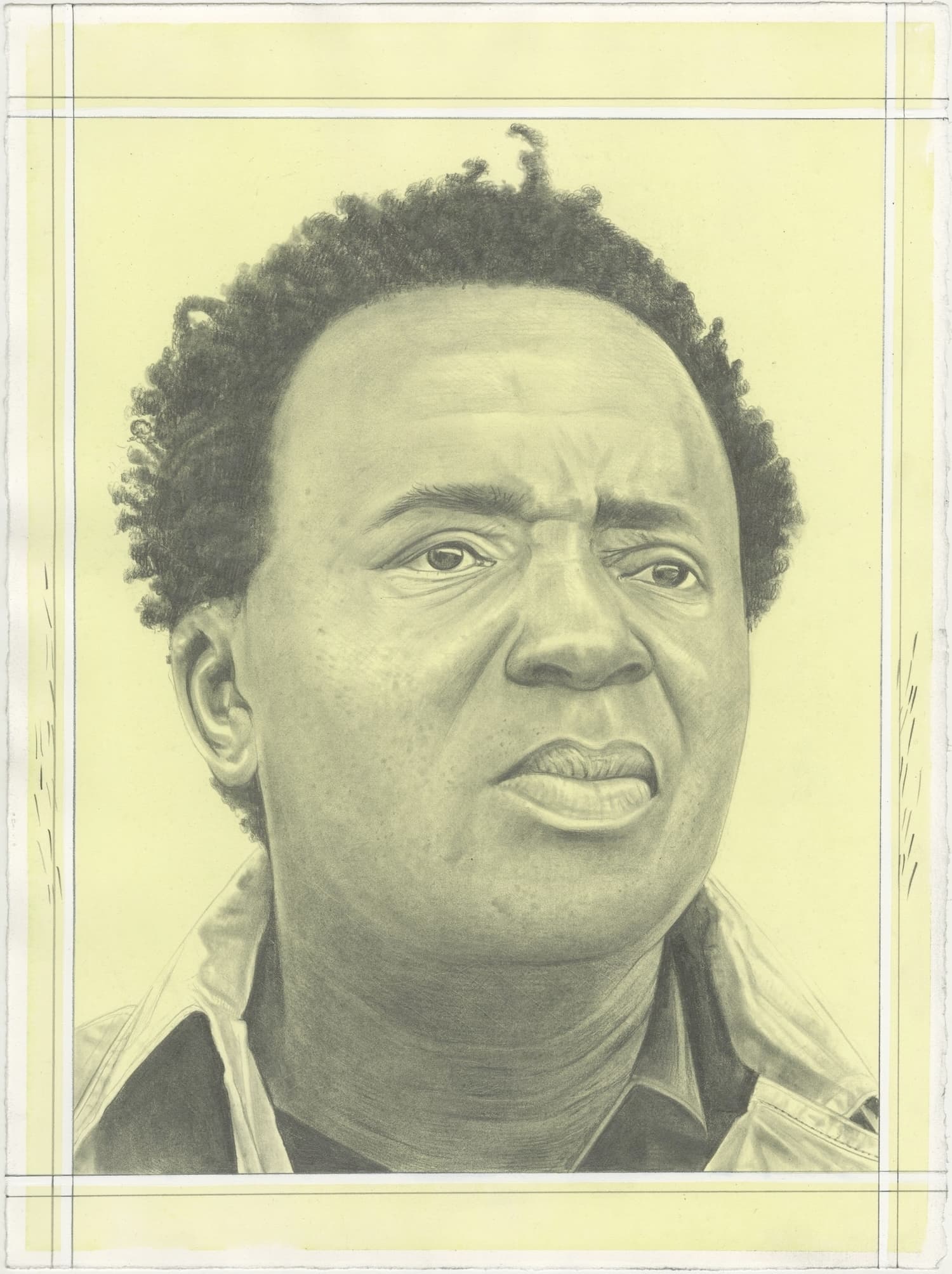
Portrait of John Akomfrah, pencil on paper by Phong H. Bui.
Word count: 4529
Paragraphs: 35
Lisson Gallery
February 11–April 25, 2026
New York
The canto has undergone several transformations since its well-defined emergence in the fourteenth century in Dante’s Commedia. For Dante, the canto functioned as a structural unit within a theological and cosmological narrative journey. Renaissance and early modern epics—Ludovico Ariosto’s Orlando Furioso, Torquato Tasso’s Gerusalemme Liberata, and Alonso de Ercilla’s La Araucana—retained the canto as a division within an expansive heroic narrative. The decisive shift came in the twentieth century with Ezra Pound. If for Dante the canto organized a coherent story, for Pound it became something else: a fragmentary unit, a collage, a container for history, economics, myth and politics—non-linear, multilingual, discontinuous. The canto shifted from chapter to method, from narrative division to modernist laboratory for marshalling civilization in fragments. In Listening All Night To The Rain, Sir John Akomfrah presents the US premiere of the critically acclaimed eight-canto work first unveiled at the British Pavilion during the sixtieth Venice Biennale. For its New York presentation, Akomfrah introduces a focused iteration of the project, debuting the central multi-channel film, Canto VI (2024), and reshaping the work’s structural inheritance into a cinematic experience tailored to this context. Rather than revive Dante’s narrative project, he adopts Pound’s modular logic and retools it for multi-screen installation. Here, the canto becomes an audiovisual vessel organizing colonial archives, diasporic memory, Black Atlantic and climate histories. Across these transformations, the ambition remains to hold disparate histories in relation and to make fragments cohere without erasing their fracture. What follows is a conversation about how such fragments are gathered, structured, and set in motion.

Installation view: John Akomfrah: Canto VI, Lisson Gallery, New York, 2026. © Smoking Dogs Films. Courtesy Smoking Dogs Films and Lisson Gallery.
Sabo Kpade (Rail): I’d like to start with a question about the lineage of the cantos. I’ve heard you speak admiringly about Ezra Pound’s The Cantos and the Italian and Spanish tradition of epic poetry. So my question is, just how useful is this literary lineage when you’re shaping a work such as Listening All Night To The Rain?
John Akomfrah: Well, the question of a literary shadow is literally that—it’s always there. Another way of considering it would be to think about the relationship between improvisation and a harmonic scale. I am aware of it, but I’m not drawing on it. There’s no obvious causality between the two. I’m not trying to do an Ezra Pound canto. I’m not even trying to emulate it, but it is a kind of charismatic presence. It’s something to be in conversation with. I’m not talking about his politics or ethics. I’m talking about the stylistic moves that he makes. I am interested in the seamless way in which he moves from one obsession to the next, from a kind of economic remuneration to a political one to a philosophic one—he moves effortlessly between subject matters and between centuries. There’s a kind of erudition to Pound, a well-learnedness, and when you’re in your sixties, you think, “Well, maybe I should aspire to that”—not that you necessarily make it. [Laughter] So it’s not an imitation, it’s not a mimicry. It’s not even an attempt to draw directly from what he’s done. It’s just to keep a kind of sense of affinity with him going.
Rail: Ezra Pound’s The Cantos spoke to the early twentieth century, and other epochs have relative poets, like Alonso de Ercilla, who wrote La Arucana in the late sixteenth century. Dante’s Commedia was the fourteenth century. Now, each of these centuries had this huge literary tradition that supposedly encapsulated them. In the twenty-first century, I think the claim can be made that the cantos in Listening All Night To The Rain stand on equal footing in relation to our own epoch.
Akomfrah: [Laughter] You know, the thing I continue to like about the modernist project—and by that I mean the project in literature that starts with Pound’s work in early 1900s—is the attempt to find a way of synthesizing lots of disparate elements into a whole. But it’s not a kind of organic whole. So when you look at The Cantos, it doesn’t try to be pretty or lyrical. There’s something angular, something a little bit cubistic about it—jarring in places even. But the ambition was always to try to be a kind of zeitgeist for a moment, to seize as many ideas that seem to organize that—it’s a kind of detrital aesthetic. It tries to dig up sedimentary elements on the culture and put it all together. And I share that ambition. I wanted to do something that draws on very many strands of themes and narratives and tropes that seem to me to still matter, if you try to understand our modernity in its African, European, or North American settings.
So I was trying to wrestle with things that I think are detrital sediments that have formed the kind of bedrock of our lives—and to that extent, yes, it’s Poundian, but no more than that. And whether that succeeds or not, whether it stands alongside a tradition even grander than Pound, I don’t know. I think there was always an ambitiousness to Pound. He wanted to do something that rivalled the early troubadours. He always wanted to be a kind of twentieth century equivalent of those figures. I don’t necessarily want to be that, but I want to learn from the desire to pull from disparate sources, to try and use the fora of your work as a sort of a vessel for containing and displaying disparate themes and narratives.

Installation view: John Akomfrah: Canto VI, Lisson Gallery, New York, 2026. © Smoking Dogs Films. Courtesy Smoking Dogs Films and Lisson Gallery.
Rail: When you mentioned detritus, I began thinking about fragments and allegory—about what Walter Benjamin wrote on allegory. There’s always the possibility of instability in interpretation, even overload. If one knows it’s an Akomfrah work, one assumes every shot has been thought through, that every image carries potential meaning—and therefore risk. I wonder how you rein that in without closing down the work? How do you avoid over-interpretation?
Akomfrah: I’m glad you mentioned allegory and risk, because the risk of improvisational music—jazz in particular—is very important. The risk of overload is important to me. In fact, I don’t really see the overload as risk, because just about everything you see in the work—whether it’s around a Black body, moments of Black history, or events around feminism—all of these narrative tropes, events, and characters are all already over-coded. They come with layers of meaning, whether I do something about it or not. So the disruptive moves that I want to set up connect with emotion. I’m trying to get things to do what Don Letts calls “culture clash”: to get things to bounce off each other, to see whether that momentarily dislodges or dislocates the direction in which they’re going. And that’s necessary, because oftentimes people assume everything I’m interested in is self-contained. So they’re like, “Okay, well, he’s doing African history. So that’s about Africans, that’s about Black people.” Ergo, it’s about Black men. Or, you know, they always come with this prescription.
People come with a sense of expectation about what they think those categories mean. So if you can get the categories—and the events that embody those categories—to somehow bounce off each other, then you can set in motion other resonances, other implications of what it meant to be African in 1959 on the eve of the independence for Nigeria, or Kenya. What did it mean? Who is the best character to speak about that? What is the root? The river of feminism, where does it start? And who can be seen to contribute to it? Who can be seen to gain from it? It’s just trying to get people to walk into the water and stand there for a bit and feel the depth, feel the temperature change, and you go from, “Oh, I’m really warm and comfortable and certain,” to, “Oh shit, this is a bit cold, this is actually uncomfortable.” There’s a kind of flow, and that’s not what happens when you stand on the bank. When you stand on the bank, nothing really troubles you. When you stand in water, you are troubled either by the flow, the force, the temperature—something happens. You are forced to go into another state, as it were. And that’s all I’m trying to get you to do. I want the certainties that appear to come with those audience members to be momentarily dislodged from their moorings, so they can float a bit, and so you can get to know a little bit more—either about me or somebody else.
Look, when I was seventeen, I was reading the Black radical tradition, whether it’s C.L.R. James or George Jackson’s prison letters. But at eighteen, I took one of the first experimental women’s studies classes in England, and I was introduced to feminism. It was such a shock. I remember the book. It was a book called Against Our Will, written by a woman called Susan Brownmiller. And in it, Brownmiller writes about how rape was used as a weapon by men to dominate women. That was such a shocking insight. I was like, “Really?!” And then the first chapter talked about one of my favorite books, Eldridge Cleaver’s Soul on Ice, and how Cleaver talked about rape, going out in search of white women to rape as a kind of revenge—I was like, “Shit, I didn’t see that.” I didn’t see the alternative reading to what he was doing, which is that it’s violence against women.
So ever since then, I’ve been interested in what happens when you have certainties and you’re moved into the slipstream of other narratives. What happens then? I’ll never forget that feeling, because I was so certain that I knew what Black Liberation meant. I was so completely convinced. And yet, in the seeds of the so-called “Manuals of Liberation,” there were, shall we say, fragments of other illiberal attitudes that I hadn’t seen at all. So my attachment to bricolage and fragments—it’s not just an aesthetic gesture. It’s an ethical move to see how many elements of the things that I think are important can be switched on at the same time. How many things can I animate and reanimate simultaneously? So they’re all like go-carts in a field bouncing off each other, setting off associations. That’s important to me.
That’s all a way of saying: I don’t mind the overload or excess. I take the risks knowing that there will be the possibility of overload or excess, and I don’t mind people reading outside of my ambitions, because sometimes it’s the only way that you’re going to get anything. Eldridge Cleaver wanted me to know he was a revolutionary Black figure—turns out he was a rapist, and I hadn’t seen it. So I’m modest about any demands I make of people.

Installation view: John Akomfrah: Canto VI, Lisson Gallery, New York, 2026. © Smoking Dogs Films. Courtesy Smoking Dogs Films and Lisson Gallery.
Rail: On the matter of fragments from the film, one that stays with me is from a British newsreel. A male voice says, “Representatives of Patrice Lumumba are insisting that the United Nations take over Katanga by force.” It’s brief. Another fragment notes that the Congolese state had broken down in six months—just those six months, without the before or after. I know these come from longer broadcasts, but in the film they feel like fragments of fragments. How do you decide which archival fragments to isolate and deploy, knowing each carries its own resonance?
Akomfrah: I think with everything that’s in the film, I feel like, “I need to lean into this.” And leaning in always requires some selective appropriations, because both of the fragments you mentioned came from news items that are longer than my entire piece. This particular Canto is only thirty minutes long. I’m pulling a fragment from a Panorama program in England from 1961 which is thirty minutes long itself. So at some point it’s not so much the archive itself—it’s about what best represents what you’re trying to say, given the fact that you can’t use everything. So my awareness of limits in the beginning then starts to define what becomes appropriate. So if I give you Richard Dimbleby speaking on Panorama in one of the earliest of news programs in the sixties about the Congo, you also know from me that there’s a life before 1960—so I offer you a number of photographs of the Congo in the nineteenth century, where a man’s clearly been pulled from his “native habitat,” stood in front of a glass plate camera, and told to stand for two minutes in order for the photo not to not have a blur. And he does it. So, in what becomes the film, I try to find fragments of a Congo-ness—fragments of brilliance, fragments of excellence, fragments of the disaster that I can put in conversation with each other.
You might not necessarily know that all of them are related, and sometimes the only way you know they’re related is if you see them together, and that’s the value of multi-screen work. I can have Patrice Lumumba speaking on screen two and a Baluba man on screen three, and white hunters who just killed an elephant and feel the best way to express their masculinity is to sit on top of it on screen four. There’s lots more there than just the voice. The voice is supposed to talk to all these other elements, or vice versa—they’re supposed to talk to the voice. At any moment, what constitutes the moment, the event, is underscored, underwritten by all this other stuff. And you can do that when you make eight-screen works.
I can tell you the future, the past, and the present of an event. I can tell you I’m talking about the Congo as is experienced by a young white woman who had to leave as a child because of the massacres, and she’s standing on the beach in the present. But then you see her as a child in the past, and then you see Lumumba speaking about the greatness of Congo in the distant past, so that at any one time there are multiple timelines all occurring simultaneously. It’s difficult to do that on a single screen, but on multiple screens, you can have time bifurcated, time as fragment, time as bricolage, time as a set of overlapping tropes. You can have all of that, if you want. And I always do. [Laughter] But I know lots of people who make multi-screen works who are not obsessed with time. They want to deal with the present, or the body. For me, the multi-screen installation is about trying to explore the manifold form that time takes at any one moment.

John Akomfrah, Listening All Night To The Rain (Canto VI), 2024. 8 channel HD video installation with surround sound, 30 minutes approximately. © Smoking Dogs Films. Courtesy Smoking Dogs Films and Lisson Gallery.
Rail: One fragment affected me deeply—the image of Lumumba sitting on the ground, arrested, his hands bound behind his back. I’m forty-one. I’ve seen a lot, but I don’t think I had seen that footage until your film. There’s a moment when a soldier tugs at the rope, asserting a kind of superiority. Even knowing what would happen to Lumumba—that his body would be dissolved in acid—that gesture was hard to watch. It carried a terrible finality. It was also difficult to see a Black soldier doing that. For a moment, it felt like betrayal. But then I remembered Wole Soyinka’s line about the oppressor’s boot and the irrelevance of who wears it. That helped me step back—to consider the wider machinations behind Lumumba’s downfall. Still, the fragment went straight to something like shame or regret, before the historical reasoning arrived. I suppose I’m saying that a fragment like that doesn’t just inform—it destabilizes. It moves first at the level of affect, and only later at the level of analysis.
Akomfrah: Yes, I know what you mean. The thing with that moment is that you see Lumumba trussed-up like an animal, and I don’t use that word as a pejorative. Animality is not a problem for me—but in that instance, Lumumba is being treated as something less than human. And for me, it’s a culmination, because we’ve set in motion these violent events that run a minute and a half before, of soldiers chasing people and throwing guns at them. You know, people being punched. The Minister being hit in the head. So by the time you get to Lumumba being trussed-up, you have been made aware of a kind of history of violence unfolding, and that’s what I meant by trying to hold different conceptions of time—different registers of time simultaneously in the same project.
The image of Lumumba being tied up runs alongside the ones of the man who, in a way, has licensed that: Joseph-Désiré Mobutu. He was Lumumba’s chosen commander of the army, somebody brought along who’s standing there with his arms folded in this kind of relaxed mode, watching this happen. But then at the same time, you see a series of color photographs of Mobutu at the White House four months later, being serenaded by the actual figures who made this possible. He’s in the Rose Garden with John F. Kennedy being saluted as a hero. He’s just had an elected Prime Minister killed, but that didn’t seem to affect his international standing. In fact, if anything, it made it more acceptable—made him more acceptable.
Nonetheless, it is an unflinchingly brutal moment to confront people with. But at the same time, I offer it as one of several fragments of one story, which is the dissolution of the Congo. Who was responsible? Who paid for the deeds? Who carried out the deeds? What’s the history that led to that moment? The Congo is one of those things I’ll never get tired of, because at the center of it is an enigma that I can’t solve, and so I go around it again and again and again. Why is it okay to have a destroyed Congo? In whose interest is the destroyed Congo, when you could easily have it the other way? I mean, the Congo is a vast place with enormous resources—every conceivable mineral on the planet is there. Why is it okay for it to always be fucked up? Why can’t the Congo just be okay? I mean, who benefits from the Congo being in this state? I don’t understand. It doesn’t make sense to me. Who actually gains anything? I don’t understand it.
So I go back to the Congo over and over, trying to understand something that is beyond understanding, and actually I’m not sure that there’s anyone for whom this makes sense. And normally, when people get to this bit, they resort to a kind of African fatalism. They think, “Oh, well, that’s what happens.” It’s like, “Well, yeah, but why does it?” I don’t get it. There was a century, starting with Leopold II—1890s to the 1990s—when you think, “Jesus Christ, man. Anyone who was unfortunate enough to be born in this place has to have, like, ten generations of hell.” Why? It doesn’t make sense to me. Really, who gains from this hell? Certainly not the Congolese.
It’s like, okay, you’re an extracting machine. But why do you need for things to be fucked up in order for it to be extracted? I don’t understand the equation. So I go back to these moments—not because I want to teach anything, but because I’m trying to learn something myself. They don’t make sense to me. Lumumba’s death does not make sense to me, even now. So you have uranium in this part of the Congo, and you don’t want the Soviet Union to know. Alright, okay, so that means you can kill this guy? Dissolve his body in acid, so that all that’s left of him is a tooth that’s given to his kids? That’s it? What’s the point of all of this? What’s the point of all this violence? I don’t get it. And either it makes me naïve or stupid, or both. I’m happy to accept that, but I don’t understand why the dystopic has to be the norm.

Installation view: John Akomfrah: Canto VI, Lisson Gallery, New York, 2026. © Smoking Dogs Films. Courtesy Smoking Dogs Films and Lisson Gallery.
Rail: You’ve cited Henryk Górecki’s Symphony of Sorrowful Songs as an influence. That piece draws on a fragment written on the wall of a Gestapo prison cell during the Holocaust. It made me think about how fragments migrate across works and across time. In your films, is sound meant to intuit meaning—or to generate it?
Akomfrah: We just spent the last three hours installing Canto VI, and as usual, fine-tuning the images—relatively speaking—didn’t take too long. The sound always takes a bit longer, especially with this one, because it’s a 360 degree experience. You’ve got eight screens, and they go across four walls, so at any one time what’s happening in front of you corresponds to something behind you. So there’s never really a back. Everyone’s got their own front and a back, but they’re interchangeable. So that makes it take a while.
The second reason it takes a while is because the sound is not an accompaniment in the obvious sense of the word. Usually, the ways in which sound accompanies is that it directly talks to what’s happening on screen. There’s a person, and you’re hearing them, but non-diegetic sound is not emanating from the image, so it has a freedom to go where it wants to go—but it also has the burden of independence. And there are perils to that freedom: Does it have the clarity? Does it have the authority? Does it have the autonomy to speak for itself? And that’s why it takes a very long time to get it to a position of independence.
I learned that from a lot of people, but you’re right to mention Górecki and the Sorrowful Songs, because what you get from him—and I think you get it from most great operatic scores—is the value of the libretto. The libretto is obviously always a fragment. It’s been drawn from something bigger, in this case, the history of the Holocaust. So you have to find the appropriate fragment from the whole, which is what he does brilliantly, and he does that every time—but the Symphony of Sorrowful Songs is particularly great for that.

John Akomfrah, Listening All Night To The Rain (Canto VI), 2024. 8 channel HD video installation with surround sound, 30 minutes approximately. © Smoking Dogs Films. Courtesy Smoking Dogs Films and Lisson Gallery.
You think, “Okay, so this is how compassion and care and brilliance and insight into a moment of the Holocaust can be made manifest in a project.” It’s not by bombastically announcing the horror itself. It’s about trying to get a fragment that stands as a revealing portrait of the whole, so you know what you’re looking at is an embodied fragment of something larger. But at the same time, that moment is not trying to be everything. It wants to be true about itself, and it believes that if it’s true enough about itself, it will tell you something about the larger portrait. In other words, it’s a kind of local-universal relationship—a discussion. If you’re sufficiently specific and brutally local, sometimes you’re lucky enough to break into the underground river of eternity.
Another work that does that well is Claude Lanzmann’s Shoah, which is this nine-and-a-half-hour documentary about the Holocaust. It starts with the voice of a young boy, but it accompanies an older man who’s floating on this river. Slowly it becomes clear that you’re watching someone who’s part of something bigger than himself. But for that moment, it’s just him floating in a boat going down this river. He gets off the boat and meets a group of older women. They all say, “So you grew up to be a big man!” The reason they remember him is because they remember him singing as a child in the concentration camp. They heard his voice because they lived around the camp. And as you’re watching this boy listening to them, you can see him thinking, “You guys were always here?”
Rail: Your films attempt to restore presence and testimony. I sometimes wonder where that restoration sits philosophically. Is it closer to John Ruskin’s idea of sublimity? Or nearer to what Saidiya Hartman calls “critical fabulation?” Or perhaps to Christina Sharpe’s notion of “wake work”?

John Akomfrah, Listening All Night To The Rain (Canto VI), 2024. 8 channel HD video installation with surround sound, 30 minutes approximately. © Smoking Dogs Films. Courtesy Smoking Dogs Films and Lisson Gallery.
Akomfrah: The point is always where you jump off, isn’t it? Where you take the leap into the unknown. And of course, I will forever acknowledge how important J.M.W. Turner has been in my life. I’m never going to deny the affinity with me. But he is a jumping off point. You look at his Slave Ship (1840), and as a painting, it’s just incredible. There’s a section of the painting that I’m particularly interested in, in that he wants to render an abstract study of light. But I want to be in there. I want to understand that, so I literally jump off the boat that he’s offered, because Turner is very cinematic. Every time you look at a Turner, there’s always a point of view—a place from which you can get into the painting. And it’s clear that the view of the slave ship is from a boat. You can sense where you are. You’re on the deck of a boat watching, spectating on a disaster, and you’re going away from it. But I’m going to be where I want to be, where the disaster is—you know what I mean?
I’m interested in that fragment. I’m interested in that texture of the disaster that he’s delineating without necessarily wanting to be graphic, and I think we have to be careful in our choice between the pornographic and the graphic—that we don’t get overly sensational in our understanding of things. But there is something there. And I know that with Afro-sublimity, once you’ve gone through the door of no return, there’s no going back. You have to go forward. There’s no way I can go with that ship, because that ship’s not going to take me to port. The port is worse than the water, so I need to stay there. I need to understand what’s happening there. So, yes, I mean, obviously, like everybody else who’s written stuff about it—whether it’s Christina Sharpe or Saidiya Hartman—I want to stay there. We all want to be there for different reasons, but we all want to be in that moment to understand the unfolding disaster and what the ethical implications of that are.
Rail: What are your expectations for Listening All Night To The Rain, when it opens in New York?
Akomfrah: We’ve spoken for the last hour about fragments, and everything I’ve said is that the possibility is that the fragments can stand for the whole. Well, this is one concrete example of that. The Venice iteration of Listening All Night To The Rain had eight cantos; here, you’ve got one. But I think there are sufficient thematic, aesthetic overlaps between this one and the others that—if you didn’t make it to Venice—you can get a sense of what we tried to do in Venice. I’m really glad that out of all the cantos, it’s this one that’s here. I think Canto VI has many of the thematic concerns of the others. I hope people have a good time with it, and if not, at least they have a thoughtful time with it.
Sabo Kpade is a critic and scholar working on Black Atlantic visual culture.