Richard Hell’s Godlike
Word count: 923
Paragraphs: 8
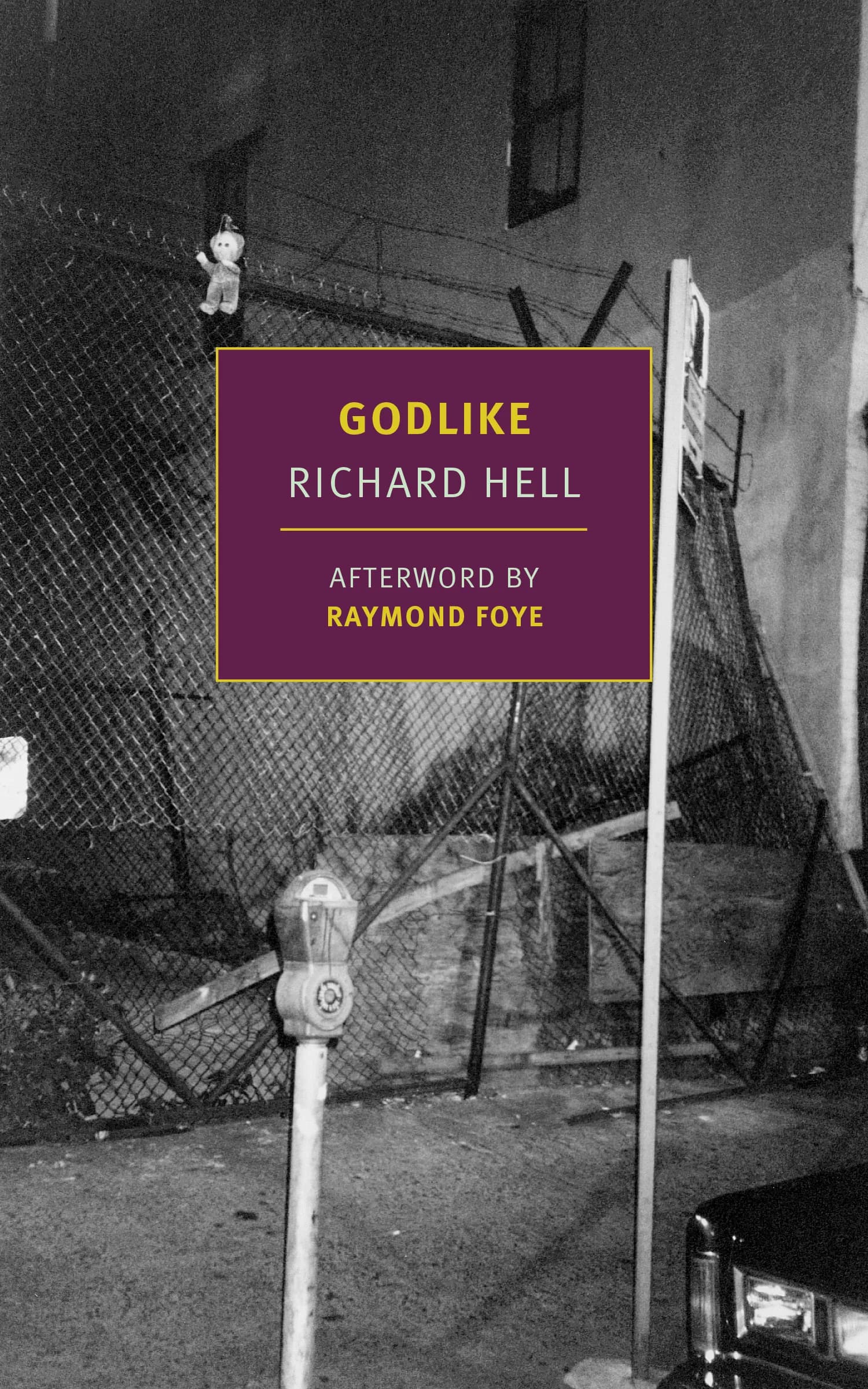
Godlike
NYRB Classics, 2026
First published in 2005, Richard Hell’s Godlike is being reissued this year as a NYRB Classic, which means that after a little over two decades it has been selected as a work of literature most likely to be discovered “outside the classroom and then remember[ed] for life.” The list for 2026 also includes John Berger’s 1972 Booker prize winning novel G. and Barbara Trapido’s incredible bildungsroman Brother of the More Famous Jack, which won the Whitbread special prize for fiction in 1982. What makes a gritty and lyrical novel like Godlike admissible to this elite canon is its frank and joyful celebration of the values, principles, and desires that flow against the general current of academic culture. In Hell’s “classic” novel we read about the tumultuous, high-voltage relationship that takes shape between two gay poets, aged sixteen and twenty-seven, in the New York of the 1970s. They fuck, they get high, they get drunk, they go to parties—consequences be damned.
It’s both a young person’s book and not. The action gives the story its youth, but the narrator’s tendency to memorialize those events make it feel more mature. In fact, the book is mostly about memory: what is recorded, what is forgotten, what is erased or preserved. Subjective considerations like these ultimately boil down to value judgements. What a person assigns importance to not only reveals who that person is but shapes who that person becomes. People change, values shift, and what we cherish ages, too. So when the object of one’s love disappears—or dies—what else can you do but pay tribute? This is the foundation from which Hell builds his book.
Godlike has a double-barreled narrative that shifts almost chapter to chapter. Hell alternates between a flowing stream-of-consciousness to a more halting, third-person point of view. Both barrels ultimately lead to the same chamber: a bed at a mental hospital in which our narrator, Paul Vaughn, is lying. One narrative details Vaughn’s current predicament as an inmate; the other tracks a love story more than twenty years old. Before either begins, however, Hell presents a sly conceit in the form of a letter from the protagonist to the reader—triggering a metafictional situation—claiming Godlike is drawn from notebooks Paul Vaughn filled up in one month in 1997 at the encouragement of his editor. So you wonder: if Jack Kerouac is Sal Paradise, is Paul Vaughn Richard Hell?
Well, yes and no. Richard Hell was born in 1949, so he was in his mid-fifties when the book was published. Paul is in his mid-fifties. There are characters and scenes that correspond directly to the downtown poetry community. Hell’s friend Ted Berrigan shows up; throughout the book Hell quotes James Schuyler, Rene Ricard, Bill Knott, Ron Padgett. And Hell gives a walking tour of places to eat on 2nd Avenue, most which are gone. While all of this detail makes the reader feel a nearness to autobiography, it is a work of fiction. The two main characters are reincarnations of Arthur Rimbaud and Paul Verlaine. So Paul Vaughn is not Richard Hell; Paul Vaughn is Paul Verlaine.
The part of Arthur Rimbaud is played by Randall Terence Wode, a young poet whose passion and desire is what ultimately shapes the narrative. As was true of the relationship between Verlaine and Rimbaud, the younger poet exerts a profound influence on the older poet. There is no balance of power. Many questionable decisions are made as Vaughn grows increasingly enamored by his young friend. Right away, they become selfish lovers, but that self-centeredness creates the kind of breath-taking gravity that bends everything around itself. “This was the reality behind the reality … T. was his master all was solved because he had his role—go with T., who understood him and loved him to the extent that a human god can love.” It sets the tone for their love story to shift into the darker, more interesting zone of tragedy. When the breakdown occurs, it’s abrupt and indirect. Hell chooses to obfuscate instead of elucidate, leaving the reader in the shadows of their own imagination.
Godlike is the kind of book that can be devoured in a single sitting. Hell’s prose flows so smoothly, and his language is playful and provocative, full of witticism and insight. When Paul is reflecting on T.’s poetry he thinks, “people’s big ideas are usually just the keys to their own problems.” Another moment finds Paul answering his own questions: “How close is the imagination to reality? Close enough: even reality is not like reality.” He describes scenes that deserve a place in the people’s history of publishing, like the collating party for an “elegant” mimeo magazine called Space Pee. To Hell’s immense credit, it never gets sentimental—he preserves an edgy attitude that delights in its own offensiveness. And in nearly equal measure to its emotional intensity, the novel has a broad intellectual range. Paul Vaughn pivots from observations on quantum physics to ruminations on what it means to age, and how God relates to death. “It’s logical that to age is to approach God. God: the truth of death, reply to death, replacement for death.” However, the narrator doesn’t dwell on any of these philosophical opportunities; carnal desire quickly reasserts itself. Above all is a poet’s love for language, love for living, even a love for failure. In the end, the fact of death confirms for Paul that love is real. It isn’t something he feels; it’s something he knows to be true.
Charles Schultz
Charles M. Schultz is Managing Editor of the Brooklyn Rail.