Sophie Calle’s Catalogue Raisonné of the Unfinished
This book forms a portrait of the artist’s practice by looking at what she could not, or did not, accomplish.
Word count: 844
Paragraphs: 8
Sophie Calle
Actes Sud, 2025
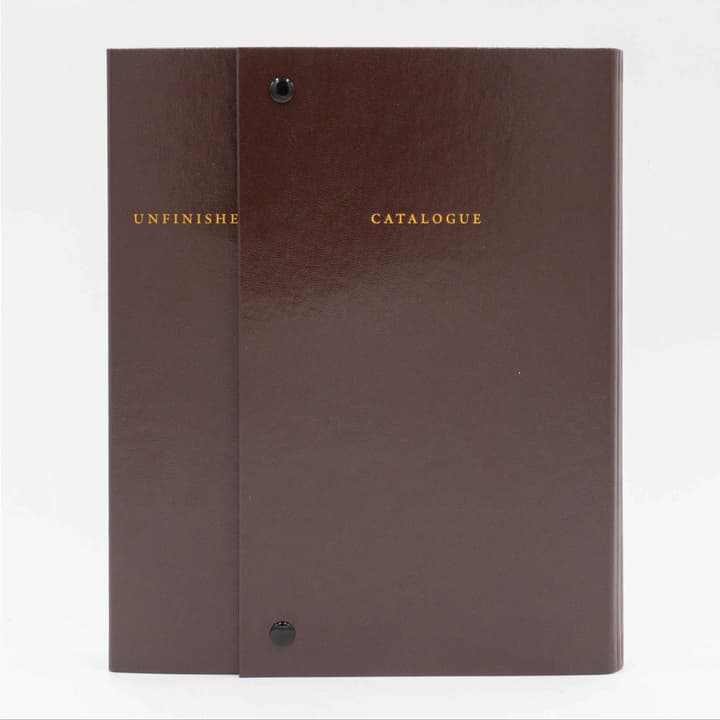
Sophie Calle’s Catalogue Raisonné of the Unfinished begins with a scan of a notebook’s cover, marked “Idees” in pen in the upper right-hand corner. An introductory text written by Calle describes a series of attempted or planned projects. These descriptions are interspersed with ephemera from these endeavors, scanned from the aforementioned notebook. This catalogue essay (of sorts) sets the tone for this publication as a compendium of the most private parts of Calle’s practice—the unfinished and abandoned projects that have languished in notebooks, memories and email drafts—presented with unsentimental retrospection.
It’s perhaps fitting that the only formal catalogue raisonné of Calle’s work documents this negative space around her completed work. Calle tends to fixate on absence, Lili Owen Rowlands noted in her New Yorker profile of the artist, forming portraits of strangers, experiences, or herself by painstakingly piecing together traces of them. In “L’Hôtel,” perhaps Calle’s best-known project, she took a job as a maid in a Venetian hotel, forming portraits of the guests by cataloguing and photographing their possessions. In “Voir La Mer” [To See the Sea], Calle asked inhabitants of Istanbul who had never seen the water to view it for the first time, photographing the aftermath of “those eyes that had just seen the sea.”
Catalogue Raisonné of the Unfinished similarly forms a portrait of Calle’s practice by looking at that which she could not, or did not, accomplish. The main catalogue is arranged according to categories of unfinishedness: errors and mishaps, sketches for future projects, attempts that failed for various reasons, projects that have yet to be created, and projects that have been started but remain on hold. Each project contains a framed work with a title, a brief description and, in large red letters, a short note about why the project remains incomplete. The facing pages contain related archival material. Her reasons for leaving these works unfinished range from dismissive (“UNNECESSARY” “WHAT’S THE POINT”) to scornful (“INFERNAL” “ENTERTAINING, NOTHING MORE”). It concludes with her one forthcoming posthumous project—a will, of sorts, that demands a group of sentimental objects be destroyed without opening. Paradoxically, cataloguing this project preserves evidence of it in perpetuity.
This catalogue was originally conceived in conjunction with Calle’s 2023 exhibition, À toi de faire, ma mignonne at the Musée Picasso in Paris. The first version of the Catalogue Raisonné of the Unfinished occupied the exhibition’s upper floor, adjacent to an inventory of the sixty-one projects completed by the artist throughout her career. Though Picasso’s work was, at Calle’s request, absent from the museum during her exhibition, traces of his presence are visible in Calle’s staging of her own work. Her decision to create a catalogue raisonné in conjunction with the Musée Picasso exhibition summons allusions to Picasso’s own project with Christian Zervos. A remarkably complete archive of his oeuvre, the thirty-three-volume project was published between 1932 and 1978 and contained more than 16,000 works. It’s also one of the best examples of an artist using their catalogue raisonné as a tool for self-mythologizing. Picasso’s project presented him as a veritable genius whose artistic development could be tracked down to the day, allowing scholars to chart the appearance and evolution of themes and motifs.
The catalogue raisonné is meant to be a definitive record of an artist’s work, but the genre also serves to cement an artist’s legacy, preserving a certain narrative of their practice. Gerhard Richter’s catalogue raisonné is reflexive, both tracing and shaping the development of his oeuvre. He numbers each work he creates, preemptively assigning its place within future editions of the catalogue raisonné. Felix Gonzalez-Torres’s posthumous catalogue raisonné attempts to account for the expansive nature of his practice by including archival material and non-works (materials that Gonzalez-Torres presented in exhibitions but did not consider works) after the standard grouping of fully-fledged works. Like Picasso, Calle has spent much of her career pondering her legacy. In 2017, she asked the writer and actor Adrian Dannatt to write her obituary, which she framed in a shadowbox and obscured with dead moths. She attempted to stage a dress rehearsal of her own funeral and chronicled the deaths of her own parents with remarkable objectivity. Elsewhere in the Musée Picasso exhibition, she presented the contents of her home in Malakoff, which had been inventoried by the auctioneers at the Hôtel Drouot in Paris, presenting her personal effects as though they were a private collection to be offered for sale.
In her own catalogue raisonné, Calle sought “to finish the unfinished,” securing her legacy by embalming these aborted projects in their present state. The red, all-caps descriptions she assigns each attempt reinforces the finality of the exercise—once labeled “unnecessary,” an unfinished work cannot be revived. Though it is presented as an act of artistic vulnerability and an inversion of the traditional catalogue raisonné, Calle’s publication still performs the genre’s core duties. Catalogue Raisonné of the Unfinished immortalizes her practice as a self-critical, sometimes tongue-in-cheek exercise in a careful exchange between disarming vulnerability and tactical defensiveness.
Jonah Goldman Kay is a writer and editor based in New Orleans.