Greer Lankton’s Could It Be Love
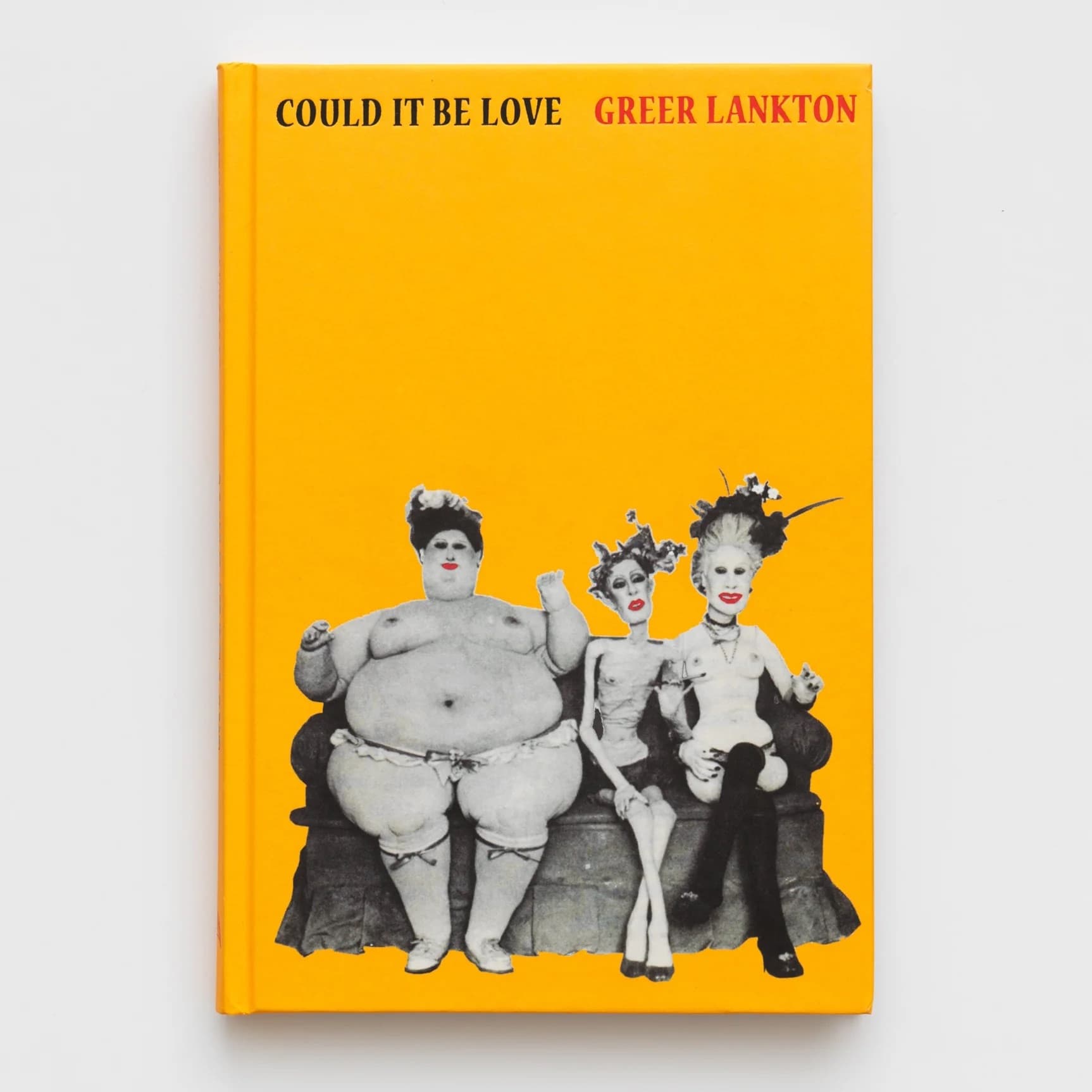
The monograph collects over one hundred photographs by the artist of her dolls, carefully posed and artfully staged.
Word count: 844
Paragraphs: 11
Greer Lankton
Edited by Francis Schichtel, Jordan Weitzman, and Nan Goldin
Magic Hour Press, 2025
It would be easy to describe Greer Lankton as another instance of a visionary trans artist “rescued” from history, but there has been sustained interest in her work since her death in 1996; her ex-husband, Paul Monroe, maintains the Greer Lankton Archives Museum (G.L.A.M.) with an active Instagram presence. During her lifetime, she was included in both the Whitney Biennial and the Venice Biennale. Lankton’s family donated the large-scale installation piece It’s All About ME, Not You (1996) to the Mattress Factory in Pittsburgh—where the work was first exhibited—for permanent display in 2009, followed by her personal archive in 2014, which is now largely digitized and available for online perusal. Many of her sketchbooks are now in the collection of MoMA. It seems inevitable that her art will inspire a fashion designer soon. Love Me, the first major solo exhibition of her work in New York since her death, opened in 2014 and traveled to Berlin in 2015—but no catalogue ever emerged.
Could It Be Love is the first monograph dedicated to Lankton’s art, produced with the Mattress Factory’s archive (not G.L.A.M.). It collects together over one hundred photographs taken by Lankton of her dolls, carefully posed and artfully staged: these aren’t installation photographs, never do we see the white walls of a gallery. One sits astride a motorcycle on a beach, another lounges on a stoop. Many of her dolls smoke, ash on the tips of their cigarettes; they admire themselves in vanity mirrors, they kiss and, presumably, they fuck. Lankton rejected the smooth crotches of Barbie and G.I. Joe: her dolls have genitalia, innards, viscera.
Supplementary photographs by celebrated photographers Peter Hujar, David Armstrong, and Nan Goldin (who also co-edited the book) provide portraits of the artist. In one photograph, taken by Goldin and used on the back cover, the artist poses amongst her dolls. It is not that they are her (chosen) family, nor is she merely their benevolent creatrix: they coexist, uneasily.
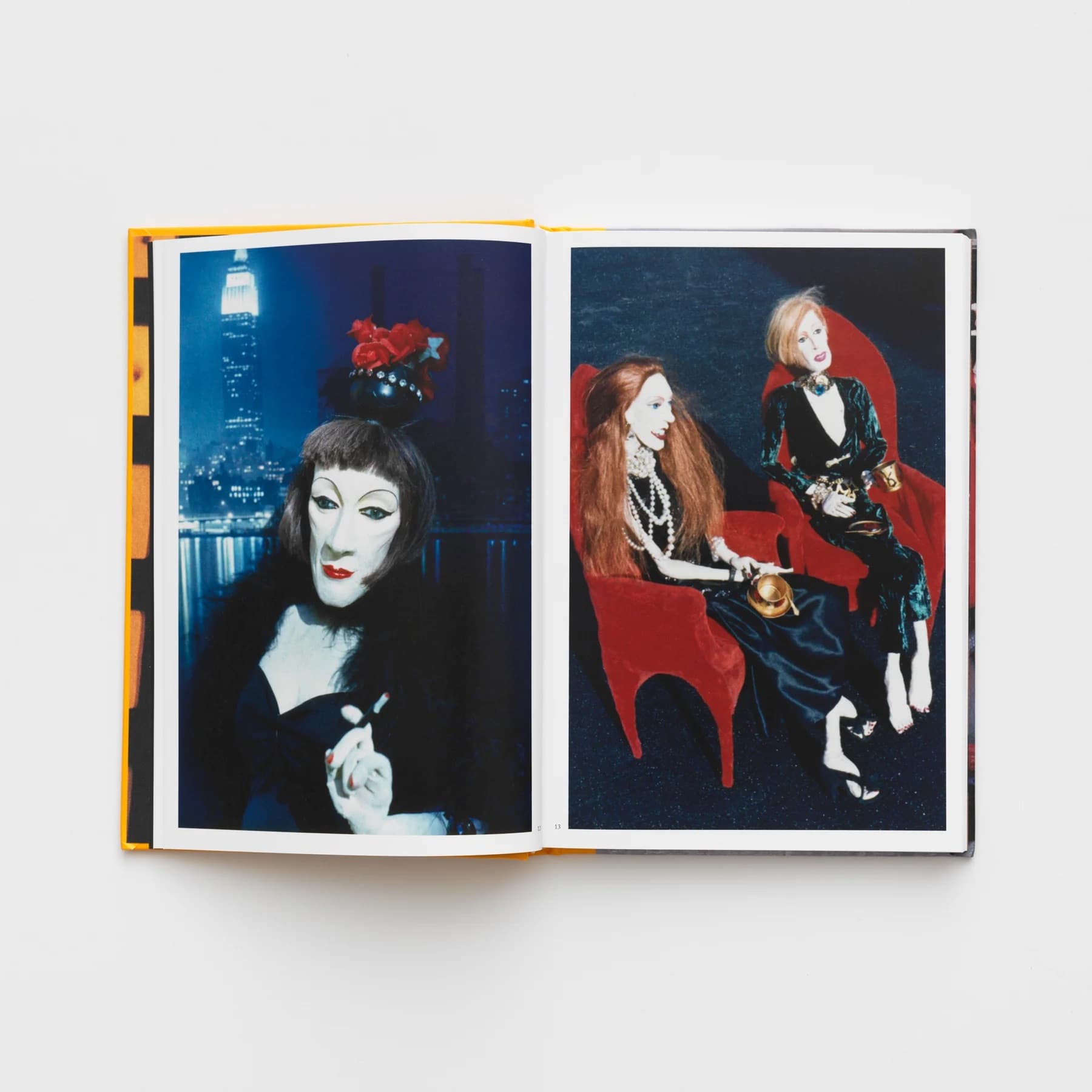
In lieu of a list of titles (many of these photographs are personal studies, perhaps never intended for publication), the editors include a cast list (“in order of appearance”), including both her own characters, Uncle Earl and Grandma Myrtle, and real-life celebrities, Warhol Superstar Candy Darling, Divine, Andy Warhol himself, and Coco Chanel. “Greer Lankton”—a self-portrait doll, curled up in a hospital bed—appears once, too. Lankton extends grace and empathy to her dolls, however strange: “They’re all freaks. Outsiders, untouchables. They’re like biographies, the kind of people you’d like to know about.” She identifies with her freaks, makes them complex, nuanced. She makes the untouchables tactile.
There’s an important distinction between her dolls—as sculptures and art objects—and her photographs of dolls. Some of the photographs are out of focus, poorly lit, strangely framed; often, this only adds to their charm. Any sense of scale is lost: some of the dolls are, well, doll-sized, as for a child, while others are closer to mannequins or even larger than life. There’s one exception where a doll poses alongside Cherry, a white dog who seems suddenly huge, yet sits comfortably next to her lifeless companion. These works are thoroughly playful and often funny, as well as highly serious.
The eerie materiality of her work shines through: their faces painted with both makeup and acrylic paint, glass eyes that shine. Sutures and seams show. They pose—actively—instead of seeming like they are being posed. They expose themselves: a cock flashed by a subway station, a hand sliced open; a doll unpicks herself, comes apart at the seams, literally, and smiles.

The editors include a brief and beautiful piece by Hilton Als, reprinted from 2014, who remembers Greer and her scene. It does feel like a missed opportunity to not commission new writing, personal essays or criticism, for the publication. Zefyr Lisowski, Harron Walker, Kay Gabriel, Mattilda Bernstein Sycamore, and Alaska Riley have all written recent essays on the artist—each combining personal reflection with cultural criticism—the latter three all in response to the publication by Primary Information of the artist’s Sketchbook, September 1977 in 2023.
One of the strangest and most unusual works, a grid of cast belly buttons created for her senior thesis show at the Pratt Institute in 1980, which contextualizes the dolls within her broader sculptural practice, is sidelined in the book as a grid of installation images on the endpapers. Lankton also produced paintings and drawings, found object assemblages; she made short films that used stop motion animation for eerie, uncanny effect.
Lankton left New York in 1991, struggling with addiction amidst a community being decimated by AIDS, and moved to Chicago. She died in 1996 of a cocaine overdose in her apartment; it was ruled a suicide. Greer’s dolls survive, they persist—framed by her camera, they are as alive as they have ever been. Could it be love? Certainly, there’s no doubt about it. Love me, the dolls ventriloquize.
Louis Shankar is a writer, researcher, and Ph.D. candidate at UCL. They live in East London.