Bharat Sikka’s Ripples in the Pond
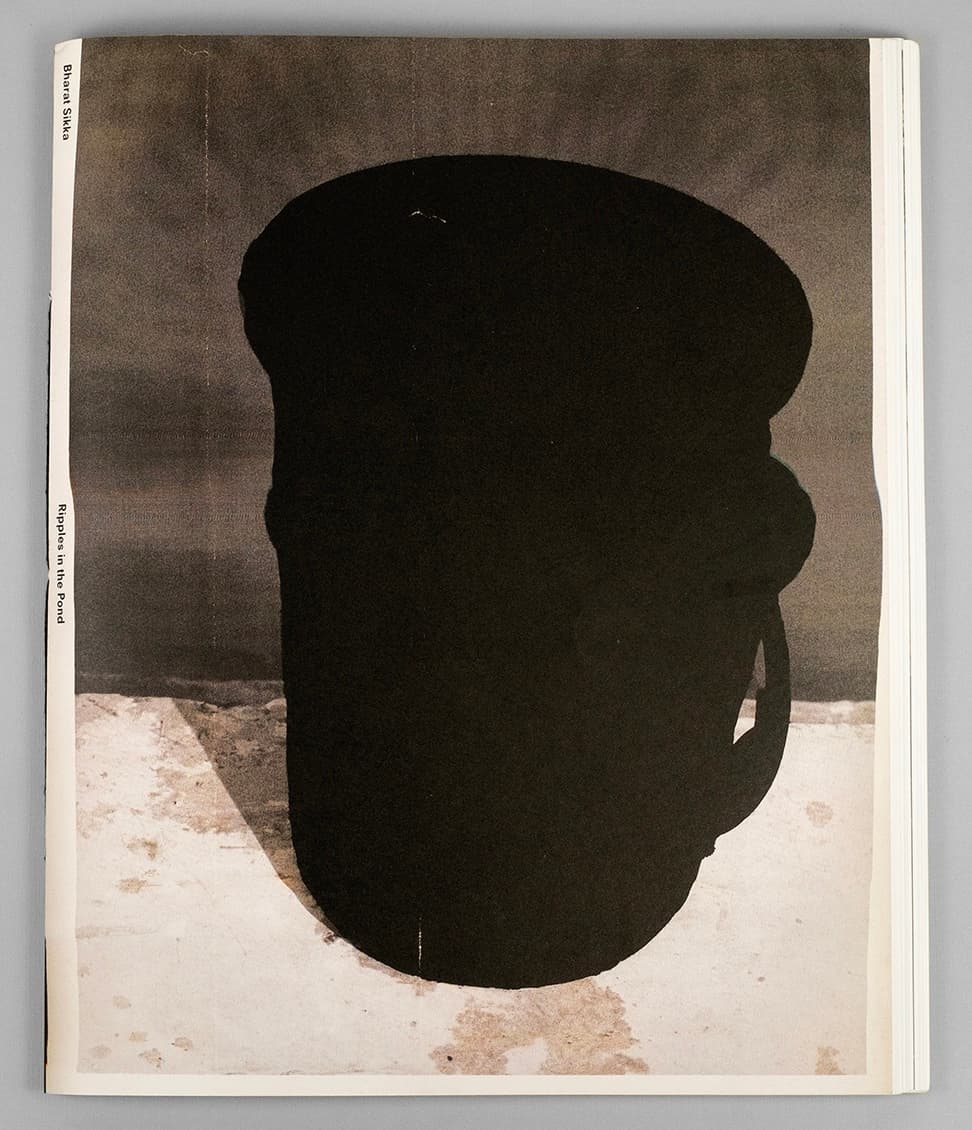
Techniques of distortion, collage, and multiple exposure describe the changes taking place across Makharda, where evidence of industrial blight and environmental decay is increasingly more visible.
Word count: 715
Paragraphs: 6
Bharat Sikka
Fw:Books, 2025
Over the past decade, Bharat Sikka has established himself as one of photography’s most tireless and imaginative bookmakers. From his early investigations into the rapidly changing social and symbolic landscapes of contemporary India, to his most recent exploration of the generative capabilities of artificial intelligence, Sikka has remained critically engaged with the evolving nature of the medium's relationship to emergent technologies and regimes of image production and social use. A distinctive quality in his photographs is their tenuous, conditional relationship to classic documentary; his images are more often constructed than they are found, which is perhaps a different way of saying that his photography is engaged with the lens as a device for rearranging the world more than it is with the shutter as a way of arresting time. Likewise, the digital and analog manipulations that populate his book sequences are often expressed through strategies of doubling and repetition that emphasize the similarly constructed nature of the photographic image itself. This quality cannot be detached from its historical and contemporary contexts. All of these aesthetic and conceptual currents converge in Sikka’s new book, Ripples in the Pond, which finds him in the township of Makharda—situated on the outskirts of Kolkata in the West Bengal state of India—an area where landscape and society exist in a subtle tension.

From the beginning of the sequence, Sikka establishes many of the relationships and processes that he will return to throughout the book. The first page is talismanic in this regard as it shows what the title suggests: the surface of a pond shimmers with a gentle ripple of water that appears both natural and artificial. The surface is accented with the prismatic wisps of color and distorted forms that Sikka creates by moving his prints across the scanner bed during the scanning process. He uses this technique to transfigure ponds, buildings, stones, trees, and people alike, at times even creating planes of pure abstraction that nonetheless evoke the absent objects. These glitches and distortions recur throughout the book, and just as they obscure what might previously have been legible, so too do they lend their own kind of unique and disarming beauty.
Distortion is one of several techniques, along with collage and multiple exposure, that Sikka uses to describe the changes taking place across the township, where evidence of industrial blight and environmental decay is increasingly more visible. These effects are made all the more potent and alluring by way of their contrast with the images created in a documentary style. Though even in the staged portraits, facades of buildings, still lifes of rocks, buckets, or bowls, Sikka’s eye for the sculptural quality of form is everpresent, and there is a sense that each picture is as much a concept as it is a directive to look. Sikka threads this motif of vision and its obstruction throughout the book in pictures of eyes covered, faces veiled, water slicked with oil, and familiar objects made fuzzy and indistinct. In each case, he allows us to glimpse the original subject or form before transforming it into a vehicle for metaphor.

This back-and-forth movement between what is visible and what is not—between what is knowable and what is not—is a framework that complicates our grasp of the relationship between the township of Makharda and its built environment. The ponds that reappear throughout the book rarely offer the possibility of reflection or tranquility, even when Sikka presents the image unmediated; the bodies of water are sites of friction and opacity. Rather than mirror the world back to us, the ponds retain traces of disturbance. If there is conflict simmering beneath the surface of these pictures, or between them, then Sikka does his best to suppress any overt expression of it. Instead, we are left to intuit that all may not be as it seems, that perhaps this seemingly underdeveloped area is subject to the same historical pressures as Kolkata or Mumbai. This ambiguity is what lends the book part of its allure and much of its critical edge, as its beauty is grounded in the landscape, architecture, and people of Makharda. But through Sikka’s process and the contrast he creates, it is transformed.
Zach Ritter is a writer based in Brooklyn, New York. His writing has appeared in American Suburb X, the Brooklyn Rail, Dear Dave, Hyperallergic, and Photograph magazine, among other publications.